


Written by Steven Hansen
The U.S. new cases 7-day rolling average are 11.1 % LOWER than the 7-day rolling average one week ago. U.S. hospitalizations due to COVID-19 are now 2.1 % LOWER than the rolling average one week ago. U.S. deaths due to coronavirus are now unchanged from the rolling average one week ago. Today’s posts include:
- U.S. Coronavirus New Cases are 174,513
- U.S. Coronavirus hospitalizations are at an elevated 124,387
- U.S. Coronavirus deaths are 1,723
- U.S. Coronavirus immunizations have been administered to 3.7 % of the population [not updated since 15 January]
- The 7-day rolling average rate of growth of the pandemic shows new cases improved, hospitalizations improved, and deaths improved
- Current charts are showing a “holiday” peak is behind us – hopefully, this improving trend will remain in play even with the new strains
- 55 Americans Have Died Following COVID Vaccination, Norway Deaths Rise To 29
- Inside the B.1.1.7 Coronavirus Variant – What researchers have learned about the U.K. variant
- COVID-19 testing capacity strained as localities struggle with vaccine staffing
- L452R COVID Variant in California Linked to Several Outbreaks a ‘Red Flag’
- Further Warning on SGLT2 Inhibitor Use and DKA Risk in COVID-19
- California health official urges pause on use of Moderna vaccine lot following possible allergic reactions
- India’s vaccination campaign is hampered by technical glitches
- Many Floridians Overdue for 2nd COVID Vaccine Dose, Worried of Side Effects

The recent worsening of the trendlines for new cases is behind us which was attributed to going back to college/university, cooler weather causing more indoor activities, mutation of the virus, fatigue from wearing masks / social distancing, holiday activities, and some loosening of regulations designed to slow the coronavirus spread.
My continuing advice is to continue to wash your hands (especially after using the toilet as COVID first sheds in your stool), putting down the toilet seat (as flushing the toilet releases a plume), wear masks, avoid crowds, and maintain social distancing. No handwashing, mask, or social distancing will guarantee you do not get infected – but it sure as hell lowers the risk in all situations – and the evidence to-date shows a lower severity of COVID-19. In addition, certain activities are believed to carry a higher risk – like being inside in air conditioning and removing your mask (such as restaurants, around your children/grandchildren, bars, and gyms). It is all about viral load – and outdoor activities are generally safe if you can maintain social distance. Finally, studies show eating right (making sure you are supporting your immune system) and adequate sleep increase your ability to fight off COVID.
include($_SERVER[‘DOCUMENT_ROOT’].’/pages/coronavirus1.htm’); ?>
Hospitalizations (grey line) and Mortality (green line)
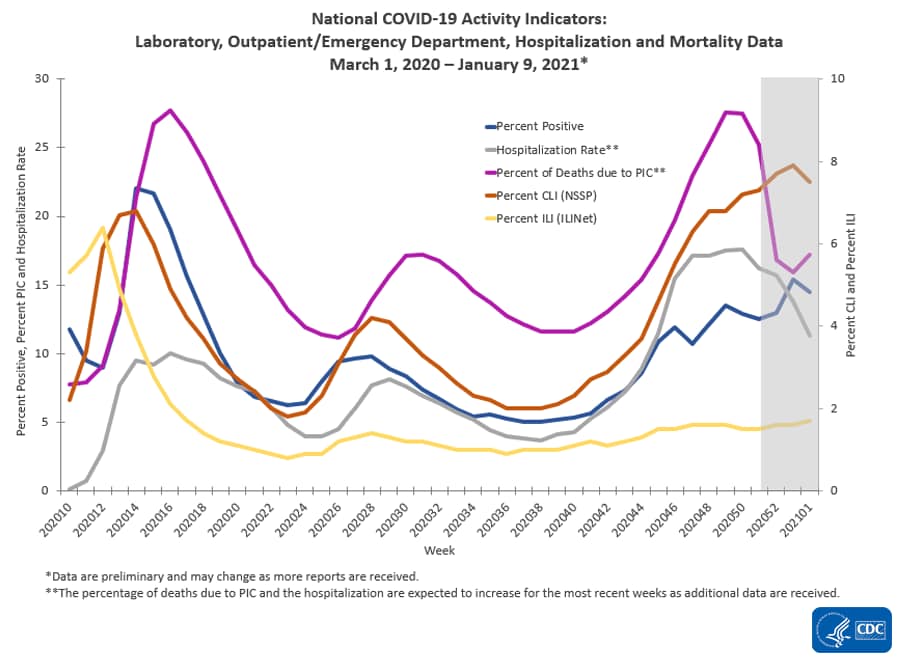
source: https://www.cdc.gov/coronavirus/2019-ncov/covid-data/covidview/index.html
Hospitalizations Are The Only Accurate Gauge As Reporting Is Just Beginning To Normalize After The Holiday Season
The 4 day Thanksgiving holiday period put the first wobble in the trends. Over weekends and holidays, the number of new cases and deaths decline. Over weekends, this is not a problem for week-over-week rolling averages as weekends are compared against the previous weekend. But when a holiday falls within a working week, a non-working day is compared to a working day which causes havok in the trends.
However, hospitalizations historically appear to be little affected by weekends or holidays – the daily counts do not vary significantly from day-to-day.
The hospitalization growth rate trend is improving.

For the Thanksgiving and the end of year holiday period – roughly, it seems each appears to have added around 5 % to the rate of growth of new cases, hospitalizations, and deaths.
Historically, hospitalization growth follows new case growth by one to two weeks.
As an analyst, I use the rate of growth to determine the trend. But, the size of the pandemic is growing in terms of real numbers – and if the rate of growth does not become negative – the pandemic will overwhelm all resources.
The graph below shows the rate of growth relative to the growth a week earlier updated through today [note that negative numbers mean the rolling averages are LOWER than the rolling averages one week ago]. As one can see, the rate of growth for new cases peaked in early December 2020 for Thanksgiving, and early January 2021 for end of year holidays – and the rate of growth is now decelerating.

In the scheme of things, new cases decline first, followed by hospitalizations, and then deaths.
It is up to each of our readers to protect themselves and others by washing your hands, wearing a mask, avoiding crowds, and maintaining social distancing.
Will The New Variants Cause The Next Spike?
Maybe and maybe not. It all depends on vaccinations:
- the more people that are vaccinated reduces the pool of people that can be infected. Today we have removed around 4% of the population from being infected which theoretically should reduce the infection rate by 4% [there is the issue that you could still be a carrier of the virus even though showing no signs]
- it is unknown what the effective rate of the current vaccines is against mutations that seem to appear almost daily. As an example, if the effective rate drops to 60%, it means the 4% reduction in the infection rate discussed above is almost cut in half.
Coronavirus News You May Have Missed
55 Americans Have Died Following COVID Vaccination, Norway Deaths Rise To 29 – ZeroHedge
Amid increasing calls for suspension of the use of mRNA-based COVID-19 vaccines produced by companies such as Pfizer, especially among elderly people, the situation in Norway has escalated significantly as the Scandi nation has now registered a total of 29 deaths among people over the age of 75 who’ve had their first COVID-19 vaccination shot.
As Bloomberg reports, this adds six to the number of known fatalities in Norway, and also lowers the age group thought to be affected from 80.
… In addition to the deaths, people have reported 96 life-threatening events following COVID-19 vaccinations, as well as 24 permanent disabilities, 225 hospitalizations, and 1,388 emergency room visits.
It’s not just the old and frail, in Israel, which proudly lays claim to the greatest vaccination effort in the world (largest percentage of the population inoculated),
As RT reports, at least 13 Israelis have experienced facial paralysis after being administered the Pfizer Covid-19 vaccine, a month after the US Food and Drug Administration reported similar issues but said they weren’t linked to the jab.
… However, it’s not just Norway as The Epoch Times’ Zachary Stieber reports that fifty-five people in the United States have died after receiving a COVID-19 vaccine, according to reports submitted to a federal system.
Deaths have occurred among people receiving both the Moderna and the Pfizer-BioNTech vaccines, according to the reports.
In some cases, patients died within days of receiving a COVID-19 vaccine.
… In addition to the deaths, people have reported 96 life-threatening events following COVID-19 vaccinations, as well as 24 permanent disabilities, 225 hospitalizations, and 1,388 emergency room visits.
Covid-19 variants may not be more deadly, but they can still cause more deaths, says Fauci – CNN
More infectious Covid-19 variants that are not necessarily more deadly can still cause more deaths, Dr. Anthony Fauci said Sunday in an interview on NBC’s Meet the Press.
“Even though on a one-to-one basis, it’s not more virulent, meaning it doesn’t make you more sick or more likely to die, just by numbers alone, the more cases you have, the more hospitalizations you’re going to have, and the more hospitalizations you have, the more deaths you’re going to have,” he said.
The Centers for Disease Control and Prevention recently warned that Covid-19 variants could accelerate the spread of the virus in the United States.
Fauci said the US is closely examining new variants, including one first identified in the UK and another, “more ominous” strain identified in South Africa and Brazil. Health experts are watching out for whether new strains could lessen the impact of Covid-19 vaccines, which would prompt some modifications to the vaccines.
Fauci, director of the National Institute of Allergy and Infectious Diseases, said it’s important for people to double down on public health measures and get vaccinated as soon as they can to prevent excess hospitalizations and deaths caused by new variants.
Inside the B.1.1.7 Coronavirus Variant – What researchers have learned about the U.K. variant. – New York Times
Federal health officials warn that it may become the dominant variant in the United States by March. It is no more deadly than other forms of the coronavirus. But because it can cause so many more infections, it may lead to many more deaths.
B.1.1.7 has been detected in at least 14 states, but the United States has no national surveillance program for determining the full extent of its spread.

L452R COVID Variant in California Linked to Several Outbreaks a ‘Red Flag’ – Newsweek
A variant of the SARS-CoV-2 virus, which causes COVID-19, has been linked to several large outbreaks in California’s Bay Area and is being seen more frequently in the state, health officials have said.
The variant—known as L452R—was first detected in Denmark in March last year and has since appeared in a number of U.S. states, including California.
The California Department of Public Health (CDPH) said in a statement on Sunday that the variant has been identified more frequently since November.
Dr. Charles Chiu, a virologist from the University of California San Francisco (UCSF), said in a press conference that the variant now accounts for around a quarter of all cases that he and his colleagues in the state were sequencing, despite representing less than five percent of cases only two months ago.
“It’s concerning that we have a variant that was actually pretty uncommon prior to early December that since then, is now roughly 25 percent of all the cases that we’re sequencing,” Chiu said in the press conference, according to KTLA.
… The L452R variant, which is different from the highly transmissible B.1.1.7 first detected in the U.K. that is now spreading in the United States, has also been detected in other locations around California, including Humboldt, Lake, Los Angeles, Mono, Monterey, Orange, Riverside, San Francisco, San Bernardino, San Diego and San Luis Obispo counties, according to the CDPH.
Public health are currently investigating this variant and its potential role in large outbreaks in the state. The true prevalence of the variant remains unclear because genomic sequencing—a technique which can reveal genetic changes in the virus—is not carried out evenly across the state or country.
How to Change Behavior During a Pandemic: From Personal Habits to Public Health – Knowable
COVID-19 testing capacity strained as localities struggle with vaccine staffing – The Hill
Local health departments struggling to find enough staff to carry out a massive vaccination campaign are finding that another key weapon against the coronavirus is being threatened: testing capacity.
Health officials across the country are facing tough decisions on whether to close testing sites or cut back on hours because they don’t have enough funding or staff to administer both vaccinations and testing.
Sen. Chris Murphy (D-Conn.) said he had spoken with health officials in Stamford, Conn., who “don’t have enough money right now to be able to both keep up their testing and distribute vaccine, so they’re going to have to make a choice.”
“That is absolutely devastating,” he said on a call hosted by Coronavirus War Room, a Democratic group.
“I’m hearing that every place in the country,” Nicole Lurie, a former assistant secretary of Health and Human Services and an adviser to President-elect Joe Biden‘s team, said on a call with reporters. “There’s just not enough personnel, enough bandwidth [to do both].”
For example, Los Angeles closed its large testing site at Dodger Stadium, converting it instead into a vaccination site. The city acknowledged the move would “temporarily reduce testing capacity in L.A. County,” but on the other hand would “more than triple the number of daily vaccines available to be dispersed to Angelenos.”
Collier County, Florida, closed most of its testing sites to make way for vaccine distribution, the local NBC affiliate reported. Gov. Ron DeSantis (R) has directed the state to find testing sites that can be shifted to vaccination locations.
The tensions illustrate how local health departments that have long raised the alarm about funding shortages are now scrambling to secure resources for multiple monumental tasks against the pandemic at the same time.
Further Warning on SGLT2 Inhibitor Use and DKA Risk in COVID-19 – Medscape
Use of sodium-glucose cotransporter 2 (SGLT2) inhibitors during acute COVID-19 illness raises the risk for euglycemic diabetic ketoacidosis (euDKA), a new case series suggests.
Five patients with type 2 diabetes who were taking SGLT2 inhibitors presented in DKA despite having glucose levels below 300 mg/dL. The report was published online last month in AACE Clinical Case Reports by Rebecca J. Vitale, MD, and colleagues at Brigham and Women’s Hospital, Boston, Massachusetts.
“A cluster of euglycemic DKA cases at our hospital during the first wave of the pandemic suggests that patients with diabetes taking SGLT2 inhibitors may be at enhanced risk for euDKA when they contract COVID-19,” senior author Naomi D.L. Fisher, MD, told Medscape Medical News.
Fisher, an endocrinologist, added: “This complication is preventable with the simple measure of holding the drug. We are hopeful that widespread patient and physician education will prevent future cases of euDKA as COVID-19 infections continue to surge.”
These cases underscore recommendations published early in the COVID-19 pandemic by an international panel, she noted.
“Patients who are acutely ill with nausea, vomiting, abdominal pain, or diarrhea, or who are experiencing loss of appetite with reduced food and fluid intake, should be advised to hold their SGLT2 inhibitor. This medication should not be resumed until patients are feeling better and eating and drinking normally.”
On the other hand, “If patients with asymptomatic or mild COVID-19 infection are otherwise well, and are eating and drinking normally, there is no evidence that SGLT2 inhibitors need to be stopped. These patients should monitor [themselves] closely for worsening symptoms, especially resulting in poor hydration and nutrition, which would be reason to discontinue their medication.”
California’s State Epidemiologist Dr. Erica S. Pan recommended pausing the administration of Covid-19 vaccines from Moderna’s lot 041L20A in a statement on Sunday, due to possible allergic reactions.
“A higher-than-usual number of possible allergic reactions were reported with a specific lot of Moderna vaccine administered at one community vaccination clinic,” Pan said. “Fewer than 10 individuals required medical attention over the span of 24 hours.”
“Out of an extreme abundance of caution and also recognizing the extremely limited supply of vaccine, we are recommending that providers use other available vaccine inventory and pause the administration of vaccines from Moderna Lot 041L20A until the investigation by the CDC, FDA, Moderna and the state is complete. We will provide an update as we learn more,” she said in a statement.
According to the statement from the California Department of Public Health (CDPH), all of the individuals appeared to be experiencing a “possible severe allergic reaction” during the standard observation period, something the CDC says some people have experienced after receiving a Covid-19 vaccine.
More than 330,000 doses from the lot have been distributed to 287 providers across California and shipments arrived in the state between January 5 and 12, according to CDPH.
India’s vaccination campaign is hampered by technical glitches. – New York Times
India’s coronavirus vaccine rollout, one of the largest in the world, has been hobbled by technical glitches in a mobile phone application, leaving the country far short of its vaccination goals in the first few days of the campaign.
State officials complained of problems with a digital platform called the Covid Vaccine Intelligence Network, or CoWIN, which is used by both vaccine providers and recipients to monitor the campaign’s progress. It is mandatory for vaccine recipients to register on the app in order to be inoculated.
Dr. Ajoy Kumar Chakraborty, director of health services in the state of West Bengal, said Monday that the software had become overwhelmed and didn’t work at many vaccination sites, and that vaccinations were curtailed as a result.
In the first phase of the campaign, which began on Saturday, government officials plan to vaccinate 30 million health and frontline workers. On the first day, about 300,000 health care workers were set to be inoculated; the actual number was about 207,000. On Sunday, the number dropped to 17,072.
[editor’s note: also read India vaccinates more than 380,000 people in first 3 days of roll out]
Many Floridians Overdue for 2nd COVID Vaccine Dose, Worried of Side Effects – Newsweek
Some Florida residents are past due for their second dose of the coronavirus vaccine as many face concerns about the vaccine’s potential side effects.
The two COVID-19 vaccines approved in the United States each require a second dose about 3-4 weeks after the first one to be fully effective. The Pfizer vaccine requires a second dose after 21 days, and the Moderna vaccine after 28 days.
More than 1 million Florida residents have been vaccinated for COVID-19, and nearly 92,000 of those have already followed up with their second dose, according to Florida’s Department of Health.
Of the remaining 915,000 people who received the first dose, more than 40,000 of them are overdue for their second shot.
Many of them are seniors who are worried about side effects from the follow-up dose.
Jason Mahon, a spokesperson for the state’s Department of Health, told local newspaper South Florida Sun-Sentinal that everyone who received the first dose is immediately scheduled for their second one. Mahon also noted that 80 percent of the people due for the second dose got it.
The issue for many Florida residents not receiving the second dose is not one of availability as Florida has collected nearly 2 million vaccine doses, according to the Center for Disease Control and Prevention (CDC).
Although the exact reason why some Floridians are skipping the second dose is unclear, some speculate it could relate to the side effects of the booster shot.
“I heard there are some seniors balking at getting the second shot because they’ve heard that the side effects are worse with the second shot,” Todd Husty, an emergency medical service director in Seminole County, told local television station WFLA.
[editor’s note: “Stick with full dose, followed by full dose,” Fauci says of Covid-19 vaccines]
The following are foreign headlines with hyperlinks to the posts
Brazil approves two coronavirus vaccines and begins inoculations.
Egyptian officials denied that an oxygen shortage at a hospital in Cairo led to the deaths of Covid patients. A Times investigation found otherwise.
Eastern Europe Doubts: Across the Balkans and other nations in southeastern Europe, a vaccination campaign is being overshadowed by heated political debates or conspiracy theories that threaten to thwart the process.
Israel Pfizer: As Israel sprints ahead in vaccinating its population against the virus, it has struck a deal with Pfizer to secure doses in exchange for medical data.
Lebanon has finalized a deal with Pfizer to secure 2.1 million doses of the vaccine against coronavirus amid a surge in infections in the small country.
Infections in the Philippines have surged past 500,000 with the government facing criticism for failing to immediately launch a vaccination program amid a global scramble for COVID-19 vaccines.
Japanese Prime Minister Yoshihide Suga has vowed to get the pandemic under control and hold the already postponed Olympics this summer with ample coronavirus protection.
The UAE is on track to have half its population vaccinated by the end of March
Pakistan approves use of China’s Sinopharm vaccine following order of 1.2 million doses
Iran records more than 5,800 daily Covid cases
France begins vaccination rollout for people over 75
South Korea’s president says he believes it will have complete “herd immunity” by November
Hong Kong reports highest number of Covid-19 cases in a month
A so-called Covid-19 “superspreader” who traveled around northeastern China has been linked to 102 confirmed infections, according to Chinese officials. The individual, who worked as a salesman promoting health products to the elderly, had traveled from his home province of Heilongjiang to neighboring Jilin province, bringing the virus with him. Authorities claim he unknowingly spread the virus among elderly residents for several days before he was tracked down by health officials as a close contact of a confirmed case.
Germany has vaccinated more than 1 million people
The following additional national and state headlines with hyperlinks to the posts
Some healthcare facilities are offering big incentives to encourage employees to get vaccinated — $500 bonuses? Free waffles? How health systems are rewarding staff for getting vaccinated
Biden Outlines Vaccine Plan, Rips Republican Lawmakers for Not Masking Up
Acceptance of COVID-19 vaccines is rising, a new USA TODAY/Suffolk University poll finds, but so is pessimism about getting back to normal.
The feds told Illinois to leave Rochelle Foods alone. Then a second COVID-19 outbreak hit.
Data Scientist Rebekah Jones, Facing Arrest, Turns Herself In To Florida Authorities
COVID-19 is a precursor for infectious disease outbreaks on a warming planet
Trader Joe’s Manager Stops Anti-Maskers Entering Store in Viral Video
Partygoers Tell Police They Were Unaware of Pandemic, Don’t Watch the News
Man Hides Inside Airport for 3 Months Over COVID Fears
Seattle Officer Accused by Nurse of Refusing to Wear Mask in ER
Fauci Says U.K. COVID Variant a ‘Clarion Call’ for People to Get Vaccine
L.A. County Lifts Cremation Limit as California COVID Deaths Soar
Thousands of troops arrive in Washington, without widespread testing.
Biden will honor those who died of the virus at the Lincoln Memorial on Tuesday.
Biden CDC pick confident there’s enough Covid vaccine to meet target amid confusion over stockpile
Cuomo asks to buy Covid vaccine directly from Pfizer amid dose shortages
Virginia posts highest two days of new Covid-19 cases since pandemic began
60% of all US Covid-19 cases have been reported since Election Day
Today’s Posts On Econintersect Showing Impact Of The Pandemic With Hyperlinks
U.S. Population Growth Slowed Further In 2020
What Sort Of Hand Has Biden Been Dealt?
Warning to Readers
The amount of politically biased articles on the internet continues to increase. And studies and opinions of the experts continue to contradict other studies and expert opinions. Honestly, it is difficult to believe anything anymore. A study usually cannot establish cause and effect – but only correlation. Be very careful what you believe about this pandemic.

I assemble this coronavirus update daily – sifting through the posts on the internet. I try to avoid politically slanted posts (mostly from CNN, New York Times, and the Washington Post) and can usually find unslanted posts on that subject from other sources on the internet. I wait to publish posts on subjects that I cannot validate across several sources. But after all this extra work, I do not know if I have conveyed the REAL facts. It is my job to provide information so that you have the facts necessary – and then it is up to readers to draw conclusions.
Analyst Opinion of Coronavirus Data
There are several takeaways that need to be understood when viewing coronavirus statistical data:
- The global counts are suspect for a variety of reasons including political. Even the U.S. count has issues as it is possible that as much as half the population has had coronavirus and was asymptomatic. It would be a far better metric using a random sampling of the population weekly. In short, we do not understand the size of the error in the tracking numbers.
- Just because some of the methodology used in aggregating the data in the U.S. is flawed – as long as the flaw is uniformly applied – you establish a baseline. This is why it is dangerous to compare two countries as they likely use different methodologies to determine who has (and who died) from coronavirus.
- COVID-19 and the flu are different but can have similar symptoms. For sure, COVID-19 so far is much more deadly than the flu. [click here to compare symptoms]
- From an industrial engineering point of view, one can argue that it is best to flatten the curve only to the point that the health care system is barely able to cope. This solution only works if-and-only-if one can catch this coronavirus once and develops immunity. In the case of COVID-19, herd immunity may need to be in the 80% to 85% range. WHO warns that few have developed antibodies to COVID-19 when recovering from COVID-19. Herd immunity does not look like an option without immunization although there is now a discussion of whether T-Cells play a part in immunity [which means one might have immunity without antibodies]
- Older population countries will have a significantly higher death rate as there is relatively few hospitalizations and deaths in younger age groups..
- There are at least 8 strains of the coronavirus. New York may have a deadlier strain imported from Europe, compared to less deadly viruses elsewhere in the United States.
- Each publication uses different cutoff times for its coronavirus statistics. Our data uses 11:00 am London time. Also, there is an unexplained variation in the total numbers both globally and in the U.S.
What we do or do not know about the coronavirus [actually there is little scientifically proven information]. Most of our knowledge is anecdotal, from studies with limited subjects, or from studies without peer review.
- How many people have been infected as many do not show symptoms?
- Masks do work. Unfortunately, early in the pandemic, many health experts — in the U.S. and around the world — decided that the public could not be trusted to hear the truth about masks. Instead, the experts spread a misleading message, discouraging the use of masks.
- Current thinking is that we develop 5 months of immunity from further COVID infection.
- The Moderna and Pfizer vaccines have an effectiveness rate of about 95 percent after two doses. That is on par with the vaccines for chickenpox and measles. The 95 percent number understates the effectivenessas it counts anyone who came down with a mild case of Covid-19 as a failure. But turning Covid into a typical flu — as the vaccines evidently did for most of the remaining 5 percent — is actually a success. Of the 32,000 people who received the Moderna or Pfizer vaccine in a research trial, only one contracted a severe Covid case.
- To what degree do people who never develop symptoms contribute to transmission? Research early in the pandemic suggested that the rate of asymptomatic infections could be as high as 81%. But a meta-analysis, which included 13 studies involving 21,708 people, calculated the rate of asymptomatic presentation to be 17%.
- The accuracy of rapid testing is questioned – and the more accurate test results are not being given in a timely manner.
- Can children widely spread coronavirus? [current thinking is that they are a minor source of the pandemic spread]
- Why have some places avoided big coronavirus outbreaks – and others hit hard?
- Air conditioning contributes to the pandemic spread.
- It appears that there is increased risk of infection and mortality for those living in larger occupancy households.
- Male patients have almost three times the odds of requiring intensive treatment unit (ITU) admission compared to females.
- Outdoor activities seem to be a lower risk than indoor activities.
- Will other medical treatments for Covid-19 ease symptoms and reduce deaths? So far only remdesivir, Bamlanivimab,
and Regeneron) are approved for treatment. What drugs work?
Arthritis drugs tocilizumab and sarilumab could cut relative risk of death of those in intensive care by 24%
- A current scientific understanding of the way the coronavirus works can be found [here].
There is now a vaccine available – the questions remain:
- how effective it will be in the general population,
- will there be any permanent side effects that will appear months from now,
- how long immunity will last [we can currently say we do not know if it will last more than 4 months],
- there is no evidence the vaccine will block transmission
Heavy breakouts of coronavirus have hit farmworkers. Farmworkers are essential to the food supply. They cannot shelter at home. Consider:
- they have high rates of respiratory disease [occupational hazard]
- they travel on crowded buses chartered by their employers
- few have health insurance
- they cannot social distance and live two to four to a room – and they eat together
- some reports say half are undocumented
- they are low paid and cannot afford not to work – so they will go to work sick
- they do not have access to sanitation when working
- a coronavirus outbreak among farmworkers can potentially shutter entire farm
The bottom line is that COVID-19 so far has been shown to be much more deadly than the data on the flu. Using CDC data, the flu has a mortality rate between 0.06 % and 0.11 % Vs. the coronavirus which to date has a mortality rate of 4 % [the 4% is the average of overall statistics – however in the last few months it has been hovering around 1.0%] – which makes it between 10 and 80 times more deadly. The reason for ranges:
Because influenza surveillance does not capture all cases of flu that occur in the U.S., CDC provides these estimated ranges to better reflect the larger burden of influenza.
There will be a commission set up after this pandemic ends to find fault [it is easy to find fault when a once-in-a-lifetime event occurs] and to produce recommendations for the next time a pandemic happens. Those that hate President Trump will conclude the virus is his fault.
Resources:
- Get the latest public health information from CDC: https://www.coronavirus.gov .
- Get the latest research from NIH: https://www.nih.gov/coronavirus.
- Find NCBI SARS-CoV-2 literature, sequence, and clinical content: https://www.ncbi.nlm.nih.gov/sars-cov-2/.
- List of studies: https://icite.od.nih.gov/covid19/search/#search:searchId=5ee124ed70bb967c49672dad
include(“/home/aleta/public_html/files/ad_openx.htm”); ?>


