


Written by Steven Hansen
The U.S. new cases 7-day rolling average is 18.6 % HIGHER than the 7-day rolling average one week ago. U.S. hospitalizations due to COVID-19 are now 4.8 % HIGHER than the rolling average one week ago. U.S. deaths due to coronavirus are now 21.6 % HIGHER than the rolling average one week ago. Today’s posts include:
- U.S. Coronavirus New Cases are at an elevated 273,854
- U.S. Coronavirus hospitalizations are at an elevated 130,777
- U.S. Coronavirus deaths are at an elevated 3,735
- U.S. Coronavirus immunizations have been administered to 2.0 % of the population
- The 7-day rolling average rate of growth of the pandemic shows new cases improved, hospitalizations unchanged, and deaths worsened
- New coronavirus variants aren’t cause for alarm yet but mutations could make COVID harder to fight, experts say
- As the coronavirus mutates, the world stumbles to respond
- University of Denver scientists develop breakthrough COVID-19 antibody test
- How computers are mapping Covid-19’s future
- How the new Covid-19 variants could pose a threat to vaccination
- A study traces contagion on an 18-hour flight.
- Biden’s plan to release all Covid-19 vaccine doses could be risky, but context is important, says former FDA official

The recent worsening of the trendlines for new cases should be attributed to going back to college/university, cooler weather causing more indoor activities, possible mutation of the virus, fatigue from wearing masks / social distancing, holiday activities, political rallies / voting, and continued loosening of regulations designed to slow the coronavirus spread.
My continuing advice is to continue to wash your hands (especially after using the toilet as COVID first sheds in your stool), putting down the toilet seat (as flushing the toilet releases a plume), wear masks, avoid crowds, and maintain social distancing. No handwashing, mask, or social distancing will guarantee you do not get infected – but it sure as hell lowers the risk in all situations – and the evidence to-date shows a lower severity of COVID-19. In addition, certain activities are believed to carry higher risk – like being inside in air conditioning and removing your mask (such as restaurants, around your children/grandchildren, bars, and gyms). It is all about viral load – and outdoor activities are generally safe if you can maintain social distance. Finally, studies show eating right (making sure you are supporting your immune system) and adequate sleep increase your ability to fight off COVID.
include($_SERVER[‘DOCUMENT_ROOT’].’/pages/coronavirus1.htm’); ?>
Hospitalizations (grey line) and Mortality (green line)
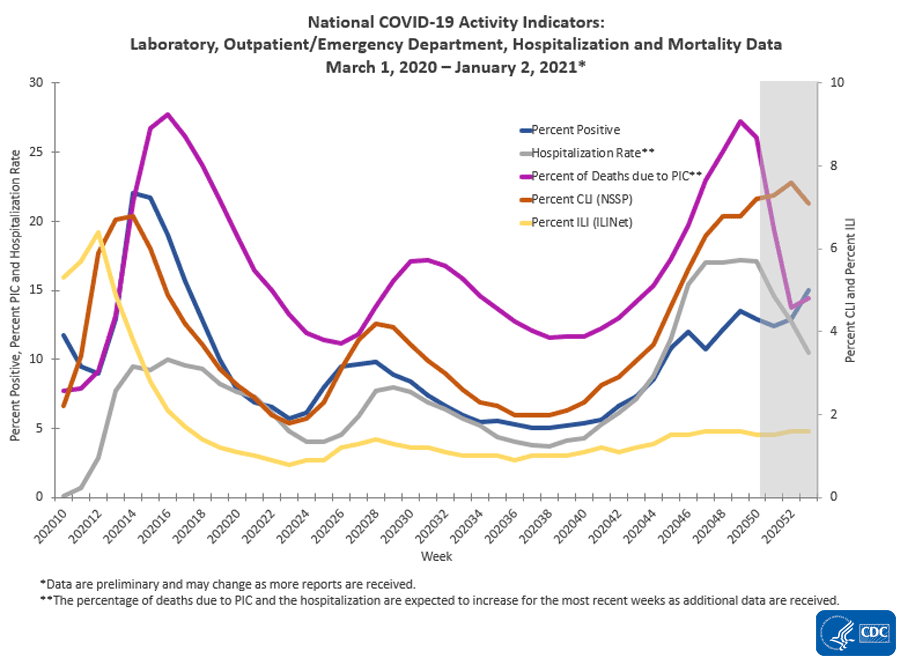
source: https://www.cdc.gov/coronavirus/2019-ncov/covid-data/covidview/index.html
The Impact of Holidays – Hospitalizations Are The Only Accurate Gauge As Reporting Is Sporadic
The 4 day Thanksgiving holiday period put a wobble in the trends. Over weekends and holidays, the number of new cases and deaths decline. Over weekends, this is not a problem for week-over-week rolling averages as weekends are compared against the previous weekend. But when a holiday falls within a working week, a non-working day is compared to a working day which causes havok in the trends. Now we are faced with the end of the year holiday season which means reporting is sporadic and numbers will initially look good – and then as the holidays end and the reporting catches up, the numbers will look terrible. In addition, family gatherings and travel will cause more virus transmission.
However, hospitalizations historically appear to be little affected by weekends or holidays – the daily counts do not vary significantly from day-to-day.
The hospitalization growth rate trend is growing at an ever slowing growth rate which is all good news as it means the number of beds needed is currently growing around 4 % every week.

For the Thanksgiving and the end of year holiday period – roughly, it seems to have added around 5 % to the rate of growth of new cases, hospitalizations, and deaths.
Historically, hospitalization growth follows new case growth by one to two weeks.
As an analyst, I use the rate of growth to determine the trend. But, the size of the pandemic is growing in terms of real numbers – and if the rate of growth does not become negative – the pandemic will overwhelm all resources.
The graph below shows the rate of growth relative to the growth a week earlier updated through today [note that negative numbers mean the rolling averages are LOWER than the rolling averages one week ago]. As one can see, the rate of growth for new cases peaked in early December 2020 ago and the rate of growth has been decelerating since.

In the scheme of things, new cases decline first, followed by hospitalizations, and then deaths.
It is up to each of our readers to protect themselves and others by washing your hands, wearing a mask, avoiding crowds, and maintaining social distancing.
We Are Likely In A Pandemic Surge Caused By The Holidays And Virus Mutation
The “experts” will tell you they told you so – and you should have stayed at home instead of traveling to be with the people you care about. And there is some truth in this opinion.
But there will be no way to accurately understand the impact of the holidays because there are new mutant strains of the coronavirus that are more transmissible.
To gauge the impact of anything, you change ONLY ONE variable at a time (and hopefully in a controlled environment). There are now two variables in play – and it is nearly impossible to separate the impact of each.
Coronavirus News You May Have Missed
Today Econintersect published two summary posts for headlines over this past week:
A study traces contagion on an 18-hour flight. – New York Times
A coronavirus outbreak aboard a September flight from Dubai to New Zealand offered researchers — and airlines — an opportunity to study in-transit contagion.
After the 18-hour flight from Dubai landed in Auckland, local health authorities discovered evidence of an outbreak that most likely occurred during the trip. Using seat maps and genetic analysis, the new study determined that one passenger initiated a chain of infection that spread to four others en route.
Previous research on apparent in-flight outbreaks focused on flights that occurred last spring, when few travelers wore masks, planes were running near capacity and the value of preventive measures was not broadly understood. The new report, of a largely empty flight in the fall, details what can happen even when airlines and passengers are aware of and more cautious about the risks.
The findings deliver a clear warning to both airlines and passengers, experts said.
“The key message here is that you have to have multiple layers of prevention — requiring testing before boarding, social distancing on the flight and masks,” said Dr. Abraar Karan, an internal medicine physician at Brigham and Women’s Hospital and Harvard Medical School who was not part of the study team. “Those things all went wrong in different ways on this flight, and if they’d just tested properly, this wouldn’t have happened.”
The new infections were detected after the plane landed in New Zealand; the country requires incoming travelers to quarantine for 14 days before entering the community. The analysis, led by researchers at the New Zealand Ministry of Health, found that seven of the 86 passengers on board tested positive during their quarantine and that at least four were newly infected on the flight. The aircraft, a Boeing 777-300ER, with a capacity of nearly 400 passengers, was only one-quarter full.
The seven passengers, from five countries, were seated within four rows of one another for the 18-hour duration of the flight. Two acknowledged that they did not wear masks, and the airline did not require mask-wearing in the lobby before boarding. Nor did it require preflight testing, although five of the seven passengers who later tested positive had taken a test, and received a negative result, in the days before boarding.
The researchers found that the passenger whom they believe initiated the outbreak had in fact tested negative, but four or five days before boarding.
“Four or five days is a long time,” Dr. Karan. “You should be asking for results of rapid tests done hours before the flight, ideally.”
University of Denver scientists develop breakthrough COVID-19 antibody test – CBS 5
Scientists at the University of Denver’s (DU) Knoebel Institute for Healthy Aging, in collaboration with two other research entities, have developed and tested a new and highly sensitive antibody test for COVID-19 that is so accurate, it can predict if a patient will experience “mild” COVID symptoms verses more “severe” symptoms.
The test has received an Emergency Use Authorization from the U.S. Food & Drug Administration (FDA).
The Knoebel Institute worked with Resilience Code, a Denver functional medicine and human performance clinic, and California company Vibrant Sciences to develop the new test.
The test is a breakthrough because it examines more viral antigens than most other antibody tests and therefore can learn a lot more about a patient with symptoms, said Dr. Daniel Linseman, associate director of the Knoebel Institute for Healthy Aging.
“Most serology tests that have been approved by the FDA so far test for only one or two viral antigens, whereas this test will test for 12 different viral antigens,” Linseman said.
The new test can also give doctors a head start on treatment for new patients. Because the virus can move very quickly through older patients or patients with what are called “comorbidities” or other medical problems, said Linseman, “speed of diagnosis” becomes very important.
The test is also important to identify those people who never experienced symptoms but have been exposed and have developed antibodies that will likely protect them from subsequent infection.
In developing the new test, and discovering distinct antibody profiles that can indicate whether you will exhibit mild symptoms or severe symptoms, researchers also found that patients who had a flu vaccine in the past year showed more mild symptoms than those who did not. They also confirmed that “loss of taste and smell” is strongly associated with a positive test for COVID. That’s a reaffirmation that the symptom is a critical indicator, Dr. Linseman said.
Viral mutations cause concerns because they can make tests, treatments and vaccines ineffective, and change the properties of a disease, making it more or less transmissible and dangerous.
The new variants appear to be pushing out older ones, raising worries about whether the changes will affect the course of disease or efforts to rein it in. So far, though, the new variants do not seem to be a cause for huge concern.
The two authorized vaccines and others under development are expected to continue to be effective against the two variants, which have spread to at least 33 countries, experts say.
Pfizer-BioNTech, the team making one of the authorized vaccines, released findings late Thursday showing that blood from people who have been vaccinated can effectively neutralize the mutated variants.
In another study published this week, led by researchers at the Fred Hutchinson Cancer Research Center in Seattle but also not yet peer reviewed, scientists found the blood of people who recovered from COVID-19 was able to completely vanquish the British variant. That suggests it won’t pose a problem for people who have been vaccinated or already recovered from COVID-19.
The South African variant was less well-controlled, the researchers found, but Jesse Bloom, the senior author, said on Twitter he’s not yet concerned about vaccines losing effectiveness.
“I am optimistic that current vaccines will remain quite useful,” he wrote, adding he is eager to get the vaccine himself. “However, I do expect that as SARS-CoV-2 continues to evolve, eventually, it may be necessary to update vaccines.”
Virtual agents of change: How computers are mapping Covid-19’s future – Knowable
Simulating the behavior of millions of idiosyncratic individuals also may be the best way to understand complex phenomena like pandemics.
It’s been a long year, but a vaccine against Covid-19 has started to roll out across the United States. There won’t be enough to vaccinate everyone right away, so public health officials will need to figure out how to manage the slow ramp-up of immunity. Do we make faster progress by focusing on locked-down regions first, or on those that have tried to stay open? Dense urban areas or suburbs full of commuters? Should we skip over pockets with high levels of vaccine skepticism or push extra-hard to vaccinate there? And, ultimately, when will it be safe to relax, unmask and start hugging people again?
Those are difficult questions to answer, because the outcome depends on so many interconnected factors, including the unpredictability of individual humans’ minds and behavior. To make things even more challenging, human behavior is a moving target: What our leaders and friends say and do today influences what we ourselves do tomorrow. Effects can loop back to alter causes in a complex tangle that’s almost impossible for analysts to think through.
The real world is full of complex problems like this, from epidemiology to economics to foreign policy. But an emerging approach within the field of complexity science promises a better way to understand how the idiosyncratic, often irrational actions of many individuals generate complex collective outcomes. Instead of trying to analyze how a society functions from the top down, the new technique known as agent-based modeling tackles the problem from the other end, by focusing on the individuals themselves.
Like SimCity or the Matrix, agent-based modeling involves the creation of a computer-simulated world replete with thousands or even millions of individual people — the “agents” the name refers to — complete with homes, jobs, friends and realistic individual foibles. “Agent-based models are artificial societies of software people,” says Joshua Epstein, a computational social scientist at New York University who is one of the pioneers of the field. “These people behave like humans behave. They’re not perfectly rational or perfectly informed.”
When enough of these agents have been created, modelers turn them loose to move, act and interact. Just as the simple behavioral choices of individual fish cause them to collectively coalesce into a school, the cumulative effect of the agents’ individual decisions and actions leads to collective patterns such as epidemics, recessions or revolutions. Such models give analysts a way to explore the sometimes surprising outcomes that result from different policy options.
Already, agent-based models have taken over fields as disparate as traffic planning, securities trading and war gaming, and their use is growing in economics and political science. And within epidemiology, such models are yielding fresh insights into the way epidemics spread and evolve, what public health officials can do to control the outcome and the likely economic consequences of the pandemic. “It’s fundamentally changed the way people do infectious disease modeling,” says Epstein.
[editor’s note: this is just a fraction of this interesting post which deserves a full read. My take is that using computer modeling – we could scientifically attack the spread of this pandemic in a methodology which would have the largest impact]
How the new Covid-19 variants could pose a threat to vaccination – VOX
The new mutations first discovered in the UK and South Africa are spreading fast around the world — and could diminish the effectiveness of the existing vaccines.
Scientists have warned that it was always possible the coronavirus could evolve to evade the Covid-19 vaccines that have been approved so far. The arrival of the UK and South Africa variants may be a step in that direction, increasing the odds of the vaccines becoming less effective over time.
In SARS-CoV-2, the main mutations scientists care about are on the spike protein of the virus — the part that allows it to enter human cells. This is also the protein that Covid-19 vaccines currently available in the US (from Moderna and Pfizer/BioNTech) are designed to imitate. About 4,000 mutations in the SARS-CoV-2 spike protein have been detected at various points in the pandemic. Most haven’t altered the function of the virus and haven’t stirred worry.
In rare cases, a mutation, or several at the same time, could lead to changes that give the virus a greater advantage. And that appears to be what’s happening with the UK and South Africa mutation.
The UK variant, B.1.1.7, contains 23 mutations in the genome of the virus while the South Africa variant, 501Y.V2, has at least 21 mutations, with some overlap between the two. In both cases, the changes seem to have increased the fitness of the virus, or its ability to propagate.
“[With genomic sequencing in South Africa] we can show quite clearly there were lots of different lineages circulating prior to October,” Lessells said. “Within the course of just a few weeks, this new lineage — 501Y.V2 — became almost the only lineage you’re detecting.” The story is similar in England, where a stunning one in 50 people were infected with Covid-19 as of last week.
The fact that these mutations have become so dominant so quickly hints that they may be more contagious. It’s not clear how much more contagious the South Africa variant is, but one estimate suggested the UK variant is up to 70 percent more transmissible.
There could also be other more familiar variables that are driving the spread of these new variants, like holiday travel.
“When you are seeing such huge transmission everywhere in the world in November and December, I just don’t know how you can say that it’s because this particular virus [variant] is more transmissible or it’s because we’re seeing great increases in transmissibility everywhere for a variety of factors,” said Anna Durbin, a vaccine researcher and a professor of international health at the Johns Hopkins School of Public Health.
Scientists still have to complete experiments in animals to pinpoint differences in transmissibility between these mutations and earlier versions of the virus — and to what extent shifts in peoples’ behavior might also explain the growth in cases.
But they’ve already zeroed in on concerning changes in the virus that are relevant to vaccine effectiveness. With the South Africa variant, for example, one change of particular interest is the E484K mutation in the receptor-binding domain of the virus where it latches on to human cells.
“The E484K mutation has been shown to reduce antibody recognition,” said Francois Balloux, a professor of computational systems biology at the University College London, in a statement. This means it can help the virus “bypass immune protection provided by prior infection or vaccination.”
[editor’s note: this is a long article which would be a disservice to summarize]
As the coronavirus mutates, the world stumbles to respond. – New York Times
The coronavirus has evolved as it has made its way across the world, as any virus is expected to do. But experts have been startled by the pace at which significant new variants have emerged.
Much remains unknown about the new variants, or even how many are sprouting worldwide. Scientists are racing to sequence enough of the virus to know, but only a handful of countries have the wherewithal or commitment to do so with regularity.
With the world stumbling in its vaccination rollout and the number of cases steeply rising to peaks that exceed those seen last spring, experts see a pressing need to immunize as many people as possible before the virus evolves enough to render the vaccines impotent.
“It’s a race against time,” said Marion Koopmans, a Dutch virologist and a member of a World Health Organization working group on coronavirus adaptations.
It was in late October that doctors and nurses at a hospital group in Durban, South Africa, noticed an odd spike in the number of Covid-19 patients in their wards.
Vaccines alone will not be enough to get ahead of the virus: It will take years to inoculate enough people to limit its evolution. In the meantime, social distancing, mask-wearing and hand-washing — combined with aggressive testing, tracking and tracing — might buy some time and avert devastating spikes in hospitalizations and deaths along the way.
Yet in the course of the pandemic, governments have often proven reluctant or unable to galvanize support for those basic defenses. Many countries have all but given up on tracking and tracing. Mask-wearing remains politically charged in the United States, despite clear evidence of its efficacy. Cities like Los Angeles have been gripped by a spike in cases linked to Christmas festivities, and national public health officials are bracing for surges, driven by people who ignored advice and traveled during the holidays.
The rapid spread of the new variants is a reminder of the failings and missteps of major countries to contain the virus earlier. Just as China failed to stop travelers from spreading the virus before the Lunar New Year last year, Britain failed to move fast enough ahead of the new variant’s spread. And just as China became a pariah early on in the pandemic, Britain now has the unfortunate distinction of being called Plague Island.
President-elect Joe Biden’s plan to release all available Covid-19 vaccine doses immediately could be risky, but it’s important to take it in context, former US Food and Drug Administration (FDA) official Dr. Norman Baylor said Saturday in an exclusive interview with CNN’s Michael Smerconish.
Both Pfizer’s and Moderna’s vaccines require two doses, 21 and 28 days apart, respectively. Second doses are currently on hold by the federal government and released according to the vaccine schedule for people to complete their two-dose regimen.
“Giving the one dose and delaying the second dose beyond what was discovered in the clinical trials, we take a risk of those individuals not necessarily being protected sufficiently,” said Baylor, former director of the FDA’s Office of Vaccines Research and Review (OVRR).
He noted that the only efficacy data available on these vaccines is from the clinical trials, which followed the outlined dosing regimen. However, the context around Biden’s plan is important, Baylor added.
“You have to have an idea of when is that second dose coming. Is that second dose coming 21, 28 days after you give that first dose?” he said. “Maybe it’ll come in five weeks – and there’s a little room for plus and minus with days – but you have to contextualize the whole plan before you can just dismiss it completely.”
The following are foreign headlines with hyperlinks to the posts
Millions In China Under New Restrictions Amid COVID-19 Spike Near Beijing
A new law in Sweden gives the government more power to impose virus restrictions.
Ukraine’s quest for vaccines lands it in a geopolitical nightmare.
Iran’s supreme leader bans vaccine imports from the U.S. and the U.K.
A large-scale study from Wuhan, China, shows that many Covid survivors face lingering problems.
How the National University of Singapore has kept the coronavirus off campus.
Germany tops 40,000 Covid deaths days after record-breaking day
Around 2 million people were vaccinated last week against coronavirus in the UK
Pope’s personal doctor dies from Covid-19 complications
Canadians call out leaders for breaking their own Covid-19 rules
Israel’s PM Netanyahu receives second dose of Covid vaccine
Japan detects new COVID variant
The following additional national and state headlines with hyperlinks to the posts
Get ready to pay taxes on unemployment benefits
Latest Hawaii travel restrictions: What to know
Vaccine registration sites are opening across the country, and filling up in minutes.
More than 150,000 people in the U.S. have received 2 doses.
Governors, under pressure from pandemic-weary constituents, are broadening access to the vaccine.
Los Angeles is having its ‘New York moment,’ with a harrowing rise in virus cases.
Fauci suggests theaters could reopen ‘some time in the fall.’
Queen Elizabeth and Prince Philip receive vaccinations in Britain.
How vaccinated grandparents should visit loved ones now
Minnesota reports first cases of coronavirus variant
Member of famed Tuskegee Airmen dies from coronavirus
Today’s Posts On Econintersect Showing Impact Of The Pandemic With Hyperlinks
Job-Letting Will Not End Before Pandemic Ends
Are Covid Lockdowns Bullish Or Bearish For Stocks? FTSE 100 In Focus.
Coronavirus Disease Weekly News 10January 2021
Coronavirus Economic Weekly News 10January 2021
The Fascinating Story Of Placebos And Why Doctors Should Use Them More Often
States Leading America’s Vaccination Race
Do-It-Yourself Contact Tracing Is A ‘Last Resort’ In Communities Besieged By Covid
Warning to Readers
The amount of politically biased articles on the internet continues to increase. And studies and opinions of the experts continue to contradict other studies and expert opinions. Honestly, it is difficult to believe anything anymore. A study usually cannot establish cause and effect – but only correlation. Be very careful what you believe about this pandemic.

I assemble this coronavirus update daily – sifting through the posts on the internet. I try to avoid politically slanted posts (mostly from CNN, New York Times, and the Washington Post) and can usually find unslanted posts on that subject from other sources on the internet. I wait to publish posts on subjects that I cannot validate across several sources. But after all this extra work, I do not know if I have conveyed the REAL facts. It is my job to provide information so that you have the facts necessary – and then it is up to readers to draw conclusions.
Analyst Opinion of Coronavirus Data
There are several takeaways that need to be understood when viewing coronavirus statistical data:
- The global counts are suspect for a variety of reasons including political. Even the U.S. count has issues as it is possible that as much as half the population has had coronavirus and was asymptomatic. It would be a far better metric using a random sampling of the population weekly. In short, we do not understand the size of the error in the tracking numbers.
- Just because some of the methodology used in aggregating the data in the U.S. is flawed – as long as the flaw is uniformly applied – you establish a baseline. This is why it is dangerous to compare two countries as they likely use different methodologies to determine who has (and who died) from coronavirus.
- COVID-19 and the flu are different but can have similar symptoms. For sure, COVID-19 so far is much more deadly than the flu. [click here to compare symptoms]
- From an industrial engineering point of view, one can argue that it is best to flatten the curve only to the point that the health care system is barely able to cope. This solution only works if-and-only-if one can catch this coronavirus once and develops immunity. In the case of COVID-19, herd immunity may need to be in the 80% to 85% range. WHO warns that few have developed antibodies to COVID-19 when recovering from COVID-19. Herd immunity does not look like an option without immunization although there is now a discussion of whether T-Cells play a part in immunity [which means one might have immunity without antibodies]
- Older population countries will have a significantly higher death rate as there is relatively few hospitalizations and deaths in younger age groups..
- There are at least 8 strains of the coronavirus. New York may have a deadlier strain imported from Europe, compared to less deadly viruses elsewhere in the United States.
- Each publication uses different cutoff times for its coronavirus statistics. Our data uses 11:00 am London time. Also, there is an unexplained variation in the total numbers both globally and in the U.S.
What we do or do not know about the coronavirus [actually there is little scientifically proven information]. Most of our knowledge is anecdotal, from studies with limited subjects, or from studies without peer review.
- How many people have been infected as many do not show symptoms?
- Masks do work.
- Do we develop lasting immunity to the coronavirus? Another coronavirus – the simple cold – does not develop long term immunity. However, How Many Americans Are Immune From COVID? Research into the coronavirus is running way behind the need for answers. Whilst we strive for herd immunity through vaccination – we lack an understanding of the general immunity people might have to the pandemic. This will affect the point herd immunity can be reached. The following articles discuss immunity: Can the Common Cold Help Protect You from COVID-19?, Does the Common Cold Protect You from COVID-19?, Immune cells for the common cold may recognize SARS-CoV-2
- To what degree do people who never develop symptoms contribute to transmission? Research early in the pandemic suggested that the rate of asymptomatic infections could be as high as 81%. But a meta-analysis, which included 13 studies involving 21,708 people, calculated the rate of asymptomatic presentation to be 17%.
- The accuracy of rapid testing is questioned – and the more accurate test results are not being given in a timely manner.
- Can children widely spread coronavirus? [current thinking is that they are a minor source of the pandemic spread]
- Why have some places avoided big coronavirus outbreaks – and others hit hard?
- Air conditioning contributes to the pandemic spread.
- It appears that there is increased risk of infection and mortality for those living in larger occupancy households.
- Male patients have almost three times the odds of requiring intensive treatment unit (ITU) admission compared to females.
- Outdoor activities seem to be a lower risk than indoor activities.
- Will other medical treatments for Covid-19 ease symptoms and reduce deaths? So far only remdesivir, Bamlanivimab,
and Regeneron) are approved for treatment. What drugs work?
Arthritis drugs tocilizumab and sarilumab could cut relative risk of death of those in intensive care by 24%
- A current scientific understanding of the way the coronavirus works can be found [here].
There is now a vaccine available – the questions remain:
- how effective it will be in the general population,
- will there be any permanent side effects that will appear months from now,
- how long immunity will last [we can currently say we do not know if it will last more than 4 months],
- there is no evidence the vaccine will block transmission
Heavy breakouts of coronavirus have hit farmworkers. Farmworkers are essential to the food supply. They cannot shelter at home. Consider:
- they have high rates of respiratory disease [occupational hazard]
- they travel on crowded buses chartered by their employers
- few have health insurance
- they cannot social distance and live two to four to a room – and they eat together
- some reports say half are undocumented
- they are low paid and cannot afford not to work – so they will go to work sick
- they do not have access to sanitation when working
- a coronavirus outbreak among farmworkers can potentially shutter entire farm
The bottom line is that COVID-19 so far has been shown to be much more deadly than the data on the flu. Using CDC data, the flu has a mortality rate between 0.06 % and 0.11 % Vs. the coronavirus which to date has a mortality rate of 4 % [the 4% is the average of overall statistics – however in the last few months it has been hovering around 1.0%] – which makes it between 10 and 80 times more deadly. The reason for ranges:
Because influenza surveillance does not capture all cases of flu that occur in the U.S., CDC provides these estimated ranges to better reflect the larger burden of influenza.
There will be a commission set up after this pandemic ends to find fault [it is easy to find fault when a once-in-a-lifetime event occurs] and to produce recommendations for the next time a pandemic happens. Those that hate President Trump will conclude the virus is his fault.
Resources:
- Get the latest public health information from CDC: https://www.coronavirus.gov .
- Get the latest research from NIH: https://www.nih.gov/coronavirus.
- Find NCBI SARS-CoV-2 literature, sequence, and clinical content: https://www.ncbi.nlm.nih.gov/sars-cov-2/.
- List of studies: https://icite.od.nih.gov/covid19/search/#search:searchId=5ee124ed70bb967c49672dad
include(“/home/aleta/public_html/files/ad_openx.htm”); ?>


