


Written by Steven Hansen
The U.S. new cases 7-day rolling average is 22.4 % HIGHER than the 7-day rolling average one week ago. U.S. hospitalizations due to COVID-19 are now 4.7 % HIGHER than the rolling average one week ago. U.S. deaths due to coronavirus are now 16.2 % HIGHER than the rolling average one week ago. Today’s posts include:
- U.S. Coronavirus New Cases are at an elevated 253,145
- U.S. Coronavirus hospitalizations are at a record 132,476 (for the next 5 days this is the number to watch as new cases and deaths will not be accurately reported)
- U.S. Coronavirus deaths are at a record 3,865
- U.S. Coronavirus immunizations have been administered to 1.6 % of the population
- The 7-day rolling average rate of growth of the pandemic shows new cases worsened, hospitalizations worsened, and deaths improved
- Early Plasma Tx Promising in Adults 65+ with Milder COVID-19
- U.S. Is Blind to Contagious New Virus Variant, Scientists Warn
- Loss of Smell Reported in 86% of Mild COVID Cases
- Fauci Says U.S. Needs More Time To ‘Catch Up’ On Vaccine Rollout
- Norwegian Nursing Home Patients Dead After Receiving First Dose Of Pfizer COVID Vaccine
- Arizona becomes world hot spot
- The Problem with the ‘Yay Science!’ Crowd
- The Effects of School Reopenings on COVID-19 Hospitalizations

The recent worsening of the trendlines for new cases should be attributed to going back to college/university, cooler weather causing more indoor activities, possible mutation of the virus, fatigue from wearing masks / social distancing, holiday activities, political rallies / voting, and continued loosening of regulations designed to slow the coronavirus spread.
My continuing advice is to continue to wash your hands (especially after using the toilet as COVID first sheds in your stool), putting down the toilet seat (as flushing the toilet releases a plume), wear masks, avoid crowds, and maintain social distancing. No handwashing, mask, or social distancing will guarantee you do not get infected – but it sure as hell lowers the risk in all situations – and the evidence to-date shows a lower severity of COVID-19. In addition, certain activities are believed to carry higher risk – like being inside in air conditioning and removing your mask (such as restaurants, around your children/grandchildren, bars, and gyms). It is all about viral load – and outdoor activities are generally safe if you can maintain social distance. Finally, studies show eating right (making sure you are supporting your immune system) and adequate sleep increase your ability to fight off COVID.
include($_SERVER[‘DOCUMENT_ROOT’].’/pages/coronavirus1.htm’); ?>
Hospitalizations (grey line) and Mortality (green line)
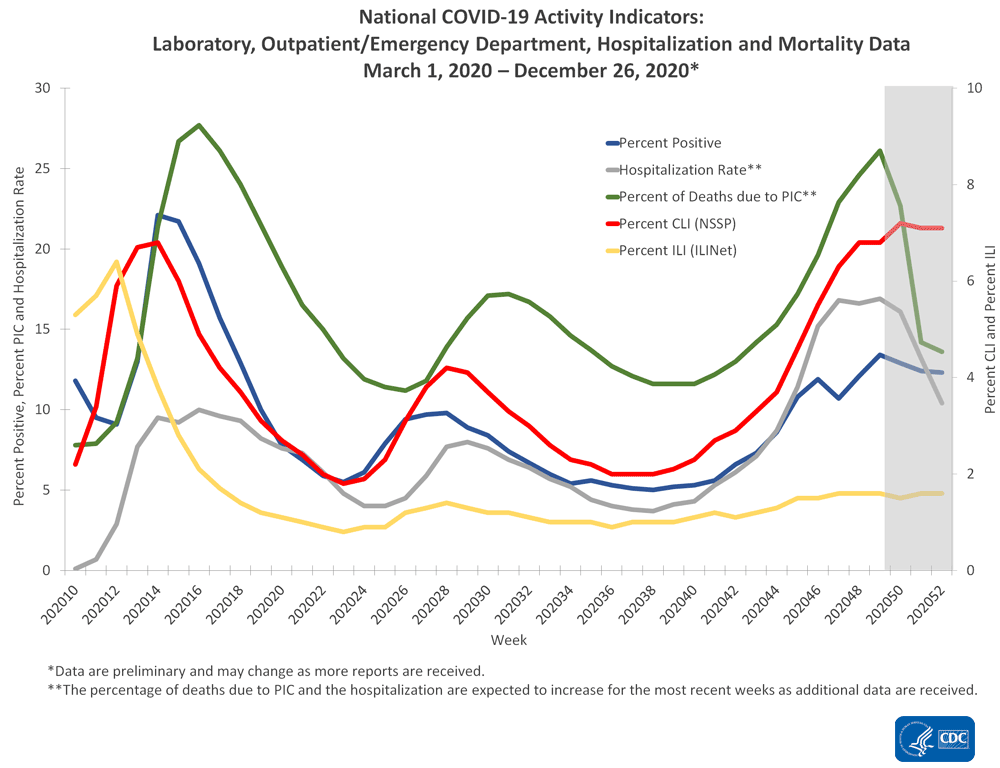
source: https://www.cdc.gov/coronavirus/2019-ncov/covid-data/covidview/index.html
The Impact of Holidays – Hospitalizations Are The Only Accurate Gauge As Reporting Is Sporadic
The 4 day Thanksgiving holiday period put a wobble in the trends. Over weekends and holidays, the number of new cases and deaths decline. Over weekends, this is not a problem for week-over-week rolling averages as weekends are compared against the previous weekend. But when a holiday falls within a working week, a non-working day is compared to a working day which causes havok in the trends. Now we are faced with the end of the year holiday season which means reporting is sporadic and numbers will initially look good – and then as the holidays end and the reporting catches up, the numbers will look terrible. In addition, family gatherings and travel will cause more virus transmission.
However, hospitalizations historically appear to be little affected by weekends or holidays – the daily counts do not vary significantly from day-to-day.
The hospitalization growth rate trend is growing at an ever slowing growth rate which is all good news as it means the number of beds needed is currently growing around 4 % every week.

For the Thanksgiving holiday period – roughly, it seems to have added around 5 % to the rate of growth of new cases, hospitalizations, and deaths.
Historically, hospitalization growth follows new case growth by one to two weeks.
As an analyst, I use the rate of growth to determine the trend. But, the size of the pandemic is growing in terms of real numbers – and if the rate of growth does not become negative – the pandemic will overwhelm all resources.
The graph below shows the rate of growth relative to the growth a week earlier updated through today [note that negative numbers mean the rolling averages are LOWER than the rolling averages one week ago]. As one can see, the rate of growth for new cases peaked in early December 2020 ago and the rate of growth has been decelerating since.

This graph is currently demonstrating that the actions to contain the pandemic are slightly working – but the rate of growth improvement is too slow as we are still seeing some record numbers. In the scheme of things, new cases decline first, followed by hospitalizations, and then deaths.
It is up to each of our readers to protect themselves and others by washing your hands, wearing a mask, avoiding crowds, and maintaining social distancing.
We Are Likely In A Pandemic Surge Caused By The Holidays And Virus Mutation
The “experts” will tell you they told you so – and you should have stayed at home instead of traveling to be with the people you care about. And there is some truth in this opinion.
But there will be no way to accurately understand the impact of the holidays because there are new mutant strains of the coronavirus that are more transmissible.
To gauge the impact of anything, you change ONLY ONE variable at a time (and hopefully in a controlled environment). There are now two variables in play – and it is nearly impossible to separate the impact of each.
Coronavirus News You May Have Missed
Norwegian Nursing Home Patients Dead After Receiving First Dose Of Pfizer COVID Vaccine – ZeroHedge
More suspicious deaths have surfaced in Europe involving patients who recently received their first dose of the coronavirus vaccine. Following reports about a Portuguese nurse dying shortly after receiving her first dose of the vaccine, our attention turns to Norway, where two nursing home residents have passed away under similar circumstances.
According to RT, the departed were among the first in the country to receive the Pfizer-BioNTech vaccine. Medical authorities said they will investigate the circumstances of these deaths to try and figure out if the vaccines had anything to do with it. Norway’s National Institute of Public Health will be leading the charge.
“We have to assess whether the vaccine is the cause of death, or if it is a coincidence that it happened soon after vaccination,” Medical Director Steiner Madsen said in a statement to the press.
To be sure, due to the advanced age of the residents, it’s possible their deaths were unrelated to the vaccine.
Around 400 people die every week in Norwegian nursing homes (on a tangential note, we can’t help but wonder how many deaths in these facilities have been mislabeled as “COVID-19 deaths”).
But a smattering reports about adverse reactions and potentially related deaths have raised eyebrows around the world. In Israel, 100s of people were infected with the virus after receiving their first dose of the vaccine.
As we reported the other day, the rate of “adverse” reactions to the COVID-19 vaccine might already be as much as 50x higher than the flu vaccine.
Vaccinations with the drug began in Norway on Dec. 27. Scientists in the US and elsewhere have criticized European leaders for the slow rollout of vaccinations (with France coming in for particularly intense criticism). The pace is set to quicken, however, now that the EMA has approved Moderna’s mRNA vaccine for emergency use in the EU on Wednesday.
U.S. Is Blind to Contagious New Virus Variant, Scientists Warn – New York Times
With no robust system to identify genetic variations of the coronavirus, experts warn that the United States is woefully ill-equipped to track a dangerous new mutant, leaving health officials blind as they try to combat the grave threat.
The variant, which is now surging in Britain and burdening its hospitals with new cases, is rare for now in the United States. But it has the potential to explode in the next few weeks, putting new pressures on American hospitals, some of which are already near the breaking point.
The United States has no large-scale, nationwide system for checking coronavirus genomes for new mutations, including the ones carried by the new variant. About 1.4 million people test positive for the virus each week, but researchers are only doing genome sequencing — a method that can definitively spot the new variant — on fewer than 3,000 of those weekly samples. And that work is done by a patchwork of academic, state and commercial laboratories.
Scientists say that a national surveillance program would be able to determine just how widespread the new variant is and help contain emerging hot spots, extending the crucial window of time in which vulnerable people across the country could get vaccinated. That would cost several hundred million dollars or more. While that may seem like a steep price tag, it’s a tiny fraction of the $16 trillion in economic losses that the United States is estimated to have sustained because of Covid-19.
“We need some sort of leadership,” said Dr. Charles Chiu, a researcher at the University of California, San Francisco, whose team spotted some of the first California cases of the new variant. “This has to be a system that is implemented on a national level. Without that kind of dedicated support, it’s simply not going to get done.”
Early Plasma Tx Promising in Adults 65+ with Milder COVID-19 – MedPage
Older adults hospitalized with milder COVID-19 who received convalescent plasma showed lower risk of developing severe respiratory disease versus patients who received placebo, a randomized trial found.
In an intention-to-treat analysis, severe respiratory disease occurred in 16% of COVID-19 patients ages 65 and older receiving convalescent plasma within 72 hours after symptom onset versus 31% of patients receiving placebo (relative risk 0.52, 95% CI 0.29-0.94, P=0.03), reported Fernando Polack, MD, of Fundación INFANT-COVID-19 Group in Buenos Aires, Argentina, and colleagues, in the New England Journal of Medicine.
However, the trial was stopped early at about three-quarters of its projected sample size due to a decline in COVID-19 cases in the region, the authors noted.
Evidence for convalescent plasma in COVID-19 has been conflicting from the beginning. Some observational studies showed promise, while more recent research found no benefit among patients with severe COVID-19. But previous studies may have administered them too late, as authors noted antibodies in plasma “must be administered soon after infection in order to be effective.” The FDA authorized its use in hospitalized COVID-19 patients in August.
Polack and colleagues pointed up how their trial differed from others: it focused on older adults, who are most affected by the pandemic, and convalescent plasma was given “in a mild stage” with the aim of preventing progression.
“Our primary endpoint” — severe respiratory illness — “was an enrollment criterion in previous studies,” the group noted.
[editor’s note: also read Study says plasma infusions, administered early, can keep older patients from many severe effects.]
The Problem with the ‘Yay Science!’ Crowd – YouTube / MedPage
This video is about how we talk about science. Now, science is responsible for the immense progress that has led to you watching this video on an electronic device and probably living to a ripe old age. Science is the very foundation of the modern world. But has the noble righteous image of science slipped?
You’ve probably heard of the term scientism before. It’s usually used to refer to people who have almost replaced religion with science but seem to make the same mistakes that the religious historically have, ie., the belief that their way of thinking is the only one that matters. The classic example of someone who embodies this that tends to be given is Richard Dawkins, who is a particularly divisive character and a fairly good example of one aspect of scientism.
But I don’t really want to talk about him aside to say that I put him on a par with Carl Sagan in terms of his science communication legacy and quality. I mean the selfish gene was written long before I was born and yet it’s aging far more gracefully and it’s far more relevant to the modern world. It’s one of the most awe-inspiring science books you can read even to this day and yet I frequently find myself double Picard face-palming at the image of science that Dawkins projects.
Fauci Says U.S. Needs More Time To ‘Catch Up’ On Vaccine Rollout – NPR
Health experts warned that the coronavirus pandemic would get worse before it got better. And that is happening. December was the deadliest month of the pandemic in the United States. The vaccines have made people optimistic, but the process has been slow.
Dr. Anthony Fauci — head of the National Institute of Allergy and Infectious Diseases at the National Institutes of Health, who will be President-elect Joe Biden’s chief medical adviser — said Thursday that the initial rollout of COVID-19 vaccines has been slow because it came during the holiday period.
“I think it would be fair to just observe what happens in the next couple of weeks. If we don’t catch up on what the original goal was, then we really need to make some changes about what we’re doing,” he said in an interview with NPR’s Morning Edition.
Fauci also said that a more contagious variant of the virus first identified in the United Kingdom and now spreading in the U.S. underscores the need to follow public health measures such as wearing a mask and social distancing. And he said that while the U.K. has implemented a lockdown, he doesn’t see “any enthusiasm” for similar nationwide measures in this country.
The Effects of School Reopenings on COVID-19 Hospitalizations – Reach
Abstract: We provide the first broad-scale evidence regarding the effect of school reopenings on COVID-19 health outcomes. We specifically focus on COVID-19-related hospitalizations, which directly measure the health outcomes of greatest interest and are not subject to the numerous measurement problems that arise with virus positivity rates and contact tracing. We also address selection bias in school reopening decisions by using panel analysis of weekly school reopening and COVID-19 hospitalization data for almost every county in the nation. In addition to fixed effects and matched difference-in-differences methods, we use teacher bargaining power as an instrumental variable. For counties whose pre-opening total new COVID-19 hospitalization rates were below roughly 36-44 per 100,000 population per week (roughly the 75th percentile of counties during the summer), we find no effect of in-person school reopening on COVID-19 hospitalization rates. For these counties, the estimates are robust to alternative school reopening and hospitalization data sources, the addition of controls for general state social distancing policies and college opening modes, and alternative estimation methods. For counties where total baseline new hospitalizations are above the 36-44 new hospitalizations per 100,000 per week, the estimates are inconsistent across methods and are therefore inconclusive. Our work contributes to the ongoing debate on teaching modes during the COVID-19 pandemic and the costs and benefits of remote education.
[editor’s note: new hospitalizations in the U.S. is currently less than 10 people per 100,000 per week
Loss of Smell Reported in 86% of Mild COVID Cases – WebMD
A European study found patients with mild cases of COVID-19 were much more likely to report losing their sense of smell than patients with moderate to critical cases. Almost all the patients got their sense of smell back within 6 months, the study said.
Researchers questioned and observed 2,581 COVID-19 patients from 18 European hospitals from March to June about olfactory dysfunction (OD), or loss of smell, according to the study published in the Journal of Internal Medicine. OD is one of the most common symptoms of the coronavirus.
Patients reported a loss of smell in 85.9% of mild cases of COVID-19, 4.5% in moderate cases, and 6.9% in severe to critical cases, the study said. A person was judged to have a mild case if there was no evidence of viral pneumonia and they were recovering at home.
Patients reported losing their sense of smell for an average of 21.6 days, but about a quarter of the patients said they didn”t recover it for 60 days.
The researchers also did “objective clinical evaluations” using things like the “sniffin-sticks test.” Researchers observed loss of smell in 54.7% of mild cases and 36.6% of moderate to critical cases, the study said.
Arizona becomes world hot spot – AP
As Arizona experienced periodic spikes in COVID-19 cases since last spring, Gov. Doug Ducey frequently resisted calls to take strong measures. He has declined to institute a statewide mask mandate, allowed school districts to mostly make their own choices and allowed businesses to stay open.
All of those choices by the Republican governor are now getting renewed scrutiny as the Grand Canyon state becomes what health officials call the latest “hot spot of the world” because of soaring case loads.
“We have a governor and health director who don’t care. Their goal in my opinion is to vaccinate their way out of this,” said Will Humble, head of the Arizona Public Health Association “Eventually it will work. There’s just going to be a lot of dead people in the meantime.”
C.J. Karamargin, the governor’s spokesman, said the current number of cases and deaths are “heartbreaking” but it’s a phenomenon happening in other states even with strict stay-at-home orders.
“Faced with strict mitigation measures in place and states that have few or minimal mitigation measures in place all are experiencing the same thing,” Karamargin said. “The mitigation measures the state of Arizona put into place early on — they remain in place. We urge every Arizonan to follow them.”
Moderna CEO: Vaccine Will Likely Work for ‘a Couple of Years’ – Medscape
The Moderna vaccine ― one of two vaccines now being distributed in the United States ― will “potentially” provide protection against COVID-19 for several years, the biotech company’s CEO said, according to Reuters.
But Stephane Bancel said the Massachusetts-based Moderna will have to conduct more research to be definitive about how long the vaccine will work. Because coronavirus vaccines are new, health experts aren’t sure how long they’ll be effective.
“The nightmare scenario that was described in the media in the spring with a vaccine only working a month or two is, I think, out of the window,” Bancel said at an event organized by the Franco-German financial services group Oddo BHF.
“The antibody decay generated by the vaccine in humans goes down very slowly (…) We believe there will be protection potentially for a couple of years.”
Bancel went on to predict Moderna would soon prove its vaccine would work against coronavirus variants found in the United Kingdom and other nations, Reuters said.
Arthritis drugs could help save lives of Covid patients, research finds – The Guardian
Two drugs used to treat rheumatoid arthritis could help to save the lives of one in 12 intensive care patients with severe Covid, researchers have found.
The NHS will begin using tocilizumab to treat coronavirus patients from Friday, health officials said after results from about 800 patients confirmed the drug brings benefits, potentially cutting the relative risk of death by 24%.
Another arthritis drug, sarilumab, appears to do the same, not only saving lives but cutting the length of time patients spent in intensive care.
Early results from an international trial previously suggested tocilizumab might improve outcomes for those with life-threatening coronavirus infections. However, other trials reported mixed results.
Both tocilizumab and sarilumab are what are known as IL-6 receptor antagonists, which dampen down the effect of proteins that can cause an overreaction of the immune system. Severe Covid has previously been linked to dangerous levels of inflammation in the body.
The new results, which have not yet undergone peer review, come from a clinical trial known as Remap-Cap (the randomized embedded multifactorial adaptive platform for community-acquired pneumonia) that involves more than 3,900 Covid patients in 15 countries around the world.
The following are foreign headlines with hyperlinks to the posts
Another Chinese city was placed on lockdown due to a new COVID outbreak.
Airline companies hope that routine testing without quarantine might save commercial travel between Europe and the U.S.
Japan Issues COVID-19 State Of Emergency For Tokyo As Infections Rise
Spiraling COVID Cases Are Overwhelming Hospitals In U.K
Give Olympic Athletes Vaccine Priority or Scrap Tokyo Games, Official Says
Once seen as a model, Israel now imposes a tighter coronavirus lockdown.
India to conduct trial nationwide vaccine rollout on Friday
The following additional national and state headlines with hyperlinks to the posts
Rep. Susan Wild (D-Pa.) told CBS News that 300-400 lawmakers hid in a secure room during the violence and some refused to wear masks even when offered them. “It’s what I would call a COVID super-spreader event,” she said. As if to confirm her fear, Rep. Jake LaTurner (R-Kan.) tested positive hours after casting votes Wednesday in the House.
Thanks to the recently passed COVID relief legislation, HHS said it has $22 billion in new funding for states to increase testing and vaccination.
COVID vaccines are still expected to protect against the new South African variant, to some extent at least.
A Florida obstetrician/gynecologist reportedly died from severe thrombocytopenia weeks after receiving the Pfizer/BioNTech vaccine. Pfizer said the two events were not likely to be related, but Miami’s medical examiner is investigating.
Undocumented immigrant workers in the U.S. have a right to get vaccinated against SARS-CoV-2 — and Mexico will pay for it, said the country’s president, following arguments to the contrary by Nebraska’s governor.
New Orleans tightens coronavirus restrictions as infections surge
Newsom proposes $600 state stimulus checks for low-income Californians
Trump administration accelerating launch of COVID-19 vaccinations in pharmacies
U.S. Sen. Rick Scott is calling for a Congressional investigation into reports of improper vaccine distribution after a Washington Post investigation found a Florida assisted-living company may have been doling out scarce vaccines to board members and affluent friends who made generous donations to the West Palm Beach facility.
Amazon is now selling COVID-19 tests for customers to use at home. The DxTerity COVID-19 Saliva at-Home Collection Kit detects the presence of the virus but does not confirm immunity or detect antibodies. A single testing kit is listed for $110, and a 10-pack bundle is available for $1,000.
US gas mileage down for first time in 5 years
The US CDC has found more than 50 US cases of coronavirus variant first identified in UK
Connecticut confirms first 2 cases of new UK COVID-19 strain
Texas health officials identify state’s first case of new Covid strain found in UK
Covid kills someone every 15 minutes in LA County, forcing ‘tough decisions’
Los Angeles is reporting one Covid death every eight minutes
Open letter from US physicians calls on Biden administration to mail masks to all American homes
California urges residents not to travel farther than 120 miles from home
Today’s Posts On Econintersect Showing Impact Of The Pandemic With Hyperlinks
02 January 2021 New York Fed Weekly Economic Index (WEI): Index Declines
December 2020 ISM and Markit Services Surveys Show Completely Different Trends
November 2020 Trade Data Continues To Show Recovery But Exports Remain In Contraction Year-over-Year
02 January 2021 Initial Unemployment Claims Rolling Average Improves
Will 2021 Be The Year Of Multiple Contraction?
Populism Erupts When People Feel Disconnected And Disrespected
The Pandemic’s Devastating Impact On Healthcare Workers
Warning to Readers
The amount of politically biased articles on the internet continues to increase. And studies and opinions of the experts continue to contradict other studies and expert opinions. Honestly, it is difficult to believe anything anymore. A study usually cannot establish cause and effect – but only correlation. Be very careful what you believe about this pandemic.

I assemble this coronavirus update daily – sifting through the posts on the internet. I try to avoid politically slanted posts (mostly from CNN, New York Times, and the Washington Post) and can usually find unslanted posts on that subject from other sources on the internet. I wait to publish posts on subjects that I cannot validate across several sources. But after all this extra work, I do not know if I have conveyed the REAL facts. It is my job to provide information so that you have the facts necessary – and then it is up to readers to draw conclusions.
Analyst Opinion of Coronavirus Data
There are several takeaways that need to be understood when viewing coronavirus statistical data:
- The global counts are suspect for a variety of reasons including political. Even the U.S. count has issues as it is possible that as much as half the population has had coronavirus and was asymptomatic. It would be a far better metric using a random sampling of the population weekly. In short, we do not understand the size of the error in the tracking numbers.
- Just because some of the methodology used in aggregating the data in the U.S. is flawed – as long as the flaw is uniformly applied – you establish a baseline. This is why it is dangerous to compare two countries as they likely use different methodologies to determine who has (and who died) from coronavirus.
- COVID-19 and the flu are different but can have similar symptoms. For sure, COVID-19 so far is much more deadly than the flu. [click here to compare symptoms]
- From an industrial engineering point of view, one can argue that it is best to flatten the curve only to the point that the health care system is barely able to cope. This solution only works if-and-only-if one can catch this coronavirus once and develops immunity. In the case of COVID-19, herd immunity may need to be in the 80% to 85% range. WHO warns that few have developed antibodies to COVID-19 when recovering from COVID-19. Herd immunity does not look like an option without immunization although there is now a discussion of whether T-Cells play a part in immunity [which means one might have immunity without antibodies]
- Older population countries will have a significantly higher death rate as there is relatively few hospitalizations and deaths in younger age groups..
- There are at least 8 strains of the coronavirus. New York may have a deadlier strain imported from Europe, compared to less deadly viruses elsewhere in the United States.
- Each publication uses different cutoff times for its coronavirus statistics. Our data uses 11:00 am London time. Also, there is an unexplained variation in the total numbers both globally and in the U.S.
What we do or do not know about the coronavirus [actually there is little scientifically proven information]. Most of our knowledge is anecdotal, from studies with limited subjects, or from studies without peer review.
- How many people have been infected as many do not show symptoms?
- Masks do work.
- Do we develop lasting immunity to the coronavirus? Another coronavirus – the simple cold – does not develop long term immunity. However, How Many Americans Are Immune From COVID? Research into the coronavirus is running way behind the need for answers. Whilst we strive for herd immunity through vaccination – we lack an understanding of the general immunity people might have to the pandemic. This will affect the point herd immunity can be reached. The following articles discuss immunity: Can the Common Cold Help Protect You from COVID-19?, Does the Common Cold Protect You from COVID-19?, Immune cells for the common cold may recognize SARS-CoV-2
- To what degree do people who never develop symptoms contribute to transmission? Research early in the pandemic suggested that the rate of asymptomatic infections could be as high as 81%. But a meta-analysis, which included 13 studies involving 21,708 people, calculated the rate of asymptomatic presentation to be 17%.
- The accuracy of rapid testing is questioned – and the more accurate test results are not being given in a timely manner.
- Can children widely spread coronavirus? [current thinking is that they are a minor source of the pandemic spread]
- Why have some places avoided big coronavirus outbreaks – and others hit hard?
- Air conditioning contributes to the pandemic spread.
- It appears that there is increased risk of infection and mortality for those living in larger occupancy households.
- Male patients have almost three times the odds of requiring intensive treatment unit (ITU) admission compared to females.
- Outdoor activities seem to be a lower risk than indoor activities.
- Will other medical treatments for Covid-19 ease symptoms and reduce deaths? So far only remdesivir, Bamlanivimab,
and Regeneron) are approved for treatment. What drugs work?
Arthritis drugs tocilizumab and sarilumab could cut relative risk of death of those in intensive care by 24%
- A current scientific understanding of the way the coronavirus works can be found [here].
There is now a vaccine available – the questions remain:
- how effective it will be in the general population,
- will there be any permanent side effects that will appear months from now,
- how long immunity will last [we can currently say we do not know if it will last more than 4 months],
- there is no evidence the vaccine will block transmission
Heavy breakouts of coronavirus have hit farmworkers. Farmworkers are essential to the food supply. They cannot shelter at home. Consider:
- they have high rates of respiratory disease [occupational hazard]
- they travel on crowded buses chartered by their employers
- few have health insurance
- they cannot social distance and live two to four to a room – and they eat together
- some reports say half are undocumented
- they are low paid and cannot afford not to work – so they will go to work sick
- they do not have access to sanitation when working
- a coronavirus outbreak among farmworkers can potentially shutter entire farm
The bottom line is that COVID-19 so far has been shown to be much more deadly than the data on the flu. Using CDC data, the flu has a mortality rate between 0.06 % and 0.11 % Vs. the coronavirus which to date has a mortality rate of 4 % [the 4% is the average of overall statistics – however in the last few months it has been hovering around 1.0%] – which makes it between 10 and 80 times more deadly. The reason for ranges:
Because influenza surveillance does not capture all cases of flu that occur in the U.S., CDC provides these estimated ranges to better reflect the larger burden of influenza.
There will be a commission set up after this pandemic ends to find fault [it is easy to find fault when a once-in-a-lifetime event occurs] and to produce recommendations for the next time a pandemic happens. Those that hate President Trump will conclude the virus is his fault.
Resources:
- Get the latest public health information from CDC: https://www.coronavirus.gov .
- Get the latest research from NIH: https://www.nih.gov/coronavirus.
- Find NCBI SARS-CoV-2 literature, sequence, and clinical content: https://www.ncbi.nlm.nih.gov/sars-cov-2/.
- List of studies: https://icite.od.nih.gov/covid19/search/#search:searchId=5ee124ed70bb967c49672dad
include(“/home/aleta/public_html/files/ad_openx.htm”); ?>


