


Written by Steven Hansen
The U.S. new cases 7-day rolling average is 16.0 % LOWER than the 7-day rolling average one week ago. U.S. hospitalizations due to COVID-19 are now 3.9 % HIGHER than the rolling average one week ago. U.S. deaths due to coronavirus are now 16.8 % LOWER than the rolling average one week ago. Today’s posts include:
- U.S. Coronavirus New Cases are 168,817
- U.S. Coronavirus hospitalizations are at a record 121,235 (for the next two weeks this is the number to watch as new cases and deaths will not be accurately reported)
- U.S. Coronavirus deaths are at a holiday reduced number of 1,718
- U.S. Coronavirus immunizations have been administered to 0.6% of the population
- The 7-day rolling average rate of growth of the pandemic shows new cases improved, hospitalizations worsened, and deaths improved
- Coronavirus Vaccinations Are Way Behind Schedule
- How Many Americans Are Immune From COVID?
- UK Coronavirus Variant Associated With Higher Viral Loads
- U.S. could be missing the new Covid variant ‘because the holes in our net are too wide’
- A Better Plan for COVID Vaccinations
- Ivermectin meta-analysis
- Small Number of Covid Patients Develop Severe Psychotic Symptoms
- Researchers think ‘hundreds’ of people in US could have new UK coronavirus strain
- Vitamin D Fails to Help in Severe COVID-19
- As Hospitals Roll Out COVID-19 Vaccines, Health Care Workers Describe Chaos And Anger
- How safe are winter outdoor activities during the coronavirus pandemic? Experts weigh in
- McConnell blocks vote on $2K checks, signals new package
- Wuhan’s Covid-19 infections may have been almost 10 times higher than official figure, study shows

The recent worsening of the trendlines for new cases should be attributed to going back to college/university, cooler weather causing more indoor activities, possible mutation of the virus, fatigue from wearing masks / social distancing, holiday activities, political rallies / voting, and continued loosening of regulations designed to slow the coronavirus spread.
My continuing advice is to continue to wash your hands (especially after using the toilet as COVID first sheds in your stool), putting down the toilet seat (as flushing the toilet releases a plume), wear masks, avoid crowds, and maintain social distancing. No handwashing, mask, or social distancing will guarantee you do not get infected – but it sure as hell lowers the risk in all situations – and the evidence to-date shows a lower severity of COVID-19. In addition, certain activities are believed to carry higher risk – like being inside in air conditioning and removing your mask (such as restaurants, around your children/grandchildren, bars, and gyms). It is all about viral load – and outdoor activities are generally safe if you can maintain social distance. Finally, studies show eating right (making sure you are supporting your immune system) and adequate sleep increase your ability to fight off COVID.
include($_SERVER[‘DOCUMENT_ROOT’].’/pages/coronavirus1.htm’); ?>
Hospitalizations (grey line) and Mortality (green line)
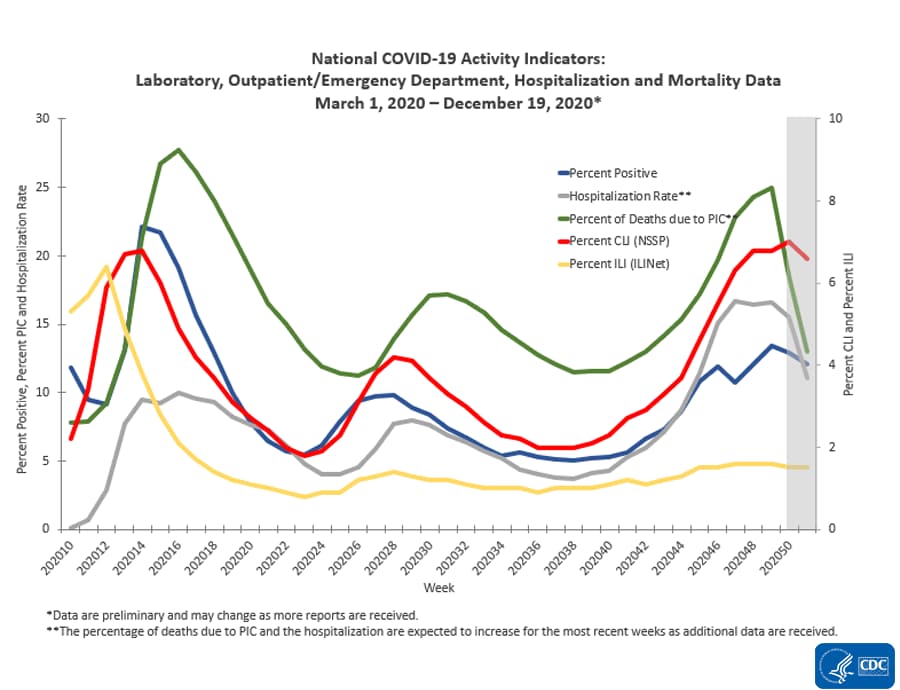
source: https://www.cdc.gov/coronavirus/2019-ncov/covid-data/covidview/index.html
The Impact of Holidays – Hospitalizations Are The Only Accurate Gauge As Most Reporting Is Not Timely
The 4 day Thanksgiving holiday period put a wobble in the trends. Over weekends and holidays, the number of new cases and deaths decline. Over weekends, this is not a problem for week-over-week rolling averages as weekends are compared against the previous weekend. But when a holiday falls within a working week, a non-working day is compared to a working day which causes havok in the trends. Now we are faced with the end of the year holiday season which means reporting is sporadic and numbers will initially look good – and then as the holidays end and the reporting catches up, the numbers will look terrible. In addition, family gatherings and travel will cause more virus transmission.
However, hospitalizations historically appear to be little affected by weekends or holidays – the daily counts do not vary significantly from day-to-day.
The hospitalization growth rate trend is growing at an ever slowing growth rate which is all good news as it means the number of beds needed is currently growing around 4 % every week.

The above graph demonstrates in the last week hospitalization rate of growth has been relatively steady. We have seen that the size of the impact of commingling and travel over the Thanksgiving holiday period – roughly, it seems to have added around 5 % to the rate of growth of new cases, hospitalizations, and deaths.
Historically, hospitalization growth follows new case growth by one to two weeks.
As an analyst, I use the rate of growth to determine the trend. But, the size of the pandemic is growing in terms of real numbers – and if the rate of growth does not become negative – the pandemic will overwhelm all resources.
The graph below shows the rate of growth relative to the growth a week earlier updated through today [note that negative numbers mean the rolling averages are LOWER than the rolling averages one week ago]. As one can see, the rate of growth for new cases peaked in early December 2020 ago and the rate of growth has been decelerating since.

This graph is currently demonstrating that the actions to contain the pandemic are slightly working – but the rate of growth improvement is too slow as we are still seeing some record numbers. In the scheme of things, new cases decline first, followed by hospitalizations, and then deaths.
It is up to each of our readers to protect themselves and others by washing your hands, wearing a mask, avoiding crowds, and maintaining social distancing.
Likely There Will Be A Pandemic Surge After New Years
The “experts” will tell you they told you so – and you should have stayed at home instead of traveling to be with the people you care about. And there is some truth in this opinion.
But there will be no way to accurately understand the impact of the holidays because there are new mutant strains of the coronavirus that are more transmissible.
To gauge the impact of anything, you change ONLY ONE variable at a time (and hopefully in a controlled environment). There are now two variables in play – and it is nearly impossible to separate the impact of each.
Coronavirus Vaccinations Are Way Behind Schedule
According to USA Today: “U.S. officials said earlier this month that there would be 20 million coronavirus vaccinations in arms by the end of the year. But so far, the numbers are far below expectations.”
The “experts” believe they should vaccinate by groups using the public health resources of each of the states – but it would be far more effective to set up vaccination centers run by the military and let anyone line up for the vaccine. Yes, I would allow teachers, health care workers, the old, and those with preexisting conditions cut into the front of the line.
Yah gotta think through how you vaccinate a lot of people – and it will take the military to create the proper methodology. It has been proven over-and-over that the “experts” are incapable of organizing anything.
How Many Americans Are Immune From COVID?
Research into the coronavirus is running way behind the need for answers. Whilst we strive for herd immunity through vaccination – we lack an understanding of the general immunity people might have to the pandemic. This will affect the point herd immunity can be reached. The following articles discuss immunity:
- Can the Common Cold Help Protect You from COVID-19?
- Does the Common Cold Protect You from COVID-19?
- Immune cells for the common cold may recognize SARS-CoV-2
Coronavirus News You May Have Missed
UK Coronavirus Variant Associated With Higher Viral Loads – Reuters
A form of inflammatory cell death called panoptosis triggers the storm of cytokines, or inflammatory proteins, that causes critical illness in COVID-19, researchers say.
“During inflammatory cell death, cells spew out their contents instead of neatly packaging them away” as happens during routine cell death, Thirumala-Devi Kanneganti of St. Jude Children’s Research Hospital told Reuters. “Neighboring cells see the cytokines released and the other unexpected debris as a sign of danger, and they can respond by secreting more cytokines, allowing the cytokine storm to build.”
Her team identified a synergy between two cytokines, TNF-alpha and IFN-gamma, as the cause of panoptosis in COVID-19. Mice given TNF-alpha and IFN-gamma developed the symptoms and organ damage of COVID-19 and died rapidly, Kanneganti said.
Treatment with antibodies that neutralize these two cytokines protected the mice from death, not just from COVID-19 but also from other life-threatening illnesses involving cytokine storms, such as sepsis, her team reported in Cell.
Trials are needed to test these treatments in humans, Kanneganti said.
Small Number of Covid Patients Develop Severe Psychotic Symptoms – New York Times
Most had no history of mental illness and became psychotic weeks after contracting the virus. Cases are expected to remain rare but are being reported worldwide.
A small number of Covid patients who had never experienced mental health problems are developing severe psychotic symptoms weeks after contracting the coronavirus.
In interviews and scientific articles, doctors described:
A 36-year-old nursing home employee in North Carolina who became so paranoid that she believed her three children would be kidnapped and, to save them, tried to pass them through a fast-food restaurant’s drive-through window.
A 30-year-old construction worker in New York City who became so delusional that he imagined his cousin was going to murder him, and, to protect himself, he tried to strangle his cousin in bed.
Beyond individual reports, a British study of neurological or psychiatric complications in 153 patients hospitalized with Covid-19 found that 10 people had “new-onset psychosis.” Another study identified 10 such patients in one hospital in Spain. And in Covid-related social media groups, medical professionals discuss seeing patients with similar symptoms in the Midwest, Great Plains and elsewhere.
“My guess is any place that is seeing Covid is probably seeing this,” said Dr. Colin Smith at Duke University Medical Center in Durham, who helped treat the North Carolina woman. He and other doctors said their patients were too fragile to be asked whether they wanted to be interviewed for this article, but some, including the North Carolina woman, agreed to have their cases described in scientific papers.
Medical experts say they expect that such extreme psychiatric dysfunction will affect only a small proportion of patients. But the cases are considered examples of another way the Covid-19 disease process can affect mental health and brain function.
Although the coronavirus was initially thought primarily to cause respiratory distress, there is now ample evidence of many other symptoms, including neurological, cognitive and psychological effects, that could emerge even in patients who didn’t develop serious lung, heart or circulatory problems. Such symptoms can be just as debilitating to a person’s ability to function and work, and it’s often unclear how long they will last or how to treat them.
Experts increasingly believe brain-related effects may be linked to the body’s immune system response to the coronavirus and possibly to vascular problems or surges of inflammation caused by the disease process.
“Some of the neurotoxins that are reactions to immune activation can go to the brain, through the blood-brain barrier, and can induce this damage,” said Dr. Vilma Gabbay, a co-director of the Psychiatry Research Institute at Montefiore Einstein in the Bronx.
Ivermectin meta-analysis by Dr. Andrew Hill – YouTube
[editor’s note: I have written many posts describing the effectiveness of Ivermectin. This video is an update of studies in process]
WHO Chief Scientist Warns “No Evidence COVID Vaccine Prevents Viral Transmission” – ZeroHedge
Once again, the WHO has stepped in to offer some confusing comments about the coronavirus vaccine, warning that there is “no evidence to be confident shots prevent transmission” and that people who receive the vaccine should continue wearing masks and following all social distancing and travel guidelines.
The comments were made by WHO chief scientist Soumya Swaminathan during what appears to have been a virtual press conference held Monday.
A clip of the offending line has begun circulating on social media
“At the moment, I don’t believe we have the evidence on any of the vaccines, to be confident that it’s going to prevent people from getting the infection and passing it on,“
Of course, a close look at the research released by Pfizer and Moderna shows the studies haven’t actually tested whether the vaccines actually prevent transmission of the virus; the goal of the trials was to see whether vaccinated patients presented with COVID symptoms at a rate that was substantially less frequent than individuals who hadn’t been vaccinated. That’s pretty much it. Though the data might hint at lowering transmission rates, that’s still tbd, apparently.
How safe are winter outdoor activities during the coronavirus pandemic? Experts weigh in – USA Today
… are some activities safer than others? And are there ways to reduce risks as much as possible?
“The short answer to both is yes,” Carney tells USA TODAY, noting that outdoor activities are often less risky than indoor activities, with some caveats.
“The virus that causes COVID-19 spreads mostly between people through respiratory droplets. So, three general things can impact this: the distance between people, crowds and whether people are wearing masks.”
If skiing is your outdoor activity of choice, decide whether you can drive to the slopes or whether you must fly. Carney says when downhill skiing, people are more than 6 feet apart, often wear masks and are mostly outdoors.
“Many ski resorts have changed practices to provide distance when waiting in lines or having people from the same group ride together on lifts,” Carney says, noting skiing with only members of your household is the least risky choice.
Because of the pandemic, some ski areas have limited capacity and have even changed food “to go,” limiting indoor time and reducing crowds.
Want to reduce your risk even further?
“Bring your own lunch. And if you want a new and more socially distant activity, try cross-country skiing – outdoors, plenty of space and great exercise,” Carney adds.
As Hospitals Roll Out COVID-19 Vaccines, Health Care Workers Describe Chaos And Anger – NPR
Health care workers across the country have started receiving COVID-19 vaccines, but doctors and nurses at some of the nation’s top hospitals are raising the alarm, charging that vaccine distribution has been unfair and a chaotic “free-for-all.”
At hospitals in Massachusetts, New York, Arizona, California and elsewhere, medical professionals say that those with the most exposure to COVID-19 patients are not always the first to get vaccinated. And others who have little or no contact with COVID-19 patients have received vaccinations.
“It definitely feels a little bit like a slap in the face,” said Jennifer DeVincent, who has been a neonatal intensive care unit nurse in the prestigious Mass General Brigham hospital system for 16 years and attends deliveries with coronavirus-positive mothers.
At Mass General Brigham, the plan was for hospital staff to use an app to sign up for vaccinations. Everyone is sorted into different “waves” meant to prioritize those most at risk. However, the plan relies on the honor code, and internal emails obtained by NPR instruct employees to “self-police.”
There were problems from the beginning. The app crashed when too many people tried to sign up at once. Then, when it was up and running again, all the appointments were snapped up within minutes. DeVincent was taking care of a patient the entire time appointments were available. Some night shift workers at Mass General Brigham woke up to learn they had slept through the announcement of the new system and the sign-up windows.
Researchers think ‘hundreds’ of people in US could have new UK coronavirus strain – CNN
Researchers studying the new UK strain of the coronavirus think it likely arrived in the US in mid-November, and that many people in the United States could already be infected.
“If I had to guess, I would say it’s probably in hundreds of people by now,” said Michael Worobey, head of the department of ecology and evolutionary biology at the University of Arizona. “It’s very possible it’s arrived multiple times in multiple places.”
“Imagine the amount of infected travelers leaving London — that’s been increasing exponentially,” said Trevor Bedford, associate professor in the vaccine and infectious disease division of the Fred Hutchinson Cancer Research Center.
British scientists have traced the new strain’s earliest known appearance back to September 20 in Kent, a county southeast of London.
Worobey and Bedford say they estimate the virus would have arrived in the US in mid-November.
Both scientists, as well as others around the world, have scoured genetic sequences of coronavirus in the United States to see if any match up with the UK variant. So far, they haven’t found any, but they say that’s likely because the US surveillance system isn’t catching them.
Health officials agree.
“You really need to assume that it’s here already, and certainly is not the dominant strain, but I would not be surprised at all if it is already here,” Dr. Anthony Fauci, the director of the National Institute of Allergy and Infectious Diseases, said Tuesday.
A Better Plan for COVID Vaccinations – MedPage
Now that the first COVID-19 vaccines are being rolled out, Operation Warp Speed, the FDA, and the CDC have recommended that governors proceed first with vaccinating two groups: healthcare workers and residents in nursing homes. But what about after that?
Planning has started in all the states and territories regarding who will get the vaccine third on the priority list, potentially starting before the end of January. The choice can be reduced to two major categories: maintenance of essential services and reduction of hospitalizations and mortality.
Operation Warp Speed, FDA, and CDC have recommended that priority should go to workers who preserve essential services for the COVID-19 response and for the overall functioning of society. Estimated at 87 million, this category includes food and medicine supply chain workers (e.g., truck drivers, grocery store and pharmacy employees), infrastructure workers, teachers, and those working in national security. The essential worker category is logical and important but will have minimal impact on reducing hospitalizations and our high daily death rate. And it will take months to implement.
The alternative candidate for third priority is vulnerable populations where vaccination will have the effect of reducing hospitalizations and deaths. Joel Zivot, MD, recently suggested vaccinating all Medicare (53 million) and Medicaid (70 million) recipients ahead of healthcare workers. Presumably, vaccinating this large group would give vaccine to the most vulnerable and underserved populations and would have a sizable impact on reducing hospitalizations and deaths. We assume that this suggestion would also include indigenous populations, the homeless, and inmates in prisons. Vaccinating these pools of patients would go throughout spring and possibly early summer.
[editor’s note: If this topic interests you, this article deserves a full read]
McConnell blocks vote on $2K checks, signals new package – The Hill
Senate Majority Leader Mitch McConnell (R-Ky.) on Tuesday blocked an attempt by Democrats to set up a stand-alone vote on increasing the amount of recently passed stimulus checks from $600 to $2,000.
… McConnell signaled separately that he could package the increase in direct stimulus checks, with a repeal of a tech shield that has emerged as a top target for Trump and election-related investigations. Trump, in his statement on signing the $2.3 trillion package, said the Senate would “start the process for a vote” that tackles the three issues.
“During this process, the president highlighted three additional issues of national significance he would like to see Congress tackle together,” McConnell said.
“Those are the three important subjects the president has linked together. This week the Senate will begin a process to bring these three priorities into focus,” he added.
Neanderthal Gene Protects Against COVID-19 – Medscape
A specific form of a protein passed down from Neanderthals protects against severe COVID-19, according to a study reported on medRxiv ahead of peer review.
Existing medications that boost levels of this protein could potentially help treat the disease, the researchers say.
The protein, called OAS1, is involved in the immune response to viruses. People with higher levels of the Neanderthal-related form of OAS1 are less susceptible to COVID-19, and if they do become infected, they are at lower risk for hospitalization, intubation and death, the researchers found.
“This protective form of OAS1 is present in sub-Saharan Africans but was lost when the ancestors of modern-day Europeans migrated out of Africa. It was then re-introduced into the European population through mating with Neanderthals” who lived more than 40,000 years ago, said coauthor Brent Richards from the Jewish General Hospital and McGill University in Montreal.
Vitamin D Fails to Help in Severe COVID-19 – Reuters
Low vitamin D levels are linked with higher risk for severe COVID-19, but treatment that boosted vitamin D levels in critically ill COVID-19 patients did not shorten their hospital stay or lower their odds of intensive care unit admission, needing mechanical ventilation, or dying, doctors in Brazil found.
They randomly assigned 240 hospitalized patients with severe COVID-19 to receive either a single high dose of vitamin D3 or placebo.
In a paper posted on medRxiv ahead of peer review, they report that after the treatment, only 6.7% of the patients in the vitamin D group had “deficient” levels of the nutrient, compared to 51.5% of patients in the placebo group. Even so, there was no difference in patients’ outcomes between the two groups.
The same was true when the researchers focused only on the 116 patients with vitamin D deficiency before the treatment.
The authors say theirs is the first randomized trial of its kind to show that vitamin D supplementation “is ineffective to improve hospital length of stay or any other clinical outcomes among hospitalized patients with severe COVID-19.”
U.S. could be missing the new Covid variant ‘because the holes in our net are too wide,’ expert says – CNBC
- “To find that strain, what we need to do is to take a percentage of the samples that are diagnosed and do deep genetic analysis, and (in) the U.S., our capacity hasn’t been spectacular,” said Dr. Nahid Bhadelia.
- A smaller sample of virus sequences means the new mutation could already be present in the country without having been detected, the CDC says.
- The U.S. has only sequenced about 51,000 infections of the 17 million total cases in the country, while the U.K. has completed 125,000 sequences so far.
Wuhan’s Covid-19 infections may have been almost 10 times higher than official figure, study shows – CNN
Nearly half a million residents in the Chinese city where the novel coronavirus first emerged may have been infected with Covid-19 — almost 10 times its official number of confirmed cases, according to a study by the Chinese Center for Disease Control and Prevention (CDC).
The study used a sample of 34,000 people in the general population in Wuhan — the original epicenter of the pandemic — and other cities in Hubei province, as well as Beijing, Shanghai, and the provinces of Guangdong, Jiangsu, Sichuan and Liaoning to estimate Covid-19 infection rates.
The researchers found an antibody prevalence rate of 4.43% for Covid-19 among residents in Wuhan, a metropolis of 11 million people. As of Sunday, Wuhan had reported a total of 50,354 confirmed cases of Covid-19, according to the Wuhan Municipal Health Commission.
The study aimed to estimate the scale of past infections in a population by testing blood serum samples from a pool of people for coronavirus antibodies. Its findings are not taken to be final statistics of how many people in a given area have been exposed to the virus.
The Chinese CDC said the study was conducted a month after China “contained the first wave of the Covid-19 epidemic.” The prevalence rate outside of Wuhan is significantly lower, the study showed. In other cities in Hubei, only 0.44% of residents surveyed were found to have coronavirus antibodies.
The following are foreign headlines with hyperlinks to the posts
German officials identified cases of the new U.K. coronavirus strain there in samples from deceased patients.
In China, authorities seek to contain a new COVID outbreak in the capital, Beijing.
EU to purchase extra 100 million doses of Pfizer-BioNTech COVID-19 vaccine
Netherlands deaths increased at the highest rate since World War II this year
Iran expects to receive 150K doses of Pfizer vaccine from US-based philanthropists
Coronavirus variant leads to record hospitalizations in England
WHO Says COVID Pandemic ‘Not Necessarily the Big One’ As New Strains Spread
Israel’s coronavirus cases near three-month high
Russian official acknowledges actual coronavirus death toll is much higher than official figures
Indonesia to ban entry to foreign nationals from January 1
Philippines expands travel ban over new coronavirus variant
Netherlands to demand negative Covid-19 test for almost all arrivals
US Forces Korea has started vaccinating military and civilian healthcare workers against Covid-19
India reports lowest 24-hour increase in Covid-19 cases in 6 months
The following additional national and state headlines with hyperlinks to the posts
“People Are Fed Up”: California Out Of Excuses As Coronavirus Defies Militant Lockdowns
The House on Monday voted to increase COVID-19 relief stimulus checks from $600 to $2,000, as President Donald Trump demanded when he signed the relief package into law Sunday. The measure will now head to the Senate where its future remains uncertain. It’s not clear when the first checks will go out , but the bill specifies that checks must be sent no later than Jan. 15.
Air travel in the U.S. over the Christmas weekend was the highest it’s been during the pandemic. It’s still much lower than last year: About 3.8 million people passed through airports from Dec. 23 to Dec. 26, compared with 9.5 million over the same days in 2019.
Crowded hospitals mean worse COVID survival odds
SAT, ACT are now ‘optional,’ colleges say
Are Americans really fleeing cities?
Two staffers from each member of the U.S. House and Senate are now eligible for the shot.
Rural healthcare workers are fleeing small-town America, citing pandemic politics and “toxic individualism.”
New York Approves Eviction Moratorium Until May
Harris receives coronavirus vaccine on camera, urges Americans to get vaccinated
Unemployment won’t lapse despite Trump signing delay
UK Coronavirus Variant Associated With Higher Viral Loads
Walgreens Gives Out Extra COVID Vaccines to General Public
California’s governor says it’s ‘self-evident’ that stay-at-home orders will be extended.
New York State’s positive test rate reaches its highest point since May: 8.3%.
States implementing UI changes quickly so there’s no payment lapse
Latest NFL Covid-19 testing window reveals uptick in cases
About 500 doses of Covid-19 vaccine discarded at medical center in Wisconsin [storage error]
Today’s Posts On Econintersect Showing Impact Of The Pandemic With Hyperlinks
Warning to Readers
The amount of politically biased articles on the internet continues to increase. And studies and opinions of the experts continue to contradict other studies and expert opinions. Honestly, it is difficult to believe anything anymore. A study usually cannot establish cause and effect – but only correlation. Be very careful what you believe about this pandemic.

I assemble this coronavirus update daily – sifting through the posts on the internet. I try to avoid politically slanted posts (mostly from CNN, New York Times, and the Washington Post) and can usually find unslanted posts on that subject from other sources on the internet. I wait to publish posts on subjects that I cannot validate across several sources. But after all this extra work, I do not know if I have conveyed the REAL facts. It is my job to provide information so that you have the facts necessary – and then it is up to readers to draw conclusions.
Analyst Opinion of Coronavirus Data
There are several takeaways that need to be understood when viewing coronavirus statistical data:
- The global counts are suspect for a variety of reasons including political. Even the U.S. count has issues as it is possible that as much as half the population has had coronavirus and was asymptomatic. It would be a far better metric using a random sampling of the population weekly. In short, we do not understand the size of the error in the tracking numbers.
- Just because some of the methodology used in aggregating the data in the U.S. is flawed – as long as the flaw is uniformly applied – you establish a baseline. This is why it is dangerous to compare two countries as they likely use different methodologies to determine who has (and who died) from coronavirus.
- COVID-19 and the flu are different but can have similar symptoms. For sure, COVID-19 so far is much more deadly than the flu. [click here to compare symptoms]
- From an industrial engineering point of view, one can argue that it is best to flatten the curve only to the point that the health care system is barely able to cope. This solution only works if-and-only-if one can catch this coronavirus once and develops immunity. In the case of COVID-19, herd immunity may need to be in the 80% to 85% range. WHO warns that few have developed antibodies to COVID-19 when recovering from COVID-19. Herd immunity does not look like an option without immunization although there is now a discussion of whether T-Cells play a part in immunity [which means one might have immunity without antibodies]
- Older population countries will have a significantly higher death rate as there is relatively few hospitalizations and deaths in younger age groups..
- There are at least 8 strains of the coronavirus. New York may have a deadlier strain imported from Europe, compared to less deadly viruses elsewhere in the United States.
- Each publication uses different cutoff times for its coronavirus statistics. Our data uses 11:00 am London time. Also, there is an unexplained variation in the total numbers both globally and in the U.S.
What we do or do not know about the coronavirus [actually there is little scientifically proven information]. Most of our knowledge is anecdotal, from studies with limited subjects, or from studies without peer review.
- How many people have been infected as many do not show symptoms?
- Masks do work.
- Do we develop lasting immunity to the coronavirus? Another coronavirus – the simple cold – does not develop long term immunity.
- To what degree do people who never develop symptoms contribute to transmission? Research early in the pandemic suggested that the rate of asymptomatic infections could be as high as 81%. But a meta-analysis, which included 13 studies involving 21,708 people, calculated the rate of asymptomatic presentation to be 17%.
- The accuracy of rapid testing is questioned – and the more accurate test results are not being given in a timely manner.
- Can children widely spread coronavirus? [current thinking is that they are a minor source of the pandemic spread]
- Why have some places avoided big coronavirus outbreaks – and others hit hard?
- Air conditioning contributes to the pandemic spread.
- It appears that there is increased risk of infection and mortality for those living in larger occupancy households.
- Male patients have almost three times the odds of requiring intensive treatment unit (ITU) admission compared to females.
- Outdoor activities seem to be a lower risk than indoor activities.
- Will other medical treatments for Covid-19 ease symptoms and reduce deaths? So far only remdesivir, Bamlanivimab,
and Regeneron) are approved for treatment. What drugs work?
- A current scientific understanding of the way the coronavirus works can be found [here].
There is now a vaccine available – the questions remain:
- how effective it will be in the general population,
- will there be any permanent side effects that will appear months from now,
- how long immunity will last [we can currently say we do not know if it will last more than 4 months],
- there is no evidence the vaccine will block transmission
Heavy breakouts of coronavirus have hit farmworkers. Farmworkers are essential to the food supply. They cannot shelter at home. Consider:
- they have high rates of respiratory disease [occupational hazard]
- they travel on crowded buses chartered by their employers
- few have health insurance
- they cannot social distance and live two to four to a room – and they eat together
- some reports say half are undocumented
- they are low paid and cannot afford not to work – so they will go to work sick
- they do not have access to sanitation when working
- a coronavirus outbreak among farmworkers can potentially shutter entire farm
The bottom line is that COVID-19 so far has been shown to be much more deadly than the data on the flu. Using CDC data, the flu has a mortality rate between 0.06 % and 0.11 % Vs. the coronavirus which to date has a mortality rate of 4 % [the 4% is the average of overall statistics – however in the last few months it has been hovering around 1.0%] – which makes it between 10 and 80 times more deadly. The reason for ranges:
Because influenza surveillance does not capture all cases of flu that occur in the U.S., CDC provides these estimated ranges to better reflect the larger burden of influenza.
There will be a commission set up after this pandemic ends to find fault [it is easy to find fault when a once-in-a-lifetime event occurs] and to produce recommendations for the next time a pandemic happens. Those that hate President Trump will conclude the virus is his fault.
Resources:
- Get the latest public health information from CDC: https://www.coronavirus.gov .
- Get the latest research from NIH: https://www.nih.gov/coronavirus.
- Find NCBI SARS-CoV-2 literature, sequence, and clinical content: https://www.ncbi.nlm.nih.gov/sars-cov-2/.
- List of studies: https://icite.od.nih.gov/covid19/search/#search:searchId=5ee124ed70bb967c49672dad
include(“/home/aleta/public_html/files/ad_openx.htm”); ?>


