


Written by Steven Hansen
The U.S. new cases 7-day rolling average is 12.3 % LOWER than the 7-day rolling average one week ago. U.S. hospitalizations due to COVID-19 are now 3.8 % HIGHER than the rolling average one week ago. U.S. deaths due to coronavirus are now 13.7 % LOWER than the rolling average one week ago. Today’s posts include:
- U.S. Coronavirus New Cases are at an elevated 226,274
- U.S. Coronavirus hospitalizations are at an elevated 117,344 (for the next two weeks this is the number to watch as new cases and deaths will not be accurately reported)
- U.S. Coronavirus deaths are at a holiday reduced number of 1,663
- U.S. Coronavirus immunizations are 11,042,450 doses distributed and 1,944,585 doses administered
- The 7-day rolling average rate of growth of the pandemic shows new cases worsened, hospitalizations improved, and deaths improved
- Likely There Will Be A Pandemic Surge After New Years
- The Case Of Not Electing To Be Vaccinated
- Corona False Alarm
- Cannabis May Reduce Deadly COVID-19 Lung Inflammation: Researchers Explain Why
- What’s Behind the Vaccine Feud Between Pfizer and the Feds?
- China, Japan Increase ‘Stay Put’ Orders, South Korea Sees Largest Daily COVID Case Spike
- Fauci says UK variant “doesn’t appear” to make people more ill
- COVID-19 antibodies may protect from virus for 6 months or longer, studies find
- Vaccinated health workers must navigate another new normal: households in which not all family members are immunized

The recent worsening of the trendlines for new cases should be attributed to going back to college/university, cooler weather causing more indoor activities, possible mutation of the virus, fatigue from wearing masks / social distancing, holiday activities, political rallies / voting, and continued loosening of regulations designed to slow the coronavirus spread.
My continuing advice is to continue to wash your hands (especially after using the toilet as COVID first sheds in your stool), putting down the toilet seat (as flushing the toilet releases a plume), wear masks, avoid crowds, and maintain social distancing. No handwashing, mask, or social distancing will guarantee you do not get infected – but it sure as hell lowers the risk in all situations – and the evidence to-date shows a lower severity of COVID-19. In addition, certain activities are believed to carry higher risk – like being inside in air conditioning and removing your mask (such as restaurants, around your children/grandchildren, bars, and gyms). It is all about viral load – and outdoor activities are generally safe if you can maintain social distance. Finally, studies show eating right (making sure you are supporting your immune system) and adequate sleep increase your ability to fight off COVID.
include($_SERVER[‘DOCUMENT_ROOT’].’/pages/coronavirus1.htm’); ?>
Hospitalizations (grey line) and Mortality (green line)
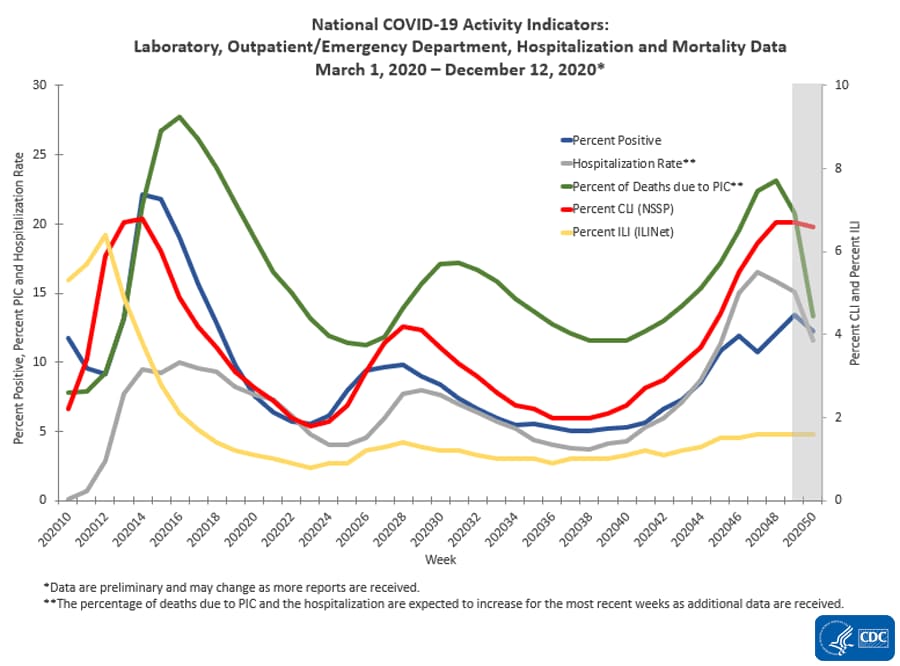
source: https://www.cdc.gov/coronavirus/2019-ncov/covid-data/covidview/index.html
The Impact of Holidays – Hospitalizations Are The Only Accurate Gauge As Most Reporting Is Not Timely
The 4 day Thanksgiving holiday period put a wobble in the trends. Over weekends and holidays, the number of new cases and deaths decline. Over weekends, this is not a problem for week-over-week rolling averages as weekends are compared against the previous weekend. But when a holiday falls within a working week, a non-working day is compared to a working day which causes havok in the trends. Now we are faced with the end of the year holiday season which means reporting is sporadic and numbers will initially look good – and then as the holidays end and the reporting catches up, the numbers will look terrible. In addition, family gatherings and travel will cause more virus transmission.
However, hospitalizations historically appear to be little affected by weekends or holidays – the daily counts do not vary significantly from day-to-day.
The hospitalization growth rate trend is growing at an ever slowing growth rate which is all good news as it means the number of beds needed is currently growing around 4 % every week.

The above graph demonstrates in the last week hospitalization rate of growth has been relatively steady. We have seen that the size of the impact of commingling and travel over the Thanksgiving holiday period – roughly, it seems to have added around 5 % to the rate of growth of new cases, hospitalizations, and deaths.
Historically, hospitalization growth follows new case growth by one to two weeks.
As an analyst, I use the rate of growth to determine the trend. But, the size of the pandemic is growing in terms of real numbers – and if the rate of growth does not become negative – the pandemic will overwhelm all resources.
The graph below shows the rate of growth relative to the growth a week earlier updated through today [note that negative numbers mean the rolling averages are LOWER than the rolling averages one week ago]. As one can see, the rate of growth for new cases peaked in early December 2020 ago and the rate of growth has been decelerating since.

This graph is currently demonstrating that the actions to contain the pandemic are slightly working – but the rate of growth improvement is too slow as we are still seeing some record numbers. In the scheme of things, new cases decline first, followed by hospitalizations, and then deaths.
It is up to each of our readers to protect themselves and others by washing your hands, wearing a mask, avoiding crowds, and maintaining social distancing.
Likely There Will Be A Pandemic Surge After New Years
The “experts” will tell you they told you so – and you should have stayed at home instead of traveling to be with the people you care about. And there is some truth in this opinion.
But there will be no way to accurately understand the impact of the holidays because there are new mutant strains of the coronavirus that are more transmissible.
To gauge the impact of anything, you change ONLY ONE variable at a time (and hopefully in a controlled environment). There are now two variables in play – and it is nearly impossible to separate the impact of each.
Coronavirus News You May Have Missed
Today Econintersect published two summary posts on coronavirus news for this past week
The Case Of Not Electing To Be Vaccinated – Brighteon
[editor’s note: I am not an anti vaxxer. But I do NOT believe in suppression of information even if I believe the conclusions are likely flawed.]
Vaccinated health workers must navigate another new normal: households in which not all family members are immunized. – New York Times
The shot introduced a microscopic shift that will have an outsize impact on his risk of getting Covid-19. But, Dr. Bell said, little else in his life will change until more of his community joins the vaccinated pool.
Dr. Bell remains a relative rarity among the people he sees both inside and outside of work. His wife, Kristen, and their children, Alain and Ruby, are unlikely to be vaccinated before the spring or summer. They, like many others, will soon live in a home divided by the splinter-thin prick of a needle — one person vaccinated, three not. They represent a liminal state that will persist for months nationwide, as the first people to be injected navigate a new coexistence with the vulnerable at home.
Although the new vaccines have been shown to be highly effective at preventing people from developing symptomatic cases of Covid-19, little data exists on how well they can stop the spread of the virus, raising the possibility that vaccinated people, despite being much safer individually, could still pose a threat to those they love.
But even as vaccines find their way into more and more arms, scientists will continue to study their effects on the population at large, searching for signs of unexpected or rare side effects and monitoring whether the vaccine might curb the coronavirus’s ability to pass from person to person.
Dr. Bell, of UVA Health, is treading cautiously with the unknowns. Perhaps the biggest is transmission, and whether the vaccine will help tame it. He said he suspected that the vaccine would have at least some impact on contagiousness. Once he is fully vaccinated, Dr. Bell might consider making the occasional masked visit to the gym — a luxury he gave up months ago after finding his usual haunt overrun with people who had tossed their face coverings aside.
[editor’s note: this document was translated from German. This document is an alternate version of the “facts” being provided – hopefully in enough detail that readers can arrive at their own conclusions. Again, I have no agenda except to pass along any potentially credible information. Click on the image below to read the document.]

What’s Behind the Vaccine Feud Between Pfizer and the Feds? – Motley Fool
Relationships are important — especially when there’s a massive effort to distribute COVID-19 vaccines underway. There have been reports recently, though, hinting that Pfizer‘s relationship with the U.S. government could be strained. In this Motley Fool Live video recorded on Dec. 18, 2020, healthcare and cannabis editor/analyst Olivia Zitkus and Fool.com writer Keith Speights discuss what’s behind the feud between Pfizer and the feds.
Cannabis May Reduce Deadly COVID-19 Lung Inflammation: Researchers Explain Why – Forbes
As COVID-19 cases continue to rise, researchers have started to look for solutions in an unlikely place – the cannabis plant. Cannabis’ active compounds have a number of properties that make it appealing as a potential adjunct treatment for infections from the novel coronavirus, and recently scientists have begun looking at its potential for reducing susceptibility to the disease, and even discussed whether it could be used as an antiviral medication.
This month, researchers from the University of Nebraska and the Texas Biomedical Research Institute are recommending more research into how cannabis-derived CBD might help treat dangerous lung inflammation from the novel coronavirus. The authors detailed the evidence for how cannabis’ anti-inflammatory powers may help in a peer-reviewed article in this month’s issue of Brain, Behavior, and Immunity.
In the article, researchers explain that “recent reports have suggested that acute infection is associated with a cytokine superstorm, which contributes to the symptoms of fever, cough, muscle pain.” These extreme instances of inflammation can lead to severe pneumonia which clog up the lungs, make breathing difficult or impossible. So, one of the important strategies that scientists are studying in the fight against COVID-19 is reducing inflammation.
In particular, researchers are looking at drugs which reduce IL-6 cytokine activity. In a recent study, one such drug, Tocilizumab, was able to clear out patients’ lungs, and resulted in recovery for 90% of the patients treated. Unfortunately, it also produced serious negative side effects like inflammation of the pancreas and hypertriglyceridemia (a risk factor for coronary artery disease). This has led researchers to continue the search for anti-inflammatory strategies – preferably ones that aren’t as harsh on these already critically ill patients.
That’s where cannabis comes in. The authors explain that several cannabinoids in the cannabis plant have anti-inflammatory properties. In particular, they point to CBD as the most likely candidate for treating COVID-19 related inflammation. CBD has shown serious anti-inflammatory properties in previous studies, it doesn’t create the disorienting psychotropic effects associated with cannabis’ most common chemical THC, and it has already been approved by the FDA as safe for children with intractable epilepsy. If successful at reducing inflammation for COVID-19 patients, it could be a safer alternative to other anti-inflammatory options.
China, Japan Increase ‘Stay Put’ Orders, South Korea Sees Largest Daily COVID Case Spike – Newsweek
Amid the coronavirus pandemic, government officials in Beijing urged residents not to leave the city, Japan has banned all new entries of foreign nationals through January, and South Korea recorded its largest case increase on Christmas Day.
Despite none of them ranking among the world’s top for either COVID-19 cases or deaths, China, Japan and South Korea are promoting strict lockdown measures ahead of 2021. Beijing public health officials told residents not to leave during the Lunar New Year holiday through February and implemented new restrictions following a handful of new coronavirus infections last week. And while the United States saw its smallest daily increase on December 25, South Korea recorded 1,241 new infections, its largest daily spike yet.
South Korea has seen more than 15,000 new cases being added in just the last 15 days, which is happening alongside its deadliest two-week period since the start of the pandemic. Meanwhile, Chinese officials canceled all large gatherings including sporting events through the February 12 New Year, while all theaters, museums and libraries are operating at 75 percent capacity.
The public health responses in both South Korea and Japan had been widely touted across the globe in the early months of the pandemic, but now many scientists worry that such trust is cracking heading into the new year. Officials in those two countries said tighter lockdown measures are necessary because transmissions are outpacing hospital expansion efforts.
[editor’s note: I think the below graph says volumes of which countries are seeing spikes]

Fauci says UK variant “doesn’t appear” to make people more ill – CNN
Dr. Anthony Fauci said that while news of new coronavirus variants may seem concerning, viruses mutate “all the time” — plus, the new UK variant does not appear to make people more ill.
“Obviously, this is something we always take seriously and it’s concerning whenever you get a mutation, but I think the American public needs to remember and realize that these are RNA viruses and continually mutating all the time. Most of the time the mutations don’t have a functional significance,” Fauci said on CNN’s “State of the Union.”
Fauci said UK and US officials are studying if the strain makes people more ill: “And the answer is It doesn’t appear to be that way,” he said.
Fauci continued: “The other issue does it escape the protection that’s induced by the vaccines that we’re currently using? And according to our British colleagues, that does not seem to be the case.”
He added that US officials will do their own studies to see if the vaccines work on the mutant variant.
“Having said that, you take something like this very seriously, you follow it very carefully, and you make whatever adjustments you need to do based on the data as it evolves,” Fauci said.
COVID-19 antibodies may protect from virus for 6 months or longer, studies find – Yahoo
Evidence from two new studies suggest that antibodies from getting COVID-19 may provide protection against future infection.
Researchers at the U.S. National Cancer Institute found that people with antibodies from natural infection were less likely to test positive again for up to six months and maybe longer, according to one of the studies published Wednesday in the New England Journal of Medicine. The research looked at 12,500 health workers at Oxford University Hospitals in the U.K.
The second study, still undergoing peer-review, involved more than 3 million people who had antibody tests from two private labs in the United States. Only .03% of those who initially had antibodies later tested positive for the coronavirus, compared with 3% of those who lacked such antibodies.
The findings are “not a surprise,” said Joshua Wolf, an infectious disease specialist at St. Jude Children’s Research Hospital in Memphis who is not affiliated with the study. “But it’s really reassuring because it tells people that immunity to the virus is common.”
The following are foreign headlines with hyperlinks to the posts
A 101-year-old woman in a nursing home in eastern Germany became the country’s first recipient of the BioNTech-Pfizer vaccine on Saturday, when Hungary and Slovakia also began inoculating people.
A citizen journalist who posted videos from Wuhan, China, is set to go on trial on Monday. Zhang Zhan, a 37-year-old former lawyer, reported on the lockdown in Wuhan. She was arrested and faces accusations of spreading lies in the first known trial of a chronicler of China’s coronavirus crisis.
A tide of new coronavirus cases in Africa is raising alarm in countries that, over all, appear to fare far better than those in Europe or the Americas.
South Korea social-distancing measures to last into January
Chinese Media Attacks U.S. ‘Selfishness’ As Trump Blames Beijing for COVID
The E.U. begins its vaccine rollout, aiming to inoculate more than 450 million people.
Germany’s vaccine rollout comes after months of preparation.
Pope Frances welcomed a vaccine’s arrival in Italy, where nearly 10,000 doses were given on Sunday.
Canada, France, Japan, Spain and Sweden find cases of the new coronavirus variant.
‘The second wave is here,’ and African doctors fear it will be worse than the first.
Italy administers first vaccine doses
Argentina to start roll-out of Russian-produced Sputnik V coronavirus vaccine Tuesday
The following additional national and state headlines with hyperlinks to the posts
In the United States, where vaccinations began two weeks ago, new surveys show that the portion of people saying they are likely or certain to take the vaccine has grown to more than 60 percent from about 50 percent this summer, and in one poll, to 73 percent — a figure that approaches what some public health experts say would create herd immunity.
Researchers Are Looking At Cannabis As A Potential Way To Prevent COVID-19
Researchers Warn Some Covid-19 Vaccines Could Increase Risk Of HIV Infection
Cannabis Shows Potential To Help And Harm In Coronavirus Cases: Experts Explain Why
Jobless Benefits Expire As Trump Doesn’t Sign Stimulus Bill, Blames China
These are the treasured diners and hidden haunts that Covid-19 closed for good.
The pandemic has devastated U.S. prisons, but it could save one woman on death row
Fauci says he believes worst is still to come in the pandemic following holiday season
TSA says it screened more than 1.1 million people at airports yesterday
Florida adds more than 17,000 coronavirus cases over two day span
Today’s Posts On Econintersect Showing Impact Of The Pandemic With Hyperlinks
A Tale Of Two Business Cycles During The Pandemic
Glaciers Of Global Finance: The Currency Composition Of Central Banks Reserve Holdings
Investor Alert: Investment Scam Complaints On The Rise
Coronavirus Disease Weekly News 27December 2020
Coronavirus Economic Weekly News 27December 2020
COVID-19 Vaccines: How Pfizer’s And Moderna’s 95% Effective MRNA Shots Work
Warning to Readers
The amount of politically biased articles on the internet continues to increase. And studies and opinions of the experts continue to contradict other studies and expert opinions. Honestly, it is difficult to believe anything anymore. A study usually cannot establish cause and effect – but only correlation. Be very careful what you believe about this pandemic.

I assemble this coronavirus update daily – sifting through the posts on the internet. I try to avoid politically slanted posts (mostly from CNN, New York Times, and the Washington Post) and can usually find unslanted posts on that subject from other sources on the internet. I wait to publish posts on subjects that I cannot validate across several sources. But after all this extra work, I do not know if I have conveyed the REAL facts. It is my job to provide information so that you have the facts necessary – and then it is up to readers to draw conclusions.
Analyst Opinion of Coronavirus Data
There are several takeaways that need to be understood when viewing coronavirus statistical data:
- The global counts are suspect for a variety of reasons including political. Even the U.S. count has issues as it is possible that as much as half the population has had coronavirus and was asymptomatic. It would be a far better metric using a random sampling of the population weekly. In short, we do not understand the size of the error in the tracking numbers.
- Just because some of the methodology used in aggregating the data in the U.S. is flawed – as long as the flaw is uniformly applied – you establish a baseline. This is why it is dangerous to compare two countries as they likely use different methodologies to determine who has (and who died) from coronavirus.
- COVID-19 and the flu are different but can have similar symptoms. For sure, COVID-19 so far is much more deadly than the flu. [click here to compare symptoms]
- From an industrial engineering point of view, one can argue that it is best to flatten the curve only to the point that the health care system is barely able to cope. This solution only works if-and-only-if one can catch this coronavirus once and develops immunity. In the case of COVID-19, herd immunity may need to be in the 80% to 85% range. WHO warns that few have developed antibodies to COVID-19 when recovering from COVID-19. Herd immunity does not look like an option without immunization although there is now a discussion of whether T-Cells play a part in immunity [which means one might have immunity without antibodies]
- Older population countries will have a significantly higher death rate as there is relatively few hospitalizations and deaths in younger age groups..
- There are at least 8 strains of the coronavirus. New York may have a deadlier strain imported from Europe, compared to less deadly viruses elsewhere in the United States.
- Each publication uses different cutoff times for its coronavirus statistics. Our data uses 11:00 am London time. Also, there is an unexplained variation in the total numbers both globally and in the U.S.
What we do or do not know about the coronavirus [actually there is little scientifically proven information]. Most of our knowledge is anecdotal, from studies with limited subjects, or from studies without peer review.
- How many people have been infected as many do not show symptoms?
- Masks do work.
- Do we develop lasting immunity to the coronavirus? Another coronavirus – the simple cold – does not develop long term immunity.
- To what degree do people who never develop symptoms contribute to transmission? Research early in the pandemic suggested that the rate of asymptomatic infections could be as high as 81%. But a meta-analysis, which included 13 studies involving 21,708 people, calculated the rate of asymptomatic presentation to be 17%.
- The accuracy of rapid testing is questioned – and the more accurate test results are not being given in a timely manner.
- Can children widely spread coronavirus? [current thinking is that they are a minor source of the pandemic spread]
- Why have some places avoided big coronavirus outbreaks – and others hit hard?
- Air conditioning contributes to the pandemic spread.
- It appears that there is increased risk of infection and mortality for those living in larger occupancy households.
- Male patients have almost three times the odds of requiring intensive treatment unit (ITU) admission compared to females.
- Outdoor activities seem to be a lower risk than indoor activities.
- Will other medical treatments for Covid-19 ease symptoms and reduce deaths? So far only remdesivir, Bamlanivimab,
and Regeneron) are approved for treatment. What drugs work?
- A current scientific understanding of the way the coronavirus works can be found [here].
There is now a vaccine available – the questions remain:
- how effective it will be in the general population,
- will there be any permanent side effects that will appear months from now,
- how long immunity will last [we can currently say we do not know if it will last more than 4 months],
- there is no evidence the vaccine will block transmission
Heavy breakouts of coronavirus have hit farmworkers. Farmworkers are essential to the food supply. They cannot shelter at home. Consider:
- they have high rates of respiratory disease [occupational hazard]
- they travel on crowded buses chartered by their employers
- few have health insurance
- they cannot social distance and live two to four to a room – and they eat together
- some reports say half are undocumented
- they are low paid and cannot afford not to work – so they will go to work sick
- they do not have access to sanitation when working
- a coronavirus outbreak among farmworkers can potentially shutter entire farm
The bottom line is that COVID-19 so far has been shown to be much more deadly than the data on the flu. Using CDC data, the flu has a mortality rate between 0.06 % and 0.11 % Vs. the coronavirus which to date has a mortality rate of 4 % [the 4% is the average of overall statistics – however in the last few months it has been hovering around 1.0%] – which makes it between 10 and 80 times more deadly. The reason for ranges:
Because influenza surveillance does not capture all cases of flu that occur in the U.S., CDC provides these estimated ranges to better reflect the larger burden of influenza.
There will be a commission set up after this pandemic ends to find fault [it is easy to find fault when a once-in-a-lifetime event occurs] and to produce recommendations for the next time a pandemic happens. Those that hate President Trump will conclude the virus is his fault.
Resources:
- Get the latest public health information from CDC: https://www.coronavirus.gov .
- Get the latest research from NIH: https://www.nih.gov/coronavirus.
- Find NCBI SARS-CoV-2 literature, sequence, and clinical content: https://www.ncbi.nlm.nih.gov/sars-cov-2/.
- List of studies: https://icite.od.nih.gov/covid19/search/#search:searchId=5ee124ed70bb967c49672dad
include(“/home/aleta/public_html/files/ad_openx.htm”); ?>


