


Written by Steven Hansen
The U.S. new cases 7-day rolling average are 1.2 % HIGHER than the 7-day rolling average one week ago. U.S. hospitalizations due to COVID-19 are now 4.2 % HIGHER than the rolling average one week ago. U.S. deaths due to coronavirus are now 8.7 % HIGHER than the rolling average one week ago. Today’s posts include:
- U.S. Coronavirus New Cases are at an elevated 195,033
- U.S. Coronavirus hospitalizations are at a record 117,777
- U.S. Coronavirus deaths are at an elevated 3,401
- U.S. Coronavirus immunizations are 9,465,725 doses distributed and 1,008,025 doses administered
- The 7-day rolling average rate of growth of the pandemic shows new cases worsened, hospitalizations improved, and deaths improved
- Merck is in a supply deal with the U.S. government for its Covid treatment
- Even as infections rise, antibody drugs are going unused
- Sorrento’s antibody injection and nose drops may be tools to fight Covid
- Study Suggests Link Between Sleep Supplement and COVID-19
- Is Covid a High Risk to Younger Adults?
- Shorter quarantines could actually help prevent COVID-19 outbreaks
- US hospitals facing a worrisome shortage of nurses, doctors
- Vaccines and a strong economy could mean inflation in 2021

The recent worsening of the trendlines for new cases should be attributed to going back to college/university, cooler weather causing more indoor activities, possible mutation of the virus, fatigue from wearing masks / social distancing, holiday activities, political rallies / voting, and continued loosening of regulations designed to slow the coronavirus spread.
My continuing advice is to continue to wash your hands (especially after using the toilet as COVID first sheds in your stool), putting down the toilet seat (as flushing the toilet releases a plume), wear masks, avoid crowds, and maintain social distancing. No handwashing, mask, or social distancing will guarantee you do not get infected – but it sure as hell lowers the risk in all situations – and the evidence to-date shows a lower severity of COVID-19. In addition, certain activities are believed to carry higher risk – like being inside in air conditioning and removing your mask (such as restaurants, around your children/grandchildren, bars, and gyms). It is all about viral load – and outdoor activities are generally safe if you can maintain social distance. Finally, studies show eating right (making sure you are supporting your immune system) and adequate sleep increase your ability to fight off COVID.
include($_SERVER[‘DOCUMENT_ROOT’].’/pages/coronavirus1.htm’); ?>
Hospitalizations (grey line) and Mortality (green line)
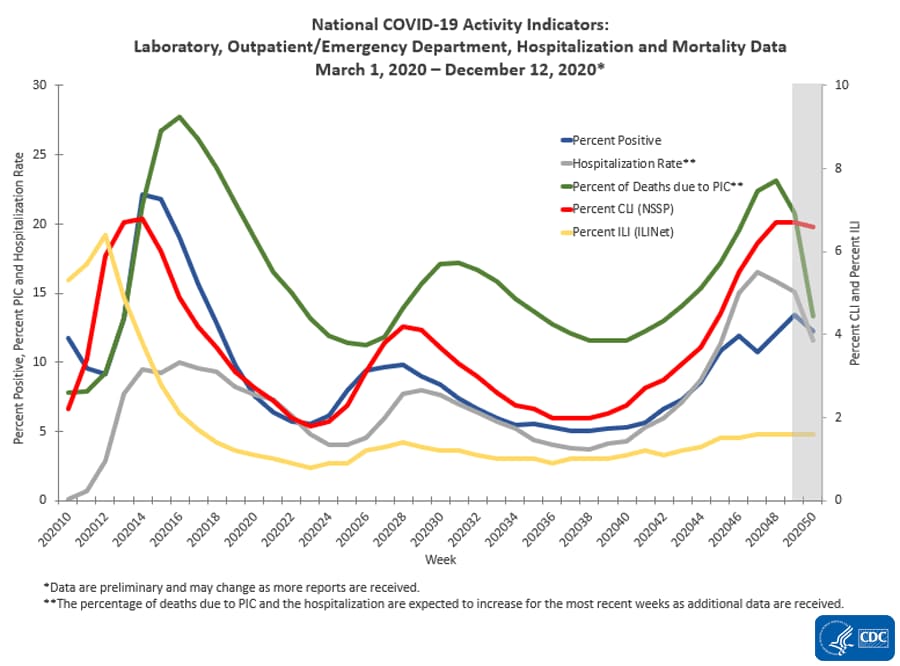
source: https://www.cdc.gov/coronavirus/2019-ncov/covid-data/covidview/index.html
The Impact of Holidays
The 4 day Thanksgiving holiday period put a wobble in the trends. Over weekends and holidays, the number of new cases and deaths decline. Over weekends, this is not a problem for week-over-week rolling averages as weekends are compared against the previous weekend. But when a holiday falls within a working week, a non-working day is compared to a working day which causes havok in the trends. However, hospitalizations historically appear to be little affected by weekends or holidays – the daily counts do not vary significantly from day-to-day.
The hospitalization growth rate trend is growing at an ever slowing growth rate which is all good news as it means the number of beds needed is currently growing around 5 % every week.

The above graph demonstrates in the last week hospitalization rate of growth has been relatively steady. We are now seeing the size of the impact of commingling and travel over the Thanksgiving holiday period – roughly, it seems to have added around 5 % to the rate of growth of new cases, hospitalizations, and deaths.
Historically, hospitalization growth follows new case growth by one to two weeks.
As an analyst, I use the rate of growth to determine the trend. But, the size of the pandemic is growing in terms of real numbers – and if the rate of growth does not become negative – the pandemic will overwhelm all resources.
The graph below shows the rate of growth relative to the growth a week earlier updated through today [note that negative numbers mean the rolling averages are LOWER than the rolling averages one week ago]. As one can see, the rate of growth for new cases peaked over one month ago and the rate of growth has been decelerating.

This graph is currently demonstrating that the actions to contain the pandemic are slightly working – but the rate of growth improvement is too slow as we are still seeing record numbers. In the scheme of things, new cases decline first, followed by hospitalizations, and then deaths.
It is up to each of our readers to protect themselves and others by washing your hands, wearing a mask, avoiding crowds, and maintaining social distancing.
Coronavirus News You May Have Missed
Merck is in a supply deal with the U.S. government for its Covid treatment – CDC
- Merck will supply about 60,000 to 100,000 doses of its Covid-19 treatment to the U.S. government for up to about $356 million.
- The agreement will help support advanced development and large-scale manufacturing of Merck’s investigational therapeutic MK-7110 to treat hospitalized patients with severe or critical Covid-19.
- In November, Merck agreed to acquire OncoImmune in a $425 million deal that gave it control of the drug.
Vaccines and strong economy could mean inflation in 2021 – Axios
With nearly $3 trillion in lending from the Fed this year, and Congress approving $900 billion in debt-financed spending on top of the $3.1 trillion budget deficit in fiscal year 2020, inflation hawks are sounding the alarm.
Why it matters: “Inflation staying low and well-behaved is the foundation on which everything in markets is currently priced,” Karen Ward, chief market strategist for Europe at JPMorgan Asset Management, told FT.
- “Investors’ assumption is that central banks will be able to stay accommodative well into the economic recovery. If inflation picks up in a way that’s not expected, that would challenge the market’s entire view.”
The big picture: Most major asset managers are predicting a significant return to growth for the U.S. economy next year, but some worry the release of pent-up demand – as mass vaccinations end the coronavirus pandemic’s depressing hold on prices – will lead to a return of inflation.
What’s happening: Indicators already have been perking up, with inflation in “pandemic products” spiking (world food prices rose at the fastest rate in six years last month), even as official metrics like consumer price indexes have shown no reason for worry.
Study Suggests Link Between Sleep Supplement and COVID-19 – Biospace
A study published in the journal Cell Discovery back in March initially suggested that melatonin – and repurposing existing medicines in general – may be the key to regulating COVID-19 within the body. Now, one of the study’s authors has found that other researchers around the globe have come up with similar theories, according to The Atlantic.
Feixiong Cheng, who published the initial research at the beginning of the outbreak, heard from other scientists that there might be something to his hunch. They all noted that, in addition to melatonin’s effects on sleep, it plays a critical role in calibrating the immune system. Its role as a moderator may lead to it one day protecting the body from going haywire when exposed to disease.
A study published as recently as November took a closer look at the theory. People who took melatonin seemed to have significantly lower odds of developing COVID-19, and other researchers started to notice a pattern. At the moment, eight clinical trials are currently being carried out to determine if the link between melatonin and the novel coronavirus is legitimate.
If it turns out that melatonin is beneficial, it would already be widely available in the U.S. as an over-the-counter dietary supplement, and people could begin taking it as soon as possible. However, Cheng does not recommend this route, acknowledging that this could simply be a spurious correlation.
Is Covid a High Risk to Younger Adults? – Wall Street Window
Jeremy Samuel Faust, Harlan Krumholz, and Rochelle Walensky’s New York Times op-ed “People Thought Covid-19 Was Relatively Harmless for Younger Adults. They Were Wrong.” (Dec. 16) is a prime example of how to convey a false impression by painting an incomplete picture.
Here’s the authors’ core claim: “Young adults are dying at historic rates. In research published on Wednesday in the Journal of the American Medical Association, we found that among U.S. adults ages 25 to 44, from March through the end of July, there were almost 12,000 more deaths than were expected based on historical norms” – a fact that, the authors imply, is sufficient to reject the belief that Covid poses no great risk to young adults. But closer examination advises against any such rejection.
First, in their op-ed the authors neglect a key fact revealed in their academic paper – namely (and quoting from that paper) “Only 38% of all-cause excess deaths in adults aged 25 to 44 years recorded during the pandemic were attributed directly to COVID-19.”
This fact means that of the 12,000 excess deaths mentioned in the op-ed, only 4,560 can be said to have been caused by Covid. And so of all the young adults who, statistically, were otherwise expected to die from March through July (64,167), the number killed by Covid was only 7.1 percent.
Second and more importantly, the total population of Americans ages 25-44 is 87.58 million. Thus, the 4,560 young adults who the authors identify as having been killed by Covid is a mere 0.0052 percent of this number. Even if we annualize these Covid deaths, the resulting figure of 10,944 is only 0.0125 percent of the total number of Americans ages 25-44. None of this is reported in the op-ed.
Bottom line: Covid-19 is indeed relatively harmless for younger adults.
Shorter quarantines could actually help prevent COVID-19 outbreaks – National Geographic
While caution is wise, researchers are now wondering if such lengthy measures are necessary and are uncovering shorter alternatives that retain public safety. Quarantines are costly, straining the mental health and finances of those in isolation, as well as the resources of governments and companies implementing these precautions. Shorter quarantines could ease that burden, but this pivot will also require better logistics such as spaces where people can quarantine, access to fast testing, and support for meals and other necessities like medicine. Making these investments could potentially increase people’s compliance with voluntary guidelines.
This push for shorter quarantines is supported by academic reports that show that people with coronavirus don’t appear to be contagious after nine or 10 days. In addition, new research shows that shorter quarantines combined with smarter testing strategies can actually do more than 14-day quarantines to reduce the risk of COVID-19 transmission.
These new studies explain why, on December 2, the U.S. Centers for Disease Control and Prevention announced two new options for quarantining. The CDC still recommends 14 days when possible, but if a person still has no symptoms and tests negative on day five or later after potential exposure, they can end their self-imposed quarantine after a week. Alternatively, if a person lacks access to testing, they can exit quarantine after 10 symptom-free days.
… Aside from shaving a few days off confinement, reducing the length of quarantines may help prevent coronavirus clusters before they happen. Recently, researchers at the Yale School of Public Health, led by biostatistician Jeff Townsend, developed mathematical models showing just that. They found that strategically combining COVID-19 testing with a shortened quarantine can ease the burden for people who have potentially been exposed.
A quarantine is only successful if it catches positive cases during the period when they’re most infectious. Yale’s work relied on new data about the incubation period of SARS-CoV-2, or how long people take to develop symptoms after being infected. It also looked at what researchers have learned this year about how the ability to transmit the virus to others changes over the course of the illness and how that compares with the viral load, the amount of detectable germ inside a person’s body.
[editor’s note: there are points made in this post which I have not covered – it is worth a full read]
US hospitals facing worrisome shortage of nurses, doctors – AP
With so many states seeing a flood of coronavirus patients, U.S. hospitals are again worried about finding enough medical workers to meet demand just as infections from the holiday season threaten to add to the burden on American health care.
California, which is enduring by far its worst spike in cases and hospitalizations, is reaching out to places like Australia and Taiwan to fill the need for 3,000 temporary medical workers, particularly nurses trained in critical care.
“We’re now in a situation where we have surges all across the country, so nobody has many nurses to spare,” said Dr. Janet Coffman, a professor of public policy at the University of California in San Francisco.
Hospitals in some states have enlisted retired nurses and students. In Alabama, more than 120 students and faculty members from the University of Alabama at Birmingham’s nursing school began helping with care last week at UAB Hospital.
“I know our biggest concern is staff, even more concerned about that than physical beds and physical ICU units,” North Carolina Gov. Roy Cooper said Tuesday.
Assessment of air contamination by SARS-CoV-2 in hospital settings – EurekAlert
In this systematic review of current evidence on air contamination with SARS-CoV-2 in hospital settings, the air close to and distant from patients with COVID-19 was frequently contaminated with SARS-CoV-2 RNA; however, few of these samples contained viable viruses. High viral loads found in toilets and bathrooms, staff areas, and public hallways suggest that these areas should be carefully considered.
Second COVID Mutation, From South Africa, in U.K.: ‘Even More Transmissible’ Than First – Newsweek
A second coronavirus mutation discovered in the United Kingdom is “even more transmissible” than the first, according to U.K. Health Secretary Matt Hancock.
The new mutation was first revealed during a press conference on Wednesday. Hancock noted that the new strain was detected in the U.K. but originated in South Africa.
“We’ve detected two cases of another new variant of coronavirus here in the U.K. Both are contacts of cases who traveled from South Africa over the past few weeks,” Hancock said during the press conference. “This new variant is highly concerning because it is yet more transmissible and it appears to have mutated further than the new variant that has been discovered in the U.K.”
“We’ve currently identified over 1,000 cases with this variant predominantly in the south of England, although cases have been identified in nearly 60 different local authority areas,” Hancock said at a press conference last week. “We do not know the extent to which this is because of the new variant, but no matter its cause, we have to take swift and decisive action which unfortunately is absolutely essential to control this deadly disease while the vaccine is rolled out.”
Drugmakers Rush to Test Whether Vaccines Stop Coronavirus Variant – Medscape
Drug makers including BioNTech and Moderna are scrambling to test their COVID-19 vaccines against the new fast-spreading variant of the virus that is raging in Britain, the latest challenge in the breakneck race to curb the pandemic.
Ugur Sahin, chief executive of Germany’s BioNTech which with partner Pfizer took less than a year to get a vaccine approved, said on Tuesday he needs another two weeks to know if his shot can stop the mutant variant of the virus.
Moderna expects immunity from its vaccine to protect against the variant and is performing more tests in coming weeks to confirm, the company said in a statement to CNN. Moderna did not immediately respond to Reuters’ requests for comment.
The mutation known as the B.1.1.7 lineage may be up to 70% more infectious and more of a concern for children. It has sown chaos in Britain, prompting a wave of travel bans that are disrupting trade with Europe and threatening to further isolate the island country.
Sahin said there are nine mutations on the virus.
While he does not believe any are significant enough to skirt the protection afforded by BioNTech’s mRNA vaccine, which was approved by the European Union on Monday, he said another 14 days or so of study and data collection are needed before offering a definitive answer.
Even as infections rise, antibody drugs are going unused. – New York Times
When federal regulators approved two antibody treatments last month for emergency use in high-risk Covid-19 patients, doctors worried there would not be enough to go around.
President Trump had taken one of the treatments, made by Regeneron, in October and promoted it as a “cure.” Early trial data had shown the treatments could keep people at risk of severe disease out of the hospital if administered soon after infection with the coronavirus.
But in a surprising turn of events, the treatments are sitting unused in hospital refrigerators around the country, just when they might do the most to help patients and relieve the burden on overwhelmed hospitals as cases and deaths surge to record levels.
The federal government has on hand nearly 532,000 doses of the two drugs, and 55 percent of that has been shipped out, according to the Department of Health and Human Services. But early data collected from hospitals by the federal government suggest that they have given only about 20 percent of their supply to patients.
Hospitals and clinics, staggered by the needs of the sick and gearing up to help administer the new coronavirus vaccines, have not focused as much attention on these treatments, which have to be infused into patients in a narrow window of time, within 10 days of when they start showing symptoms, but before they’re sick enough to be hospitalized. Administrators have struggled to identify people who should get the antibody drugs because of delays in testing and a lack of coordination between testing sites and hospitals.
Sorrento’s antibody injection and nose drops may be tools to fight Covid – CNBC
It won a $34 million contract from DARPA, co-funded by JPEO, to develop an intramuscular injection that delivers gene-encoded neutralizing antibodies against Covid and its variant strains. The company has initiated manufacturing of the neutralizing antibody STI-2020 in the protein form to produce 100,000 doses to be available next year, in the anticipation of an emergency use authorization from the FDA.
Sorrento also filed an investigational new drug application with the FDA for a Phase 1 clinical trial to test the safety and efficacy of COVI-DROPS, antibody nose drops it claims can boost Covid immunity.
COVI-DROPS has been studied in hamsters at the Animal Biosafety Lab at the University of Texas Medical Branch. According to scientific director of the lab, Dr. Slobodan Paessler, “the drops when administered to hamsters infected with Covid-19 prevented tissue damage and disease. It’s an exciting discovery and Sorrento has a good right to be hopeful.”
The following are foreign headlines with hyperlinks to the posts
Antarctica now has dozens of cases
The U.S. government won’t require negative COVID-19 tests for passengers coming in from Britain, despite the emergence of a new virus strain that is reportedly much more transmissible.
The Georgia college student who received a 4-month prison sentence for breaking quarantine rules in the Cayman Islands had her sentence cut in half following an appeal.
U.K.-France Border Reopens Amid Spread Of New Coronavirus Strain
Anger at U.K. Border As Truck Drivers Need COVID Tests to Re-Enter France
Italian nursing home sets up ‘hug room’ amid pandemic
Israel finds four cases of COVID-19 mutation
Canada authorizes Moderna COVID-19 vaccine
Record COVID-19 deaths reported in Germany
Africa Needs About $9Bln for COVID Vaccines, Access Big Problem
Indian airports are struggling with the ban on flights from Britain.
Argentina approves Russia’s Sputnik COVID-19 vaccine
Lufthansa airlifts fresh food to England as UK border chaos continues
Every country has vaccine skeptics. In Russia, doctors are in their ranks
The following additional national and state headlines with hyperlinks to the posts
Trump demands $2,000 stimulus checks; calls long awaited coronavirus relief bill a ‘disgrace’
Pfizer and BioNTech will supply the U.S. with an additional 100 million doses of their COVID-19 vaccine under a second agreement.
U.S. Aiming for All Americans to Get Vaccine By June With New Pfizer Order
These U.S. real estate markets are poised for a post-pandemic boom
Veterans homes barred mask-wearing as COVID spread
A COVID-19 vaccine is ‘boon’ to cruise industry
The San Joaquin Valley in California has become a coronavirus hotspot and an epicenter of denial
The COVID-19 pandemic overwhelmed funeral home owner Andrew Cleckley, eventually causing him to lose his funeral director’s license because bodies of the deceased were not properly stored or cared for.
New York state saw nation’s biggest population decline in last year
Latest Rise in Child COVID-19 Cases Is Relatively Small
Calif. Nurses Strike Over Unsafe Staffing as COVID Hospitalizations Surge
Suicide Rate Dropped To Lowest Level Since 1999 Last Year
Isolation appears to have helped homeless populations avoid the worst of the pandemic.
Salt Lake City says it will reopen schools, which had been all-remote, once teachers are vaccinated.
Covid has taken a toll on young athletes – and their college prospects
The coronavirus pandemic is expected to cause a 15% decline in U.S. sales in 2020, which would mark one of the worst declines for the industry since 1980.
The U.S. now has access to two different Covid vaccines, but nearly 40% of Americans say they don’t want to get the shot
The U.S. has vaccinated just 1 million people out of a goal of 20 million for December
Louisiana Congressman-elect Luke Letlow moved to intensive care unit with COVID-19
The pandemic is forcing older workers to retire early
Today’s Posts On Econintersect Showing Impact Of The Pandemic With Hyperlinks
Final December 2020 Michigan Consumer Sentiment Declines
November 2020 Real Income and Expenditures Declined
Headline Durable Goods New Orders Improved Again In November 2020
19 December 2020 Initial Unemployment Claims Rolling Average Again Worsens
Infographic Of The Day: The Pandemic’s Impact On Festive Spending
Warning to Readers
The amount of politically biased articles on the internet continues to increase. And studies and opinions of the experts continue to contradict other studies and expert opinions. Honestly, it is difficult to believe anything anymore. A study usually cannot establish cause and effect – but only correlation. Be very careful what you believe about this pandemic.

I assemble this coronavirus update daily – sifting through the posts on the internet. I try to avoid politically slanted posts (mostly from CNN, New York Times, and the Washington Post) and can usually find unslanted posts on that subject from other sources on the internet. I wait to publish posts on subjects that I cannot validate across several sources. But after all this extra work, I do not know if I have conveyed the REAL facts. It is my job to provide information so that you have the facts necessary – and then it is up to readers to draw conclusions.
Analyst Opinion of Coronavirus Data
There are several takeaways that need to be understood when viewing coronavirus statistical data:
- The global counts are suspect for a variety of reasons including political. Even the U.S. count has issues as it is possible that as much as half the population has had coronavirus and was asymptomatic. It would be a far better metric using a random sampling of the population weekly. In short, we do not understand the size of the error in the tracking numbers.
- Just because some of the methodology used in aggregating the data in the U.S. is flawed – as long as the flaw is uniformly applied – you establish a baseline. This is why it is dangerous to compare two countries as they likely use different methodologies to determine who has (and who died) from coronavirus.
- COVID-19 and the flu are different but can have similar symptoms. For sure, COVID-19 so far is much more deadly than the flu. [click here to compare symptoms]
- From an industrial engineering point of view, one can argue that it is best to flatten the curve only to the point that the health care system is barely able to cope. This solution only works if-and-only-if one can catch this coronavirus once and develops immunity. In the case of COVID-19, herd immunity may need to be in the 80% to 85% range. WHO warns that few have developed antibodies to COVID-19 when recovering from COVID-19. Herd immunity does not look like an option without immunization although there is now a discussion of whether T-Cells play a part in immunity [which means one might have immunity without antibodies]
- Older population countries will have a significantly higher death rate as there is relatively few hospitalizations and deaths in younger age groups..
- There are at least 8 strains of the coronavirus. New York may have a deadlier strain imported from Europe, compared to less deadly viruses elsewhere in the United States.
- Each publication uses different cutoff times for its coronavirus statistics. Our data uses 11:00 am London time. Also, there is an unexplained variation in the total numbers both globally and in the U.S.
What we do or do not know about the coronavirus [actually there is little scientifically proven information]. Most of our knowledge is anecdotal, from studies with limited subjects, or from studies without peer review.
- How many people have been infected as many do not show symptoms?
- Masks do work.
- Do we develop lasting immunity to the coronavirus? Another coronavirus – the simple cold – does not develop long term immunity.
- To what degree do people who never develop symptoms contribute to transmission? Research early in the pandemic suggested that the rate of asymptomatic infections could be as high as 81%. But a meta-analysis, which included 13 studies involving 21,708 people, calculated the rate of asymptomatic presentation to be 17%.
- The accuracy of rapid testing is questioned – and the more accurate test results are not being given in a timely manner.
- Can children widely spread coronavirus? [current thinking is that they are a minor source of the pandemic spread]
- Why have some places avoided big coronavirus outbreaks – and others hit hard?
- Air conditioning contributes to the pandemic spread.
- It appears that there is increased risk of infection and mortality for those living in larger occupancy households.
- Male patients have almost three times the odds of requiring intensive treatment unit (ITU) admission compared to females.
- Outdoor activities seem to be a lower risk than indoor activities.
- Will other medical treatments for Covid-19 ease symptoms and reduce deaths? So far only remdesivir, Bamlanivimab,
and Regeneron) are approved for treatment. What drugs work?
- A current scientific understanding of the way the coronavirus works can be found [here].
There is now a vaccine available – the questions remain:
- how effective it will be in the general population,
- will there be any permanent side effects that will appear months from now,
- how long immunity will last [we can currently say we do not know if it will last more than 4 months],
- there is no evidence the vaccine will block transmission
Heavy breakouts of coronavirus have hit farmworkers. Farmworkers are essential to the food supply. They cannot shelter at home. Consider:
- they have high rates of respiratory disease [occupational hazard]
- they travel on crowded buses chartered by their employers
- few have health insurance
- they cannot social distance and live two to four to a room – and they eat together
- some reports say half are undocumented
- they are low paid and cannot afford not to work – so they will go to work sick
- they do not have access to sanitation when working
- a coronavirus outbreak among farmworkers can potentially shutter entire farm
The bottom line is that COVID-19 so far has been shown to be much more deadly than the data on the flu. Using CDC data, the flu has a mortality rate between 0.06 % and 0.11 % Vs. the coronavirus which to date has a mortality rate of 4 % [the 4% is the average of overall statistics – however in the last few months it has been hovering around 1.0%] – which makes it between 10 and 80 times more deadly. The reason for ranges:
Because influenza surveillance does not capture all cases of flu that occur in the U.S., CDC provides these estimated ranges to better reflect the larger burden of influenza.
There will be a commission set up after this pandemic ends to find fault [it is easy to find fault when a once-in-a-lifetime event occurs] and to produce recommendations for the next time a pandemic happens. Those that hate President Trump will conclude the virus is his fault.
Resources:
- Get the latest public health information from CDC: https://www.coronavirus.gov .
- Get the latest research from NIH: https://www.nih.gov/coronavirus.
- Find NCBI SARS-CoV-2 literature, sequence, and clinical content: https://www.ncbi.nlm.nih.gov/sars-cov-2/.
- List of studies: https://icite.od.nih.gov/covid19/search/#search:searchId=5ee124ed70bb967c49672dad
include(“/home/aleta/public_html/files/ad_openx.htm”); ?>


