


Written by Steven Hansen
The U.S. new cases 7-day rolling average is 7.1 % HIGHER than the 7-day rolling average one week ago. U.S. deaths due to coronavirus are now 7.4 % HIGHER than the rolling average one week ago. U.S. hospitalizations due to COVID-19 are now 6.1 % HIGHER than the rolling average one week ago. Today’s posts include:
- U.S. Coronavirus New Cases are at an elevated 193,454
- U.S. Coronavirus deaths are at 1,311
- U.S. Coronavirus hospitalizations are at a record 110,549
- The 7-day rolling average rate of growth of the pandemic shows new cases improved, hospitalizations marginally improved, and deaths improved
- Effectiveness and safety of Moderna COVID-19 vaccine confirmed, path cleared for expected authorization this week
- FDA says fatigue, headaches and muscle pain are most common side effects of Moderna’s Covid vaccine
- Infectious Diseases Expert Questions COVID Spread Link to Outdoor Dining
- FDA Approves Over-the-Counter COVID-19 Test for Emergency Use
- Understanding Messenger RNA and Other SARS-CoV-2 Vaccines
- Early data suggest wearables can catch some cases of Covid-19 before symptoms emerge
- Americans Are Growing Less Reluctant To Take COVID-19 Vaccine
- Some European Countries Batten Down For The Holidays With New Coronavirus Lockdowns
- The Pandemic’s Toll on the U.S. Restaurant Industry

The recent worsening of the trendlines for new cases should be attributed to going back to college/university, cooler weather causing more indoor activities, possible mutation of the virus, fatigue from wearing masks / social distancing, holiday activities, political rallies / voting, and continued loosening of regulations designed to slow the coronavirus spread.
My continuing advice is to continue to wash your hands (especially after using the toilet as COVID first sheds in your stool), putting down the toilet seat (as flushing the toilet releases a plume), wear masks, avoid crowds, and maintain social distancing. No handwashing, mask, or social distancing will guarantee you do not get infected – but it sure as hell lowers the risk in all situations – and the evidence to-date shows a lower severity of COVID-19. In addition, certain activities are believed to carry higher risk – like being inside in air conditioning and removing your mask (such as restaurants, around your children/grandchildren, bars, and gyms). It is all about viral load – and outdoor activities are generally safe if you can maintain social distance.
include($_SERVER[‘DOCUMENT_ROOT’].’/pages/coronavirus1.htm’); ?>
Hospitalizations (grey line) and Mortality (green line)
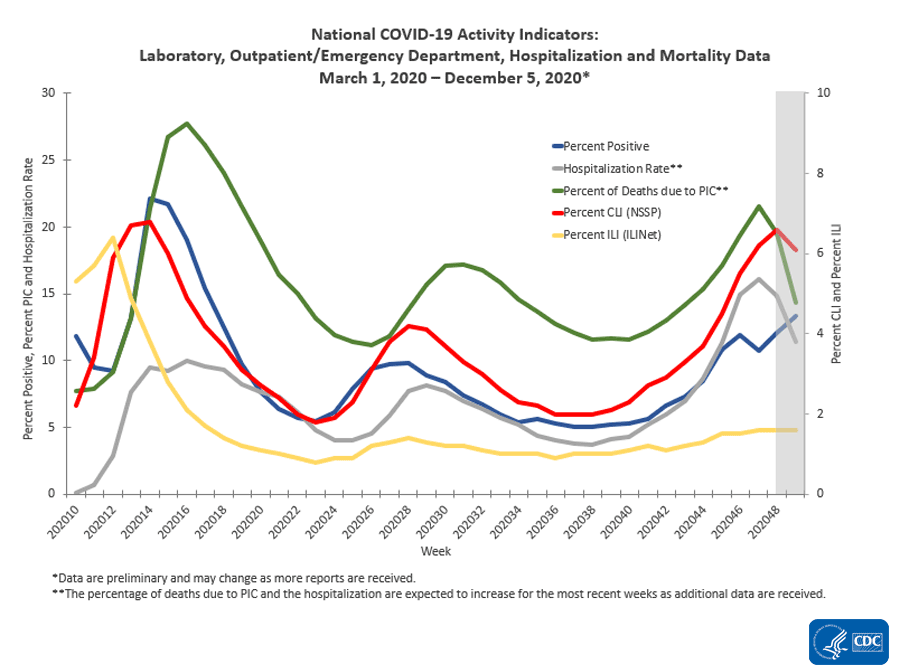
source: https://www.cdc.gov/coronavirus/2019-ncov/covid-data/covidview/index.html
The Impact of Holidays
The 4 day Thanksgiving holiday period put a wobble in the trends. Over weekends and holidays, the number of new cases and deaths decline. Over weekends, this is not a problem for week-over-week rolling averages as weekends are compared against the previous weekend. But when a holiday falls within a working week, a non-working day is compared to a working day which causes havok in the trends. However, hospitalizations historically appear to be little affected by weekends or holidays – the daily counts do not vary significantly from day-to-day [although they are now in record territory and the raw numbers grow every day].
The hospitalization growth rate continues to grow at an ever slowing growth rate which is not good news as it means the number of beds needed is currently growing around 6 % every week.

The above graph demonstrates in the last week hospitalization rate of growth has been steady. We are now seeing the size of the impact of commingling and travel over the Thanksgiving holiday period – roughly, it seems to have added around 5% to the rate of growth of new cases, hospitalizations, and deaths. Historically, hospitalization growth follows new case growth by one to two weeks.
As an analyst, I use the rate of growth to determine the trend. But, the size of the pandemic is growing in terms of real numbers – and if the rate of growth does not become negative – the pandemic will overwhelm all resources.
The graph below shows the rate of growth relative to the growth a week earlier updated through today [note that negative numbers mean the rolling averages are LOWER than the rolling averages one week ago]. As one can see, the rate of growth for new cases peaked over one month ago and the rate of growth has been decelerating.

This graph is currently demonstrating that the actions to contain the pandemic are working – but the rate of growth improvement is too slow as we are still seeing record numbers. In the scheme of things, new cases decline first, followed by hospitalizations, and then deaths.
It is up to each of our readers to protect themselves and others by washing your hands, wearing a mask, avoiding crowds, and maintaining social distancing.
Coronavirus News You May Have Missed
Vaccine maker Moderna is poised to win authorization for its COVID-19 vaccine days after Pfizer-BioNTech did the same.
Data released Tuesday by the U.S. Food and Drug Administration confirmed that Moderna’s vaccine appeared safe and highly effective in a study of more than 30,000 volunteers.
Unlike Pfizer-BioNTech’s vaccine, Moderna’s will be given only to adults. The company has begun testing in teenagers but has not accumulated enough data to include in its authorization request to the FDA.
An independent advisory committee to the FDA will review the data in an all-day meeting Thursday. If the Vaccines and Related Biological Products Advisory Committee decides that the vaccine’s benefits outweigh its risks, the vaccine is likely to be authorized this week by the FDA commissioner.
An independent advisory committee to the U.S. Centers for Disease Control and Prevention will review the data this weekend and will vote on whether to add the vaccine to the nation’s vaccine schedule for adults.
Then, as with Pfizer-BioNTech’s vaccine, it will be distributed across the country, probably starting Monday.
… Both rely on a technology called mRNA to make a bit of protein from the virus that causes COVID-19, training the immune system to attack it.
Moderna’s vaccine, called mRNA-1273, was shown to be 94% effective overall, with no major differences by age, race, gender, previous infection with COVID-19 or other medical problems.
The vaccine will cause temporary side effects in most people a day or two after the shot, the data confirms.
[editor’s note: also read Operation Warp Speed is set to distribute 6 million doses of Moderna’s similar product if, as expected, it’s authorized following a Thursday FDA advisory committee meeting.0
Early data suggest wearables can catch some cases of Covid-19 before symptoms emerge – STAT
The results of several ambitious studies testing wearables as early predictors of for Covid-19 are in — and they suggest that data from devices including Apple Watches, Fitbits, and Oura smart rings may be useful for flagging some infections in people before they even feel ill.
Recently published research from ongoing efforts at three high-profile institutions in the Golden State — the University of California in San Francisco, Stanford University, and Scripps Research Translational Institute in San Diego — indicate that wearables can detect a bump in heart rate or temperature, the most consistent signs that the body is mounting a response to an external threat before symptoms appear. Feeding those data to algorithms that crunch large amounts of information provides a sort of traffic map for the spread of the virus — and could prove a useful tool in the pandemic response in the months to come.
While the Scripps and Stanford studies are device-agnostic — they accept data from people with Apple Watches, Fitbits, and Garmins — the UCSF study is a partnership with smart ring maker Oura and analyzes data from those devices only.
Oura’s findings, published Monday in Scientific Reports, showed that temperature data from its rings could be used to foreshadow coronavirus infections in 76% of participants with the virus roughly three days before they felt sick. The study, conducted in collaboration with UCSF, enrolled 65,000 people over five months and involved analyzing data from 50 people who said they had Covid-19.
For Stanford’s study, published in November in Nature Biomedical Engineering, researchers used deviations in people’s resting heart rate to accurately identify roughly 2 out of every 3 people with Covid-19 four to seven days before they felt symptoms. The study recruited more than 5,000 people and examined data from 32 people who reported a confirmed Covid-19 diagnosis.
The findings were similar to those from Scripps, which in October published a study in Nature Medicine with close to 31,000 participants — of whom 54 reported testing positive — showing that by pairing wearable data including sleep and activity levels, heart rate, and temperature with self-reported symptoms, researchers could predict Covid-19 with about 80% accuracy, a significantly better result than if they had tracked people’s symptoms alone.
Post-Vax Symptoms or COVID-19 Illness? – MedPage
Distinguishing between systemic signs of COVID-19 vaccination and symptoms of coronavirus infection in healthcare professionals receiving the newly authorized vaccine will depend on many factors, including type of symptoms and clinical judgment, according to the CDC.
On a call with clinicians Monday, the latter were advised to pay more attention to those that were not reported as post-vaccination symptoms in clinical trials, but instead are linked with COVID-19 infection itself: cough, sore throat, shortness of breath, rhinorrhea, and loss of taste or smell.
However, when it comes to symptoms such as fever, fatigue, headache, chills, myalgia and arthralgia, healthcare professionals (HCPs) must rely on their clinical skills and judgments about factors such as virus exposure and symptom duration and severity.
Importantly, David Kuhar, MD, of the CDC’s COVID-19 Response Healthcare Infection Control Team, noted that COVID-19 vaccination does not influence the results of viral (nucleic acid or antigen) tests for SARS-CoV-2, meaning positive viral tests should not be attributed to the vaccine.
Clinical judgment will be critical in determining COVID-19 symptoms versus post-vaccination symptoms, beginning with whether the healthcare provider had “unprotected exposure to SARS-CoV-2 in the previous 14 days,” Kuhar said. He also emphasized that in clinical trials, symptoms were likely to resolve within 3 days of vaccination and within 1-2 days of onset, so any symptoms past that timeframe, or worsening symptoms, are more suggestive of COVID.
If a healthcare worker presents with systemic symptoms that could be either post-vaccination or infection, Kuhar said healthcare professionals may return to work if they are afebrile, feeling well enough and willing to come into work, and their symptoms are only limited to those observed following vaccination.
Americans Are Growing Less Reluctant To Take COVID-19 Vaccine – NPR
Now that federal regulators have authorized one COVID-19 vaccine for emergency use in the U.S. — and appear close to authorizing another — it seems Americans are growing less reluctant about receiving an inoculation themselves. The Kaiser Family Foundation, or KFF, released a poll Tuesday showing a significant leap in the number of people saying they definitely or probably would get vaccinated.
About 71% of respondents to the late November and early December survey said they would get a vaccine, up from 63% in an August/September poll. KFF says the increase was evident across all racial and ethnic groups surveyed, as well as both Democrats and Republicans.
Of course, since the previous poll, there have been important advances in the development of a vaccine for COVID-19, which has cost more than 300,000 lives in the U.S.
FDA Approves Over-the-Counter COVID-19 Test for Emergency Use – Newsweek
Officials at the U.S. Food and Drug Administration (FDA) formally authorized an over-the-counter, at-home coronavirus test for emergency use on Tuesday.
Developed by health care manufacturing company Ellume, the newly approved diagnostic assessment is the first of its kind to receive FDA clearance. Its authorization marks an important development for coronavirus testing procedures as the country continues to grapple with increasing transmission rates, surging hospitalization numbers and record fatalities as a result of the pandemic.
“Today’s authorization is a major milestone in diagnostic testing for COVID-19,” said Stephen Hahn, the FDA’s commissioner, in a statement released alongside the agency’s Tuesday announcement. “By authorizing a test for over-the-counter use, the FDA allows it to be sold in places like drugstores, where a patient can buy it, swab their nose, run the test and find out their results in as little as 20 minutes.”
… Ellume’s test offers a simpler, and faster, process for individuals to determine whether they are carrying the novel virus. It will allow users to collect their own nasal swab samples and subsequently screen them for proteins, called antigens, that signal an active coronavirus infection. The home-screening device is paired with a smartphone application that can provide results in roughly 20 minutes.
According to the FDA, Ellume’s test kit proved highly accurate during clinical trials that preceded its approval for emergency use, accurately diagnosing 96 percent of positive specimens and 100 percent of negative specimens collected from symptomatic individuals. Accuracy figures for asymptomatic groups were slightly lower, with the home assessment correctly identifying 91 percent of positive cases and 96 percent of negative ones, the FDA said.
FDA says fatigue, headaches and muscle pain are most common side effects of Moderna’s Covid vaccine – CNBC
Fatigue, headaches and muscle pain are the most common side effects from Moderna’s Covid-19 vaccine, along with some rare symptoms like intractable nausea or vomiting and facial swelling that are likely triggered by the shots, according to new data released Tuesday by the Food and Drug Administration.
On a positive note, the data shows the shots were generally better tolerated by people over 64 who are also among the most vulnerable to the disease than for younger people.
Side effects to vaccines are common. It’s actually an immune response that indicates the shots are working as intended, doctors say. Many physicians are advising the public to brace for some stronger-than-usual side effects from the Covid-19 shots than, say, a typical flu shot, and to possibly take a day or two off work to recover.
More than 9 out of 10 participants who received the vaccine felt pain at the injection site, almost 7 out of 10 felt fatigued and roughly 6 out of 10 had headaches or muscle pain, the FDA said.
More than 44% of people who received the vaccine reported experiencing joint pain and over 43% reported chills. The FDA noted that more severe “serious adverse reactions occurred in 0.2% to 9.7% of participants” and were more common after the second dose than the first. Like Pfizer’s Covid-19 vaccine, which the FDA authorized last week, Moderna’s vaccine similarly requires two shots separated by a few weeks.
Nearly 15% of vaccine participants got a fever after either the first or second dose, according to the FDA.
Some side effects were hard to shake, though most resolved within a week, the FDA said. Fewer than 6%, reported symptoms that persisted for at least a week after getting the shot, but that was similar to the placebo group. Some of the trial participants had a fever that lasted more than a week; seven were in the vaccine group and four got the placebo, the FDA noted.
The FDA said there were seven “serious adverse events” in the trial, but none of them were fatal. Four were attributed to the vaccine by trial investigators and Moderna, including intractable nausea and vomiting, facial swelling and rheumatoid arthritis.
The FDA noted that serious reactions were less frequent in people older than 64 compared with younger trial participants.
[editor’s note: U.S. Food and Drug Administration staff recommends monitoring people who get Moderna‘s Covid-19 vaccine for possible cases of Bell’s palsy, saying it’s not necessarily a side effect but worth monitoring after three trial participants who were vaccinated came down with the condition.]
Understanding Messenger RNA and Other SARS-CoV-2 Vaccines – Medscape
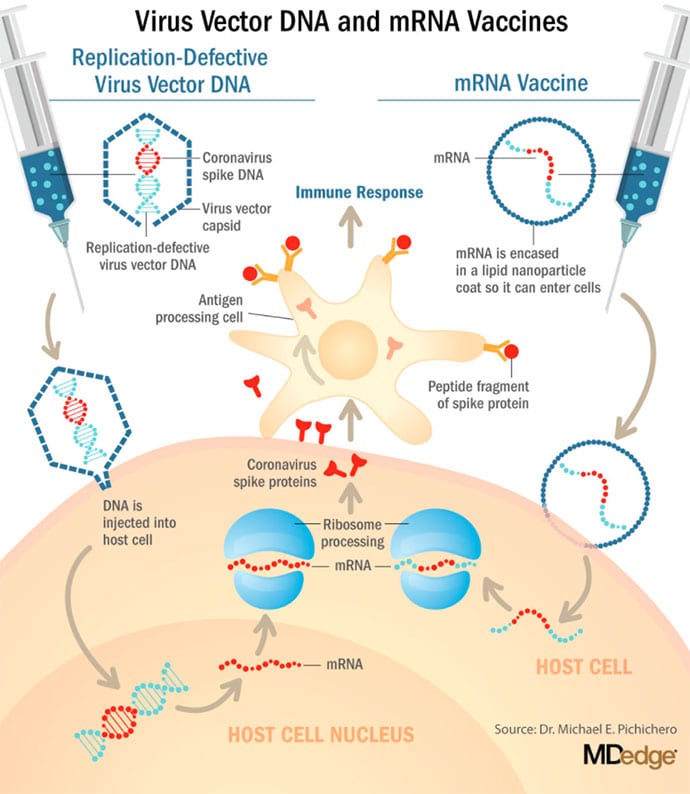
These are new and revolutionary vaccines, although the ability to inject mRNA into animals dates back to 1990, technological advances today make it a reality.1 Traditional vaccines typically involve injection with antigens such as purified proteins or polysaccharides or inactivated/attenuated viruses. mRNA vaccines work differently. They do not contain antigens. Instead, they contain a blueprint for the antigen in the form of genetic material, mRNA. In the case of Pfizer’s and Moderna’s vaccines, the mRNA provides the genetic information to synthesize the spike protein that the SARS-CoV-2 virus uses to attach to and infect human cells. Each type of vaccine is packaged in proprietary lipid nanoparticles to protect the mRNA from rapid degradation, and the nanoparticles serve as an adjuvant to attract immune cells to the site of injection. (The properties of the respective lipid nanoparticle packaging may be the factor that impacts storage requirements discussed below.) When injected into muscle (myocyte), the lipid nanoparticles containing the mRNA inside are taken into muscle cells, where the cytoplasmic ribosomes detect and decode the mRNA resulting in the production of the spike protein antigen. It should be noted that the mRNA does not enter the nucleus, where the genetic information (DNA) of a cell is located, and can’t be reproduced or integrated into the DNA. The antigen is exported to the myocyte cell surface where the immune system’s antigen presenting cells detect the protein, ingest it, and take it to regional lymph nodes where interactions with T cells and B cells results in antibodies, T cell-mediated immunity, and generation of immune memory T cells and B cells. A particular subset of T cells – cytotoxic or killer T cells – destroy cells that have been infected by a pathogen. The SARS-CoV-2 mRNA vaccine from Pfizer was reported to induce powerful cytotoxic T-cell responses. Results for Moderna’s vaccine had not been reported at the time this column was prepared, but I anticipate the same positive results.
[editor’s note; this is a good article to read in full to educate yourself on mRNA vaccines]
Some European Countries Batten Down For The Holidays With New Coronavirus Lockdowns – NPR
The holiday season is upon us, and usually that means packed shopping malls and kisses beneath the mistletoe, long-distance travel and big family festivities — just about everything, in other words, that could make an already dire pandemic even worse. So officials in multiple European countries, caught between a yule log and a hard place, are imposing a new wave of strict coronavirus lockdowns.
Leaders in Germany, the Netherlands and the Czech Republic have announced bans on large gatherings and the closure of nonessential businesses over the second half of December into January.
“We have no choice: The number of contacts between people must be reduced,” Dutch Prime Minister Mark Rutte said in a televised address to the country Monday evening. “Everything must now be focused on that.”
The Pandemic’s Toll on the U.S. Restaurant Industry – Statista
As the coronavirus rages on in the United States, forcing several states to close down businesses and public life once again, the National Restaurant Association rang the alarm bell last week. In a letter to Congressional leadership, the organization urged lawmakers to reach an agreement on a second coronavirus relief package and help protect the restaurant industry, which has been “in economic free fall” for nearly nine months now.
In the letter addressed to Nancy Pelosi, Mitch McConnell, Kevin McCarthy and Chuck Schumer, the National Restaurant Association cites the results of its latest survey of 6,000 restaurant operators, showing that 87 percent of full-service restaurants reported an average 36 percent drop in sales and that 10,000 restaurants have closed across the nation in the past three months alone.
“What these findings make clear is that more than 500,000 restaurants of every business type—franchise, chain, and independent—are in an economic free fall,” said Sean Kennedy, executive vice president for Public Affairs in the letter. “And for every month that passes without a solution from Congress, thousands more restaurants will close their doors for good.”
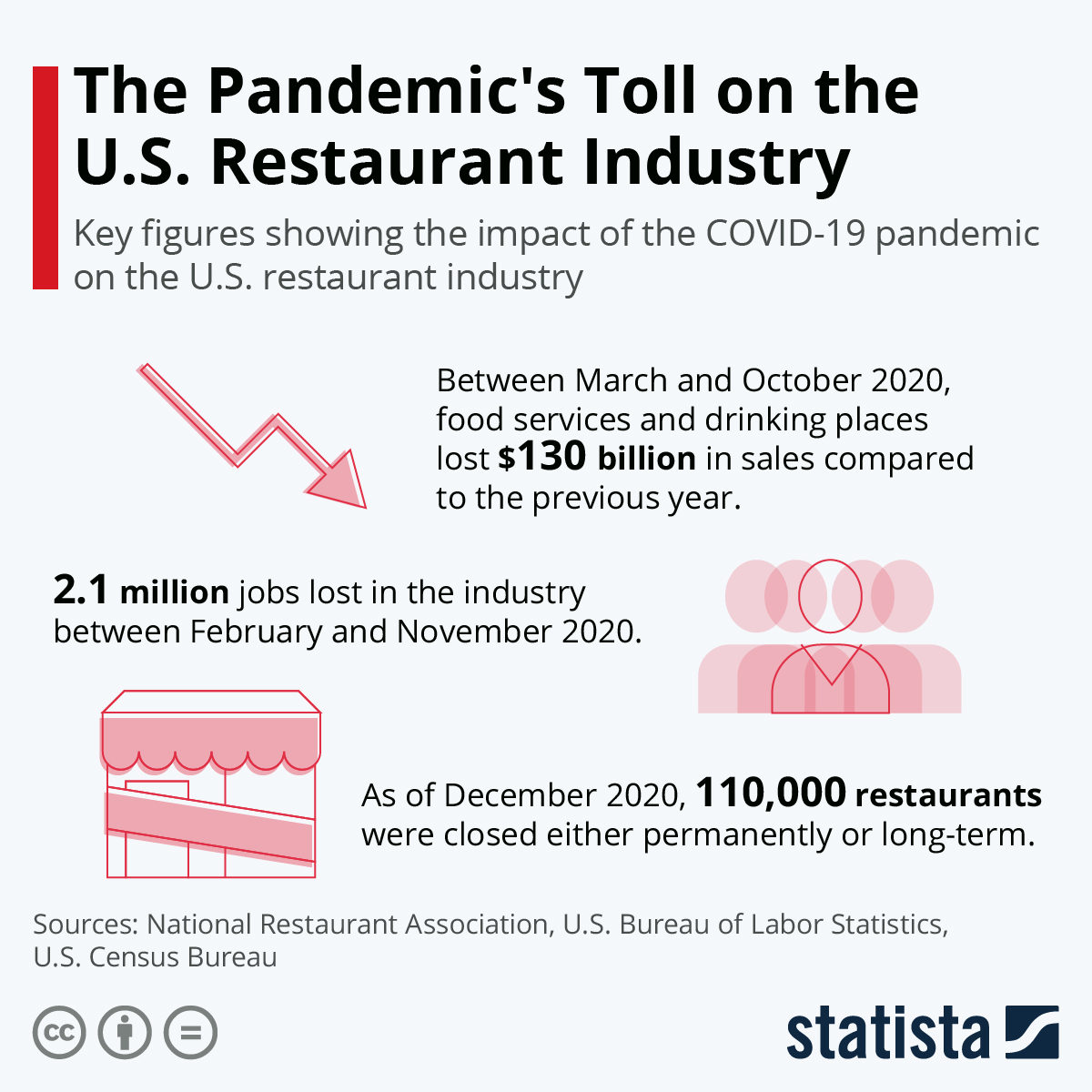
As the following chart shows, the food services industry has been hit incredibly hard by the pandemic, losing $130 billion in sales between March and October as a result of mandated closures and capacity limits. By the end of November, the industry had lost 2.1 million jobs compared to its pre-pandemic state and as of December, an estimated 110,000 restaurants were closed either permanently or long-term due to the crisis.
You will find more infographics at Statista
Infectious Diseases Expert Questions COVID Spread Link to Outdoor Dining – Newsweek
Rising coronavirus infections in California saw San Francisco and surrounding Bay Area counties impose strict new stay-at-home orders last week, which closed various businesses including outdoor dining facilities.
However, one San Francisco doctor noted the decision to shut outdoor dining venues may be questionable due to the lack of data linking outdoor dining with the spread of COVID-19 infection, San Francisco’s KRON-TV reported.
Dr. Monica Gandhi, an infectious diseases expert at the University of California, San Francisco (UCSF) told KRON there’s been no clear evidence linking outdoor dining to the spread of the virus. “There hasn’t been any data presented that if done right with ventilation, with masking, hand hygiene and distancing, smaller tables. Everything that people did and many restaurants did to keep it safe that restaurants became a root of spread.”
Gandhi highlighted a previous study done by the U.S. Centers for Disease Control and Prevention (CDC), which indicated eating at restaurants raised the risk of COVID-19 without differentiating between indoor and outdoor dining.
The following are foreign headlines with hyperlinks to the posts
It’s clear the pandemic has further exposed vast inequities that exist between countries and could now come at a punishing cost for people around the world. Some experts say the chances that vaccine shots will be shared fairly between rich nations and the rest are fading fast.
Britain’s Lockdown: London and its surrounding locales will be placed under the highest level of restrictions beginning Wednesday as infections rise rapidly in the capital.
UK reduces self-isolation period from 14 to 10 days
Britain’s health secretary said over 1,000 coronavirus cases in England have been linked to a new genetic variant in recent days, but said there’s no reason to think vaccines won’t be effective against it, and no evidence suggests it causes more severe disease.
Dutch Prime Minister Mark Rutte has imposed a tough new nationwide lockdown, saying schools, nonessential shops, museums and gyms will close until Jan. 19.
Germany’s health minister has further increased his pressure on the European Union’s regulatory agency and demanded that a coronavirus vaccine be approved before Christmas.
South African President Cyril Ramaphosa has announced the closure of many of the country’s beaches throughout the holiday season to fight a resurgence of cases.
Germany asks citizens to not to go Christmas shopping
The Dutch prime minister announced a strict national lockdown, closing schools, gyms, and other nonessential businesses until mid-January
Canada Administers Its 1st COVID-19 Vaccine Shots
COVID Vaccine Certificates Could be Issued to Inoculated Across Europe
Oliver Stone Has Russian COVID Vaccine, Asks Why It’s ‘Ignored’ in the West
Rep. Calvert says he tested positive for COVID-19
Russia says a trial of the Sputnik vaccine showed a 91.4 percent efficacy rate.
South Africa tightens restrictions; officials say student parties are fueling new cases.
Singapore announces plans to allow entry to business travelers from all countries
The following additional national and state headlines with hyperlinks to the posts
The vast majority of nursing homes in the U.S. won’t start vaccinating staff and residents against COVID-19 until Dec. 21, and some won’t start until Dec. 28
Hundreds more U.S. hospitals are also gearing up to vaccinate their workers, and federal health officials are reviewing a second vaccine. About 400 hospitals and other health care facilities will get their first shipments of the Pfizer vaccine today.
There is increased risk of infection and mortality for those living in larger occupancy households.
An increasing number of Americans said they’d definitely or probably get a COVID-19 vaccine if it were deemed safe by experts and made free for the public, a Kaiser Family Foundation poll found.
Last week marked the deadliest for the U.S. since the pandemic started, with over 17,000 fatalities attributed to COVID-19.
Crede Bailey, director of White House security, has recovered from a severe case of COVID-19 after a 3-month hospitalization, though he lost his right foot in the ordeal.
Originally planned to “defeat despair and inspire hope” around COVID-19, HHS has reworked its $250-million ad campaign with focus now on vaccine acceptance, with NIAID Director Anthony Fauci, MD, in a starring role.
An NIH guideline panel cited insufficient evidence to recommend the recently authorized JAK inhibitor baricitinib (Olumiant), in combination with remdesivir (Veklury) for hospitalized COVID-19 patients, except for cases where steroids cannot be used.
A JAK inhibitor, ruxolitinib (Jakafi), failed to reduce severe complications (mechanical ventilation, ICU care, or death) in a phase III trial of patients hospitalized for COVID-19, Novartis announced.
In Utah, the first case of SARS-CoV-2 in wild mink was identified.
For Hungry Americans Across The Country, Food Insecurity Crisis Deepens
NCAA Plans To Hold All Of Women’s Basketball Tournament In San Antonio This Spring
Santa Claus Tests Positive for COVID, Exposing 50 Kids in Georgia
Oxygen Use More Than Expected During Aero-Medevac of COVID Patients
Justices side with religious challenges to health limits in Colorado, New Jersey
Tokyo Olympic Games torch relay scheduled to start in 100 days
Active-duty US soldier in Germany dies of COVID-19
Moderna vaccine data accessed in cyberattack on EU regulator
A snowstorm in the Northeast threatens to snarl vaccine deliveries.
New York City’s iconic Times Square New Year’s Eve celebration will roll forward amid the pandemic but is closed to the public
The pandemic has had a long-lasting impact on the future of work with over one-fourth of Americans continuing to work remotely in 2021, according to an Upwork survey.

Pence likely to get the coronavirus vaccine by Friday
Funeral homes, morgues grapple with surge in US Covid-19 deaths
Hill leaders negotiating last-ditch relief plan as Dems may be forced to abandon state and local aid
Today’s Posts On Econintersect Showing Impact Of The Pandemic With Hyperlinks
Warning to Readers
The amount of politically biased articles on the internet continues to increase. And studies and opinions of the experts continue to contradict other studies and expert opinions. Honestly, it is difficult to believe anything anymore. A study usually cannot establish cause and effect – but only correlation. Be very careful what you believe about this pandemic.

I assemble this coronavirus update daily – sifting through the posts on the internet. I try to avoid politically slanted posts (mostly from CNN, New York Times, and the Washington Post) and can usually find unslanted posts on that subject from other sources on the internet. I wait to publish posts on subjects that I cannot validate across several sources. But after all this extra work, I do not know if I have conveyed the REAL facts. It is my job to provide information so that you have the facts necessary – and then it is up to readers to draw conclusions.
Analyst Opinion of Coronavirus Data
There are several takeaways that need to be understood when viewing coronavirus statistical data:
- The global counts are suspect for a variety of reasons including political. Even the U.S. count has issues as it is possible that as much as half the population has had coronavirus and was asymptomatic. It would be a far better metric using a random sampling of the population weekly. In short, we do not understand the size of the error in the tracking numbers.
- Just because some of the methodology used in aggregating the data in the U.S. is flawed – as long as the flaw is uniformly applied – you establish a baseline. This is why it is dangerous to compare two countries as they likely use different methodologies to determine who has (and who died) from coronavirus.
- COVID-19 and the flu are different but can have similar symptoms. For sure, COVID-19 so far is much more deadly than the flu. [click here to compare symptoms]
- From an industrial engineering point of view, one can argue that it is best to flatten the curve only to the point that the health care system is barely able to cope. This solution only works if-and-only-if one can catch this coronavirus once and develops immunity. In the case of COVID-19, herd immunity may need to be in the 80% to 85% range. WHO warns that few have developed antibodies to COVID-19 when recovering from COVID-19. Herd immunity does not look like an option without immunization although there is now a discussion of whether T-Cells play a part in immunity [which means one might have immunity without antibodies]
- Older population countries will have a significantly higher death rate as there is relatively few hospitalizations and deaths in younger age groups..
- There are at least 8 strains of the coronavirus. New York may have a deadlier strain imported from Europe, compared to less deadly viruses elsewhere in the United States.
- Each publication uses different cutoff times for its coronavirus statistics. Our data uses 11:00 am London time. Also, there is an unexplained variation in the total numbers both globally and in the U.S.
What we do or do not know about the coronavirus [actually there is little scientifically proven information]. Most of our knowledge is anecdotal, from studies with limited subjects, or from studies without peer review.
- How many people have been infected as many do not show symptoms?
- Masks do work.
- Do we develop lasting immunity to the coronavirus? Another coronavirus – the simple cold – does not develop long term immunity.
- To what degree do people who never develop symptoms contribute to transmission? Research early in the pandemic suggested that the rate of asymptomatic infections could be as high as 81%. But a meta-analysis, which included 13 studies involving 21,708 people, calculated the rate of asymptomatic presentation to be 17%.
- The accuracy of rapid testing is questioned – and the more accurate test results are not being given in a timely manner.
- Can children widely spread coronavirus? [current thinking is that they are a minor source of the pandemic spread]
- Why have some places avoided big coronavirus outbreaks – and others hit hard?
- Air conditioning contributes to the pandemic spread.
- It appears that there is increased risk of infection and mortality for those living in larger occupancy households.
- Male patients have almost three times the odds of requiring intensive treatment unit (ITU) admission compared to females.
- Outdoor activities seem to be a lower risk than indoor activities.
- Will other medical treatments for Covid-19 ease symptoms and reduce deaths? So far only remdesivir, Bamlanivimab,
and Regeneron) are approved for treatment. What drugs work?
- A current scientific understanding of the way the coronavirus works can be found [here].
There is now a vaccine available – the questions remain:
- how effective it will be in the general population,
- will there be any permanent side effects that will appear months from now,
- how long immunity will last [we can currently say we do not know if it will last more than 4 months],
- there is no evidence the vaccine will block transmission
Heavy breakouts of coronavirus have hit farmworkers. Farmworkers are essential to the food supply. They cannot shelter at home. Consider:
- they have high rates of respiratory disease [occupational hazard]
- they travel on crowded buses chartered by their employers
- few have health insurance
- they cannot social distance and live two to four to a room – and they eat together
- some reports say half are undocumented
- they are low paid and cannot afford not to work – so they will go to work sick
- they do not have access to sanitation when working
- a coronavirus outbreak among farmworkers can potentially shutter entire farm
The bottom line is that COVID-19 so far has been shown to be much more deadly than the data on the flu. Using CDC data, the flu has a mortality rate between 0.06 % and 0.11 % Vs. the coronavirus which to date has a mortality rate of 4 % [the 4% is the average of overall statistics – however in the last few months it has been hovering around 1.0%] – which makes it between 10 and 80 times more deadly. The reason for ranges:
Because influenza surveillance does not capture all cases of flu that occur in the U.S., CDC provides these estimated ranges to better reflect the larger burden of influenza.
There will be a commission set up after this pandemic ends to find fault [it is easy to find fault when a once-in-a-lifetime event occurs] and to produce recommendations for the next time a pandemic happens. Those that hate President Trump will conclude the virus is his fault.
Resources:
- Get the latest public health information from CDC: https://www.coronavirus.gov .
- Get the latest research from NIH: https://www.nih.gov/coronavirus.
- Find NCBI SARS-CoV-2 literature, sequence, and clinical content: https://www.ncbi.nlm.nih.gov/sars-cov-2/.
- List of studies: https://icite.od.nih.gov/covid19/search/#search:searchId=5ee124ed70bb967c49672dad
include(“/home/aleta/public_html/files/ad_openx.htm”); ?>


