


Written by Steven Hansen
The U.S. new cases 7-day rolling average is 8.9 % HIGHER than the 7-day rolling average one week ago. U.S. deaths due to coronavirus are now 9.6 % HIGHER than the rolling average one week ago. U.S. hospitalizations due to COVID-19 are now 6.2 % HIGHER than the rolling average one week ago. Today’s posts include:
- U.S. Coronavirus New Cases are at an elevated 190,920
- U.S. Coronavirus deaths are at 1,389
- U.S. Coronavirus hospitalizations are at a record 109,331
- The 7-day rolling average rate of growth of the pandemic shows new cases improved, hospitalizations marginally worsened, and deaths improved
- At least 356,000 more people in the United States have died than usual since the coronavirus pandemic began. But more than 1/4 of these deaths are not linked to Covid-19.
- 5 major airlines to roll out digital health passport for travelers next month
- Five key genes linked to severe COVID-19 found, suggesting drug targets
- COVID-19 Neurologic Fallout Not Limited to the Severely Ill
- COVID Vaccinations Now Ongoing Across America
- Federal database for Covid-19 vaccination info raises concerns about privacy and vaccine uptake
- Millions of hungry Americans turn to food banks for first time
- Scientists focus on bats for clues to prevent next pandemic
- NIH Director Begs Americans To Swallow Vaccine Skepticism

The recent worsening of the trendlines for new cases should be attributed to going back to college/university, cooler weather causing more indoor activities, possible mutation of the virus, fatigue from wearing masks / social distancing, holiday activities, political rallies / voting, and continued loosening of regulations designed to slow the coronavirus spread.
My continuing advice is to continue to wash your hands (especially after using the toilet as COVID first sheds in your stool), putting down the toilet seat (as flushing the toilet releases a plume), wear masks, avoid crowds, and maintain social distancing. No handwashing, mask, or social distancing will guarantee you do not get infected – but it sure as hell lowers the risk in all situations – and the evidence to-date shows a lower severity of COVID-19. In addition, certain activities are believed to carry higher risk – like being inside in air conditioning and removing your mask (such as restaurants, around your children/grandchildren, bars, and gyms). It is all about viral load – and outdoor activities are generally safe if you can maintain social distance.
include($_SERVER[‘DOCUMENT_ROOT’].’/pages/coronavirus1.htm’); ?>
Hospitalizations (grey line) and Mortality (green line)
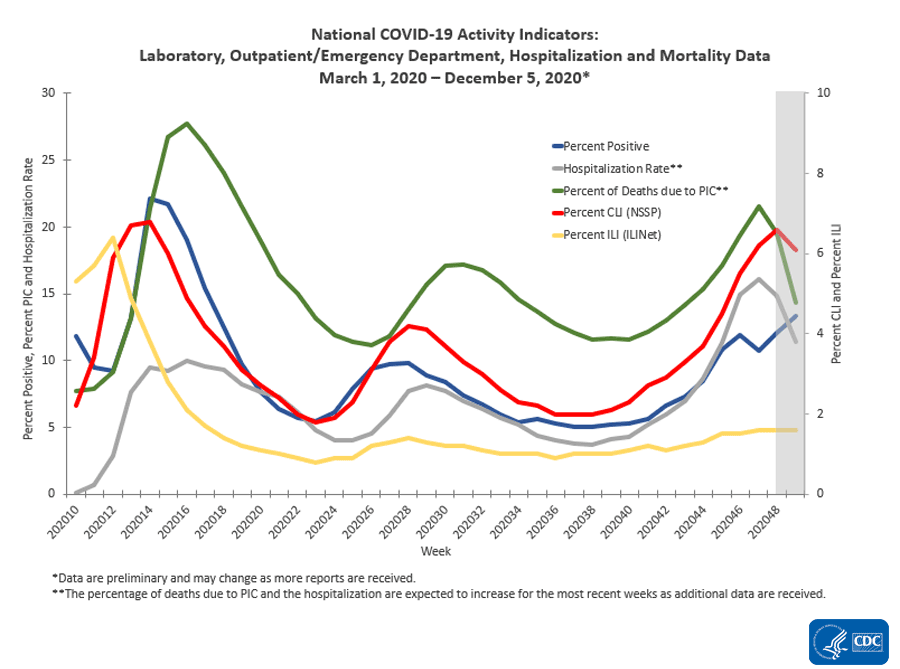
source: https://www.cdc.gov/coronavirus/2019-ncov/covid-data/covidview/index.html
The Impact of Holidays
The 4 day Thanksgiving holiday period put a wobble in the trends. Over weekends and holidays, the number of new cases and deaths decline. Over weekends, this is not a problem for week-over-week rolling averages as weekends are compared against the previous weekend. But when a holiday falls within a working week, a non-working day is compared to a working day which causes havok in the trends. However, hospitalizations historically appear to be little affected by weekends or holidays – the daily counts do not vary significantly from day-to-day [although they are now in record territory and the raw numbers grow every day].
The hospitalization growth rate continues to grow at an ever slowing growth rate which is not good news as it means the number of beds needed is currently growing around 6 % every week.

The above graph demonstrates in the last week hospitalization rate of growth has been steady. We are now seeing the size of the impact of commingling and travel over the Thanksgiving holiday period – roughly, it seems to have added around 5% to the rate of growth of new cases, hospitalizations, and deaths. Historically, hospitalization growth follows new case growth by one to two weeks.
As an analyst, I use the rate of growth to determine the trend. But, the size of the pandemic is growing in terms of real numbers – and if the rate of growth does not become negative – the pandemic will overwhelm all resources.
The graph below shows the rate of growth relative to the growth a week earlier updated through today [note that negative numbers mean the rolling averages are LOWER than the rolling averages one week ago]. As one can see, the rate of growth for new cases peaked over one month ago and the rate of growth has been decelerating.

This graph is currently demonstrating that the actions to contain the pandemic are working – but the rate of growth improvement is too slow as we are still seeing record numbers. In the scheme of things, new cases decline first, followed by hospitalizations, and then deaths.
It is up to each of our readers to protect themselves and others by washing your hands, wearing a mask, avoiding crowds, and maintaining social distancing.
Coronavirus News You May Have Missed
Fauci Projects U.S. Could Reach COVID Herd Immunity by Mid-2021 – Newsweek
Dr. Anthony Fauci shared an updated time line for the U.S. to potentially achieve herd immunity on Monday, assuming the general population can begin to receive COVID-19 vaccines in late March or early April of 2021. Discussing the nation’s preliminary vaccine rollout during an MSNBC interview, the leading public health expert suggested the U.S. could reach herd immunity by the end of next spring.
Fauci, who has served as director of the National Institute of Allergy and Infectious Diseases for more than three decades, helped guide the federal COVID-19 response as a member of the White House Coronavirus Task Force this year. He previously estimated that herd immunity, a term used to describe widespread protection from disease when the majority of a population is formally immunized, was possible by the end of next summer.
However, with the first rounds of COVID-19 vaccine deliveries now underway, Fauci said the U.S. could realize large-scale, indirect immunity several months earlier.
2020 Was Especially Deadly. Covid Wasn’t the Only Culprit. – New York Times
The year 2020 has been abnormal for mortalities. At least 356,000 more people in the United States have died than usual since the coronavirus pandemic took hold in the country in the spring. But not all of these deaths have been directly linked to Covid-19.
More than a quarter of deaths above normal have been from other causes, including diabetes, Alzheimer’s disease, high blood pressure and pneumonia, according to a New York Times analysis of estimates from the Centers for Disease Control and Prevention.
[editor’s note: you really need to read this entire post as I have only included a small snip of the information which is important]

Scientists focus on bats for clues to prevent next pandemic – AP
The goal now is to identify other viruses that may be highly contagious and lethal in humans, and to use that information to devise plans to stop them from ever infecting people — to forestall the next potential global disease outbreak before it gets started.
In a highly connected world, an outbreak in one place endangers the entire globe, just as the coronavirus did. And the Brazilian team is just one among many worldwide racing to minimize the risk of a second pandemic this century.
To some, it might seem too soon to contemplate the next global outbreak, with the world still grappling with the devastating fallout of the ongoing one. But scientists say it’s highly like that, without savvy intervention, another novel virus will jump from animal to human host and find the conditions to spread like wildfire.
As this pandemic has shown, modern transport can disperse the pathogen to all corners of the globe in a matter of hours and spread easily in densely populated cities.
It’s not a question of if, but of when, according to Dr. Gagandeep Kang, an infectious diseases expert at Christian Medical College at Vellore in southern India.
She pointed to previous research that found India was among the most likely places in the world for such a “spillover” event to occur, due to population density and increasing human and livestock incursion into its dense tropical forests teeming with wildlife.
It’s no coincidence that many scientists are focusing attention on the world’s only flying mammals — bats.
Millions of hungry Americans turn to food banks for first time – PBS
Hunger is a harsh reality in the richest country in the world. Even during times of prosperity, schools hand out millions of hot meals a day to children, and desperate elderly Americans are sometimes forced to choose between medicine and food.
Now, in the pandemic of 2020, with illness, job loss and business closures, millions more Americans are worried about empty refrigerators and barren cupboards. Food banks are doling out meals at a rapid pace and an Associated Press data analysis found a sharp rise in the amount of food distributed compared with last year. Meanwhile, some folks are skipping meals so their children can eat and others are depending on cheap food that lacks nutrition.
Those fighting hunger say they’ve never seen anything like this in America, even during the Great Recession of 2007-2009.
The first place many Americans are finding relief is a neighborhood food pantry, most connected to vast networks of nonprofits. Tons of food move each day from grocery store discards and government handouts to warehouse distribution centers, and then to the neighborhood charity.
… Feeding America, the nation’s largest anti-hunger organization, scrambled to keep up as states locked down and schools — many providing free breakfasts and lunches — closed. In late March, 20 percent of the organization’s 200 food banks were in danger of running out of food.
The problem with supply subsided, but demand has not. Feeding America has never handed out so much food so fast — 4.2 billion meals from March through October. The organization has seen a 60 percent average increase in food bank users during the pandemic: about 4 in 10 are first-timers.
An AP analysis of Feeding America data from 181 food banks in its network found the organization has distributed nearly 57 percent more food in the third quarter of the year, compared with the same period in 2019.
Federal database for Covid-19 vaccination info raises concerns about privacy and vaccine uptake – CNN
As Operation Warp Speed prepares to give the first Americans the coronavirus vaccine, states are set to turn over varying levels of non-identifiable information about vaccine recipients in order to help the federal government track the effort to eradicate the virus.
But not all states have been willing to hand over their data blanketly. Plans for a new database to manage that information, which OWS laid out last week, have raised privacy concerns and led to fears that it could actually discourage Americans from getting vaccinated.
The issue of data-sharing turned into a standoff between federal agencies compiling the new database and New York Gov. Andrew Cuomo Wednesday, with the Democratic governor raising concerns about how it might impact vaccine uptake — especially in immigrant communities.
State immunization systems will provide non-identifying information, such as who has been vaccinated, what vaccine an individual received, and the site where the vaccine was administered, which will be stored in a cyber-secure federal database called the Data Clearinghouse, according to Army Col. RJ Mikesh, information technology lead for OWS, which is tasked with overseeing federal vaccine distribution.
The Centers for Disease Control and Prevention and Department of Health and Human Services have been working on signing data use and sharing agreements with states, counties and other jurisdictions that would allow them to compile state-gathered details in the Data Clearinghouse. The database will then be used for things like accessing patterns of vaccination, tracking the required second doses and highlighting under-vaccinated populations, Mikesh said.
… But it has raised issues like data privacy, how the data gathering might affect vaccine uptake, and HIPAA compliance.
The Minnesota Department of Health said they will only be sharing date of birth, county and vaccine information to the Data Clearinghouse. “This is just a matter of Minnesota being limited by our state’s data privacy laws,” said Scott Smith, information officer with the Minnesota Department of Health.
5 major airlines to roll out digital health passport for travelers next month – Health Care Dive
[editor’s note: this post is worth a full read]
- Following a successful trial with United Airlines in October, four more major airlines plan to roll out a digital health pass for international travel, called CommonPass, in December.
- The technology launched by the Commons Project Foundation and the World Economic Forum allows travelers to document their COVID-19 status electronically and present it when boarding an airplane or crossing a border.
- CommonPass as operated by the CommonTrust Network, a nonprofit aimed at giving people digital access to health information, including vaccination records and lab results, using interoperable standards like HL7 FHIR. It includes hundreds of health systems and hospitals, along with accredited labs and other providers, in the U.S. and worldwide.
NIH Director Begs Americans To Swallow Vaccine Skepticism – ZeroHedge
The director of the National Institutes of Health begged Americans to “hit the reset button” on their concerns over whether the COVID-19 vaccine, which was developed faster than any vaccine in the history of Western medicine, will be safe.
“I would like to plead to people who are listening to this this morning to really hit the reset button on whatever they think they knew about this vaccine that might cause them to be so skeptical,” Dr. Francis Collins told NBC News’ “Meet the Press.”
Collins also said that it’s unknown whether someone who’s had the vaccine could still acquire the virus and silently spread to others around them – saying that “it will take us a couple of months to figure that out,” and that people still need to mask up and social distance.
Let’s not forget that earlier his month a former Pfizer executive expressed dire concerns over the rushed vaccines, joining a German pulmonologist in calling for the European Medicine Agency to halt Pfizer vaccine studies until a design study could be created which addresses a host of serious safety concerns ranging from potentially fatal reactions to ‘infertility of indefinite duration.’
[editor’s note: The questions remain:
- how effective it will be in the general population,
- will there be any permanent side effects that will appear months from now,
- how long immunity will last [we can currently say we do not know if it will last more than 4 months],
- there is no evidence the vaccine will block transmission]
Five key genes linked to severe COVID-19 found, suggesting drug targets – Reuters
Five key genes are linked with the most severe form of COVID-19, scientists said on Friday, in research that also pointed to several existing drugs that could be repurposed to treat people who risk getting critically ill with the pandemic disease.
Researchers who studied the DNA of 2,700 COVID-19 patients in 208 intensive care units across Britain found that five genes involving in two molecular processes – antiviral immunity and lung inflammation – were central to many severe cases.
“Our results immediately highlight which drugs should be at the top of the list for clinical testing,” said Kenneth Baillie, an academic consultant in critical care medicine at Edinburgh University who co-led the research.
The genes – called IFNAR2, TYK2, OAS1, DPP9 and CCR2 – partially explain why some people become desperately sick with COVID-19, while others are not affected, Baillie said.
The findings, published in the journal Nature, should help scientists speed up the search for potential drugs for COVID-19 by conducting clinical trials of medicines that target specific antiviral and anti-inflammatory pathways.
Among those with the most potential, he said, should be a class of anti-inflammatory drugs called JAK inhibitors, which includes the arthritis drug baricitinib, made by Eli Lilly. [editor’s note: also read A new study shows an arthritis drug may help Covid-19 patients recover.]
Baillie’s team also found that a boost in the activity of the INFAR2 gene could create protection against COVID-19, because it is likely to mimic the effect of treatment with interferon.
Various existing drugs are being explored in clinical trials for their potential against COVID-19 including interferon-beta-1a, interleukin-1 receptor antagonist and Sanofi’s arthritis drug Kevzara.
So far, a steroid called dexamethasone and a newly developed antiviral called remdesivir, made by Gilead, are the only drugs authorised around the world to treat COVID-19 patients – although remdesivir is not recommended for severe cases of the disease and has had mixed results in trials.
Last month, the U.S. Food and Drug Administration approved Eli Lilly’s antibody drug for COVID-19, bamlanivimab, for patients who are not hospitalized but are at risk of serious illness because of their age or other conditions.
COVID-19 Neurologic Fallout Not Limited to the Severely Ill – Medscape
Serious neurologic complications in patients with COVID-19 are not limited to the severely ill, new research confirms.
“We found a range of neurologic diagnoses, including stroke and seizures, among hospitalized patients with COVID-19 and the majority were not critically ill, suggesting that these complications are not limited just to those patients who require ICU care or a ventilator,” study investigator Pria Anand, MD, Division of Neuro-Infectious Diseases, Boston University School of Medicine, Boston, Massachusetts, told Medscape Medical News.
The study was published online December 9 in Neurology Clinical Practice.
For the study, the investigators reviewed the medical records of 74 adults (mean age, 64 years) who were hospitalized with COVID-19 and evaluated for neurologic conditions at Boston Medical Center, a safety-net hospital caring primarily for underserved, low-income, racial and ethnic minority populations.
The most common COVID-19 symptoms on arrival to the hospital were cough (39%), dyspnea (36%), and fever (34%). Eleven patients required intubation (15%) and 28 required some form of supplemental oxygen (38%). Thirty-four patients required intensive care (46%).
The most common neurologic COVID-19 symptoms at presentation were altered mental status (53%), myalgia (24%), fatigue (24%), and headache (18%).
‘New Variant’ of COVID That Spreads Rapidly Found in South of England – Newsweek
A”new variant” of the COVID-19 virus has been identified in the United Kingdom and linked to a faster spread of the disease, Britain’s health secretary has said. The World Health Organization has been notified.
Matt Hancock announced that London and a number of other areas in the south of England will be placed under new harsher restrictions following “very sharp rises” in COVID cases.
It is not yet known what extent the new variant of COVID has had on the rise in cases and there is “nothing to suggest” it causes worse disease or that vaccines would no longer work, he said. At least 60 different local authorities in England have recorded infections caused by the new strain.
Hancock told Britain’s lawmakers in the House of Commons that average daily hospital admissions are up 13 percent and that average daily cases have risen 14 percent in the last week across the U.K.
[edior’s note: also read London to enter top tier of restrictions as UK identifies new Covid variant]
The following are foreign headlines with hyperlinks to the posts
Britain’s pragmatic RECOVERY trial finds no benefit from azithromycin in hospitalized COVID patients.
Italy is reclaiming a record that nobody wants: The most virus deaths in Europe.
Germany’s Hard Lockdown: The country suffered far less than most others on the continent in spring with swift measures. It’s now closing most stores and schools, and further limiting social contact in an effort to drive down the rate of infections that have remained high recently.
Russia’s novel approach to the COVID vaccine: first approve it, then start the clinical efficacy trial, and, now, test it in animals.
New Zealand commits to travel bubbles with Australia, Cook Islands
COVID Cases Spike in Belgian Care Home After a Visit From Santa Claus
COVID Vaccine Passports Announced by Israel in World First
Sex Party Near COVID Clinic Shut Down, Over 50 Arrested
Bicycling surges in Manila amid coronavirus lockdowns.
African PM Becomes First Head of Government to Die After Coronavirus Diagnosis
South Korea reports 718 new coronavirus cases
The following additional national and state headlines with hyperlinks to the posts
CDC Director Robert Redfield, MD, officially signed off Sunday on ACIP‘s recommendation of the Pfizer/BioNTech COVID-19 vaccine in people 16 and older.
Nursing Home Worry: After 110,000 deaths ravaged America’s nursing homes and pushed them to the front of the vaccine line, they now face a vexing problem: skeptical residents and workers balking at getting the shots.
Trump Says White House Staff Won’t Be 1st To Receive COVID-19 Vaccine
Doses of the Pfizer-BioNTech COVID-19 vaccine are en route to all 50 states
“I feel hopeful today,” said New York nurse Sandra Lindsay, who was among the first Americans to be inoculated with the Pfizer/BioNTech vaccine on Monday
Vaccinations began in the U.S. on Monday, the start to a monthslong process of distributing shots to a nation in dire need of relief
Hospitals scramble to prioritize Covid vaccine for their workers. Who gets them first?
The first shots of the vaccine are expected to be administered today, but CVS said it won’t be providing them in long-term care facilities for another week.
White House staff were to jump to the front of the vaccine line, but President Trump said not so fast.
The feds are buying up another 100 million doses of Moderna’s COVID-19 vaccine, doubling the initial order, but Pfizer has yet to accept a similar request.
Pfizer negotiating with Trump administration for additional 100M COVID-19 vaccine doses next year
Baricitinib plus remdesivir (Veklury) cut recovery time by 1 day versus remdesivir alone in hospitalized COVID-19 patients, particularly those on high-flow oxygen or noninvasive ventilation, in the ACTT-2 trial.
At least one snow leopard at a Kentucky zoo tested positive for SARS-CoV-2.
Docs Cheer Medicare’s OK to Off-Site Hospital Care
California Gov. Newsom faces recall campaign over coronavirus restrictions
Pfizer negotiating with Trump administration for additional 100M COVID-19 vaccine doses next year
Florida GOP Senate leader tests positive for COVID-19 ahead of Electoral College meeting
White House recommended tighter restrictions in Florida
Americans far less likely to wear masks indoors with non-household members than in public
Nursing Home Vaccinations May Be Delayed
Florida COVID Cases Skyrocket Two Weeks After Thanksgiving
Hundreds of Minnesota Businesses Join Forces to Defy COVID Lockdown Order
U.S. plans to ship 6 million Moderna Covid vaccine doses once FDA gives OK
Today’s Posts On Econintersect Showing Impact Of The Pandemic With Hyperlinks
Retail Hiring Slows In November – On Pace To Fall Below 2019 Level
Identifying The Most Financially Vulnerable Families
COVID-19 Hits The Poor Harder, But Scaled-Up Testing Can Help
Warning to Readers
The amount of politically biased articles on the internet continues to increase. And studies and opinions of the experts continue to contradict other studies and expert opinions. Honestly, it is difficult to believe anything anymore. A study usually cannot establish cause and effect – but only correlation. Be very careful what you believe about this pandemic.

I assemble this coronavirus update daily – sifting through the posts on the internet. I try to avoid politically slanted posts (mostly from CNN, New York Times, and the Washington Post) and can usually find unslanted posts on that subject from other sources on the internet. I wait to publish posts on subjects that I cannot validate across several sources. But after all this extra work, I do not know if I have conveyed the REAL facts. It is my job to provide information so that you have the facts necessary – and then it is up to readers to draw conclusions.
Analyst Opinion of Coronavirus Data
There are several takeaways that need to be understood when viewing coronavirus statistical data:
- The global counts are suspect for a variety of reasons including political. Even the U.S. count has issues as it is possible that as much as half the population has had coronavirus and was asymptomatic. It would be a far better metric using a random sampling of the population weekly. In short, we do not understand the size of the error in the tracking numbers.
- Just because some of the methodology used in aggregating the data in the U.S. is flawed – as long as the flaw is uniformly applied – you establish a baseline. This is why it is dangerous to compare two countries as they likely use different methodologies to determine who has (and who died) from coronavirus.
- COVID-19 and the flu are different but can have similar symptoms. For sure, COVID-19 so far is much more deadly than the flu. [click here to compare symptoms]
- From an industrial engineering point of view, one can argue that it is best to flatten the curve only to the point that the health care system is barely able to cope. This solution only works if-and-only-if one can catch this coronavirus once and develops immunity. In the case of COVID-19, herd immunity may need to be in the 80% to 85% range. WHO warns that few have developed antibodies to COVID-19 when recovering from COVID-19. Herd immunity does not look like an option without immunization although there is now a discussion of whether T-Cells play a part in immunity [which means one might have immunity without antibodies]
- Older population countries will have a significantly higher death rate as there is relatively few hospitalizations and deaths in younger age groups..
- There are at least 8 strains of the coronavirus. New York may have a deadlier strain imported from Europe, compared to less deadly viruses elsewhere in the United States.
- Each publication uses different cutoff times for its coronavirus statistics. Our data uses 11:00 am London time. Also, there is an unexplained variation in the total numbers both globally and in the U.S.
What we do not know about the coronavirus [actually there is little scientifically proven information]. Most of our knowledge is anecdotal, from studies with limited subjects, or from studies without peer review.
- How many people have been infected as many do not show symptoms?
- Masks do work.
- Do we develop lasting immunity to the coronavirus? Another coronavirus – the simple cold – does not develop long term immunity.
- To what degree do people who never develop symptoms contribute to transmission? Research early in the pandemic suggested that the rate of asymptomatic infections could be as high as 81%. But a meta-analysis, which included 13 studies involving 21,708 people, calculated the rate of asymptomatic presentation to be 17%.
- The accuracy of rapid testing is questioned – and the more accurate test results are not being given in a timely manner.
- Can children widely spread coronavirus? [current thinking is that they are a minor source of the pandemic spread]
- Why have some places avoided big coronavirus outbreaks – and others hit hard?
- Air conditioning contributes to the pandemic spread.
- Outdoor activities seem to be a lower risk than indoor activities.
- Will other medical treatments for Covid-19 ease symptoms and reduce deaths? So far only remdesivir, Bamlanivimab,
and Regeneron) are approved for treatment. What drugs work?
- A current scientific understanding of the way the coronavirus works can be found [here].
There is now a vaccine available – the questions remain:
- how effective it will be in the general population,
- will there be any permanent side effects that will appear months from now,
- how long immunity will last [we can currently say we do not know if it will last more than 4 months],
- there is no evidence the vaccine will block transmission
Heavy breakouts of coronavirus have hit farmworkers. Farmworkers are essential to the food supply. They cannot shelter at home. Consider:
- they have high rates of respiratory disease [occupational hazard]
- they travel on crowded buses chartered by their employers
- few have health insurance
- they cannot social distance and live two to four to a room – and they eat together
- some reports say half are undocumented
- they are low paid and cannot afford not to work – so they will go to work sick
- they do not have access to sanitation when working
- a coronavirus outbreak among farmworkers can potentially shutter entire farm
The bottom line is that COVID-19 so far has been shown to be much more deadly than the data on the flu. Using CDC data, the flu has a mortality rate between 0.06 % and 0.11 % Vs. the coronavirus which to date has a mortality rate of 4 % [the 4% is the average of overall statistics – however in the last few months it has been hovering around 1.0%] – which makes it between 10 and 80 times more deadly. The reason for ranges:
Because influenza surveillance does not capture all cases of flu that occur in the U.S., CDC provides these estimated ranges to better reflect the larger burden of influenza.
There will be a commission set up after this pandemic ends to find fault [it is easy to find fault when a once-in-a-lifetime event occurs] and to produce recommendations for the next time a pandemic happens. Those that hate President Trump will conclude the virus is his fault.
Resources:
- Get the latest public health information from CDC: https://www.coronavirus.gov .
- Get the latest research from NIH: https://www.nih.gov/coronavirus.
- Find NCBI SARS-CoV-2 literature, sequence, and clinical content: https://www.ncbi.nlm.nih.gov/sars-cov-2/.
- List of studies: https://icite.od.nih.gov/covid19/search/#search:searchId=5ee124ed70bb967c49672dad
include(“/home/aleta/public_html/files/ad_openx.htm”); ?>


