


Written by Steven Hansen
The U.S. new cases 7-day rolling average is 10.8 % HIGHER than the 7-day rolling average one week ago. U.S. deaths due to coronavirus are now 9.9 % HIGHER than the rolling average one week ago. U.S. hospitalizations due to COVID-19 are now 6.0 % HIGHER than the rolling average one week ago. Today’s posts include:
- U.S. Coronavirus New Cases are at an elevated 219,510
- U.S. Coronavirus deaths are at an elevated 2,368
- U.S. Coronavirus hospitalizations are at a record 108,108
- The 7-day rolling average rate of growth of the pandemic shows new cases improved, hospitalizations again improved, and deaths improved
- Safety and Efficacy of AstraZeneca Vaccine
- Pfizer COVID vaccine ingredients are pretty standard
- Americans’ hesitancy to get vaccine a ‘significant problem’
- How concerned should you be about allergies and the Pfizer vaccine?
- Navajo Nation will receive first doses of COVID-19 vaccine early this week
- Is Dizziness a COVID-19 Symptom? Doctors Explain the Coronavirus Link to Vertigo
- Has a year of living with Covid-19 rewired our brains?
- Despite promises of solidarity on Covid-19, rich countries are snapping up the supply of promising vaccines

The recent worsening of the trendlines for new cases should be attributed to going back to college/university, cooler weather causing more indoor activities, possible mutation of the virus, fatigue from wearing masks / social distancing, holiday activities, political rallies / voting, and continued loosening of regulations designed to slow the coronavirus spread.
My continuing advice is to continue to wash your hands (especially after using the toilet as COVID first sheds in your stool), putting down the toilet seat (as flushing the toilet releases a plume), wear masks, avoid crowds, and maintain social distancing. No handwashing, mask, or social distancing will guarantee you do not get infected – but it sure as hell lowers the risk in all situations – and the evidence to-date shows a lower severity of COVID-19. In addition, certain activities are believed to carry higher risk – like being inside in air conditioning and removing your mask (such as restaurants, around your children/grandchildren, bars, and gyms). It is all about viral load – and outdoor activities are generally safe if you can maintain social distance.
include($_SERVER[‘DOCUMENT_ROOT’].’/pages/coronavirus1.htm’); ?>
Hospitalizations (grey line) and Mortality (green line)
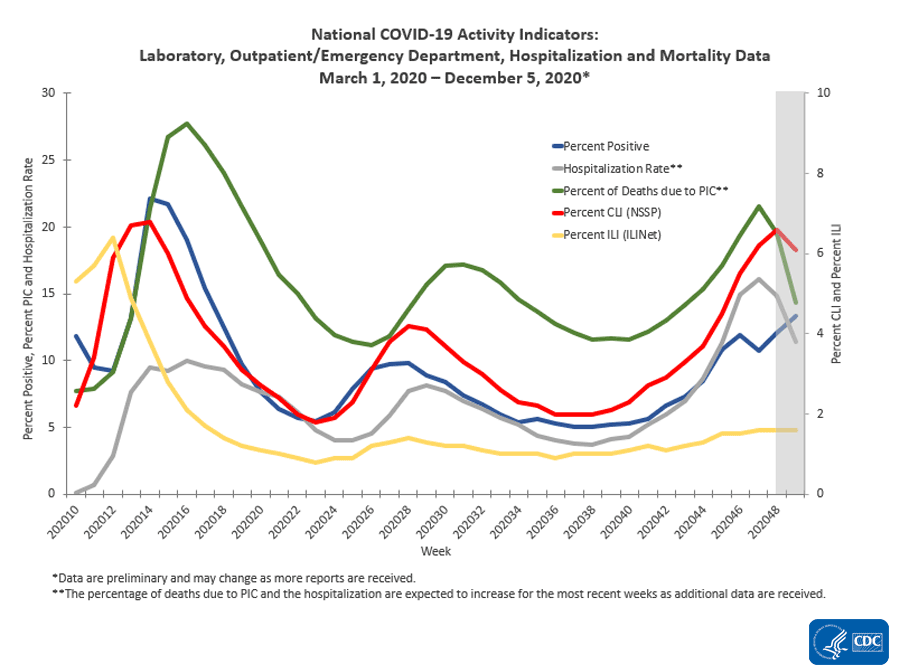
source: https://www.cdc.gov/coronavirus/2019-ncov/covid-data/covidview/index.html
Saturday Night Live – Dr. Fauci & Dr. Birx
The Impact of Holidays
The 4 day Thanksgiving holiday period put a wobble in the trends. Over weekends and holidays, the number of new cases and deaths decline. Over weekends, this is not a problem for week-over-week rolling averages as weekends are compared against the previous weekend. But when a holiday falls within a working week, a non-working day is compared to a working day which causes havok in the trends. However, hospitalizations historically appear to be little affected by weekends or holidays – the daily counts do not vary significantly from day-to-day [although they are now in record territory and the raw numbers grow every day].
The hospitalization growth rate continues to grow at an ever slowing growth rate which is not good news as it means the number of beds needed is currently growing around 6 % every week.

The above graph demonstrates in the last week hospitalization rate of growth has been steady. We are now seeing the size of the impact of commingling and travel over the Thanksgiving holiday period – roughly, it seems to have added around 5% to the rate of growth of new cases, hospitalizations, and deaths. Historically, hospitalization growth follows new case growth by one to two weeks.
As an analyst, I use the rate of growth to determine the trend. But, the size of the pandemic is growing in terms of real numbers – and if the rate of growth does not become negative – the pandemic will overwhelm all resources.
The graph below shows the rate of growth relative to the growth a week earlier updated through today [note that negative numbers mean the rolling averages are LOWER than the rolling averages one week ago]. As one can see, the rate of growth for new cases peaked over one month ago and the rate of growth has been decelerating.

This graph is currently demonstrating that the recent actions to contain the pandemic are working. In the scheme of things, new cases decline first, followed by hospitalizations, and then deaths.
It is up to each of our readers to protect themselves and others by washing your hands, wearing a mask, avoiding crowds, and maintaining social distancing.
Coronavirus News You May Have Missed
To catch up on news you might have missed this past week, two summary articles were published today:
Between April 23 and Nov 4, 2020, 23 848 participants were enrolled and 11 636 participants (7548 in the UK, 4088 in Brazil) were included in the interim primary efficacy analysis. In participants who received two standard doses, vaccine efficacy was 62·1% (95% CI 41·0-75·7; 27 [0·6%] of 4440 in the ChAdOx1 nCoV-19 group vs71 [1·6%] of 4455 in the control group) and in participants who received a low dose followed by a standard dose, efficacy was 90·0% (67·4-97·0; three [0·2%] of 1367 vs 30 [2·2%] of 1374; pinteraction=0·010). Overall vaccine efficacy across both groups was 70·4% (95·8% CI 54·8-80·6; 30 [0·5%] of 5807 vs 101 [1·7%] of 5829). From 21 days after the first dose, there were ten cases hospitalised for COVID-19, all in the control arm; two were classified as severe COVID-19, including one death. There were 74 341 person-months of safety follow-up (median 3·4 months, IQR 1·3-4·8): 175 severe adverse events occurred in 168 participants, 84 events in the ChAdOx1 nCoV-19 group and 91 in the control group. Three events were classified as possibly related to a vaccine: one in the ChAdOx1 nCoV-19 group, one in the control group, and one in a participant who remains masked to group allocation.
Interpretation
ChAdOx1 nCoV-19 has an acceptable safety profile and has been found to be efficacious against symptomatic COVID-19 in this interim analysis of ongoing clinical trials.
Pfizer COVID vaccine ingredients are pretty standard, experts say – USA Today
Experts say the ingredients in the COVID-19 vaccine developed by Pfizer and German partner BioNTech, which was authorized Friday by the U.S. Food and Drug Administration, looks pretty standard for a vaccine.
In a letter to the FDA, Pfizer listed the ingredients in its vaccine. They can be organized into four basic categories:
Active Ingredient
- 30 mcg of a nucleosidemodified messenger RNA (modRNA) encoding the viral spike (S) glycoprotein of SARS-CoV-2.
Fats
- lipids (0.43 mg (4-hydroxybutyl)azanediyl)bis(hexane-6,1-diyl)bis(2-hexyldecanoate), 0.05 mg 2[(polyethylene glycol)-2000]-N,N-ditetradecylacetamide, 0.09 mg 1,2-distearoyl-sn-glycero-3- phosphocholine, and 0.2 mg cholesterol)
Salts
- 0.01 mg potassium chloride
- 0.01 mg monobasic potassium phosphate
- 0.36 mg sodium chloride
- 0.07 mg dibasic sodium phosphate dihydrate
Sugar
[editor’s note: also read First COVID-19 vaccine doses to be delivered Monday]
- 6 mg sucrose
FDA chief: Americans’ hesitancy to get vaccine a ‘significant problem’ – The Hill
Dr. Stephen Hahn, the commissioner of the Food and Drug Administration (FDA), said on Sunday that resistance to the COVID-19 vaccine by some Americans is a “significant problem” and officials are working to address those “fears and concerns.”
Host Martha Raddatz noted during Hahn’s appearance on ABC’s “This Week” that recent polling shows between one-quarter and one-third of Americans do not want to receive a vaccine.
“That is a significant problem,” Hahn responded. “I mean, if you think about how we get out of this pandemic, we have to continue our mitigation efforts right now. That is so important, mask wearing, et cetera.
“But the way we see light at the end of the tunnel, the way we get through this is to achieve herd immunity. And that means we need to vaccinate a significant number of people in this country, including those who are hesitant,” he added.
Hahn also said officials “need to address their fears and concerns.”
Deaths from the virus have risen sharply in college towns — but few have been college students. – New York Times
As coronavirus deaths soar across the country, deaths in communities that are home to colleges have risen faster than the rest of the nation, a New York Times analysis of 203 counties where students compose at least 10 percent of the population has found.
In late August and early September, as college students returned to campus and some institutions put into place rigorous testing programs, the number of reported infections surged. Yet because serious illness and death are rare among young coronavirus patients, it was unclear at the time whether the growth of infections on campus would translate into a major health crisis.
But since the end of August, deaths from the virus have doubled in counties with a large college population, compared with a 58 percent increase in the rest of the nation.
Few of the victims were college students but, rather, older people and others living and working in the community.
Since the pandemic began, a Times survey has identified more than 397,000 infections at more than 1,800 colleges and universities. Those cases include more than 90 deaths involving college employees and students.
The link between an outbreak at a college and a coronavirus death in the wider community is often indirect and difficult to document, according to public health experts, especially without extensive contact tracing, which many local health departments in the United States lack resources to pursue.
But researchers have begun finding evidence of ties to college students. Using genetic sequencing to track cases around the University of Wisconsin-La Crosse, Paraic Kenny, a cancer geneticist at the Kabara Cancer Research Institute of the Gundersen Medical Foundation, has found links between infections at the university and cases and deaths in the surrounding region.
Should you wear two face masks to make them more effective? – CNBC
It’s important to make sure that your mask has enough layers of fabric to be effective, but some, including President-elect Joe Biden, have been seen wearing multiple masks at once. Experts say that this is an extra step that can help limit any “leakage” of air, but isn’t necessary in most cases.
“For all the rest of us, a second mask may reduce ‘leakage’ and could be a reasonable thing to do, particularly for public-facing employees such as teachers, grocery cashiers and bus drivers,” said Dr. Sten Vermund, dean of the Yale School of Public Health in New Haven, Connecticut, noting that medical professionals wearing fitted N95 masks should avoid adding an extra layer.
“There is no harm to dual masking unless someone were to have trouble breathing, but this is rare in mask use unless someone has prior respiratory limitations such as severe COPD.”
Dr. S. Patrick Kachur, a professor at the Columbia University Mailman School of Public Health in New York City, said that some combinations, such as a mask and a neck gaiter, could be more effective than the singular gaiter, since some gaiters are just one layer of fabric.
Germany to go into national lockdown over Christmas to stem surge in Covid-19 cases – CNN
Germany will go into a “hard” national lockdown, starting next week and continuing through the Christmas period, German Chancellor Angela Merkel said Sunday, after agreeing to stricter measures with state governments to stem a wave of coronavirus cases.
As of next Wednesday, all non-essential shops, services and schools will close until January 10, and Christmas Day gatherings will be reduced from 10 people to only five from two different households.
This week, Merkel made an impassioned plea for Germans to limit their social contacts ahead of the holidays: despite the country’s respected health system and early success in containing the virus, a recent partial lockdown has failed to stop the second-wave surge. Germany reported record daily deaths on Friday, with 598 fatalities tallied in a span of 24 hours.
The new measures take aim at traditional festivities: Christmas church services will be subject to prior registration with no singing allowed, alcohol is to be banned from all public spaces and an annual New Year’s Eve fireworks display will be canceled. Some states are also implementing additional measures, such as Bavaria, which will have a 9 p.m. curfew.
Has a year of living with Covid-19 rewired our brains? – The Guardian
What might be the psychological impact of living through a pandemic? Will it change us for ever?
“People talk about the return to normality, and I don’t think that is going to happen,” says Frank Snowden, a historian of pandemics at Yale, and the author of Epidemics and Society: From the Black Death to the Present. Snowden has spent 40 years studying pandemics. Then last spring, just as his phone was going crazy with people wanting to know if history could shed light on Covid-19, his life’s work landed in his lap. He caught the coronavirus.
Snowden believes that Covid-19 was not a random event. All pandemics “afflict societies through the specific vulnerabilities people have created by their relationships with the environment, other species, and each other,” he says. Each pandemic has its own properties, and this one – a bit like the bubonic plague – affects mental health. Snowden sees a second pandemic coming “in the train of the Covid-19 first pandemic … [a] psychological pandemic”.
Aoife O’Donovan, an associate professor of psychiatry at the UCSF Weill Institute for Neurosciences in California, who specialises in trauma, agrees. “We are dealing with so many layers of uncertainty,” she says. “Truly horrible things have happened and they will happen to others and we don’t know when or to whom or how and it is really demanding cognitively and physiologically.”
The impact is experienced throughout the body, she says, because when people perceive a threat, abstract or actual, they activate a biological stress response. Cortisol mobilises glucose. The immune system is triggered, increasing levels of inflammation. This affects the function of the brain, making people more sensitive to threats and less sensitive to rewards.
In practice, this means that your immune system may be activated simply by hearing someone next to you cough, or by the sight of all those face masks and the proliferation of a colour that surely Pantone should rename “surgical blue”, or by a stranger walking towards you, or even, as O’Donovan found, seeing a friend’s cleaner in the background of a Zoom call, maskless. And because, O’Donovan points out, government regulations are by necessity broad and changeable, “as individuals we have to make lots of choices. This is uncertainty on a really intense scale.”
Navajo Nation will receive first doses of COVID-19 vaccine early this week – The Hill
The Navajo Nation announced on Saturday that it will receive its first doses of Pfizer and BioNTech’s COVID-19 vaccine early this week.
The nation said in a statement that it is expecting its first shipments on Monday and Tuesday. The doses will be administered to health care workers and those in long-term assisted living facilities.
The shipments will be transported to Gallup Indian Medical Center, Chinle IHS and Northern Navajo Medical Center, the nation said. Doses will then be sent to other locations that are able to store the vaccine at “deep frozen temperature.”
The Food and Drug Administration approved Pfizer and BioNTech’s vaccine for emergency use on Friday, and states are expected to receive their first doses next week. The vaccine will need to be stored at minus 70 degrees Celsius, or minus 94 degrees Fahrenheit.
The announcement comes as the Navajo Nation experiences a second wave of coronavirus infections.
Last week, the nation extended its stay-at-home order to Dec. 28 after experiencing a surge in cases that it attributed to family gatherings and off-reservation travel. The order was first imposed Nov. 13, and was scheduled to end Dec. 6.
How concerned should you be about allergies and the Pfizer vaccine? – New York Times
British drug regulators recommended on Wednesday that people with severe allergic reactions to food and medicine not receive Pfizer’s coronavirus vaccine after two health care workers, both with such a history, had a serious reaction.
The initial report on the British cases set off alarm and confusion, and left many people with allergies wondering whether the new vaccine would be safe for them.
Here’s what we know so far:
The workers both experienced anaphylaxis, a life-threatening reaction that impairs breathing and can drop blood pressure within minutes or even seconds after exposure to an allergen. Both workers were treated with epinephrine and have recovered, the regulators said.
People with a history of an anaphylactic reaction to any vaccine were excluded from Pfizer’s studies, company officials said on Thursday.
Among those who participated in the Pfizer trials, a very small number of people had allergic reactions. A document published by the F.D.A. on Tuesday said that 0.63 percent of participants who received the vaccine reported potential allergic reactions, compared with 0.51 percent of people who received a placebo.
In Pfizer’s late-stage clinical trial, one of the 18,801 participants who received the vaccine had an anaphylactic reaction, according to safety data published by the F.D.A. None in the placebo group did.
“If I were a person that had an underlying allergic tendency, I might want to be prepared that I might get a reaction, and therefore be ready to treat it,” Dr. Fauci said, in a webcast moderated by Dr. Sanjay Gupta of CNN, sponsored by Harvard and The New England Journal of Medicine.
Dr. Fauci acknowledged that the problem could turn out to affect a lot of people, but he said that other vaccines would eventually become available for those affected.
Tough months lie ahead, but the rollout of the first vaccine in record time and the likely imminent approvals of others, is a turning point for wealthy countries that can afford vaccines.
But for public health officials in the developing world, it is a harsh reminder that the race to end this deadly pandemic will separate the world’s haves and the have-nots.
The alleged Covid-19 vaccine hoarding and bitter experience of past inequalities leave many feeling cynical about global solidarity.
Rich countries have been on a vaccine shopping spree for months. A continuously updated database compiled by the Duke Global Health Innovation Center shows bilateral deals worth billions of dollars by a handful of countries for emerging vaccines.
Several countries and regional blocks have preordered vaccines that could cover far more than their entire populations. The People’s Vaccine Alliance, an international vaccine watchdog that includes Amnesty International and Oxfam, said this past week that rich countries have bought enough Covid-19 vaccine doses to immunize their populations three times over.
The Canadian government alone has secured enough inoculations to vaccinate their citizens five or even six times over, though not all the vaccine candidates it preordered may be approved for usage.
Is Dizziness a COVID-19 Symptom? Doctors Explain the Coronavirus Link to Vertigo – Prevention
Some research has linked vertigo to COVID-19. In fact, a review of research published in the Ear, Nose & Throat Journal called dizziness “one of the main clinical manifestation of COVID-19.”
For the paper, researchers analyzed 14 different studies that included data from 141 coronavirus patients—and found that all of them experienced vertigo at some point. They also found that dizziness was the initial symptom in three of those patients and, in two of them, it was followed by respiratory symptoms. “It is imperative that attending physicians remain vigilant, especially when managing nonspecific symptoms such as dizziness, as it can be easily overlooked,” the researchers concluded.
The following are foreign headlines with hyperlinks to the posts
Italy Reclaims Highest Death Count in Europe, Surpassing U.K
Japan sets daily COVID-19 record as cases top 3,000 for first time ever
South Korea sees record rise in daily cases
The following additional national and state headlines with hyperlinks to the posts
Vaccine distribution is underway, federal officials said Saturday, hours after the Food and Drug Administration authorized the Pfizer/BioNTech vaccine.
AstraZeneca buying drug developer Alexion for $39B
Operation Warp Speed head says 40M doses of vaccine will be distributed by end of the month
Fox Nation host Nancy Grace tests positive for COVID-19
Country music star Charley Pride dies from coronavirus complications
UPS and FedEx say plans to ship the vaccine are underway.
Federal authorities charge two men with stealing 192 ventilators that were bound for El Salvador.
More than 600 facilities will receive coronavirus vaccines this week
These containers used to ship fresh tuna. Now they’ll deliver Covid-19 vaccines
Today’s Posts On Econintersect Showing Impact Of The Pandemic Wh Hyperlinks
Employment Losses In Contact-Intensive Industries
The Costs Of Corporate Debt Overhang Following The COVID-19 Outbreak
Coronavirus Disease Weekly News 13December 2020
Coronavirus Economic Weekly News 13December 2020
Commodity Prices Soar Despite Pandemic
America’s Scariest Charts – Updated 10December 2020
Warning to Readers
The amount of politically biased articles on the internet continues to increase. And studies and opinions of the experts continue to contradict other studies and expert opinions. Honestly, it is difficult to believe anything anymore. A study usually cannot establish cause and effect – but only correlation. Be very careful what you believe about this pandemic.

I assemble this coronavirus update daily – sifting through the posts on the internet. I try to avoid politically slanted posts (mostly from CNN, New York Times, and the Washington Post) and can usually find unslanted posts on that subject from other sources on the internet. I wait to publish posts on subjects that I cannot validate across several sources. But after all this extra work, I do not know if I have conveyed the REAL facts. It is my job to provide information so that you have the facts necessary – and then it is up to readers to draw conclusions.
Analyst Opinion of Coronavirus Data
There are several takeaways that need to be understood when viewing coronavirus statistical data:
- The global counts are suspect for a variety of reasons including political. Even the U.S. count has issues as it is possible that as much as half the population has had coronavirus and was asymptomatic. It would be a far better metric using a random sampling of the population weekly. In short, we do not understand the size of the error in the tracking numbers.
- Just because some of the methodology used in aggregating the data in the U.S. is flawed – as long as the flaw is uniformly applied – you establish a baseline. This is why it is dangerous to compare two countries as they likely use different methodologies to determine who has (and who died) from coronavirus.
- COVID-19 and the flu are different but can have similar symptoms. For sure, COVID-19 so far is much more deadly than the flu. [click here to compare symptoms]
- From an industrial engineering point of view, one can argue that it is best to flatten the curve only to the point that the health care system is barely able to cope. This solution only works if-and-only-if one can catch this coronavirus once and develops immunity. In the case of COVID-19, herd immunity may need to be in the 80% to 85% range. WHO warns that few have developed antibodies to COVID-19 when recovering from COVID-19. Herd immunity does not look like an option without immunization although there is now a discussion of whether T-Cells play a part in immunity [which means one might have immunity without antibodies]
- Older population countries will have a significantly higher death rate as there is relatively few hospitalizations and deaths in younger age groups..
- There are at least 8 strains of the coronavirus. New York may have a deadlier strain imported from Europe, compared to less deadly viruses elsewhere in the United States.
- Each publication uses different cutoff times for its coronavirus statistics. Our data uses 11:00 am London time. Also, there is an unexplained variation in the total numbers both globally and in the U.S.
What we do not know about the coronavirus [actually there is little scientifically proven information]. Most of our knowledge is anecdotal, from studies with limited subjects, or from studies without peer review.
- How many people have been infected as many do not show symptoms?
- Masks do work.
- Do we develop lasting immunity to the coronavirus? Another coronavirus – the simple cold – does not develop long term immunity.
- To what degree do people who never develop symptoms contribute to transmission? Research early in the pandemic suggested that the rate of asymptomatic infections could be as high as 81%. But a meta-analysis, which included 13 studies involving 21,708 people, calculated the rate of asymptomatic presentation to be 17%.
- The accuracy of rapid testing is questioned – and the more accurate test results are not being given in a timely manner.
- Can children widely spread coronavirus? [current thinking is that they are a minor source of the pandemic spread]
- Why have some places avoided big coronavirus outbreaks – and others hit hard?
- Air conditioning contributes to the pandemic spread.
- Outdoor activities seem to be a lower risk than indoor activities.
- Will other medical treatments for Covid-19 ease symptoms and reduce deaths? So far only two drugs (remdesivir and Regeneron) are approved for treatment. What drugs work?

- A current scientific understanding of the way the coronavirus works can be found [here].
There is now a vaccine available – the questions remain:
- how effective it will be in the general population,
- how long immunity will last [we can currently say we do not know if it will last more than 4 months],
- there is no evidence the vaccine will block transmission
Heavy breakouts of coronavirus have hit farmworkers. Farmworkers are essential to the food supply. They cannot shelter at home. Consider:
- they have high rates of respiratory disease [occupational hazard]
- they travel on crowded buses chartered by their employers
- few have health insurance
- they cannot social distance and live two to four to a room – and they eat together
- some reports say half are undocumented
- they are low paid and cannot afford not to work – so they will go to work sick
- they do not have access to sanitation when working
- a coronavirus outbreak among farmworkers can potentially shutter entire farm
The bottom line is that COVID-19 so far has been shown to be much more deadly than the data on the flu. Using CDC data, the flu has a mortality rate between 0.06 % and 0.11 % Vs. the coronavirus which to date has a mortality rate of 4 % [the 4% is the average of overall statistics – however in the last few months it has been hovering around 1.0%] – which makes it between 10 and 80 times more deadly. The reason for ranges:
Because influenza surveillance does not capture all cases of flu that occur in the U.S., CDC provides these estimated ranges to better reflect the larger burden of influenza.
There will be a commission set up after this pandemic ends to find fault [it is easy to find fault when a once-in-a-lifetime event occurs] and to produce recommendations for the next time a pandemic happens. Those that hate President Trump will conclude the virus is his fault.
Resources:
- Get the latest public health information from CDC: https://www.coronavirus.gov .
- Get the latest research from NIH: https://www.nih.gov/coronavirus.
- Find NCBI SARS-CoV-2 literature, sequence, and clinical content: https://www.ncbi.nlm.nih.gov/sars-cov-2/.
- List of studies: https://icite.od.nih.gov/covid19/search/#search:searchId=5ee124ed70bb967c49672dad
include(“/home/aleta/public_html/files/ad_openx.htm”); ?>


