


Written by Steven Hansen
The U.S. new cases 7-day rolling average is 15.4 % HIGHER than the 7-day rolling average one week ago. U.S. deaths due to coronavirus are now 17.4 % HIGHER than the rolling average one week ago. U.S. hospitalizations due to COVID-19 are now 6.2 % HIGHER than the rolling average one week ago. Today’s posts include:
- U.S. Coronavirus New Cases are at a record 231,775
- U.S. Coronavirus deaths are at a record 3,309
- U.S. Coronavirus hospitalizations are at a record 108,044
- The 7-day rolling average rate of growth of the pandemic shows new cases improved, hospitalizations again improved, and deaths improved
- Millions of Pfizer vaccine doses to be shipped immediately after F.D.A. approval
- Pregnant and breastfeeding women may opt to receive the vaccine
- Contact Tracing Apps Promised Big and Did Not Deliver
- Trump administration to purchase another 100M doses of Moderna vaccine
- CDC will monitor for Bell’s palsy among Pfizer vaccine recipients, but sees no causal relationship
- These Hospital Staff Are Surprisingly Shielded From COVID-19 Infection
- Why cruise ships are setting sail again as COVID-19 rages
- COVID Causes a Huge Decrease in College Enrollments

The recent worsening of the trendlines for new cases should be attributed to going back to college/university, cooler weather causing more indoor activities, possible mutation of the virus, fatigue from wearing masks / social distancing, holiday activities, political rallies / voting, and continued loosening of regulations designed to slow the coronavirus spread.
My continuing advice is to continue to wash your hands (especially after using the toilet as COVID first sheds in your stool), putting down the toilet seat (as flushing the toilet releases a plume), wear masks, avoid crowds, and maintain social distancing. No handwashing, mask, or social distancing will guarantee you do not get infected – but it sure as hell lowers the risk in all situations – and the evidence to-date shows a lower severity of COVID-19. In addition, certain activities are believed to carry higher risk – like being inside in air conditioning and removing your mask (such as restaurants, around your children/grandchildren, bars, and gyms). It is all about viral load – and outdoor activities are generally safe if you can maintain social distance.
include($_SERVER[‘DOCUMENT_ROOT’].’/pages/coronavirus1.htm’); ?>
Hospitalizations (grey line) and Mortality (green line)
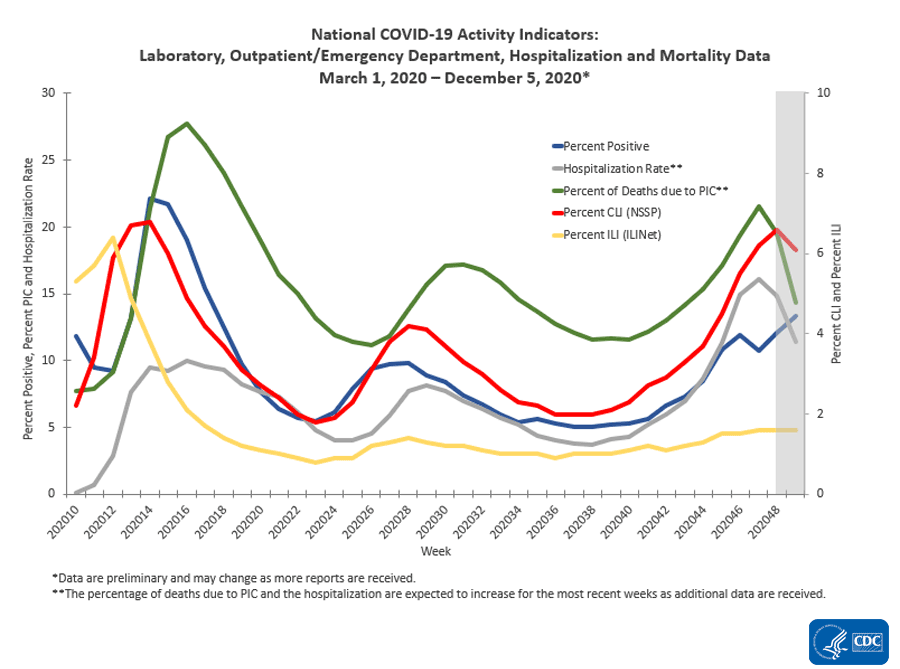
source: https://www.cdc.gov/coronavirus/2019-ncov/covid-data/covidview/index.html
The Impact of Thanksgiving
The 4 day Thanksgiving holiday period put a wobble in the trends. Over weekends and holidays, the number of new cases and deaths decline. Over weekends, this is not a problem for week-over-week rolling averages as weekends are compared against the previous weekend. But when a holiday falls within a working week, a non-working day is compared to a working day which causes havok in the trends. However, hospitalizations historically appear to be little affected by weekends or holidays – the daily counts do not vary significantly from day-to-day [although they are now in record territory and the raw numbers grow every day].
The hospitalization growth rate so far is little changed over the past week which is not good news as it means the number of beds needed is growing around 7 % every week.

The above graph demonstrates in the last week hospitalization rate of growth has been steady. But what we do NOT know right now is the size of the impact of commingling and travel over the Thanksgiving holiday period – although it has slowed the decline in the rate of growth that we were seeing before . The CDC says it will have caused a significant growth in new cases, hospitalizations, and deaths. Historically, hospitalization growth follows new case growth by one to two weeks. That means this week we will be able to measure the impact of Thanksgiving on the spread of COVID-19.
As an analyst, I use rate of growth to determine the trend. But, the size of the pandemic is growing in terms of real numbers – and if the rate of growth does not become negative – the pandemic will overwhelm all resources.
The graph below shows the rate of growth relative to the growth a week earlier updated through today [note that negative numbers mean the rolling averages are LOWER than the rolling averages one week ago]. As one can see, the rate of growth for new cases peaked over one month ago and the rate of growth has been decelerating.

This graph is currently demonstrating that the recent actions to contain the pandemic were beginning to bite – but have now been impacted by Thanksgiving. In the scheme of things, new cases decline first, followed by hospitalizations, and then deaths.
It is up to each of our readers to protect themselves and others by washing your hands, wearing a mask, avoiding crowds, and maintaining social distancing.
Coronavirus News You May Have Missed
Pfizer/BioNTech vaccine first vaccine OK’ed in U.S. to prevent COVID-19 since start of pandemic – MedPage
Pfizer/BioNTech’s mRNA vaccine candidate was authorized for prevention of COVID-19 illness in individuals age 16 and older, becoming the first vaccine to earn that distinction, the FDA said late Friday.
The emergency use authorization allows the vaccine to be distributed in the U.S., with the agency noting clear evidence the vaccine may be effective in preventing COVID-19 and the benefits outweigh the risk in this population.
But the process was not without its share of drama, with the Washington Post reporting earlier on Friday that FDA Commissioner Stephen Hahn, MD, was told by the White House that he had to authorize this vaccine on Friday or resign.
Despite the accelerated timeline, safety was a key theme throughout the FDA’s statement, with the agency stating, “in making this determination, the FDA can assure the public and medical community that it has conducted a thorough evaluation of the available safety, effectiveness and manufacturing quality information.”
“Efforts to speed vaccine development have not sacrificed scientific standards or the integrity of our vaccine evaluation process,” said Peter Marks, MD, PhD, director of the FDA’s Center for Biologics Evaluation and Research.
This vaccine is a two-dose regimen, to be administered three weeks apart. The agency noted the most common adverse events were pain at the injection site, tiredness, headache, muscle pain, chills, joint pain, and fever; more people experienced reactions following the second dose.
In addition to the press release announcing the authorization, the FDA released the official letter sent to Pfizer and fact sheets for providers and patients.
The CDC’s Advisory Committee on Immunization Practices is expected to meet Saturday to discuss the vaccine and possibly include it in the adult and child immunization schedule.
Data from the pivotal phase II/III clinical trial recently published in the New England Journal of Medicine found vaccine efficacy 7 days after the second vaccine dose was 95% (95% CI 90.3%-97.6%). It was 66% (three cases in the control group; one in the vaccine group) against severe COVID-19 at least 7 days after the second dose, albeit with a wide and nonsignificant confidence interval (95% CI -124.8% to 96.3%) given the small number of events.
Interestingly, the FDA noted data are not available to make a determination about how long the vaccine will protect someone from COVID-19, nor is there evidence the vaccine blocks transmission.
On Thursday, the FDA’s Vaccines and Related Biological Products Advisory Committee voted 17-4-1 to recommend the vaccine for an EUA, despite concerns by a minority of members about the paucity of data in individuals ages 16-17.
Moderna’s similar vaccine comes before the same committee on Dec. 17, and quick authorization of that product would be no surprise.
[editor’s note: In a video announcing the emergency authorization of Pfizer’s vaccine, President Donald Trump called the vaccine a “medical miracle” that will “save millions of lives and end the pandemic once and for all.” He said the first doses would be administered in the U.S. “in less than 24 hours.”]
Millions of Pfizer vaccine doses to be shipped immediately after F.D.A. approval. – New York Times
The Food and Drug Administration authorized Pfizer’s Covid-19 vaccine for emergency use on Friday, clearing the way for millions of highly vulnerable people to begin receiving the vaccine within days.
The authorization is a historic turning point in a pandemic that has taken more than 290,000 lives in the United States. With the decision, the United States becomes the sixth country — in addition to Britain, Bahrain, Canada, Saudi Arabia and Mexico — to clear the vaccine. Other authorizations, including by the European Union, are expected within weeks.
The F.D.A.’s decision followed an extraordinary sequence of events on Friday morning when the White House chief of staff, Mark Meadows, told the F.D.A. commissioner, Dr. Stephen Hahn, to consider looking for his next job if he didn’t get the emergency approval done on Friday, according to a senior administration official who spoke on condition of anonymity because he was not authorized to discuss the matter. Dr. Hahn then ordered vaccine regulators at the agency to do it by the end of the day.
The authorization set off a complicated coordination effort from Pfizer, private shipping companies, state and local health officials, the military, hospitals and pharmacy chains to get the first week’s batch of about three million doses to health care workers and nursing home residents as quickly as possible, all while keeping the vaccine at ultracold temperatures.
Pfizer has a deal with the U.S. government to supply 100 million doses of the vaccine by next March. Under that agreement, the shots will be free to the public.
Every state, along with six major cities, has submitted to the federal government a list of locations — mostly hospitals — where the Pfizer vaccine is to ship initially. In populous Florida, the first recipients will be five hospitals, in Jacksonville, Miami, Orlando, Tampa and Hollywood. In tiny, rural Vermont, only the University of Vermont Medical Center and a state warehouse will get supplies.
Trump administration to purchase another 100M doses of Moderna vaccine – The Hill
The Trump administration announced on Friday that it will purchase another 100 million doses of Moderna’s COVID-19 vaccine candidate, according to a release from the Department of Health and Human Services (HHS).
The vaccine is still pending emergency authorization from the Food & Drug Administration (FDA) but approval appears likely.
The U.S. had previously ordered 100 million doses of the vaccine earlier this year, and those will begin shipping immediately upon FDA authorization, with 20 million expected by the end of December.
The second batch of 100 million doses purchased by the U.S. will be delivered in the second quarter of next year, according to HHS.
“Securing another 100 million doses from Moderna by June 2021 further expands our supply of doses across the Operation Warp Speed portfolio of vaccines,” HHS Secretary Alex Azar said.
“This new federal purchase can give Americans even greater confidence we will have enough supply to vaccinate all Americans who want it by the second quarter of 2021,” he added.
The Moderna vaccine was co-developed with scientists from the National Institute of Allergy and Infectious Diseases, run by Anthony Fauci.
The clinical trial involving 30,000 participants found the vaccine was 94.1 percent effective.
Kids catch and spread coronavirus half as much as adults, Iceland study confirms – National Geographic
Emerging research is confirming that schools aren’t the primary drivers of COVID-19 outbreaks – but that cases will seep in and contribute to the disease’s spread whenever a country loses control of containing the pandemic.
National Geographic was given exclusive access to the results from an Icelandic study that provides definitive evidence of how much children contribute to coronavirus spread. Researchers with the nation’s Directorate of Health and deCODE genetics, a human-genomic company in Reykjavik, monitored every adult and child in the country who was quarantined after potentially being exposed this spring, using contact tracing and genetic sequencing to trace links between various outbreak clusters. This 40,000-person study found that children under 15 were about half as likely as adults to be infected, and only half as likely as adults to transmit the virus to others. Almost all the coronavirus transmissions to children came from adults.
“They can and do get infected and transmit to others, but they do both less frequently than adults,” says Kári Stefánsson, the chief executive of deCODE.
This analysis is one in a recent flurry of large-scale studies that support the conclusion that infected adults pose a greater danger to children than kids do to adults. These studies could help inform officials in badly-hit countries like the United States who are struggling to decide when, or if, to close schools, knowing that such shutdowns are harming children. In addition to vital academic lessons, schools provide many critical services to communities, so last week, the U.S. Centres for Disease Control and Prevention recommended that schools should be both “the last settings to close” and “the first to reopen.”
But even if children are generally less susceptible, when infection surges in a community, the risks in schools can dramatically increase. With the U.S. failing to contain the virus on a national level, American Kindergarten to 12th Grade schools have reported more than 313,000 COVID-19 cases as of December 10.
These Hospital Staff Are Surprisingly Shielded From COVID-19 Infection – MedPage
Contrary to expectations, anesthesia and ICU staff seemed to have been spared the worst of U.K. hospital worker infections during the COVID-19 pandemic, two researchers gleaned from media reports.
There has been just one anesthetist who died from COVID-19 out of the estimated 15,595 anesthetists and intensivists working in the country, according to Tim Cook, MBBS, of Royal United Hospitals Bath NHS Foundation Trust and the University of Bristol in England, and Simon Lennane, BM, an NHS general practitioner in Ross-on-Wye, England.
As of October, the risk of COVID-related death among these doctors has been “notably lower than expected” and less than half that observed in other physicians and the NHS workforce in general, the duo reported online in the journal Anaesthesia.
In all, there have been 207 deaths from COVID-19 among NHS healthcare workers at the time of the report.
The authors cited other studies showing that anesthesia and ICU staff in general, not just doctors, have under half the risks of infection and hospitalization of their colleagues manning the other wards.
Cook and Lennane suggested that contrary to expectations that these hospital workers would be at higher risk given their proximity to aerosol-emitting procedures and the sickest of the sick, they could have been helped by several unique features of their work environments during the pandemic:
- Provision of higher-performing personal protective equipment (PPE)
- Increased awareness and practice of infection control precautions (e.g., formal PPE donning and doffing practices)
- Well-ventilated environments
- Less coughing and sneezing among patients in ICUs and operating rooms
CDC will monitor for Bell’s palsy among Pfizer vaccine recipients, but sees no causal relationship – CNBC
The U.S. federal government will continue to monitor occurrences of Bell’s palsy — a partial paralysis in the face — among people who receive Pfizer’s Covid-19 vaccine after four cases were reported among trial participants, though the vaccine doesn’t appear to cause the condition.
Dr. Sara Oliver, an officer at the Centers for Disease Control and Prevention, said during the agency’s Advisory Committee on Immunization Practices on Friday that there is “no known or expected causal relationship between the vaccine and Bell’s palsy.” The ACIP develops recommendations on how to use vaccines to control diseases in the United States, according to the CDC.
“Post authorization safety and effectiveness studies will be critical as well. Specifically, surveillance for Bell’s palsy could help determine any possible causal relationship,” Oliver said.
CONTACT TRACING APPS PROMISED BIG AND DIDN’T DELIVER – The Verge
California rolled out a COVID-19 contact tracing app this week, and officials — including Apple CEO Tim Cook — touted it as an advancement that would help slow their ongoing surge in cases. Using the app will be easy. Measuring whether the app can deliver will be harder.
Nine months after Apple and Google first announced their partnership, contact tracing apps’ role in reducing viral transmission is still difficult to measure. Relatively few people have downloaded the apps, and because of the apps’ focus on privacy, it may be nearly impossible to quantify how well they’re actually able to help prevent disease.
“It seems to me that it’s incumbent upon those who are behind these efforts to show evidence that they’re having some effect,” says Ryan Calo, law professor and a director of the Tech Policy Lab at the University of Washington. “So far, I’ve personally been unconvinced that there’s been any kind of significant showing of efficacy.”
“I’VE PERSONALLY BEEN UNCONVINCED THAT THERE’S BEEN ANY KIND OF SIGNIFICANT SHOWING OF EFFICACY”States each spent hundreds of thousands of dollars to develop these contact tracing apps, rebranded over the summer as exposure notification apps. New York’s cost $700,000, for example, while Virginia’s had a $229,000 price tag. The apps were designed to supplement state efforts to manually track and stop the spread of COVID-19. Anyone who tested positive for the coronavirus would still, ideally, get a phone call from a contact tracer. Contact tracers would ask who they’d interacted with during the time they may have been contagious, and ask those people to quarantine or be tested for the coronavirus.
Manual contact tracing isn’t perfect — contact tracers can only find the people that a sick person knows they were in touch with, and the process can be slow. That’s the gap automated contact tracing apps aim to fill. In theory, they would let someone who tested positive alert strangers they stood by on a long subway ride or grocery store employees they interacted with that they’d been exposed to the virus. And it would happen fast: telling the app you’d tested positive would automatically notify those contacts, without waiting for a tracer to call.
There’s one major catch: that entire scenario relies on lots of people downloading the app. Those strangers on the subway have to use it in order for them to get any benefit from an alert. If only a handful of people turn on exposure notifications, the chances that the random people who they interact with in their daily lives will also have the system running is fairly low.
[editor’s note: this post worth a full read. As a process engineer, contact tracing cannot work unless the levels of the pandemic is very low.]
Why cruise ships are setting sail again as COVID-19 rages – National Geographic
WHEN YOU TAKE a cruise during a pandemic, daily activities look and feel quite different from pre-COVID-19 times. Breakfast is served at socially distanced tables after a pre-meal temperature check. At night, you can dance at a club, provided you cover your face and give other passengers a wide berth. The pool is open, kept clean by staffers in face shields and protective jumpsuits who also spray the lounge chairs with disinfectants.
Before March, a cruise ship worker in a hazmat suit would’ve seemed straight out of a high-seas horror movie. But for people traveling during a pandemic, like Victoria Balabaeva, such precautions seem assuring.
“It made me feel safe seeing how seriously the ship is taking health protocols,” said Balabaeva, who, in September, after months of lockdowns in her native Italy, joined 3,000 or so other passengers for an eight-day trip on MSC Cruises’ MSC Grandiosa. The ship set off from Genoa to destinations including Naples and Malta, one of the first sailings since the pandemic started.
Cruise ships made headlines early in the year when they became floating coronavirus superspreader events, forcing crew and passengers to seek medical attention, evacuate, or quarantine, and leading to 3,689 cases and at least 41 reported dead in the U.S. alone.
Now, with new safety protocols and far fewer passengers on board, a handful of jumbo ships like MSC Grandiosa and Royal Caribbean International’s Quantum of the Seas have resumed sailing from European and Southeast Asian ports. How they’re doing it—and what passengers think—previews how the $150 billion industry might chart a recovery in 2021 and beyond.
[editor’s note: if this subject interests you – read the entire article]
COVID Causes a Huge Decrease in College Enrollments, New Report Finds – Newsweek
A new report from the National Student Clearinghouse Research Center reveals the alarming effects COVID-19 has had on college enrollment. The key takeaway is that there was a decline of 21.7 percent of high school graduates who enrolled in college this fall.
However, the eight annual National College Progression Rates report indicates the pandemic had little impact on high school graduation in the school year 2019-2020. In fact, the change on high school graduation over last year was less than plus or minus 1.0 percent, regardless of income level, poverty level, minority level, or urbanicity of high schools. But those same distinctions of income and location show COVID-19 had a remarkably larger impact on immediate college enrollments rates for graduates of high-poverty, low-income and urban high schools.
The 21.7 percent decline of students going to college immediately after high school represents a decline of nearly eight times the pre-pandemic loss rate. (In 2019, 2.8 percent fewer students enrolled for college immediately after high school than the year prior.) Additionally, there were 29.2 percent fewer enrollments from graduates of low-income high schools, compared to a 16.9 percent drop from those from higher-income high schools; 26.4 percent fewer graduates of high-minority high schools enrolled in college versus a 18.0 percent decrease for low-minority high schools; there was a 32.6 percent drop for high-poverty school graduates while schools with low-poverty rates saw a 16.4 percent decrease; and 25.1 percent fewer graduates of urban high schools enrolled in college, while there were 19.8 percent fewer new enrollees from suburban high schools and 18.1 percent fewer from rural high schools.
Pregnant and breastfeeding women may opt to receive the vaccine – New York Times
In its emergency authorization of the Pfizer-BioNTech vaccine on Friday night, the Food and Drug Administration took an unexpected step, leaving open the possibility that pregnant and breastfeeding women may opt for immunization against the coronavirus.
The agency authorized the vaccine for anyone 16 and older, and asked Pfizer to file regular reports on the safety of the vaccine, including its use in pregnant women.
There had been no guarantee that the agency would take this route. The vaccine was not tested in pregnant women or in those who were breastfeeding. Regulators in the United Kingdom recommended against these women receiving the shots even while acknowledging that the evidence so far “raises no concerns for safety in pregnancy.”
The Centers for Disease Control and Prevention has not yet endorsed the vaccine for pregnant women, but an advisory committee to the agency is expected to meet this weekend to make further recommendations.
The following are foreign headlines with hyperlinks to the posts
Mexico approves Pfizer vaccine for emergency use
British and Russian vaccine makers are set to begin clinical trials combining two vaccines.
The following additional national and state headlines with hyperlinks to the posts
Here’s how all 50 states will dole out vaccines
Who is really ‘first in line’ for the vaccine? It depends on your state.
Wisconsin Hospital Leader On Getting Ready For Vaccinations
‘Hold Their Feet To the Fire’: Getting A COVID-19 Vaccine To Hard-Hit Indian Country
Pennsylvania governor tests negative after coronavirus diagnosis
WWII Hero and ‘Candy Bomber’ Contracts COVID-19, Family Says
Restaurants, Bars Account for Less Than 2 Percent of COVID-19 Cases in N.Y.
Los Angeles County could face ‘catastrophic suffering and death,’ health official warns.
Devin Nunes said he has tested positive for coronavirus antibodies.
About 63% of U.S. adults reported that they’ve been using all or most of their income to cover their monthly expenses since the outbreak of Covid-19, according to a recent survey by Highland Solutions of roughly 2,000 U.S. adults. Prior to the pandemic, 53% of respondents said they were not living paycheck to paycheck.
Walgreens may begin administering coronavirus vaccines at nursing homes before Christmas, according to Rick Gates, the company’s senior vice president of pharmacy and healthcare.
From Elon Musk to Oracle — the coronavirus accelerates California exodus
No ICU beds left in Mississippi as COVID-19 case levels continue to hit record highs
Today’s Posts On Econintersect Showing Impact Of The Pandemic With Hyperlinks
Financing The U.S. Response To COVID-19
Why Paying People To Get The Coronavirus Vaccine Won’t Work
Cost Per Jab Of Covid-19 Vaccine Candidates
Warning to Readers
The amount of politically biased articles on the internet continues to increase. And studies and opinions of the experts continue to contradict other studies and expert opinions. Honestly, it is difficult to believe anything anymore. A study usually cannot establish cause and effect – but only correlation. Be very careful what you believe about this pandemic.

I assemble this coronavirus update daily – sifting through the posts on the internet. I try to avoid politically slanted posts (mostly from CNN, New York Times, and the Washington Post) and can usually find unslanted posts on that subject from other sources on the internet. I wait to publish posts on subjects that I cannot validate across several sources. But after all this extra work, I do not know if I have conveyed the REAL facts. It is my job to provide information so that you have the facts necessary – and then it is up to readers to draw conclusions.
Analyst Opinion of Coronavirus Data
There are several takeaways that need to be understood when viewing coronavirus statistical data:
- The global counts are suspect for a variety of reasons including political. Even the U.S. count has issues as it is possible that as much as half the population has had coronavirus and was asymptomatic. It would be a far better metric using a random sampling of the population weekly. In short, we do not understand the size of the error in the tracking numbers.
- Just because some of the methodology used in aggregating the data in the U.S. is flawed – as long as the flaw is uniformly applied – you establish a baseline. This is why it is dangerous to compare two countries as they likely use different methodologies to determine who has (and who died) from coronavirus.
- COVID-19 and the flu are different but can have similar symptoms. For sure, COVID-19 so far is much more deadly than the flu. [click here to compare symptoms]
- From an industrial engineering point of view, one can argue that it is best to flatten the curve only to the point that the health care system is barely able to cope. This solution only works if-and-only-if one can catch this coronavirus once and develops immunity. In the case of COVID-19, herd immunity may need to be in the 80% to 85% range. WHO warns that few have developed antibodies to COVID-19. At this point, herd immunity does not look like an option although there is now a discussion of whether T-Cells play a part in immunity [which means one might have immunity without antibodies]
- Older population countries will have a higher death rate.
- There are at least 8 strains of the coronavirus. New York may have a deadlier strain imported from Europe, compared to less deadly viruses elsewhere in the United States.
- Each publication uses different cutoff times for its coronavirus statistics. Our data uses 11:00 am London time. Also, there is an unexplained variation in the total numbers both globally and in the U.S.
What we do not know about the coronavirus [actually there is little scientifically proven information]. Most of our knowledge is anecdotal, from studies with limited subjects, or from studies without peer review.
- How many people have been infected as many do not show symptoms?
- Masks do work.
- Do we develop lasting immunity to the coronavirus? Another coronavirus – the simple cold – does not develop long term immunity.
- To what degree do people who never develop symptoms contribute to transmission? Research early in the pandemic suggested that the rate of asymptomatic infections could be as high as 81%. But a meta-analysis, which included 13 studies involving 21,708 people, calculated the rate of asymptomatic presentation to be 17%.
- The accuracy of rapid testing is questioned – and the more accurate test results are not being given in a timely manner.
- Can children widely spread coronavirus? [current thinking is that they are a minor source of the pandemic spread]
- Why have some places avoided big coronavirus outbreaks – and others hit hard?
- Air conditioning contributes to the pandemic spread.
- Outdoor activities seem to be a lower risk than indoor activities.
- It seems a vaccine will be available before the end of the year – the question is how effective it will be in the general population AND how long immunity will last.
- Will other medical treatments for Covid-19 ease symptoms and reduce deaths? So far only two drugs (remdesivir and Regeneron) are approved for treatment.
- A current scientific understanding of the way the coronavirus works can be found [here].
Heavy breakouts of coronavirus have hit farm workers. Farmworkers are essential to the food supply. They cannot shelter at home. Consider:
- they have high rates of respiratory disease [occupational hazard]
- they travel on crowded buses chartered by their employers
- few have health insurance
- they cannot social distance and live two to four to a room – and they eat together
- some reports say half are undocumented
- they are low paid and cannot afford not to work – so they will go to work sick
- they do not have access to sanitation when working
- a coronavirus outbreak among farmworkers can potentially shutter entire farm
The bottom line is that COVID-19 so far has been shown to be much more deadly than the data on the flu. Using CDC data, the flu has a mortality rate between 0.06 % and 0.11 % Vs. the coronavirus which to date has a mortality rate of 4 % [the 4% is the average of overall statistics – however in the last few months it has been hovering around 1.0%] – which makes it between 10 and 80 times more deadly. The reason for ranges:
Because influenza surveillance does not capture all cases of flu that occur in the U.S., CDC provides these estimated ranges to better reflect the larger burden of influenza.
There will be a commission set up after this pandemic ends to find fault [it is easy to find fault when a once-in-a-lifetime event occurs] and to produce recommendations for the next time a pandemic happens. Those that hate President Trump will conclude the virus is his fault.
Resources:
- Get the latest public health information from CDC: https://www.coronavirus.gov .
- Get the latest research from NIH: https://www.nih.gov/coronavirus.
- Find NCBI SARS-CoV-2 literature, sequence, and clinical content: https://www.ncbi.nlm.nih.gov/sars-cov-2/.
- List of studies: https://icite.od.nih.gov/covid19/search/#search:searchId=5ee124ed70bb967c49672dad
include(“/home/aleta/public_html/files/ad_openx.htm”); ?>


