


Written by Steven Hansen
The U.S. new cases 7-day rolling average is 17.1 % HIGHER than the 7-day rolling average one week ago. U.S. deaths due to coronavirus are now 22.9 % HIGHER than the rolling average one week ago. U.S. hospitalizations due to COVID-19 are now 6.7 % HIGHER than the rolling average one week ago. Today’s posts include:
- U.S. Coronavirus New Cases are at a near-record 224,452
- U.S. Coronavirus deaths are at an elevated 2,768
- U.S. Coronavirus hospitalizations are at a record 107,248
- The 7-day rolling average rate of growth of the pandemic shows new cases improved, hospitalizations again improved, and deaths improved
- Why two members of the FDA advisory panel on the Pfizer-BioNTech vaccine voted against approval
- AstraZeneca to work on Covid vaccine combinations with Russia’s Sputnik V developers
- Sanofi/GSK announces delay in COVID-19 vaccine after interim results show low immune response in older people
- Jumping the line for a vaccine will be pretty easy
- Many U.S. Hospitals Are Running Critically Short Of ICU Beds
- Australia Cancels COVID Vaccine Trial being developed by the University of Queensland Over ‘Unexpected’ False Positives For HIV
- More Americans Have Died From Coronavirus Than in Combat During WWII

The recent worsening of the trendlines for new cases should be attributed to going back to college/university, cooler weather causing more indoor activities, possible mutation of the virus, fatigue from wearing masks / social distancing, holiday activities, political rallies / voting, and continued loosening of regulations designed to slow the coronavirus spread.
My continuing advice is to continue to wash your hands (especially after using the toilet as COVID first sheds in your stool), putting down the toilet seat (as flushing the toilet releases a plume), wear masks, avoid crowds, and maintain social distancing. No handwashing, mask, or social distancing will guarantee you do not get infected – but it sure as hell lowers the risk in all situations – and the evidence to-date shows a lower severity of COVID-19. In addition, certain activities are believed to carry higher risk – like being inside in air conditioning and removing your mask (such as restaurants, around your children/grandchildren, bars, and gyms). It is all about viral load – and outdoor activities are generally safe if you can maintain social distance.
include($_SERVER[‘DOCUMENT_ROOT’].’/pages/coronavirus1.htm’); ?>
Hospitalizations (grey line) and Mortality (green line)
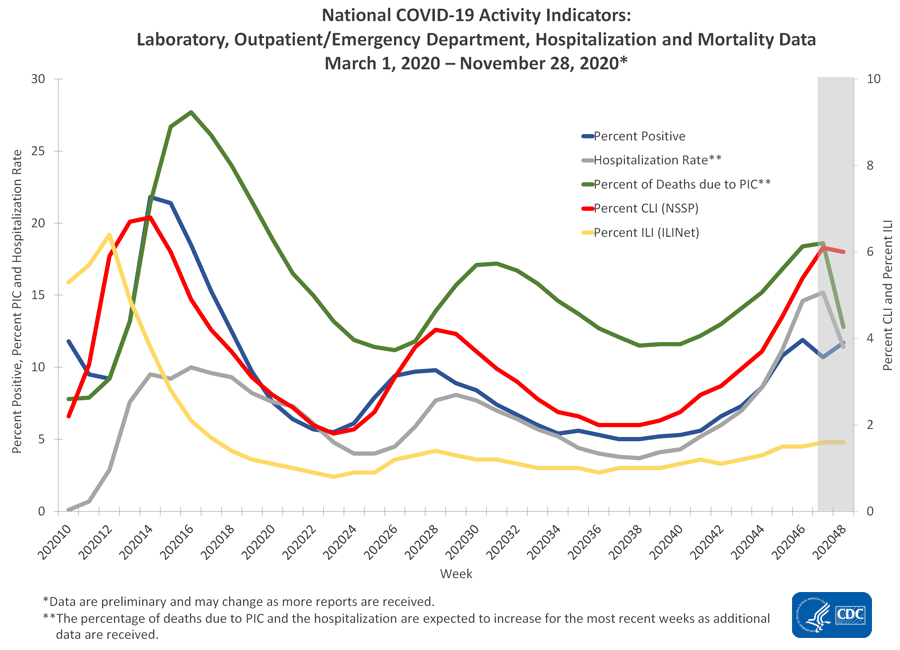
source: https://www.cdc.gov/coronavirus/2019-ncov/covid-data/covidview/index.html
The Impact of Thanksgiving
The 4 day Thanksgiving holiday period put a wobble in the trends. Over weekends and holidays, the number of new cases and deaths decline. Over weekends, this is not a problem for week-over-week rolling averages as weekends are compared against the previous weekend. But when a holiday falls within a working week, a non-working day is compared to a working day which causes havok in the trends. However, hospitalizations historically appear to be little affected by weekends or holidays – the daily counts do not vary significantly from day-to-day [although they are now in record territory and the raw numbers grow every day].
The hospitalization growth rate so far is little changed over the past week which is not good news as it means the number of beds needed is growing around 7 % every week.

The above graph demonstrates in the last week hospitalization rate of growth has been steady. But what we do NOT know right now is the size of the impact of commingling and travel over the Thanksgiving holiday period – although it has slowed the decline in the rate of growth that we were seeing before . The CDC says it will have caused a significant growth in new cases, hospitalizations, and deaths. Historically, hospitalization growth follows new case growth by one to two weeks. That means this week we will be able to measure the impact of Thanksgiving on the spread of COVID-19.
As an analyst, I use rate of growth to determine the trend. But, the size of the pandemic is growing in terms of real numbers – and if the rate of growth does not become negative – the pandemic will overwhelm all resources.
The graph below shows the rate of growth relative to the growth a week earlier updated through today [note that negative numbers mean the rolling averages are LOWER than the rolling averages one week ago]. As one can see, the rate of growth for new cases peaked over one month ago and the rate of growth has been decelerating.

This graph is currently demonstrating that the recent actions to contain the pandemic were beginning to bite – but have now been impacted by Thanksgiving. In the scheme of things, new cases decline first, followed by hospitalizations, and then deaths.
It is up to each of our readers to protect themselves and others by washing your hands, wearing a mask, avoiding crowds, and maintaining social distancing.
Coronavirus News You May Have Missed
Jumping the line for a vaccine will be pretty easy – Axios
After the first round of coronavirus vaccines is administered, state and local officials largely will not be able to ensure that the rest of the process puts high-risk people first.
Between the lines: Experts have spent months debating the ins and outs of a complex prioritization system for these vaccines, all in the hopes of saving as many lives as possible. But the actual process will likely rely heavily on the honor system.
The big picture: It’ll be relatively easy to ensure that the highest-priority groups — health care workers and nursing-home residents — are the ones who actually receive the first vaccine doses, because hospitals and long-term care facilities can just go through their staff and resident rosters to figure out who should be offered a vaccine.
- “Right now we’re very much focused on getting it to the hospitals and the nursing homes, and they’ll be what we call a closed point of distribution,” said Bryan Mroz, Acting Assistant Secretary of the Maryland Department of Health.
But after that, enforcement gets harder. Experts have said the next round of doses should be focused on people who are most at risk to catch or spread the virus, or for serious illness. That would include many service workers and people with underlying health conditions.
[editor’s note: this is a good article to read completely]
- But there aren’t great enforcement tools to make sure that’s how things work.
- “Eventually you’ll get to the point where there’s a lot of providers and distribution points involved in this plan, and it’s going to be harder and harder to ensure you adhere strictly to these priority groups. I’m sure there will be a point where we see line jumping,” said Josh Michaud, associate director of global health policy at the Kaiser Family Foundation.
- “As far as enforcement, states will try to direct vaccines as best as they can to reach the populations they want to, but once they’re at those distribution points, it’s hard to control this process,” he added.
AstraZeneca to work on Covid vaccine combinations with Russia’s Sputnik V developers – CNBC
[editor’s note: per the New York Times – “Vaccination often requires one injection and then a boost, and the process can take two forms: giving the same vaccine multiple times, a technique known as “homologous boosting,” or combining different, yet similar vaccines, called “heterologous boosting.” By combining different but similar vaccines, AstraZeneca and the Russian Investment Fund said they were hoping to boost the immune protection of people who may receive the injections. The Gamaleya Research Institute of Epidemiology and Microbiology in Moscow, which develops the Sputnik V vaccine, uses two different human adenoviruses to develop its product. AstraZenca uses an adenovirus that infects chimpanzees.”
- The move comes shortly after the developers of the Sputnik V Covid-19 vaccine approached AstraZeneca via Twitter late last month to ask whether they should try combining the two common cold virus-based vaccines to boost efficacy.
- The Russian Direct Investment Fund said clinical trials of AstraZeneca’s vaccine in combination with its own would begin by the end of the month.
- The co-operation between AstraZeneca and Russia’s state-backed science research institute is likely to be seen as a vote of confidence in Moscow’s Sputnik V vaccine.
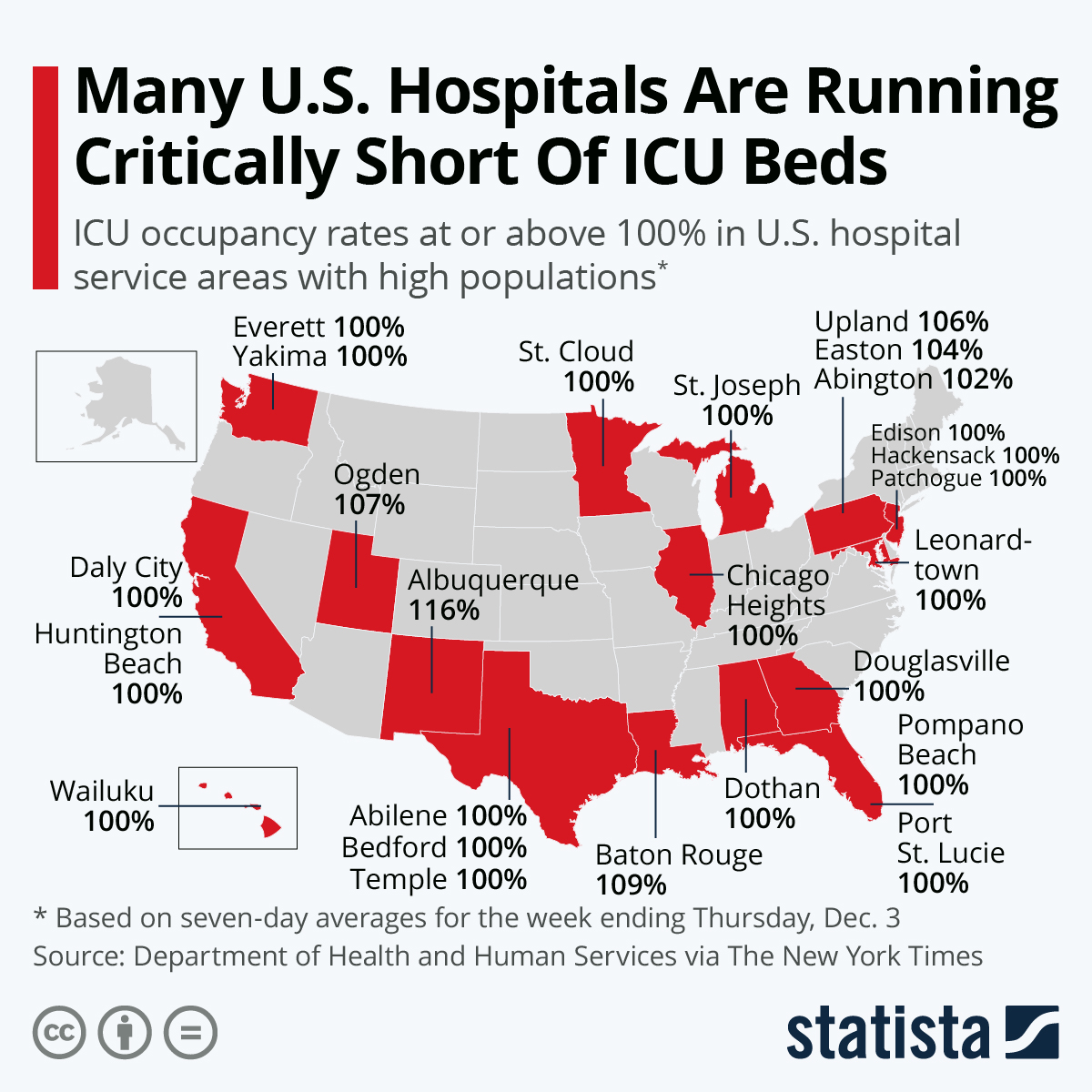
Many U.S. Hospitals Are Running Critically Short Of ICU Beds – Statista
Department of Health and Human Services data reported by the New York Times has detailed average U.S. hospital and ICU bed occupancy rates for the week ending December 03. It paints an extremely disturbing picture of health system that is buckling under the strain of the pandemic in some parts of the country. Current hospital capacity stands at 59 percent while ICU occupancy is 72 percent, with both figures climbing steadly. The numbers are already significantly higher than that in some parts of the country. 2,200 counties were included in the analysis and the average hospital is 90 percent in 126 of them and well above that in some countries in Kentucky, Georgia, Minnesota, Oklahoma and Texas.
According to the dataset, ICU bed capacity is already at or above 100 percent in 113 hospital service areas with the highest occupancy rate seen in Cullman, Alabama, at 131 percent. It also looked at how things are developing in areas with a high population, an ominous trend which is illustrated on this map. There are zero ICU beds available in Albuquerque, for example, which has an occupancy rate of 116 percent. In Baton Rouge, that figure is 106 percent while it stands at 107 percent in Ogden, Utah. The New York Times described the situation in El Paso as marginally better with 13 free ICU beds out of 400 in total, which still makes for an occupancy rate of 95 percent.
More than a third of Americans now live in areas that are running critically short of free ICU beds and that hospitals serving 100 million people reported fewer than 15 available intensive care beds at theend of last week. The situation is worse in some places, however, particularly acrossa swathe of Midwest, South and Southwest. One in 10 people in those areas live in an area where ICU beds are completely full or 95 percent full. The disturbing hospital-level data comes as the U.S. registered more than 3,00 deaths in 24 hours for the first time. With an FDA panel meeting to consider approving Pfizer’s vaccine, there is some badly needed hope on the horizon.
You will find more infographics at Statista
Sanofi/GSK announce delay in COVID-19 vaccine after interim results show low immune response in older people – USA Today
Sanofi and GlaxoSmithKline (GSK) announced Friday a delay in their COVID-19 vaccine program after study results found older patients failed to demonstrate a sufficient immune response against the coronavirus.
The companies said in a joint statement the low immune response was likely due to an insufficient concentration of the antigen, which triggers the immune system to create antibodies to fight the coronavirus.
“The results of the study are not as we hoped,” Roger Connor, president of GSK Vaccines, said in the press release. “Our aim now is to work closely with our partner Sanofi to develop this vaccine, with an improved antigen formulation, for it to make a meaningful contribution to prevention COVID-19.”
Phase 1/2 trial interim results found participants between 18 and 49 years old showed an immune response comparable to patients who recovered from COVID-19. In addition, they reported positive results from a “challenge study” in which non-human primates were intentionally exposed to the virus.
First vaccinations could come Monday or Tuesday from Pfizer vaccine – The Hill
Secretary of Health and Human Services Alex Azar on Friday said that the first vaccinations outside of a clinical trial with the Pfizer coronavirus vaccine could come as soon as Monday or Tuesday.
The Food and Drug Administration is expected to within days issue an emergency use authorization for the vaccine after an advisory panel to the agency voted to give it the green light on Thursday.
The FDA indicated an authorization would come soon in a statement on Friday.
“Following yesterday’s positive advisory committee meeting outcome regarding the Pfizer-BioNTech COVID-19 vaccine, the U.S. Food and Drug Administration has informed the sponsor that it will rapidly work toward finalization and issuance of an emergency use authorization,” the FDA said. “The agency has also notified the U.S. Centers for Disease Control and Prevention and Operation Warp Speed, so they can execute their plans for timely vaccine distribution.”
Azar said during an appearance on ABC that “we should be seeing the authorization of this first vaccine” in “the next couple of days.”
[editor’s note: also The F.D.A. is expected to issue the Pfizer vaccine authorization on Friday evening. Also the video below discusses why two members of the FDA advisory panel on the Pfizer-BioNTech vaccine voted against approval]
Australia Cancels COVID Vaccine Trial being developed by the University of Queensland Over ‘Unexpected’ False Positives For HIV – The Guardian
The Australian government has terminated its agreement with Australian biotech company CSL Limited to supply 51m doses of a Covid-19 vaccine being developed by the University of Queensland, after vaccine trial participants returned false positive test results for HIV.
Australia had hoped the protein vaccine would be available by mid-2021. Phase one clinical trials in humans began in July in Brisbane, with phase two and three clinical trials due to commence in December. It is one of four vaccines secured by the Australian government.
But on Friday the Australian prime minister, Scott Morrison, said: “University of Queensland vaccine will not be able to proceed based on the scientific advice, and that will no longer feature as part of Australia’s vaccine plan.
“I think the decision we’ve made today should give Australians great assurance that we are proceeding carefully, we are moving swiftly, but not with any undue haste here,” he said.
The following are foreign headlines with hyperlinks to the posts
One year on, Wuhan market at epicentre of virus outbreak remains barricaded and empty
Australia Vaccine: Prime Minister Scott Morrison says his government won’t rush approval of Pfizer’s vaccine as he wants people to have confidence in the product.
Responding to similar pressures, the European Central Bank announced that it will ramp up its bond-buying program to try to hold down longer-term interest rates to spur borrowing and spending.
EU leaders have sealed an agreement on a massive long-term budget and coronavirus recovery package after they overcame objections from Hungary and Poland.
In Canada, COVID-19 Vaccine Transport Rules Will Keep Early Doses Out of Most Care Homes
More Than a Quarter of British Hesitant About COVID Vaccine, Study Finds
Germany hits new virus case record for 2nd straight day
Emirates president Tim Clark says business travel could bounce back in 2022
The following additional national and state headlines with hyperlinks to the posts
McConnell rejects bipartisan Covid relief plan while House adjourns until next week
CDC director: US COVID-19 deaths likely to exceed 9/11 toll for 60 days
California’s Confusing Messages: Health officials are urging the state’s residents to stay home as much as possible because of a surge taxing the state’s hospitals. But the most recent stay-at-home order allows Californians to do many more activities than the March shutdown that made the state a model on how to respond to the virus.
South Africa: The country is seeing a dramatic rise in cases and is bracing for increased hospitalizations and deaths.
India Vaccine: Serum Institute of India, the world’s largest manufacturer of vaccines, is increasing its production capacity by the end of 2021 to over 2.5 billion doses a year to cope with future disease outbreaks.
12 million Americans are set to lose their unemployment benefits the day after Christmas. Eviction moratoriums for renters and protections for student borrowers are also set to expire, as well as a federal program for paid family leave. And congressional negotiations are still at an impasse.
Boston Biotechnology Conference Led to 300,000 COVID-19 Cases
Dr. Anthony Fauci and frontline medical workers were named TIME Magazine’s Guardians of the Year
In Iowa, more than 1 in every 1,000 residents have died of COVID-19.
FedEx, UPS to ‘split country into two’ for vaccines
Facebook will not require employees to get a vaccine
As the pandemic surge continued, a third of U.S. hospitals reported 90%-100% occupancy of ICU beds, and patients with COVID-19 occupied almost half of all ICU beds at the country.
New Hampshire House Speaker Dick Hinch died of COVID-19, just a week after being sworn into office.
The Tarrant County (Texas) medical examiner requisitioned two refrigerated trucks to relieve storage shortages at the county morgue.
Cuomo shutters indoor dining in New York City as COVID spikes
Fauci addresses Black Americans’ vaccine concerns: This was ‘developed by an African American woman’
United Airlines flight attendants asked to keep working after COVID-19 exposure: report
California County Urges Hospitals to Halt Elective Surgeries
California COVID Cases Surge as Sonoma County Issues Stay-at-Home Order
More Americans Have Died From Coronavirus Than in Combat During WWII
COVID Cases in NY Near Previous Peak 5 Months After Fauci Praised Handling
Va. Gov. Requires Masks Indoors and Ties COVID Spread to Worship Services
After more than 3,000 U.S. deaths in a day, a warning: ‘The worst is yet to come.’
Already hobbled by remote learning, schools confront a growing problem: hackers.
Even as Covid-19 infections reach record levels, a growing number of colleges and universities are determined to bring students back for the spring semester.
Today’s Posts On Econintersect Showing Impact Of The Pandemic With Hyperlinks
Preliminary December 2020 Michigan Consumer Sentiment Improved Due To Biden Win
November 2020 Producer Price Final Demand Continues To Show Modest Year-over-Year Growth
Rail Week Ending 05 December 2020 – Improvement Continues
Office Return Stalls In The U.S.
Warning to Readers
The amount of politically biased articles on the internet continues to increase. And studies and opinions of the experts continue to contradict other studies and expert opinions. Honestly, it is difficult to believe anything anymore. A study usually cannot establish cause and effect – but only correlation. Be very careful what you believe about this pandemic.

I assemble this coronavirus update daily – sifting through the posts on the internet. I try to avoid politically slanted posts (mostly from CNN, New York Times, and the Washington Post) and can usually find unslanted posts on that subject from other sources on the internet. I wait to publish posts on subjects that I cannot validate across several sources. But after all this extra work, I do not know if I have conveyed the REAL facts. It is my job to provide information so that you have the facts necessary – and then it is up to readers to draw conclusions.
Analyst Opinion of Coronavirus Data
There are several takeaways that need to be understood when viewing coronavirus statistical data:
- The global counts are suspect for a variety of reasons including political. Even the U.S. count has issues as it is possible that as much as half the population has had coronavirus and was asymptomatic. It would be a far better metric using a random sampling of the population weekly. In short, we do not understand the size of the error in the tracking numbers.
- Just because some of the methodology used in aggregating the data in the U.S. is flawed – as long as the flaw is uniformly applied – you establish a baseline. This is why it is dangerous to compare two countries as they likely use different methodologies to determine who has (and who died) from coronavirus.
- COVID-19 and the flu are different but can have similar symptoms. For sure, COVID-19 so far is much more deadly than the flu. [click here to compare symptoms]
- From an industrial engineering point of view, one can argue that it is best to flatten the curve only to the point that the health care system is barely able to cope. This solution only works if-and-only-if one can catch this coronavirus once and develops immunity. In the case of COVID-19, herd immunity may need to be in the 80% to 85% range. WHO warns that few have developed antibodies to COVID-19. At this point, herd immunity does not look like an option although there is now a discussion of whether T-Cells play a part in immunity [which means one might have immunity without antibodies]
- Older population countries will have a higher death rate.
- There are at least 8 strains of the coronavirus. New York may have a deadlier strain imported from Europe, compared to less deadly viruses elsewhere in the United States.
- Each publication uses different cutoff times for its coronavirus statistics. Our data uses 11:00 am London time. Also, there is an unexplained variation in the total numbers both globally and in the U.S.
What we do not know about the coronavirus [actually there is little scientifically proven information]. Most of our knowledge is anecdotal, from studies with limited subjects, or from studies without peer review.
- How many people have been infected as many do not show symptoms?
- Masks do work.
- Do we develop lasting immunity to the coronavirus? Another coronavirus – the simple cold – does not develop long term immunity.
- To what degree do people who never develop symptoms contribute to transmission? Research early in the pandemic suggested that the rate of asymptomatic infections could be as high as 81%. But a meta-analysis, which included 13 studies involving 21,708 people, calculated the rate of asymptomatic presentation to be 17%.
- The accuracy of rapid testing is questioned – and the more accurate test results are not being given in a timely manner.
- Can children widely spread coronavirus? [current thinking is that they are a minor source of the pandemic spread]
- Why have some places avoided big coronavirus outbreaks – and others hit hard?
- Air conditioning contributes to the pandemic spread.
- Outdoor activities seem to be a lower risk than indoor activities.
- It seems a vaccine will be available before the end of the year – the question is how effective it will be in the general population AND how long immunity will last.
- Will other medical treatments for Covid-19 ease symptoms and reduce deaths? So far only two drugs (remdesivir and Regeneron) are approved for treatment.
- A current scientific understanding of the way the coronavirus works can be found [here].
Heavy breakouts of coronavirus have hit farm workers. Farmworkers are essential to the food supply. They cannot shelter at home. Consider:
- they have high rates of respiratory disease [occupational hazard]
- they travel on crowded buses chartered by their employers
- few have health insurance
- they cannot social distance and live two to four to a room – and they eat together
- some reports say half are undocumented
- they are low paid and cannot afford not to work – so they will go to work sick
- they do not have access to sanitation when working
- a coronavirus outbreak among farmworkers can potentially shutter entire farm
The bottom line is that COVID-19 so far has been shown to be much more deadly than the data on the flu. Using CDC data, the flu has a mortality rate between 0.06 % and 0.11 % Vs. the coronavirus which to date has a mortality rate of 4 % [the 4% is the average of overall statistics – however in the last few months it has been hovering around 1.0%] – which makes it between 10 and 80 times more deadly. The reason for ranges:
Because influenza surveillance does not capture all cases of flu that occur in the U.S., CDC provides these estimated ranges to better reflect the larger burden of influenza.
There will be a commission set up after this pandemic ends to find fault [it is easy to find fault when a once-in-a-lifetime event occurs] and to produce recommendations for the next time a pandemic happens. Those that hate President Trump will conclude the virus is his fault.
Resources:
- Get the latest public health information from CDC: https://www.coronavirus.gov .
- Get the latest research from NIH: https://www.nih.gov/coronavirus.
- Find NCBI SARS-CoV-2 literature, sequence, and clinical content: https://www.ncbi.nlm.nih.gov/sars-cov-2/.
- List of studies: https://icite.od.nih.gov/covid19/search/#search:searchId=5ee124ed70bb967c49672dad
include(“/home/aleta/public_html/files/ad_openx.htm”); ?>


