


Written by Steven Hansen
The U.S. new cases 7-day rolling average is 10.0 % HIGHER than the 7-day rolling average one week ago. U.S. deaths due to coronavirus are now 36.1 % HIGHER than the rolling average one week ago. U.S. hospitalizations due to COVID-19 are now 9.6 % HIGHER than the rolling average one week ago. Today’s posts include:
- U.S. Coronavirus New Cases are at a record 227,885
- U.S. Coronavirus deaths are at a near-record 2,607
- U.S. Coronavirus hospitalizations are at a record 101,276
- The 7-day rolling average rate of Growth of the Pandemic shows new cases worsened, hospitalizations unchanged, and deaths worsened [note that there was the usual under-reporting over holiday periods and over-reporting for days after the holiday ends which accounts for the surge we are now seeing.]
- CDC Urges Universal Indoor Mask Use When Not At Home.
- Reinfection reports are still rare but steadily growing around the world, and they’re likely underreported
- Fact Check: Has COVID-19 Had No Impact on Overall US Deaths This Year?
- Survey Finds Asian Americans Are Racial Or Ethnic Group Most Willing To Get Vaccine
- Poll shows 61 percent of Americans likely to take COVID-19 vaccine
- Convincing You To Get The Coronavirus Vaccine
- Cost-cutting measures still planned for end of year
- Europe’s Loss: The Long-term Economic Impact of COVID-19

The recent worsening of the trendlines for new cases should be attributed to going back to college/university, cooler weather causing more indoor activities, possible mutation of the virus, fatigue from wearing masks / social distancing, holiday activities, political rallies / voting, and continued loosening of regulations designed to slow the coronavirus spread.
My continuing advice is to continue to wash your hands (especially after using the toilet as COVID first sheds in your stool), putting down the toilet seat (as flushing the toilet releases a plume), wear masks, avoid crowds, and maintain social distancing. No handwashing, mask, or social distancing will guarantee you do not get infected – but it sure as hell lowers the risk in all situations – and the evidence to-date shows a lower severity of COVID-19. In addition, certain activities are believed to carry higher risk – like being inside in air conditioning and removing your mask (such as restaurants, around your children/grandchildren, bars, and gyms). It is all about viral load – and outdoor activities are generally safe if you can maintain social distance.
include($_SERVER[‘DOCUMENT_ROOT’].’/pages/coronavirus1.htm’); ?>
Hospitalizations (grey line) and Mortality (green line)
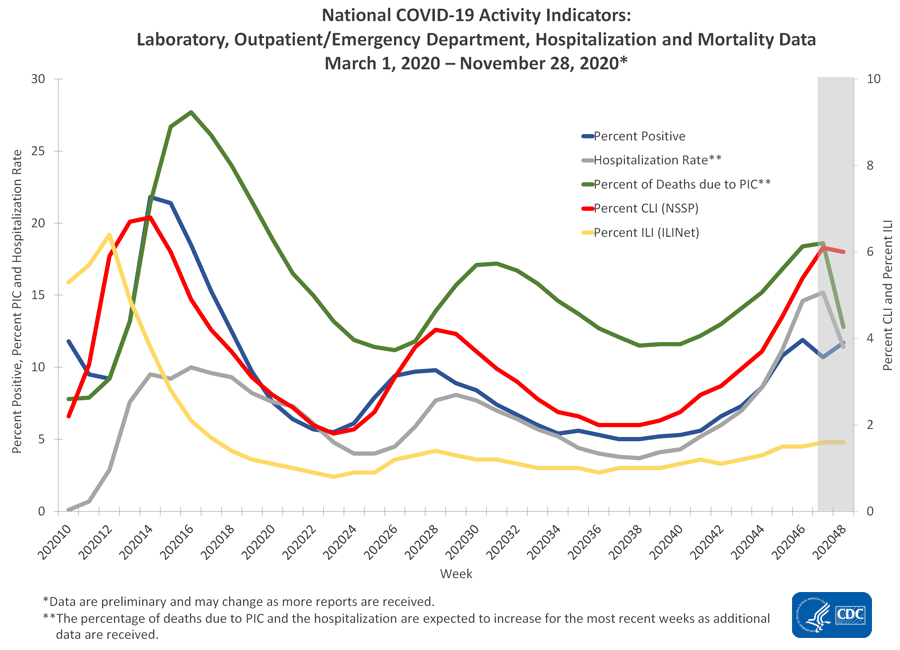
source: https://www.cdc.gov/coronavirus/2019-ncov/covid-data/covidview/index.html

The Seven Day Rolling Average Rate of growth Trends for pandemic new cases worsened, hospitalizations worsened, and deaths worsened
Too many headlines are telling you the pandemic is out of control. Anyone with analytical abilities knows this is not true. For this to be true, the rate of growth needs to continue to rise.
No doubt, the pandemic is elevated and we must take steps to minimize our exposure to the virus.
The graph below shows the rate of growth relative to the growth a week earlier updated through today [note that negative numbers mean the rolling averages are LOWER than the rolling averages one week ago]. As one can see, the rate of growth for new cases peaked over one month ago and the rate of growth has been decelerating.

This graph is currently demonstrating that the recent actions to contain the pandemic were beginning to bite – but have now been impacted by Thanksgiving. In the scheme of things, new cases decline first, followed by hospitalizations, and then deaths.
It is up to each of our readers to protect themselves and others by washing your hands, wearing a mask, avoiding crowds, and maintaining social distancing.
Coronavirus News You May Have Missed
Fact Check: Has COVID-19 Had No Impact on Overall US Deaths This Year? – Newsweek
In late November, the student-run Johns Hopkins News-Letter published a story, since retracted, about a study claiming that there have been no extra deaths, known as “excess deaths,” in the U.S. this year from COVID-19 compared to deaths expected in an otherwise normal year.
The story was published on November 22, then taken down, with a retraction published on November 27. The retraction said the study cited in the story “has been used to support dangerous inaccuracies that minimize the impact of the pandemic.”
Anderson said taking down the story was warranted.
“The study was retracted by the newsletter for a reason,” Anderson said. “It’s because it wasn’t very good at all.”
The student-run publication said its decision was made “to stop the spread of misinformation,” and it acknowledged that it had inaccurately claimed that there was “no evidence that COVID-19 created any excess deaths” and that number of total deaths were “not above normal death numbers.”
In its retraction, the Johns Hopkins student publication said Briand is neither a medical professional nor a disease researcher.
This year, there have been nearly 300,000 excess deaths attributed to COVID-19, as of early October, according to Centers for Disease Control and Prevention (CDC) data
But data from the CDC contradict the original story’s reporting, as well as Briand’s analyses and claims.
“As of October 15, 216,025 deaths from COVID-19 have been reported in the United States; however, this might underestimate the total impact of the pandemic on mortality,” according to the CDC.
“Overall, an estimated 299,028 excess deaths occurred from late January through October 3, 2020, with 198,081 (66%) excess deaths attributed to COVID-19,” according to a report on the CDC’s website. “Excess deaths are defined as the number of persons who have died from all causes, in excess of the expected number of deaths for a given place and time.”
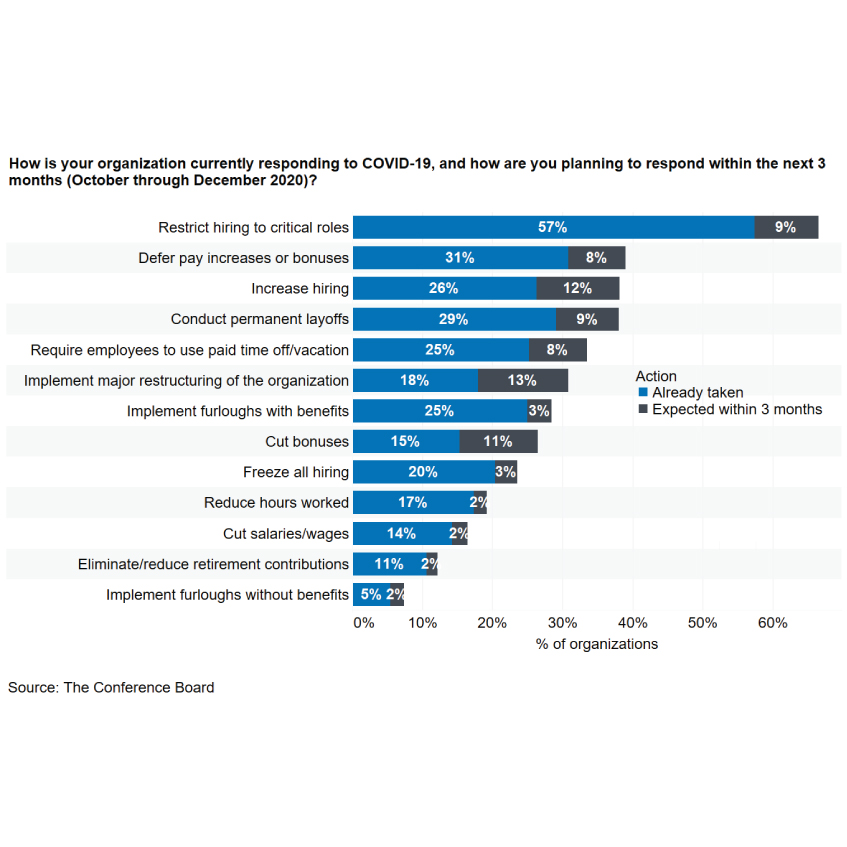
Cost-cutting measures still planned for end of year – The Conference Board
The financial pain employees experienced during the pandemic is likely not over yet. According to our recent survey of 330 HR executives at US companies, cost-cutting measures may still be in the works for the final month of 2020. When asked in September, 13 percent of surveyed companies planned to restructure their organization between October and December, 11 percent planned to cut bonuses, 9 percent planned to conduct permanent layoffs, and 8 percent planned to defer pay increases and bonuses. On the positive side, many organizations have been able to reverse some of the cost-cutting actions they took at the beginning of the pandemic, specifically around reducing salaries and wages (25 percent fully reversed).
While some businesses have restored cuts made early in the pandemic, many continue to struggle, with dire results for employees. More than one-third of respondents do not expect their organization’s revenue to return to prepandemic levels within the next year.
Survey Finds Asian Americans Are Racial Or Ethnic Group Most Willing To Get Vaccine – NPR
A wide-ranging survey shows Americans’ willingness to receive a coronavirus vaccine when it becomes publicly available and confidence in its effectiveness are on the rise.
But when broken down by racial or ethnic group, Black respondents show the most reluctance, with less than half saying they will do so.
The survey by the Pew Research Center found that 60% of Americans overall say they would definitely or probably get a vaccine for the coronavirus if it were available today.
While that figure is 9% higher than it was in September, it still lags behind the 72% of Americans who said in May they would get the vaccine, when clinical trials for a vaccine were just getting underway.
Roughly four in 10 respondents overall (39%) say they would definitely not or probably not get a vaccine, according to Pew.
However, about half of that cohort did leave open the possibility they could change their mind once more information is available and once others get vaccinated. The other half said they are “pretty certain” more information will not change their decision.
A whopping 83% of “English-speaking Asian Americans…say they would definitely or probably get vaccinated,” outpacing all other racial or ethnic groups, according to Pew.
White and Latinx respondents answered about the same, with 63% and 61% respectively saying they definitely or probably would get the vaccine.
“Black Americans continue to stand out as less inclined to get vaccinated than other racial and ethnic groups,” according to Pew, which found that just 42% of African Americans said they would get one when made publicly available.
This figure may be surprising to some, given that 71% of Black respondents told researchers they knew someone who has died or been hospitalized due to the virus, nearly 20 points higher than Americans overall (54%).
Poll shows 61 percent of Americans likely to take COVID-19 vaccine – National Geographic

Delirium May Be Initial COVID-19 Symptom in Older Adults – MedPage
Delirium is well recognized as one of the first signs, and often the sole sign, of an infection in older adults. Older, severely ill adults seen in the ED often present with this acute disturbance in cognition, also referred to as encephalopathy, although it is commonly not detected.
The first prospective study of neurologic disorders in hospitalized patients with confirmed COVID-19 in the U.S. showed that encephalopathy was the most common new-onset neurologic manifestation, affecting 6.8%.
Retrospective reports have shown an even higher prevalence of delirium or encephalopathy, with rates increasing from 42% at onset of COVID-19 to 62% at hospitalization, though some have not assessed the potential roles of sedation or pre-existing conditions.
Similarly, a study from Wuhan, China, found that neurologic manifestations — most commonly dizziness, headache, and an altered level of consciousness — were more prevalent in patients in critical condition compared with those with mild or moderate presentations of the disease (45.5% vs 30.2%).
In a recent multicenter cohort study, older adults admitted to the ED and diagnosed with SARS-CoV-2 infection often presented with delirium and no other COVID-19 symptoms, reported Maura Kennedy, MD, MPH, of Massachusetts General Hospital in Boston, and colleagues.
About 28% of COVID-19 patients 65 and older presented to the ED with delirium, and delirium was a primary symptom in 16% of these patients. Furthermore, more than a third (37%) of patients with delirium did not present with typical COVID-19 signs like fever or shortness of breath, they wrote in JAMA Network Open.
Reinfection reports are still rare but steadily growing around the world, and they’re likely underreported. – National Geographic
People can catch COVID-19 twice. That’s the emerging consensus among health experts who are learning more about the possibility that those who’ve recovered from the coronavirus can get it again. So far, the phenomenon doesn’t appear to be widespread—with a few hundred reinfection cases reported worldwide—yet those numbers are likely to expand as the pandemic continues.
Identifying reinfections is tricky: Not only does it take a while for subsequent bouts to show up, health departments must make sure that alleged cases really are reinfections because coronavirus residue can linger for weeks. For example, University of Alabama football coach Nick Saban made headlines just before Thanksgiving when he tested positive for a second time. But it is unclear if he was truly reinfected because of a blindspot in how officials screened for cases during his first episode back in October.
… Reinfections are hard to document because researchers can’t simply rely on patients’ accounts of return symptoms or on routine COVID-19 tests involving polymerase chain reaction (PCR). They need stronger genetic proof, which calls for different technologies.
A new mutation appears in SARS-CoV-2 every 15 days, on average. So far, those natural changes are not so extensive that they alter the nature or potency of the coronavirus, aka it isn’t a new strain. But they can provide evidence that the patient’s second bout wasn’t the same as the original infection.
“It’s not that patients get re-infected from a new strain,” says Nathan Grubaugh, assistant professor of epidemiology at Yale School of Public Health in New Haven, Connecticut. Such sequencing data, he says, simply offers a “genetic signature” to show if the recurrence of the disease stems from a new infection.
… But it takes time to prove if immunity to any disease is durable. For early clues to how COVID-19 might behave, health experts tried to divine the risk of reinfection by looking at other human coronaviruses. For example, one study of four seasonal coronaviruses published in September in Nature Medicine found that reinfections could occur as soon as six or nine months later, but were more likely to be observed at 12 months. But a body’s response to SARS-CoV-2 is unlike that of seasonal viruses because humans and those latter germs have had time to adapt to each other.
[editor’s note: an interesting article which deserves a full read. Also read: Recent data suggests people who were once infected with the coronavirus could be infected again as their antibody response wanes]
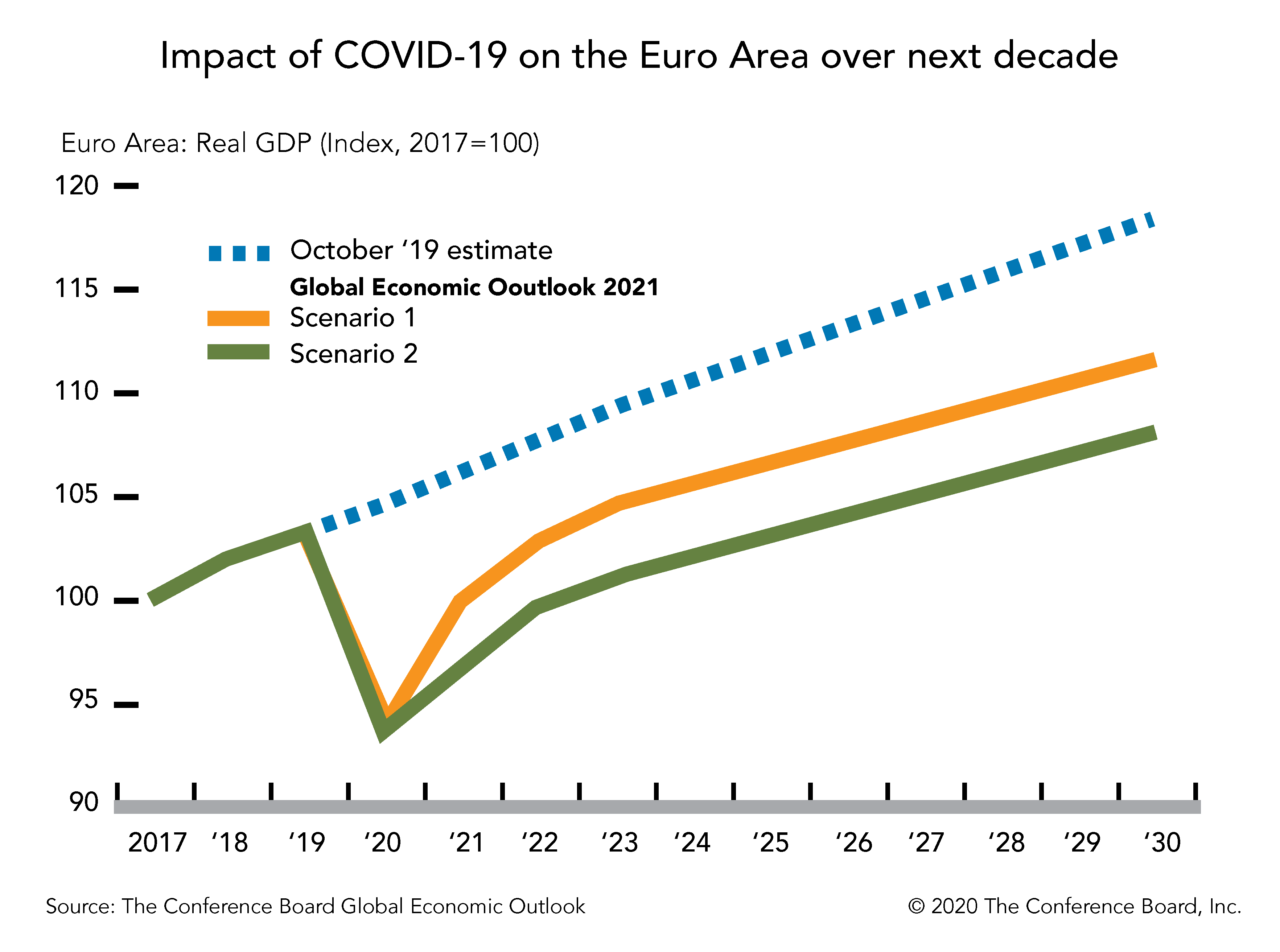
Europe’s Loss: The Long-term Economic Impact of COVID-19 – The Conference Board
Among mature economies, the Euro Area has been one of the most adversely affected by the shock of the COVID-19 pandemic. Euro Area GDP is expected to finish 2020 with a -8.4 percent decline compared with an average decline of -5.4 percent for all mature economies. Growth will pick up in 2021, but how will this shock affect growth later in the decade?
Compared to estimates The Conference Board made in 2019, the Euro Area economy will likely be 6 percent smaller by 2030 than initially projected (scenario 1 in chart). According to a more pessimistic projection (scenario 2 in chart), however, this gap could be as large as 9 percent. This loss in economic output is partly due to the deep recession caused by the pandemic but is also the result of anemic long-term potential growth rates beyond 2023.
For more a more detailed look at The Conference Board Euro Area outlook, download our new report: “GEO 2021 Europe: Uncertainty Lingers in 2021, Slow Growth Returns for the Long Term“
And Now For An Important Message: Convincing You To Get The Coronavirus Vaccine – NPR
For 78 years, the Advertising Council has been helping Americans face national challenges. From Smokey Bear’s “remember, only you can prevent forest fires,” to “loose lips sink ships” during World War II and the 1990s campaign friends don’t let friends drive drunk.
More recently, during the coronavirus pandemic, the nonprofit advertising group launched a #MaskUpAmerica campaign.
Now the Ad Council is preparing to convince people that a coronavirus vaccine is safe. Only about 60% of American adults say they would get the vaccine, according to a recent survey by the Pew Research Center. That’s up from about 50% in September, well before vaccines were announced.
Lisa Sherman, president and CEO of the Ad Council, tells NPR’s All Things Considered that the $50 million campaign will be the most significant in the group’s history. It’s “our moonshot moment. We’re approaching this with the size and the speed and the scale and the urgency unlike anything we’ve ever done before.”
CDC urges ‘universal’ indoor mask use when not at home – The Hill
The Centers for Disease Control and Prevention (CDC) on Friday recommended the “universal use of face masks” as a key step to fighting the coronavirus pandemic, warning the U.S. has “entered a phase of high-level transmission.”
The agency recommended in a report that officials at the state and local level “issue policies or directives mandating universal use of face masks in indoor (nonhousehold) settings” as one strategy to combat the virus, a tactic President Trump and many GOP governors have resisted.
The CDC said wearing a mask is most important when someone is indoors somewhere besides their house and outdoors when six feet of distance cannot be maintained. Masks should also be used inside one’s household when someone is infected or has had recent exposure to the virus, the report said.
Fauci’s Timeline for When He Thinks America Will Beat COVID – Newsweek
The U.S. COVID-19 outbreak will “get worse before it gets better” and the country won’t see “dramatic changes” until the third quarter of next year, Dr. Anthony Fauci told Newsweek.
Speaking to Newsweek, the director of the National Institute of Allergy and Infectious Diseases (NIAID) and member of the White House COVID-19 task force said: “I think the decreases are going to start as we get into April and as more of the general population gets vaccinated.
“Then as you get to May, June and July, towards the end of the second quarter of 2021, I think you’re going to start seeing some dramatic changes as we go into the third quarter.
Noting the country “never got out of the first wave” of the COVID-19 outbreak, Fauci explained: “I don’t even talk in waves anymore [when describing the outbreak]. I see it more like a high background with different surges super-imposed upon it, as opposed to a wave that comes and goes.”
The following are foreign headlines with hyperlinks to the posts
Bahrain follows Britain in approving Pfizer’s vaccine for emergency use before the U.S. does.
Stay home this Christmas, a Canadian premier begs citizens.
The following are additional national and state headlines with hyperlinks to the posts
Education Department Extends Student Loan Payment Freeze Through January
State, local officials plead for vaccine distribution funds
Alabama Republican becomes third House member to test positive for COVID-19 this week
Progressives push for direct payments to be included in COVID-19 relief deal
Pressure on Southern California ICU Capacity Triggers Stay-at-home Order
Updated Guidance Urges Kids to Wear Face Masks During Most Youth Sports
A stay-at-home order has been issued by heath officials in the San Francisco Bay Area
Cases surge in the Northeast and Mid-Atlantic, often exceeding the scale of the spring outbreak.
Restaurants in Washington State defy governor and invite guests inside.
As Miami’s cases soar, officials plead with residents to stay home for the holidays
A coronavirus outbreak hobbles an unemployment center in Oregon.
The Rose Bowl will be played in front of an empty stadium.
Ford Motor is delaying the launch of its upcoming Bronco SUV to the summer of next year due to coronavirus-related problems in its supply chain
Children and young teens could get a Covid-19 vaccine in the second half of next year,
The restaurant industry lost 17,400 jobs in November, marking the first month since April that food and drinking places have seen employment shrink.
Hawaii is offering free round trips to remote workers who want to live there temporarily
Covid-19 is raging through overcrowded California prisons
First shipments of coronavirus vaccine will fall short
Today’s Posts On Econintersect Showing Impact Of The Pandemic With Hyperlinks
November 2020 Kansas City Fed Manufacturing Marginally Declines
What Are Emergency Use Authorizations, And Do They Guarantee That A Vaccine Or Drug Is Safe?
How A Flu Virus Shut Down The US Economy In 1872 By Infecting Horses
Warning to Readers
The amount of politically biased articles on the internet continues to increase. And studies and opinions of the experts continue to contradict other studies and expert opinions. Honestly, it is difficult to believe anything anymore. A study usually cannot establish cause and effect – but only correlation. Be very careful what you believe about this pandemic.

I assemble this coronavirus update daily – sifting through the posts on the internet. I try to avoid politically slanted posts (mostly from CNN, New York Times, and the Washington Post) and can usually find unslanted posts on that subject from other sources on the internet. I wait to publish posts on subjects that I cannot validate across several sources. But after all this extra work, I do not know if I have conveyed the REAL facts. It is my job to provide information so that you have the facts necessary – and then it is up to readers to draw conclusions.
Analyst Opinion of Coronavirus Data
There are several takeaways that need to be understood when viewing coronavirus statistical data:
- The global counts are suspect for a variety of reasons including political. Even the U.S. count has issues as it is possible that as much as half the population has had coronavirus and was asymptomatic. It would be a far better metric using a random sampling of the population weekly. In short, we do not understand the size of the error in the tracking numbers.
- Just because some of the methodology used in aggregating the data in the U.S. is flawed – as long as the flaw is uniformly applied – you establish a baseline. This is why it is dangerous to compare two countries as they likely use different methodologies to determine who has (and who died) from coronavirus.
- COVID-19 and the flu are different but can have similar symptoms. For sure, COVID-19 so far is much more deadly than the flu. [click here to compare symptoms]
- From an industrial engineering point of view, one can argue that it is best to flatten the curve only to the point that the health care system is barely able to cope. This solution only works if-and-only-if one can catch this coronavirus once and develops immunity. In the case of COVID-19, herd immunity may need to be in the 80% to 85% range. WHO warns that few have developed antibodies to COVID-19. At this point, herd immunity does not look like an option although there is now a discussion of whether T-Cells play a part in immunity [which means one might have immunity without antibodies]
- Older population countries will have a higher death rate.
- There are at least 8 strains of the coronavirus. New York may have a deadlier strain imported from Europe, compared to less deadly viruses elsewhere in the United States.
- Each publication uses different cutoff times for its coronavirus statistics. Our data uses 11:00 am London time. Also, there is an unexplained variation in the total numbers both globally and in the U.S.
What we do not know about the coronavirus [actually there is little scientifically proven information]. Most of our knowledge is anecdotal, from studies with limited subjects, or from studies without peer review.
- How many people have been infected as many do not show symptoms?
- Masks do work.
- Do we develop lasting immunity to the coronavirus? Another coronavirus – the simple cold – does not develop long term immunity.
- To what degree do people who never develop symptoms contribute to transmission? Research early in the pandemic suggested that the rate of asymptomatic infections could be as high as 81%. But a meta-analysis, which included 13 studies involving 21,708 people, calculated the rate of asymptomatic presentation to be 17%.
- The accuracy of rapid testing is questioned – and the more accurate test results are not being given in a timely manner.
- Can children widely spread coronavirus? [current thinking is that they are a minor source of the pandemic spread]
- Why have some places avoided big coronavirus outbreaks – and others hit hard?
- Air conditioning contributes to the pandemic spread.
- Outdoor activities seem to be a lower risk than indoor activities.
- It seems a vaccine will be available before the end of the year – the question is how effective it will be in the general population AND how long immunity will last.
- Will other medical treatments for Covid-19 ease symptoms and reduce deaths? So far only two drugs (remdesivir and Regeneron) are approved for treatment.
- A current scientific understanding of the way the coronavirus works can be found [here].
Heavy breakouts of coronavirus have hit farm workers. Farmworkers are essential to the food supply. They cannot shelter at home. Consider:
- they have high rates of respiratory disease [occupational hazard]
- they travel on crowded buses chartered by their employers
- few have health insurance
- they cannot social distance and live two to four to a room – and they eat together
- some reports say half are undocumented
- they are low paid and cannot afford not to work – so they will go to work sick
- they do not have access to sanitation when working
- a coronavirus outbreak among farmworkers can potentially shutter entire farm
The bottom line is that COVID-19 so far has been shown to be much more deadly than the data on the flu. Using CDC data, the flu has a mortality rate between 0.06 % and 0.11 % Vs. the coronavirus which to date has a mortality rate of 4 % [the 4% is the average of overall statistics – however in the last few months it has been hovering around 1.0%] – which makes it between 10 and 80 times more deadly. The reason for ranges:
Because influenza surveillance does not capture all cases of flu that occur in the U.S., CDC provides these estimated ranges to better reflect the larger burden of influenza.
There will be a commission set up after this pandemic ends to find fault [it is easy to find fault when a once-in-a-lifetime event occurs] and to produce recommendations for the next time a pandemic happens. Those that hate President Trump will conclude the virus is his fault.
Resources:
- Get the latest public health information from CDC: https://www.coronavirus.gov .
- Get the latest research from NIH: https://www.nih.gov/coronavirus.
- Find NCBI SARS-CoV-2 literature, sequence, and clinical content: https://www.ncbi.nlm.nih.gov/sars-cov-2/.
- List of studies: https://icite.od.nih.gov/covid19/search/#search:searchId=5ee124ed70bb967c49672dad
Europe’s Loss: The Long-term Economic Impact of COVID-19
include(“/home/aleta/public_html/files/ad_openx.htm”); ?>


