


Written by Steven Hansen
The U.S. new cases 7-day rolling average is 13.4 % HIGHER than the 7-day rolling average one week ago. U.S. deaths due to coronavirus are now 21.4 % HIGHER than the rolling average one week ago. U.S. hospitalizations due to COVID-19 are now 18.1 % HIGHER than the rolling average one week ago. Today’s posts include:
- U.S. Coronavirus New Cases are at an elevated 175,494
- U.S. Coronavirus deaths today fell to an elevated 1,486
- U.S. Coronavirus hospitalizations are at a record 83,227
- Rate of Growth of the Pandemic new cases, hospitalizations, and deaths continued to improve
- More than 2.9 million flyers passed through TSA security over the three-day period that ended Saturday
- A Negative Coronavirus Test Does Not Mean You Can Safely Socialize
- Why the race to find Covid-19 vaccines is far from over
- European countries believed that Germany would always have spare ICU beds for them. Now they’re almost full
- Pandemic puts all eyes on public health
- Covid-19 vaccines may have potentially unpleasant side effects
- US economy hurtles toward ‘COVID cliff’ with programs set to expire
- College students face incredible mental health stressors during COVID-19 pandemic
- WHO warns of COVID-19 third wave, says Europe failed to learn from Asia

The recent worsening of the trendlines for new cases should be attributed to going back to college/university, cooler weather causing more indoor activities, possible mutation of the virus, fatigue from wearing masks / social distancing, holiday activities, political rallies / voting, and continued loosening of regulations designed to slow the coronavirus spread.
My continuing advice is to continue to wash your hands (especially after using the toilet as COVID first sheds in your stool), putting down the toilet seat (as flushing the toilet releases a plume), wear masks, avoid crowds, and maintain social distancing. No handwashing, mask, or social distancing will guarantee you do not get infected – but it sure as hell lowers the risk in all situations – and the evidence to-date shows a lower severity of COVID-19. In addition, certain activities are believed to carry a higher risk – like being inside in air conditioning and removing your mask (such as restaurants, around your children/grandchildren, bars, and gyms). It is all about viral load – and outdoor activities are generally safe if you can maintain social distance.
include($_SERVER[‘DOCUMENT_ROOT’].’/pages/coronavirus1.htm’); ?>
Hospitalizations (grey line) and Mortality (green line) For Week ending 14NOV2020
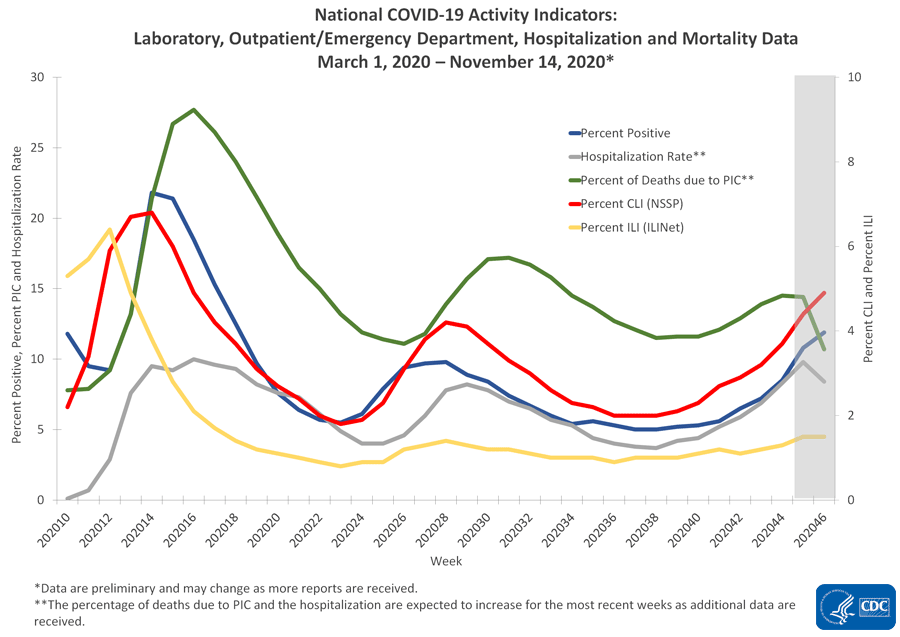
source: https://www.cdc.gov/coronavirus/2019-ncov/covid-data/covidview/index.html
Rate of Growth of Pandemic New Cases, Hospitalizations, and Deaths Continued To Improve Today
Too many headlines are telling you the pandemic is out of control. Anyone with analytical abilities knows this is not true. For this to be true, the rate of growth needs to continue to rise.
No doubt, the pandemic is elevated and we must take steps to minimize our exposure to the virus.
The graph below shows the rate of growth relative to the growth a week earlier updated through today. As one can see, the rate of growth for new cases peaked about one week ago and the rate of growth has been decelerating.

This graph demonstrates that the recent actions to contain the pandemic are beginning to bite.
It is up to each of our readers to protect themselves and others by washing your hands, wearing a mask, avoiding crowds, and maintaining social distancing.
Coronavirus News You May Have Missed
Today Econintersect published two summary articles for the headlines last week:
US economy hurtles toward ‘COVID cliff’ with programs set to expire – The Hill
A slew of expiring emergency programs are setting up an economic “COVID cliff” come 2021, which could see millions of people lose unemployment insurance and get evictions, while a growing wave of small businesses close shop.
March’s CARES Act set up myriad programs to give people economic relief in the earliest days of the COVID-19 pandemic, many of which are set to expire on Dec. 31.
Unless a divided Congress can reach a deal to extend the programs, the country’s economic suffering could skyrocket.
“It’s a lot of risk to be putting on the economy at a time when so many other pressures are already underway,” said Shai Akabas, director of economic policy at the Bipartisan Policy Center.
The prospects of a deal are dim.
House Speaker Nancy Pelosi (D-Calif.), who is pushing for a $2.2 trillion package, and Senate Majority Leader Mitch McConnell (R-Ky.), who endorses a more limited $500 billion approach, have yet to hold a meeting on the subject. Their staffs have not discussed the matter either.
More than 1 million people passed through US airports Friday, despite Covid warnings – CNN
Despite a record number of new Covid cases and the Centers for Disease Control recommending against traveling for Thanksgiving, Friday and Saturday were two of the busiest days at US airports since the pandemic brought air travel to a near halt in March.
The Transportation Security Administration screened slightly more than 1 million people at US airports on Friday. Saturday’s screenings fell just short of that mark, but were enough to bring the two-day total to 2 million.
That’s still only 42% of the volume screened on the Friday and Saturday before Thanksgiving a year ago, but it marks only the second- and third- busiest days for US airport traffic since mid-March. The only time that topped those days was October 18, when 1.03 million passengers were screened.
[editor’s note: according to USA Today: More than 2.9 million flyers passed through TSA security over the three-day period that ended Saturday, including over 1 million on Friday. That marked only the second time the number surpassed 1 million since the start of the pandemic.]
Pandemic puts all eyes on public health – Knowable
The CDC is highly qualified to direct what a national strategy would be. They know how to put a surveillance system together; then they could send their guidance and funding to the state and local agencies. But if the political arm doesn’t allow the scientific arm to do its job, what we have is a muddled mess.
It’s the data system that really drives public health. One example is the surveillance system for a vaccine-preventable disease like measles or mumps. Doctors are required to report any cases of those diseases to the local public health authority, which sends the information up to the state, which sends it onto the national level. It becomes an early warning system to identify when there’s a spike in the disease that needs to be addressed.
We have surveillance systems for all different kinds of diseases, including cancer. Also, we have surveillance systems for foodborne illnesses and other health risks. Local public health agencies report those up the line, and the CDC has epidemic intelligence officers who go in and track down where the problem came from.
… In the case of Covid-19, surveillance worked inconsistently because it was largely left up to the state and local governments. And that’s a problem, because capacity is diminished due to decades of underinvesting in public health at those levels.
… The country’s total health care spending is greater than that of any other nation by far, but that is mostly for medical care. Less than 3 percent of our total health care spending goes for public health, and that percentage has been shrinking.
Public health agencies at the state and local level used to receive much more funding from the federal government — grants made from the CDC — and that gave them stability to plan and prepare for crises. The federal share of total public health expenditures was 50 percent in the 1970s, and now it’s down around 13 percent or so. And it’s not distributed equally.
[editor’s note: when something does not work as well as expected, pundits crawl out and criticize. The problem here is that a uniform policy is not as effective in finding optimum solutions. I do suggest a complete read of this post as there are nuggets of truth mixed in with opinion.]
Why the race to find Covid-19 vaccines is far from over – The Guardian
While everyone celebrated this month’s news that not one but two experimental vaccines against Covid-19 have proved at least 90% effective at preventing disease in late-stage clinical trials, research into understanding how the Sars-CoV-2 virus, which causes Covid-19, interacts with the human immune system never paused.
There are plenty of questions still to answer about the Pfizer/BioNTech and Moderna vaccines: how well will they protect the elderly, for example, and how long for? Which aspects of the immune response that they elicit are protective and which aren’t? Can even better results be achieved, with vaccines that target different parts of the immune system?
We are likely to need several Covid-19 vaccines to cover everyone and as a contingency, in case the virus mutates and “escapes” the ability of one vaccine to neutralise it, a real possibility in light of the discovery of an altered form of Sars-CoV-2 infecting European mink. But we also need better methods of diagnosing and treating the disease. The recent suspension of two major vaccine trials due to serious adverse events is a salutary reminder that there’s much still to learn and a pandemic, while no one would wish for one, provides scientists with a golden opportunity for learning.
Like most Covid-19 vaccine candidates, the Pfizer and Moderna vaccines are injected into the muscle, from where they enter the bloodstream and stimulate the production of antibodies to Sars-CoV-2 (specifically to the protein that forms the spikes covering its surface). But antibodies are only one component of the body’s adaptive immune response, which develops over time, in response to invasion by a virus or other pathogen. There is also innate immunity, which we are born with and that is mobilised instantly upon infection, but is not tailored to any specific pathogen. “There are a lot of moving parts to this,” says immunopharmacologist Stephen Holgate, of the University of Southampton in the UK, who wonders why scientists have focused on so few of them.
[editor’s note: there is a lot of “meat” in this post – and it deserves a full read]
Covid-19 vaccines may have potentially unpleasant side effects – NBC
Pfizer is expected to seek federal permission to release its Covid-19 vaccine by the end of November, a move that holds promise for quelling the pandemic but also sets up a tight time frame to make sure consumers understand what it will mean to get the shots.
The vaccine, and likely most others, will require two doses to work, injections that must be given weeks apart, company protocols show. Scientists anticipate that the shots will cause enervating flu-like side effects — including sore arms, muscle aches and fever — that could last days and temporarily sideline some people from work or school. And even if a vaccine proves 90 percent effective, the rate Pfizer touted for its product, 1 in 10 recipients would still be vulnerable. That means, at least in the short term, as population-level immunity grows, people can’t stop social distancing and throw away their masks.
Left out so far in the push to develop vaccines with unprecedented speed has been a large-scale plan to communicate effectively about those issues in advance, said Saad Omer, director of the Yale Institute for Global Health.
‘A perfect storm’: College students face incredible mental health stressors during COVID-19 pandemic – USA Today
All the extra stressors are doing a number on students’ mental health, affecting them disproportionately worse than others, according to a survey by the Centers for Disease Control and Prevention in June. Adults age 18-24 reported having experienced disproportionately worse mental health outcomes, increased substance use and elevated suicidal thoughts due to the pandemic.
“It has surely been a difficult nine months,” UL Lafayette Dean of Students Margarita Perez said. “We’re seeing stress, anxiety, worry, loneliness, depression.”
Brian Frederick, psychologist at the University of Louisiana at Lafayette’s Counseling and Testing Center, said this is a more vulnerable time for college students because transitions typically lead to fear.
“They’re leaving home for the first time,” Frederick said. “Classrooms have a different structure, or they’re online. It’s a whole different way of teaching and learning. There’s been a transition in the amount and type of contact we can have with family and friends.”
No, a Negative Coronavirus Test Does Not Mean You Can Safely Socialize – New York Times
Many people consider a negative coronavirus test to be a ticket to freely socialize without precautions. But scientists and doctors say this is dangerously misguided. It is one precautionary measure but does not negate the need for others, like quarantining, masking and distancing.
The main reason is that a test gives information about the level of the virus at one point in time. A person could be infected but not have enough virus yet for it to register on a test. Or, a person may become infected in the hours or days after taking a test. Also, the tests do not have 100 percent accuracy.
“If you require all of your guests to email you a negative test result before your Thanksgiving dinner, it will definitely decrease the risk of an outbreak — but not completely,” said Dr. KJ Seung, chief of strategy and policy for the Covid response at Partners in Health. Yet this is a common misperception contact tracers hear when talking to people, he said.
The experts agreed that tests were very useful for one thing: If someone receives a positive test, that person knows to stay home and isolate. But a negative test, while helpful, is not sufficient, said Dr. Esther Choo, an emergency medicine physician and a professor at Oregon Health and Science University.
A test “filters out those who are positive and definitely shouldn’t be there,” she said. “Testing negative basically changes nothing about behavior. It still means wear a mask, distance, avoid indoors if you can.”
Germany was seen as a beacon for other European countries during the first coronavirus wave and hailed for one of the world’s best health care systems. But it is now beginning to struggle with more severe infections than at any other point during the pandemic.
Coronavirus infection numbers hit an all-time record Friday, with nearly 24,000 new daily cases recorded — and so did the number of patients in the country’s intensive care units. Official data from the German Interdisciplinary Association for Intensive and Emergency Medicine (DIVI) show that the number of Covid-19 patients in German intensive care units (ICU) has climbed from 267 on September 21 to 3,615 as of November 20 — a more than 13-fold increase in the space of just two months.
Europe’s largest economy has gotten through the pandemic fairly well for now compared to its neighboring countries. This in in part due to its high intensive care capacity with 33.9 beds per 100,000 inhabitants; in contrast, Italy has just 8.6. But with Covid cases across the region skyrocketing, even Germany’s healthcare system is under strain and hospitals in some areas are increasingly coming close to their limits.
Germany’s leadership on Friday warned the system could collapse in weeks if the current trajectory continues. “The number of severe cases in intensive patients is still rising. The number of deaths is something that is not really being talked about and it remains very high,” said Steffen Seibert, spokesman for Chancellor Angela Merkel.
… And that could be bad news for all of Europe. Until now, Germany has been taking in Covid patients from neighboring countries whose health care systems are overwhelmed.
Coronavirus: WHO warns of COVID-19 third wave, says Europe failed to learn from Asia – DW
The World Health Organization’s special COVID-19 envoy David Nabarro told the Solothurner Zeitung in Switzerland that Europe was likely to see a third wave of the deadly COVID-19 pandemic in early 2021 before a vaccine can be introduced.
“They missed building up the necessary infrastructure during the summer months after they brought the first wave under the control,” Nabarro said. “Now we have the second wave. If they don’t build the necessary infrastructure, we’ll have a third wave early next year.”
He also said Europe had much to learn from Asian countries. “One has to react quickly to the virus, robustly and decisively,” he said. “Especially at the start, when the virus is still spreading very slowly in different communities. If you react half-heartedly, the problem will get bigger very quickly.”
Europe briefly enjoyed sinking infection rates during the summer, but they are now surging again. Germany, with a population of 84 million, saw cases rise by 14,000 on Sunday.
FDA grants emergency approval to coronavirus antibody treatment given to Trump – The Hill
The U.S. Food and Drug Administration (FDA) on Saturday granted emergency authorization for the antibody treatment administered to and later praised by President Trump for his past COVID-19 diagnosis.
The antibody cocktail from Regeneron is authorized for treating mild to moderate COVID-19 in adults, as well as pediatric patients at least 12 years old who have a high risk of progressing to severe disease.
The company said it could have enough doses for around 80,000 patients by the end of November, and enough for approximately 300,000 patients in total by the end of January.
Regeneron CEO Leonard S. Schleifer said in a statement that the emergency authorization is “an important step in the fight against COVID-19,” adding that “the science and technology investments Regeneron has made over three decades positioned us to move rapidly to invent, study and maximize production” of the cocktail.
… Monoclonal antibodies like Regeneron’s treatment are lab-generated versions of one of the human body’s main defenses against pathogens.
The FDA issued a similar emergency use authorization earlier this month for an Eli Lilly antibody drug to treat mild to moderate COVID-19 cases.
White House vaccine czar says he expects children could receive a vaccine by mid-2021 – CNN
Dr. Moncef Slaoui, the White House vaccine czar, told CNN’s Jake Tapper today that he expects children will be able to receive the coronavirus vaccine some time in the middle of next year.
Slaoui, who is the head of the US government’s efforts to develop a vaccine, said at this point the lowest age that children have received a vaccine during the trials has been 12- to 14-year-olds in the Pfizer trials.
“I don’t know whether the FDA will approve the vaccine for use down to that age. Maybe they will stop at 18 years of age and above,” he said.
Slaoui said that the government is planning to run clinical trials into younger adolescents, and then toddlers and infants on “an expedited basis” in the coming months.
He said that he expects by May 2021 that ” toddlers, 4, 5 years old and down to 12 months old” could receive a vaccines, adding that first, “we need to run those clinical trials on an expedited basis.”
[editor’s note: on the same show, Dr. Moncef Slaoui, said the first Americans to receive a coronavirus vaccine could get it as soon as Dec. 11.]
The following are foreign headlines with hyperlinks to the posts
South Korea tightening virus restrictions on Seoul
England to end lockdown, shift to tiered COVID-19 restrictions
The latest virus wave appears to have crested in Europe, but the struggle is far from over.
S.Korea reports more than 300 new coronavirus cases for fifth straight day
South Korea to close bars, restrict restaurants and churches amid coronavirus spike
Fighting the pandemic and healing its economic damage dominate talks at the G20 summit.
Japan’s COVID-19 cases hit record high for fourth day
Ontario reports 1,588 COVID-19 cases and 21 deaths, breaking previous record
The following are additional national and state headlines with hyperlinks to the posts
U.S. Passes 12 Million Confirmed Coronavirus Cases
Columbia University Bans 70 Students From Campus for COVID Violations
Loeffler Joins Growing List of GOP Senators in Quarantine After COVID Tests
Huntington Beach COVID ‘Curfew Breakers’ Rally to Protest Stay Home Orders
Food Bank Workers Beg Congress for Stimulus Package Before Thanksgiving
States and cities order nightly curfews as health systems strain under record hospitalizations.
South Dakota and New Mexico offer a snapshot of the alternate realities in the U.S. pandemic.
Moderna to charge $25-$37 for COVID-19 vaccine
NYC Dead Stay in Freezer Trucks Set Up During Spring Covid-19 Surge
The joy of weddings is leading to the misery of coronavirus spread across America
Coronavirus Pandemic Stands to Force Changes in U.S. Spy Services
More than 200 workers test positive for coronavirus at Golden Gate Fields
Today’s Posts On Econintersect Showing Impact Of The Pandemic With Hyperlinks
V-Shaped Recovery Eludes G-7 Countries
Temporary Layoffs And Unemployment In The Pandemic
How Has COVID-19 Affected Banking System Vulnerability?
The Great Reset Vs. The Great Reset
Coronavirus Disease Weekly News 22November 2020
Coronavirus Economic Weekly News 22November 2020
COVID-19 Update: US Vs. EU Vs. Rest Of The World – 18 November 2020
The Pandemic In China: A Governance Lesson To The West
Moderna Vaccine Pressures Novavax
Warning to Readers
The amount of politically biased articles on the internet continues to increase. And studies and opinions of the experts continue to contradict other studies and expert opinions. Honestly, it is difficult to believe anything anymore. A study usually cannot establish cause and effect – but only correlation. Be very careful what you believe about this pandemic.

I assemble this coronavirus update daily – sifting through the posts on the internet. I try to avoid politically slanted posts (mostly from CNN, New York Times, and the Washington Post) and can usually find unslanted posts on that subject from other sources on the internet. I wait to publish posts on subjects that I cannot validate across several sources. But after all this extra work, I do not know if I have conveyed the REAL facts. It is my job to provide information so that you have the facts necessary – and then it is up to readers to draw conclusions.
Analyst Opinion of Coronavirus Data
There are several takeaways that need to be understood when viewing coronavirus statistical data:
- The global counts are suspect for a variety of reasons including political. Even the U.S. count has issues as it is possible that as much as half the population has had coronavirus and was asymptomatic. It would be a far better metric using a random sampling of the population weekly. In short, we do not understand the size of the error in the tracking numbers.
- Just because some of the methodology used in aggregating the data in the U.S. is flawed – as long as the flaw is uniformly applied – you establish a baseline. This is why it is dangerous to compare two countries as they likely use different methodologies to determine who has (and who died) from coronavirus.
- COVID-19 and the flu are different but can have similar symptoms. For sure, COVID-19 so far is much more deadly than the flu. [click here to compare symptoms]
- From an industrial engineering point of view, one can argue that it is best to flatten the curve only to the point that the health care system is barely able to cope. This solution only works if-and-only-if one can catch this coronavirus once and develops immunity. In the case of COVID-19, herd immunity may need to be in the 80% to 85% range. WHO warns that few have developed antibodies to COVID-19. At this point, herd immunity does not look like an option although there is now a discussion of whether T-Cells play a part in immunity [which means one might have immunity without antibodies]
- Older population countries will have a higher death rate.
- There are at least 8 strains of the coronavirus. New York may have a deadlier strain imported from Europe, compared to less deadly viruses elsewhere in the United States.
- Each publication uses different cutoff times for its coronavirus statistics. Our data uses 11:00 am London time. Also, there is an unexplained variation in the total numbers both globally and in the U.S.
- The real question remains if the U.S. is over-reacting to this virus. The following graphic from the CDC puts the annual flu burden in perspective [click on image to enlarge]. Note that using this data is dangerous as the actual flu cases are estimated and not counted – nobody knows how accurate these guesses are.
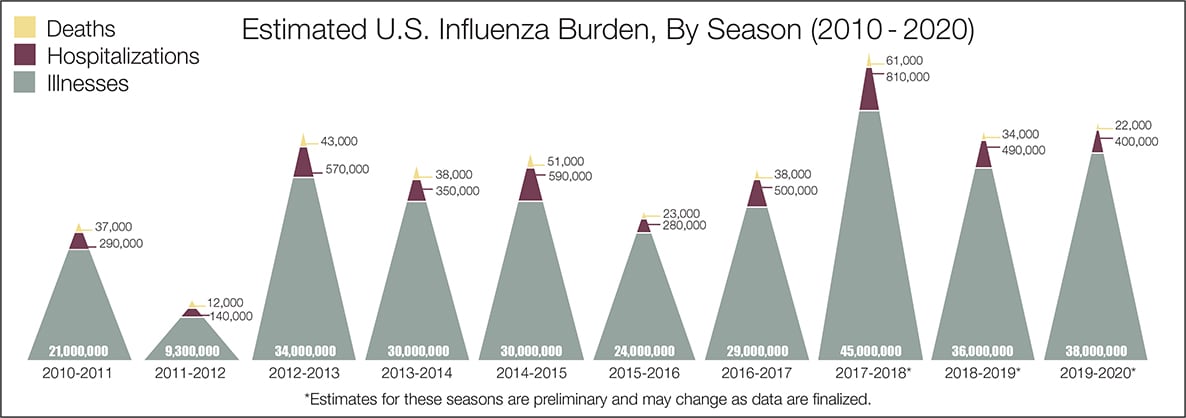
What we do not know about the coronavirus [actually there is little scientifically proven information]. Most of our knowledge is anecdotal, from studies with limited subjects, or from studies without peer review.
- How many people have been infected as many do not show symptoms?
- Masks do work.
- Do we develop lasting immunity to the coronavirus? Another coronavirus – the simple cold – does not develop long term immunity.
- To what degree do people who never develop symptoms contribute to transmission?
- The US has scaled up coronavirus testing – and the accuracy of the tests has been improving. However, if one loses immunity – the coronavirus testing value is reduced.
- Can children widely spread coronavirus? [current thinking is that they are becoming a major source of the pandemic spread]
- Why have some places avoided big coronavirus outbreaks – and others hit hard?
- What effect will the weather have? At this point, it does not seem hot weather slows this coronavirus down – and it seems air conditioning contributes to its spread.
- Outdoor activities seem to be a lower risk than indoor activities.
- Can the world really push out an effective vaccine in 12 to 18 months?
- Will other medical treatments for Covid-19 ease symptoms and reduce deaths? So far only one drug (remdesivir) is approved for treatment.
- A current scientific understanding of the way the coronavirus works can be found [here].
Heavy breakouts of coronavirus have hit farm workers. Farmworkers are essential to the food supply. They cannot shelter at home. Consider:
- they have high rates of the respiratory disease [occupational hazard]
- they travel on crowded buses chartered by their employers
- few have health insurance
- they cannot social distance and live two to four to a room – and they eat together
- some reports say half are undocumented
- they are low paid and cannot afford not to work – so they will go to work sick
- they do not have access to sanitation when working
- a coronavirus outbreak among farmworkers can potentially shutter entire farm
The bottom line is that COVID-19 so far has been shown to be much more deadly than the data on the flu. Using CDC data, the flu has a mortality rate between 0.06 % and 0.11 % Vs. the coronavirus which to date has a mortality rate of 4 % [the 4% is the average of overall statistics – however in the last few months it has been hovering around 1.0%] – which makes it between 10 and 80 times more deadly. The reason for ranges:
Because influenza surveillance does not capture all cases of flu that occur in the U.S., CDC provides these estimated ranges to better reflect the larger burden of influenza.
There will be a commission set up after this pandemic ends to find fault [it is easy to find fault when a once-in-a-lifetime event occurs] and to produce recommendations for the next time a pandemic happens. Those that hate President Trump will conclude the virus is his fault.
Resources:
- Get the latest public health information from CDC: https://www.coronavirus.gov .
- Get the latest research from NIH: https://www.nih.gov/coronavirus.
- Find NCBI SARS-CoV-2 literature, sequence, and clinical content: https://www.ncbi.nlm.nih.gov/sars-cov-2/.
- List of studies: https://icite.od.nih.gov/covid19/search/#search:searchId=5ee124ed70bb967c49672dad
include(“/home/aleta/public_html/files/ad_openx.htm”); ?>


