


Written by Steven Hansen
The U.S. new cases 7-day rolling average is 42.1 % HIGHER than the 7-day rolling average one week ago. U.S. deaths due to coronavirus are now 29.4 % HIGHER than the rolling average one week ago. U.S. hospitalizations due to COVID-19 are now 20.7 % HIGHER than the rolling average one week ago. Today’s posts include:
- U.S. Coronavirus New Cases are below yesterday’s record of 184,813 and are at the second-highest level seen at 165,277
- U.S. Coronavirus deaths today declined to 1,255
- U.S. Coronavirus hospitalizations are at a record 69,455
- U.S. Surgeon General Blames ‘Pandemic Fatigue’ For Recent COVID-19 Surge
- The story of mRNA: How a once-dismissed idea became a leading technology in the Covid vaccine race
- Melatonin a Promising Candidate for Prevention and Treatment of COVID-19
- How accurate is coronavirus testing?
- Fauci on the pandemic: “We can get this to plateau, to come down”
- Fears of double-dip recession rise alongside COVID-19 cases

The recent worsening of the trendlines for new cases should be attributed to going back to college/university, cooler weather causing more indoor activities, possible mutation of the virus, fatigue from wearing masks / social distancing, holiday activities, and continued loosening of regulations designed to slow the coronavirus spread.
My continuing advice is to continue to wash your hands (especially after using the toilet as COVID first sheds in your stool), putting down the toilet seat (as flushing the toilet releases a plume), wear masks, avoid crowds, and maintain social distancing. No handwashing, mask, or social distancing will guarantee you do not get infected – but it sure as hell lowers the risk in all situations – and the evidence to-date shows a lower severity of COVID-19. In addition, certain activities are believed to carry a higher risk – like being inside in air conditioning and removing your mask (such as restaurants, around your children/grandchildren, bars, and gyms). It is all about viral load – and outdoor activities are generally safe if you can maintain social distance.
include($_SERVER[‘DOCUMENT_ROOT’].’/pages/coronavirus1.htm’); ?>
Hospitalizations (grey line) and Mortality (green line) For Week ending 07NOV2020
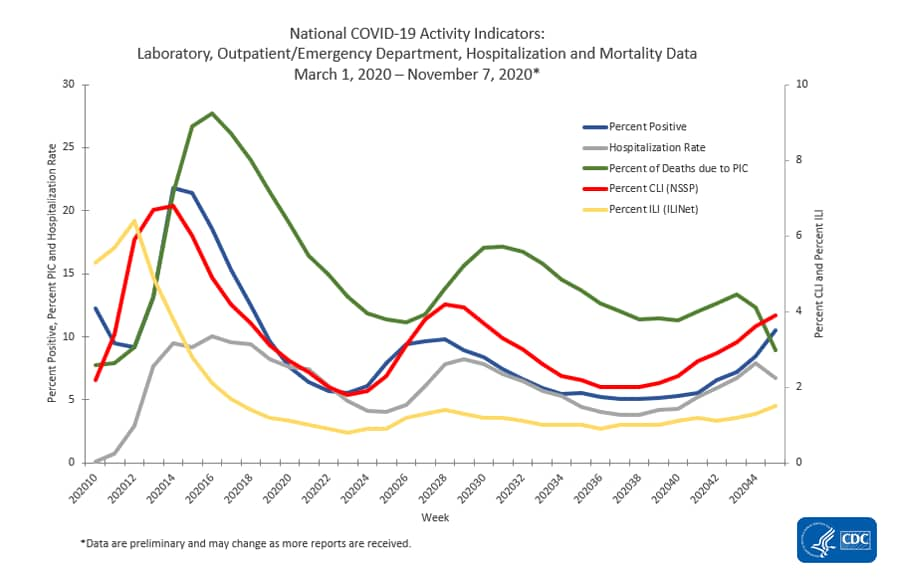
source: https://www.cdc.gov/coronavirus/2019-ncov/covid-data/covidview/index.html
My Thoughts On Lockdowns
Most Americans oppose general lockdowns – and the effectiveness of a general lockdown is questionable. What the CDC says about the incubation period of COVID-19:
The incubation period for COVID-19 is thought to extend to 14 days, with a median time of 4-5 days from exposure to symptoms onset. One study reported that 97.5% of persons with COVID-19 who develop symptoms will do so within 11.5 days of SARS-CoV-2 infection.
So a logical person would surmise that a 14-day lockdown (with no exceptions for essential work) would mostly wipe out the disease. The problem here is that:
- there must be exceptions for essential workers – say police, fire, medical, some government, relief agencies, farms / food distribution – the list goes on. The more exceptions, the less effective a lockdown will be.
- there is incomplete information on “COVID Mary’s” – superspreaders who are contagious for months who do not have symptoms
- there is a growing reality that lockdowns are a double-edged sword which tends to damage people’s physical and mental health (not to mention the damage to the economy)
The real problem with lockdowns is noncompliance which makes a general lockdown ineffective. Sure, it will knock the disease down – but it comes back after the lockdown. Lockdown’s work in China because of the heavy-handed approach by the government – something that would be unconstitutional in the U.S.
So if a general lockdown is not effective enough – what about targetted lockdowns such as closing higher risk establishments and activities such as bars, restaurants, sporting events, concerts, beaches …
These past months, I have become more skeptical that targetted lockdowns are effective. No doubt based on what we believe we know, people should avoid high-risk activities. High-risk activities include almost anything done indoors where there are people not in your immediate family. Inviting your neighbor over for coffee, buying groceries, or even getting a flu shot is a higher risk activity.
This past week my grandson who works in a bike shop, was exposed to a fellow employee who was positive for COVID. We live in a county in Florida who has a mask ordinance in place literally since the beginning of the pandemic – yet my grandson and other workers behind the scenes were not wearing masks (or social distancing). I have heard of other incidents of retail and industrial workers not wearing masks or social distancing in lunchrooms – or other behind-the-scenes activities.
We have read over-and-over that the best “tool” in the fight against COVID is wearing a mask and social distancing – and limiting indoor activities & crowded outdoor activities. Best to stay at home according to the experts.
I have no intention of staying at home – but I do wear a proven effective mask and I try to stay away from others. In my county, the public health service provided the suggested washable three-layer mask to every resident by mail months ago.
The question should not be whether we need to stop / lockdown an activity – but what steps need to be taken to ensure that activity is as safe as possible. As examples:
- special masks should be handed out at bars where patrons can drink with their mask on – as well as social distancing and modifications to the HVAC systems to ensure a high rate of injection of outdoor air

- for restaurants, HVAC system modifications, outdoor dining, maybe face-shields
The burden on the “experts” should be to make activities as safe as possible – not the option to shutdown. We do NOT understand the negative impacts of shutting things down. I believe a government that locks down had a flawed approach to managing the pandemic.
The real problem is compliance with social distancing and wearing masks. 20% of employees in retail have or had COVID. I suggest a majority did not comply with social distancing or wearing masks around fellow employees.
I am tired of COVID – I want my life back. But if a large portion of our population will not take even the basic steps of social distancing and wearing masks [or even get immunized when available] – nothing will stop this pandemic short of its going away on its own.
And for your Sunday read, I suggest a National Institue of Health post: Lockdowns and the COVID-19 pandemic: What is the endgame?
Coronavirus News You May Have Missed
Econintersect today published two articles summarizing the headlines of this past week:
The story of mRNA: How a once-dismissed idea became a leading technology in the Covid vaccine race – STAT
But what the companies [Pfizer and Moderna] share may be bigger than their differences: Both are banking on a genetic technology that has long held huge promise but has so far run into biological roadblocks. It is called synthetic messenger RNA, an ingenious variation on the natural substance that directs protein production in cells throughout the body. Its prospects have swung billions of dollars on the stock market, made and imperiled scientific careers, and fueled hopes that it could be a breakthrough that allows society to return to normalcy after months living in fear.
There are about a dozen experimental vaccines in late-stage clinical trials globally, but the ones being tested by Pfizer and Moderna are the only two that rely on messenger RNA.
For decades, scientists have dreamed about the seemingly endless possibilities of custom-made messenger RNA, or mRNA.
Researchers understood its role as a recipe book for the body’s trillions of cells, but their efforts to expand the menu have come in fits and starts. The concept: By making precise tweaks to synthetic mRNA and injecting people with it, any cell in the body could be transformed into an on-demand drug factory.
But turning scientific promise into medical reality has been more difficult than many assumed. Although relatively easy and quick to produce compared to traditional vaccine-making, no mRNA vaccine or drug has ever won approval.
U.S. Surgeon General Blames ‘Pandemic Fatigue’ For Recent COVID-19 Surge – NPR
The COVID-19 crisis in the U.S. is getting worse by nearly every metric. On Friday alone, there were more than 184,000 new confirmed cases and 1,400 deaths, the Johns Hopkins Coronavirus Resource Center reported. Hospitals are reaching capacity. To date in the U.S., there have been more than 10 million confirmed cases of the virus and more than 240,000 have died — more than any other nation.
U.S. Surgeon General Jerome Adams says “pandemic fatigue” is largely to blame. People are tired and aren’t taking mitigation measures as seriously as before, he says.
“The virus hit different places of the country at different points,” Adams, who is also a member of the White House Coronavirus Task Force, tells NPR’s All Things Considered. “And so you’ve had people who’ve been doing these things since February, March, April, but they didn’t really start to see the wave until later on. And they’re just plain tired.”
As the winter months and holidays approach, people can be tempted to escape the cold and spend time indoors with friends and family. Adams is encouraging people to have a virtual dinner or celebrate Thanksgiving only with other people who live in their household.
“The three W’s are most important if you do come together around other people: wear a mask, wash your hands and frequently disinfect commonly touched surfaces, and watch your distance from other people,” Adams says. “And if you can’t do these things in this environment where you’re planning on coming together, then you should probably stay home because, again, this virus is incredibly unforgiving.”
Fears of double-dip recession rise alongside COVID-19 cases – The Hill
Economists across the political spectrum have consistently warned that sustained growth is dependent on getting the coronavirus under control, with many now viewing the rise in infections with heightened concern.
“It’s alarming, to put it mildly,” said Beth Ann Bovino, chief U.S. economist at S&P Global. “If this spreads and governments are forced to go back to lockdown measures, this very fragile recovery is sure to fail.”
Earlier in the year, S&P Global forecasted several scenarios for the economic recovery. The baseline scenario, which would lead to a 4 percent decline in gross domestic product, assumed Congress would pass a limited, $500 billion relief bill, and that the winter spike in COVID-19 would be under control.
Instead, there is no coronavirus relief package and cases are surging.
“Everything that is happening now, the risk of a resurgence in COVID-19 as well as policymakers walking away from stimulus negotiations — those two factors are what my team had feared would happen,” said Bovino.
Without improvements on either front, a bigger economic contraction is likely, to the tune of 5.1 percent.
“It wouldn’t be as large as what we experienced in the first half of the year, but it would be a double dip,” Bovino said.
Fauci on the pandemic: “We can get this to plateau, to come down” – CNN
Dr. Anthony Fauci, the top infectious disease expert in the US, said a nationwide policy on masks and social distancing is crucial to mitigating the spread of Covid-19.
Fauci’s comments come just after the US recorded 184,000 new Covid-19 cases on Friday.
“Everybody has got to do it,” Fauci said about mask wearing and social distancing. “There is no excuse not to do that right now. Because we know that can turn things around. I mean, that is the tool we have. As I’ve mentioned just recently and as you eluded to, we have good news with regard to the vaccine. So there is light at the end of the tunnel. Help is coming and that should, I believe, motivate people to just say we are going to double down and do this uniformly. Those are the tools we have right now. And they do work. We can get this to plateau to come down.”
Fauci added that without a nationwide policy, the US could hit 439,000 total deaths due to Covid-19 by March 1.
How accurate is coronavirus testing? – Fox
Recently, more patients have reported testing to be inaccurate, including figures from Tesla CEO Elon Musk, who tweeted Friday that after taking four tests for COVID-19, two were negative and two came back positive.
Saphier explained these inaccuracies occur mostly from rapid testing – an antigen test screening for virus proteins – since they could have a false negative rate of up to 50%.
“It’s far more likely to have a false negative of that antigen test than it is to have a false positive,” she explained.
As a rapid test backup, Dr. Saphier urged any patient testing positive to also undergo a PCR test – which screens for genetic virus material and takes several days for results develop.
“If the PCR test comes back positive, chances are you have the coronavirus,” she said. “And whether or not you have symptoms doesn’t really matter because we know that there is a high amount of asymptomatic individuals who are still transmitting the virus.”
Saphier mentioned that the FDA has released a statement to physicians and lab technicians warning of an increase in rapid test false positives being reported.
Coronavirus vaccine scientist: ‘We could have a normal winter next year’ – Politico
One of the scientists behind the coronavirus vaccine that has been found to be 90 percent effective said that “if everything continues to go well … we could have a normal winter next year.”
BioNTech co-founder Uğur Şahin told the BBC on Sunday that “this winter will be hard” and the vaccine “will not have a big impact on the infection numbers.” But he said that “if everything continues to go well,” the goal is to deliver more than 300 million doses of the vaccine before “April next year, which could allow us to already start to make an impact.”
He added that “what is absolutely essential is that we get a high vaccination rate before autumn/winter next year … so all the vaccination and immunization approaches must be accomplished before next autumn — and I’m confident that this will happen because a number of vaccine companies are helping us to increase the supply — so that we could have a normal winter next year.”
… Asked by the BBC’s Andrew Marr if people should expect to have an “annual COVID-19 jab” in similar fashion to an annual flu jab, Şahin said that “with the flu we are dealing with every year a different strain or different strains” but although COVID-19 has “some mutations,” so far “the mutations are very distinct and I don’t expect that the virus will have a dramatic shift.”
“The only reason for booster immunizations will be if we realize that there is no protection after one year [since getting the vaccine shot] … it could be that it’s immunization each year, every second year or even every five years.”
Melatonin a Promising Candidate for Prevention and Treatment of COVID-19 – Cleveland Clinic
Results from a new Cleveland Clinic-led study suggest that melatonin, a hormone that regulates the sleep-wake cycle and is commonly used as an over-the-counter sleep aid, may be a viable treatment option for COVID-19.
.. Analysis of patient data from Cleveland Clinic’s COVID-19 registry also revealed that melatonin usage was associated with a nearly 30% reduced likelihood of testing positive for SARS-CoV-2 after adjusting for age, race, smoking history, and various disease comorbidities. Notably, the reduced likelihood of testing positive for the virus increased from 30 to 52 percent for African Americans when adjusted for the same variables.
“It is very important to note these findings do not suggest people should start to take melatonin without consulting their physician,” said Feixiong Cheng, PhD, assistant staff in Cleveland Clinic’s Genomic Medicine Institute and lead author on the study. “Large-scale observational studies and randomized controlled trials are critical to validate the clinical benefit of melatonin for patients with COVID-19, but we are excited about the associations put forth in this study and the opportunity to further explore them.”
The following are foreign headlines with hyperlinks to the posts
Austria to Test Entire Population for COVID-19 Antibodies After Lockdown
Coronavirus cases have been rising fast of late in Switzerland, with the most recent weekly per-capita rates more than double US levels
Mexico surpasses one million coronavirus cases.
Czech Republic sees further decline in COVID cases, still among highest in Europe
India reports 41,100 new coronavirus cases
China finds coronavirus on frozen meat, packaging from Latin America, New Zealand
The following are additional national and state headlines with hyperlinks to the posts
Navajo Nation to reinstate reservation lockdown for three weeks amid coronavirus surge
Elon Musk Says He ‘Most Likely’ Has Moderate Case of COVID
Feds Sue to Halt Sale of ‘Nano Silver’ Product Claiming to Cure COVID
Doctors plead with Americans to take the virus surge seriously.
With some states reimposing coronavirus restrictions, workers worry about losing wages.
The N.F.L. says none of its 200 virus cases in the first half of the season were linked to games.
Al Howard, the officer who saved Martin Luther King after a stabbing, died of Covid-19
Trump says coronavirus vaccine won’t be delivered to New York right away
Biden advisors concerned about the lack of intel briefings, Covid-19 planning
NYC Positivity Stays Below School Closing Threshold: Mayor
‘We expect this to get harder.’ For the NFL, it’s Super Bowl or bust as the pandemic rages
Coronavirus spread across the US pushes Colorado to ramp up emergency response
They saved lives during the pandemic — now they’re facing deportation from Ireland
US Surgeon General: Loss of taste, smell helps differentiate COVID-19 from flu
National lockdown ‘a measure of last resort,’ Biden coronavirus taskforce head says
New coronavirus cases exploded in many N.J. counties this week.
Oregon governor warns violators of coronavirus ‘freeze’ could face jail, hefty fines
Coronavirus: A month-by-month look at our path forward
Today’s Posts On Econintersect Showing Impact Of The Pandemic With Hyperlinks
Data Disruption: The Impact Of COVID-19 On Inflation Measurement
Building The Post-COVID Pipeline: Invigorating Community Colleges
How Has The COVID-19 Recession Affected U.S. Labor Across Occupations And Industries?
Infographic Of The Day: A Self-care Checklist For Your Mental Health During COVID-19
Coronavirus Disease Weekly News 15November 2020
Coronavirus Economic Weekly News 15November 2020
How COVID Death Counts Become The Stuff Of Conspiracy Theories
Warning to Readers
The amount of politically biased articles on the internet continues to increase. And studies and opinions of the experts continue to contradict other studies and expert opinions. Honestly, it is difficult to believe anything anymore. A study usually cannot establish cause and effect – but only correlation. Be very careful what you believe about this pandemic.

I assemble this coronavirus update daily – sifting through the posts on the internet. I try to avoid politically slanted posts (mostly from CNN, New York Times, and the Washington Post) and can usually find unslanted posts on that subject from other sources on the internet. I wait to publish posts on subjects that I cannot validate across several sources. But after all this extra work, I do not know if I have conveyed the REAL facts. It is my job to provide information so that you have the facts necessary – and then it is up to readers to draw conclusions.
Analyst Opinion of Coronavirus Data
There are several takeaways that need to be understood when viewing coronavirus statistical data:
- The global counts are suspect for a variety of reasons including political. Even the U.S. count has issues as it is possible that as much as half the population has had coronavirus and was asymptomatic. It would be a far better metric using a random sampling of the population weekly. In short, we do not understand the size of the error in the tracking numbers.
- Just because some of the methodology used in aggregating the data in the U.S. is flawed – as long as the flaw is uniformly applied – you establish a baseline. This is why it is dangerous to compare two countries as they likely use different methodologies to determine who has (and who died) from coronavirus.
- COVID-19 and the flu are different but can have similar symptoms. For sure, COVID-19 so far is much more deadly than the flu. [click here to compare symptoms]
- From an industrial engineering point of view, one can argue that it is best to flatten the curve only to the point that the health care system is barely able to cope. This solution only works if-and-only-if one can catch this coronavirus once and develops immunity. In the case of COVID-19, herd immunity may need to be in the 80% to 85% range. WHO warns that few have developed antibodies to COVID-19. At this point, herd immunity does not look like an option although there is now a discussion of whether T-Cells play a part in immunity [which means one might have immunity without antibodies]
- Older population countries will have a higher death rate.
- There are at least 8 strains of the coronavirus. New York may have a deadlier strain imported from Europe, compared to less deadly viruses elsewhere in the United States.
- Each publication uses different cutoff times for its coronavirus statistics. Our data uses 11:00 am London time. Also, there is an unexplained variation in the total numbers both globally and in the U.S.
- The real question remains if the U.S. is over-reacting to this virus. The following graphic from the CDC puts the annual flu burden in perspective [click on image to enlarge]. Note that using this data is dangerous as the actual flu cases are estimated and not counted – nobody knows how accurate these guesses are.
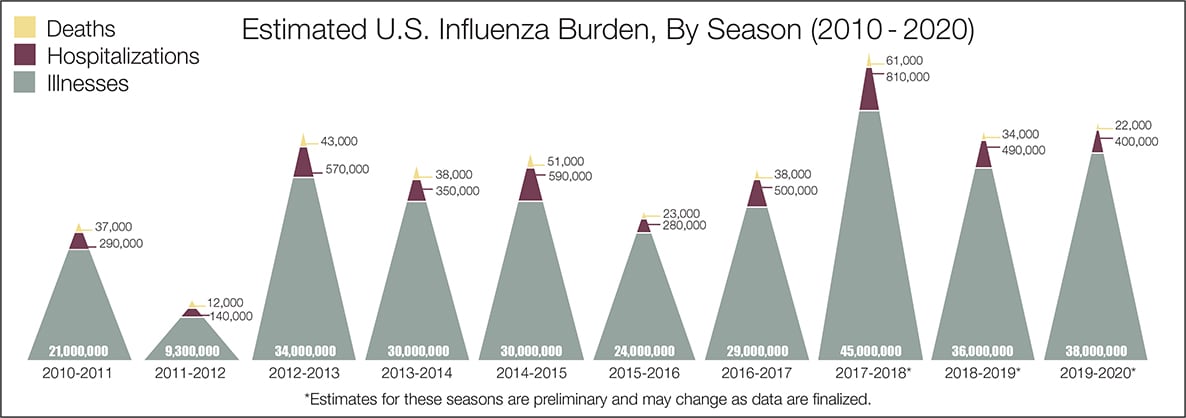
What we do not know about the coronavirus [actually there is little scientifically proven information]. Most of our knowledge is anecdotal, from studies with limited subjects, or from studies without peer review.
- How many people have been infected as many do not show symptoms?
- Masks do work.
- Do we develop lasting immunity to the coronavirus? Another coronavirus – the simple cold – does not develop long term immunity.
- To what degree do people who never develop symptoms contribute to transmission?
- The US has scaled up coronavirus testing – and the accuracy of the tests has been improving. However, if one loses immunity – the coronavirus testing value is reduced.
- Can children widely spread coronavirus? [current thinking is that they are becoming a major source of the pandemic spread]
- Why have some places avoided big coronavirus outbreaks – and others hit hard?
- What effect will the weather have? At this point, it does not seem hot weather slows this coronavirus down – and it seems air conditioning contributes to its spread.
- Outdoor activities seem to be a lower risk than indoor activities.
- Can the world really push out an effective vaccine in 12 to 18 months?
- Will other medical treatments for Covid-19 ease symptoms and reduce deaths? So far only one drug (remdesivir) is approved for treatment.
- A current scientific understanding of the way the coronavirus works can be found [here].
Heavy breakouts of coronavirus have hit farm workers. Farmworkers are essential to the food supply. They cannot shelter at home. Consider:
- they have high rates of the respiratory disease [occupational hazard]
- they travel on crowded buses chartered by their employers
- few have health insurance
- they cannot social distance and live two to four to a room – and they eat together
- some reports say half are undocumented
- they are low paid and cannot afford not to work – so they will go to work sick
- they do not have access to sanitation when working
- a coronavirus outbreak among farmworkers can potentially shutter entire farm
The bottom line is that COVID-19 so far has been shown to be much more deadly than the data on the flu. Using CDC data, the flu has a mortality rate between 0.06 % and 0.11 % Vs. the coronavirus which to date has a mortality rate of 4 % [the 4% is the average of overall statistics – however in the last few months it has been hovering around 1.0%] – which makes it between 10 and 80 times more deadly. The reason for ranges:
Because influenza surveillance does not capture all cases of flu that occur in the U.S., CDC provides these estimated ranges to better reflect the larger burden of influenza.
There will be a commission set up after this pandemic ends to find fault [it is easy to find fault when a once-in-a-lifetime event occurs] and to produce recommendations for the next time a pandemic happens. Those that hate President Trump will conclude the virus is his fault.
Resources:
- Get the latest public health information from CDC: https://www.coronavirus.gov .
- Get the latest research from NIH: https://www.nih.gov/coronavirus.
- Find NCBI SARS-CoV-2 literature, sequence, and clinical content: https://www.ncbi.nlm.nih.gov/sars-cov-2/.
- List of studies: https://icite.od.nih.gov/covid19/search/#search:searchId=5ee124ed70bb967c49672dad
include(“/home/aleta/public_html/files/ad_openx.htm”); ?>


