


Written by Steven Hansen
The U.S. new cases 7-day rolling average is 44.6 % HIGHER than the 7-day rolling average one week ago. U.S. deaths due to coronavirus are now 19.5 % HIGHER than the rolling average one week ago. U.S. hospitalizations due to COVID-19 are now 16.4 % HIGHER than the rolling average one week ago. Today’s posts include:
- U.S. Coronavirus New Cases are at a record 147,274
- U.S. Coronavirus deaths today are the highest since August 13
- U.S. Coronavirus hospitalizations are at a record 61,964
- Multi-layer cloth masks protect both wearers and those around them from COVID-19
- COVID-19 Hospitalizations Hit Record Highs. Where Are Hospitals Reaching Capacity?
- A new wave of coronavirus-driven layoffs are looming – here’s who is most at risk
- A study finds that many children who have never had the virus carry an antibody to prevent it.
- World Will “Never” Return To Normal After COVID
- Trump Could Clean House at Health Agencies
- COVID-19: What Makes ‘Waves’ During a Pandemic?
- Here’s What’s Wrong With COVID-19 Case Counts

The recent worsening of the trendlines for new cases should be attributed to going back to college/university, cooler weather causing more indoor activities, possible mutation of the virus, fatigue from wearing masks / social distancing, holiday activities, and continued loosening of regulations designed to slow the coronavirus spread.
My continuing advice is to continue to wash your hands (especially after using the toilet as COVID first sheds in your stool), putting down the toilet seat (as flushing the toilet releases a plume), wear masks, avoid crowds, and maintain social distancing. No handwashing, mask, or social distancing will guarantee you do not get infected – but it sure as hell lowers the risk in all situations – and the evidence to-date shows a lower severity of COVID-19. In addition, certain activities are believed to carry a higher risk – like being inside in air conditioning and removing your mask (such as restaurants, around your children/grandchildren, bars, and gyms). It is all about viral load – and outdoor activities are generally safe if you can maintain social distance.
include($_SERVER[‘DOCUMENT_ROOT’].’/pages/coronavirus1.htm’); ?>
Hospitalizations (grey line) and Mortality (green line) For Week ending 24OCT2020
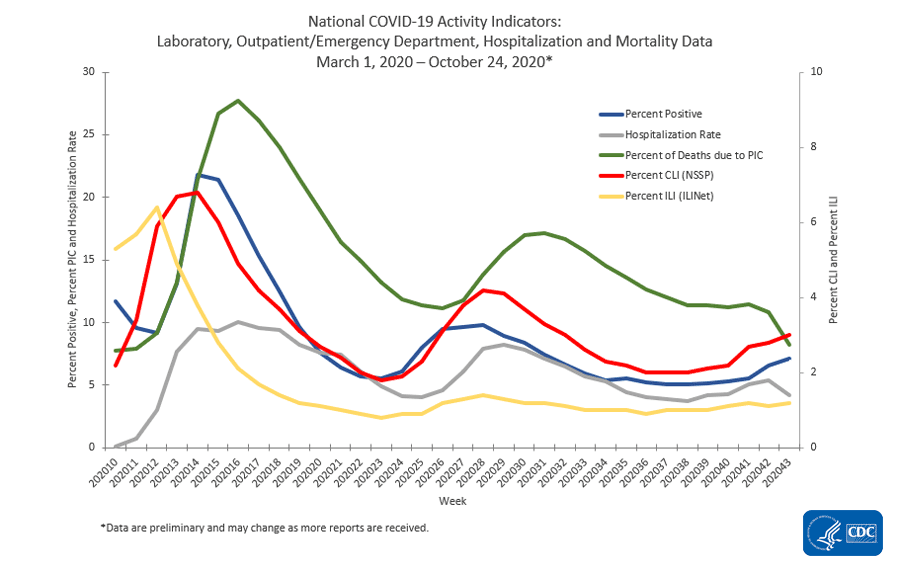
source: https://www.cdc.gov/coronavirus/2019-ncov/covid-data/covidview/index.html
Coronavirus News You May Have Missed
Here’s What’s Wrong With COVID-19 Case Counts – MedPage
… The researchers asked 60 Harvard physicians and medical students a seemingly simple question: If a test to detect disease with a prevalence of 1/1,000 has a false positive rate of 5%, what is the chance that a person found to have a positive result actually has the disease?
Only 14% gave the correct answer of 2% with most answering 95%.
The base rate fallacy/false positive paradox is derived from Bayes theorem. When the incidence of a disease in a population is low unless the test used has very high specificity, more false positives will be determined than true positives. The difference in the numbers can be quite striking and certainly not inherently understandable.
We have learned in the past from routine PSA testing and mammograms that a positive test in a screening situation needs to be taken in context. The incidence of disease in the population that you are testing is extremely important for accuracy.
… An elaborate plan [at Purdue University] was implemented, including a signed pledge from all students to behave properly, wear masks, maintain social distancing. A decision was made to perform random testing on 10% of the students and staff each week. Since staff and students combined are 50,000 at Purdue University, 5,000 tests are done every week. The purpose of random testing was surveillance to encourage students and staff to maintain proper behavior.
The Indiana State Department of Health advised against a random testing program, as it felt overall data accuracy would be difficult. Commingling of data in our county from the people tested WITH symptoms together with the randomly tested Purdue students WITHOUT symptoms has occurred. Base rate fallacy/false positive paradox, unfortunately, becomes ignored when one does this.
… So far, 90% of the students who test positive do not develop symptoms. Only one has been hospitalized and none have died. Had Purdue chosen to test all 50,000 students and staff every week, 10 times the number would have reported as testing positive weekly. Had this data been commingled with testing of symptomatic individuals, there certainly would have been an outcry by the casual observer to close everything down again. Yet those numbers would be only representative of the positivity of mass testing, not the prevalence of infective patients.
… By base rate fallacy/false positive paradox, if the specificity of a test is 95%, when used in a population with a 2% incidence of disease — such as healthy college students and staff — there will be 5 false positives for every 2 true positives. (The actual incidence of active COVID-19 in college age students is not known but estimated to be less than 0.6% by Indiana University/Fairbanks data. Even using a test with 99% specificity with a 1% population incidence generates 10 false positives for every 9 true positives.
Using the same test on patients with COVID-19 symptoms, because their incidence of disease is 50% or greater, the test does not have to be perfect. Even using a test with only 90% specificity, the number of false positives will be much less significant.
[editor’s note: this post was hard to summarize and deserves a full read]
Trump Could Clean House at Health Agencies – Medscape
As President Donald J. Trump starts firing officials of his administration ― even if it appears that they would only have a few months left in the job ― some health officials may find their positions on the line.
Among those possibly in Trump’s sights: HHS Secretary Alex Azar, US Food and Drug Administration (FDA) Commissioner Stephen Hahn, MD, Centers for Disease Control and Prevention (CDC) Director Robert Redfield, MD, and White House Coronavirus Task Force member Anthony Fauci, MD, who is also the director of the National Institutes of Allergy and Infectious Diseases.
- Azar has had a long run as a Trump appointee. He took office in January 2018 and has been a staunch loyalist. But he’s frequently been the butt of grousing by Trump for not doing enough to help lower drug prices and for his handling of the coronavirus pandemic. Azar was initially in charge of the Trump virus effort but was quickly replaced by Vice President Mike Pence. It was widely reported in late April that Trump was considering firing Azar, but the president called that “fake news” in a tweet.
- Most of the president’s ire has been directed at Fauci. As far back as April, Trump retweeted a call for Fauci’s firing. Twitter removed the original tweet but kept Trump’s comments on the original tweet. But such a firing cannot be easily done. Some have speculated that Trump could pressure Fauci’s boss, Francis Collins, MD, PhD — the director of the National Institutes of Health (NIH), who is a political appointee — to get rid of him. But Collins would have to come up with a reason to fire Fauci. Because he is not a political appointee, Fauci is afforded a raft of protections given to civil service employees of the federal government. To demote or fire Fauci, Collins would have to give him 30 days’ notice unless there’s a belief that he committed a crime. Fauci would have at least a week to offer evidence and affidavits in support of his service. He’d also be entitled to legal representation, a written decision, and the specific reasons for the action being taken quickly. He could also request a hearing, and he’d be able to appeal any action to the Merit Systems Protection Board. The process could take months, if not years.
- Collins has been with NIH since 1993, when he headed the Human Genome Project and the National Human Genome Research Institute. Politico has speculated that Collins, 70, might retire if Trump was reelected. It’s unclear what he’ll do now.
- Redfield, who has taken heat for his leadership from many in public health — and was asked in October to stand up to Trump by former CDC Director William H. Foege, MD — has been openly contradicted by the president on more than one occasion, according to The New York Times. In September, The Hill reported that Trump told reporters that he’d chastised Redfield by phone soon after Redfield had told a Senate committee that a coronavirus vaccine would not be available until mid-2021.
A study finds that many children who have never had the virus carry an antibody to prevent it. – New York Times
It’s been a big puzzle of the pandemic: Why are children so much less likely than adults to become infected with the coronavirus and, if infected, less likely to become ill?
A possible reason may be that many children already have antibodies to other coronaviruses, according to researchers at the Francis Crick Institute in London. About one in five of the colds that plague children are caused by viruses in this family. Antibodies to those viruses may also block SARS-CoV-2, the new coronavirus causing the pandemic.
In a study published Friday in Science, the group, led by George Kassiotis, who leads the Retroviral Immunology Laboratory at the institute, reports that on average only 5 percent of adults had these antibodies, compared with 43 percent of children.
In March, as the pandemic was just beginning, Dr. Kassiotis and his colleagues decided to develop a highly sensitive antibody test. To assess it, they examined blood samples taken before the pandemic from over 300 adults and 48 children and adolescents, comparing them with samples from more than 170 people who had been infected with the new coronavirus.
The scientists expected samples taken before the pandemic to have no antibodies that attacked the new coronavirus. Those were to be the controls for the test the scientists were developing.
Instead, they found that many children, and some adults, carried one antibody in particular that could prevent coronaviruses, including the new one, from entering cells. This antibody attaches itself to a spike that pokes out of coronaviruses.
A new wave of coronavirus-driven layoffs are looming – here’s who is most at risk – Bankrate
Economists say the second wave of layoffs risks repeating old stories and creating new ones.
Another round similar to what Americans witnessed back in March could be poised to wreak havoc on the labor market, as the colder winter months weigh on sales and cause an uptick in the virus — what’s known to cause apprehension among the economy’s consumer powerhouse even without an official lockdown. That means some Americans who were laid off once could potentially face job loss again.
Separately, a prolonged slump in the economy risks spilling over into the higher-paying industries first left mostly untouched. Businesses might be inclined to let go of employees as revenues plummet, even though those individuals are working from home. Already, a wave of white-collar layoffs across firms including ExxonMobil, Chevron, Charles Schwab, Goldman Sachs, Wells Fargo, Salesforce and Allstate has hit the market.
… Eight months into coronavirus crisis, no industry has fully recovered
Industry Percent of jobs in the industry that were cut Percent of job cuts that were recovered Scenic & sightseeing transportation 65.94 38.02 Clothing & accessories stores 61.83 59.24 Amusement, gambling & recreation 58.06 51.05 Dentist offices 56.2 93.24 Arts, entertainment & recreation 53.77 40.13 Film & sound recording industries 51.7 18.61 Food & drinking places 49.39 61.85 Leisure & hospitality 49.32 53.84 Furniture & home furnishing stores 46.12 73.65 Accomodation 43.62 20.46 Museums & historical sites 28.48 7.21 Department stores 24.82 93.31 Administrative & waste services 17.49 41.01 Social assistance 16.29 45.81 Air transportation 15.28 -36.88 Retail trade 15.21 79.74 Manufacturing 10.61 52.53 Health care 9.56 57.68 Professional & technical services 5.78 42.85 Government 4.26 2.79 Financial activities 3.15 41.94 Hospitals 2.31 -3.62 Percentage of jobs lost between February and April among hardest-hit industries *
Percent of jobs brought back (or taken away) between May and September **
Source: Bureau of Labor Statistics, November 2020


World Will “Never” Return To Normal After COVID – ZeroHedge
In his book Covid-19: The Great Reset, World Economic Forum globalist Klaus Schwab asserts that the world will “never” return to normal, despite him admitting that coronavirus “doesn’t pose a new existential threat.”
Breitbart’s James Delingpole unveils how Schwab is even more explicit in his book about the elite’s plan for exploiting the COVID pandemic than in his public statements.
Schwab has continually pushed for COVID to be exploited to push for a new world order, claiming, “Now is the historical moment of time not only to fight the… virus but to shape the system… for the post-corona era.”
However, he goes further in the book, making it clear that the financial elite will never allow life to return to normal, suggesting that rolling lockdowns and other restrictions will become permanent.
“Many of us are pondering when things will return to normal,” writes Schwab.
“The short response is: never. Nothing will ever return to the ‘broken’ sense of normalcy that prevailed prior to the crisis because the coronavirus pandemic marks a fundamental inflection point in our global trajectory.”
The globalist makes this assertion despite admitting that the threat posed by COVID pales in comparison to previous pandemics.
“Unlike certain past epidemics, COVID-19 doesn’t pose a new existential threat,” he writes.
Schwab makes clear that the ‘Fourth Industrial Revolution’ or ‘The Great Reset’ will fundamentally change how the world operates.
“Radical changes of such consequence are coming that some pundits have referred to as ‘before coronavirus’ (BC) and ‘after coronavirus’ (AC) era. We will continue to be surprised by both the rapidity and unexpected nature of these changes – as they conflate with each other, they will provoke second-, third-, fourth- and more-order consequences, cascading effects and unforeseen outcomes,” he writes.
As Delingpole explains in his column, “The Great Reset” merely represents a re-packaging of the old globalist agenda which has been stuttering over the last decade.
COVID-19 Hospitalizations Hit Record Highs. Where Are Hospitals Reaching Capacity? – NPR

Multi-layer cloth masks protect both wearers and those around them from COVID-19 – CDC
Studies demonstrate that cloth mask materials can also reduce wearers’ exposure to infectious droplets through filtration, including filtration of fine droplets and particles less than 10 microns. The relative filtration effectiveness of various masks has varied widely across studies, in large part due to variation in experimental design and particle sizes analyzed. Multiple layers of cloth with higher thread counts have demonstrated superior performance compared to single layers of cloth with lower thread counts, in some cases filtering nearly 50% of fine particles less than 1 micron. Some materials (e.g., polypropylene) may enhance filtering effectiveness by generating triboelectric charge (a form of static electricity) that enhances capture of charged particles while others (e.g., silk) may help repel moist droplets31 and reduce fabric wetting and thus maintain breathability and comfort.
Data regarding the “real-world” effectiveness of community masking are limited to observational and epidemiological studies.
- An investigation of a high-exposure event, in which 2 symptomatically ill hair stylists interacted for an average of 15 minutes with each of 139 clients during an 8-day period, found that none of the 67 clients who subsequently consented to an interview and testing developed infection. The stylists and all clients universally wore masks in the salon as required by local ordinance and company policy at the time.
- In a study of 124 Beijing households with > 1 laboratory-confirmed case of SARS-CoV-2 infection, mask use by the index patient and family contacts before the index patient developed symptoms reduced secondary transmission within the households by 79%.
- A retrospective case-control study from Thailand documented that, among more than 1,000 persons interviewed as part of contact tracing investigations, those who reported having always worn a mask during high-risk exposures experienced a greater than 70% reduced risk of acquiring infection compared with persons who did not wear masks under these circumstances.
- A study of an outbreak aboard the USS Theodore Roosevelt, an environment notable for congregate living quarters and close working environments, found that use of face coverings on-board was associated with a 70% reduced risk.
- Investigations involving infected passengers aboard flights longer than 10 hours strongly suggest that masking prevented in-flight transmissions, as demonstrated by the absence of infection developing in other passengers and crew in the 14 days following exposure.
COVID-19: What Makes ‘Waves’ During a Pandemic? – MedPage
The theory, he [Stephen Morse, PhD, of Columbia University Mailman School of Public Health] said, was that the infected population develops “some degree of herd immunity” to the existing virus, which then undergoes a minor genetic change that allows it to recirculate and reinfect the population.
But critical to the theory of “waves” is a “pause” in infections, where the virus dies down. And that hasn’t happened yet to any notable extent with COVID-19, Morse noted.
“It’s not relevant here, because I think we’re still in the first wave,” he said, adding that there are still plenty of susceptible people that have yet to be infected, and that any “pause” in the pandemic has been through measures “artificially designed to slow it down.”
… And even if SARS-CoV-2 is mutating, he said, such changes appear to be happening regularly and are “not biologically significant.” Morse pointed to the D614G mutation, which seems to make SARS-CoV-2 more transmissible, but it remains unclear “whether it’s more virulent” or makes any difference in the disease that would be “significant.”
Fischer said she thought the different peaks in cases had to do more with behavior rather than anything biological related to the virus, with no data yet to show “a huge biological change” in SARS-CoV-2.
“Kids go back to school, people move indoors and spend time in indoor spaces again. People are exhausted and fatigued of being disciplined about maintaining physical distance,” she said. “The whole point of lockdown was initially thought to reduce rapid transmission of the virus so we didn’t overwhelm the healthcare system. But the time wasn’t well-used” to ramp up public health interventions, she said.
[editor’s note: although I believe I summarized this post well, I did leave points out that one may find significant]
The following are foreign headlines with hyperlinks to the posts
Iran Cemetery Crisis: The Behesht-e-Zahra cemetery on the outskirts of the capital, Tehran, is struggling to keep up with the pandemic ravaging the country.
Iran has imposed a nightly curfew on businesses in Tehran and several other cities and towns.
Lebanon Searching for Medicine: Adding to the nation’s woes, desperate Lebanese search daily for their prescriptions after many medications — including fever pills used in COVID-19 treatment — have vanished from pharmacies, a new dark chapter in their country’s financial meltdown exacerbated by the pandemic.
Cambodia has banned all state-organized events in the capital and a neighboring province for two weeks to prevent the spread of the coronavirus after a number of people connected to a Hungarian official’s visit tested positive.
Merkel: Second COVID-19 wave will likely ‘be more severe’ than first
European Union to purchase 200 million doses of Pfizer coronavirus vaccine
Russia says tests show its COVID-19 vaccine is 92 percent effective
UK confirmed COVID-19 deaths surge past 50,000
The Organization of the Petroleum Exporting Countries has once again cut its forecast for global oil demand growth next year, citing rising coronavirus cases and a weaker-than-anticipated economic outlook
European Central Bank President Christine Lagarde has warned against an immediate economic impact from a Covid-19 vaccine
What is BioNTech? The European company behind Pfizer’s Covid-19 vaccine
Cuba reopens Havana airport ahead of tourism high season
Hong Kong and Singapore to set up a ‘travel bubble’ as Covid cases fall
The following are additional national and state headlines with hyperlinks to the posts
Gripped by a third wave of the virus, El Paso has more people hospitalized with the coronavirus than some entire states.
Restaurants, gyms and other crowded indoor venues accounted for 80 percent of new infections in the U.S. from March to May.
Dr. Anthony Fauci, the country’s top infectious disease expert, says he estimates most Americans will be able to receive a vaccine by the end of April.
Experts say no need to cancel Thanksgiving, but play it safe
Pfizer’s CEO Dumps 62% Of His Stock On COVID Vaccine Announcement
Missouri, Illinois, and the St. Louis area broke records Tuesday for COVID-19 cases, hospitalizations, and deaths.
Health officials warned of capacity challenges in Oregon as coronavirus patients in hospitals jumped 57% in the past week.
Swelling COVID numbers also have Chicago doctors worried about staff shortages and available ICU beds.
Meet Ugur Sahin MD, PhD, and Ozlem Tureci, MD, the husband-wife team behind the breakthrough mRNA COVID-19 vaccine candidate from Pfizer and its partner BioNTech.
If Pfizer submits its positive initial trial data to health regulators as quickly as expected, some Americans can start being vaccinated in December, HHS Secretary Alex Azar said.
COVID patients with intellectual disabilities and developmental disorders were three times more likely to die than others who were infected, an analysis of privately insured patients showed.
Vermont orders quarantine for visitors amid new COVID-19 outbreak
El Paso more than doubling number of mobile morgues as virus surges
Only 49% Americans open to another COVID-19 lockdown
Iowa’s governor announces mask requirements for the first time.
Texas prisons are the highest in the nation for Covid-19 deaths.
Philadelphia public schools have shelved plans to resume in-person classes.
2 more people at White House Election Night party test positive for coronavirus
Typical investor yanked $12,000 from 401(k) during pandemic: Vanguard
“West Wing” actor Richard Schiff tests positive for Covid-19
US nursing homes still have dangerously long waits for virus test results
Today’s Posts On Econintersect Showing Impact Of The Pandemic With Hyperlinks
Learning From Experience: Why Nations May Have Responded Differently To COVID-19
The Crisis Is Not Over, Keep Spending Wisely
How Close Is The World To A Coronavirus Vaccine?
Warning to Readers
The amount of politically biased articles on the internet continues to increase. And studies and opinions of the experts continue to contradict other studies and expert opinions. Honestly, it is difficult to believe anything anymore. A study usually cannot establish cause and effect – but only correlation. Be very careful what you believe about this pandemic.

I assemble this coronavirus update daily – sifting through the posts on the internet. I try to avoid politically slanted posts (mostly from CNN, New York Times, and the Washington Post) and can usually find unslanted posts on that subject from other sources on the internet. I wait to publish posts on subjects that I cannot validate across several sources. But after all this extra work, I do not know if I have conveyed the REAL facts. It is my job to provide information so that you have the facts necessary – and then it is up to readers to draw conclusions.
Analyst Opinion of Coronavirus Data
There are several takeaways that need to be understood when viewing coronavirus statistical data:
- The global counts are suspect for a variety of reasons including political. Even the U.S. count has issues as it is possible that as much as half the population has had coronavirus and was asymptomatic. It would be a far better metric using a random sampling of the population weekly. In short, we do not understand the size of the error in the tracking numbers.
- Just because some of the methodology used in aggregating the data in the U.S. is flawed – as long as the flaw is uniformly applied – you establish a baseline. This is why it is dangerous to compare two countries as they likely use different methodologies to determine who has (and who died) from coronavirus.
- COVID-19 and the flu are different but can have similar symptoms. For sure, COVID-19 so far is much more deadly than the flu. [click here to compare symptoms]
- From an industrial engineering point of view, one can argue that it is best to flatten the curve only to the point that the health care system is barely able to cope. This solution only works if-and-only-if one can catch this coronavirus once and develops immunity. In the case of COVID-19, herd immunity may need to be in the 80% to 85% range. WHO warns that few have developed antibodies to COVID-19. At this point, herd immunity does not look like an option although there is now a discussion of whether T-Cells play a part in immunity [which means one might have immunity without antibodies]
- Older population countries will have a higher death rate.
- There are at least 8 strains of the coronavirus. New York may have a deadlier strain imported from Europe, compared to less deadly viruses elsewhere in the United States.
- Each publication uses different cutoff times for its coronavirus statistics. Our data uses 11:00 am London time. Also, there is an unexplained variation in the total numbers both globally and in the U.S.
- The real question remains if the U.S. is over-reacting to this virus. The following graphic from the CDC puts the annual flu burden in perspective [click on image to enlarge]. Note that using this data is dangerous as the actual flu cases are estimated and not counted – nobody knows how accurate these guesses are.
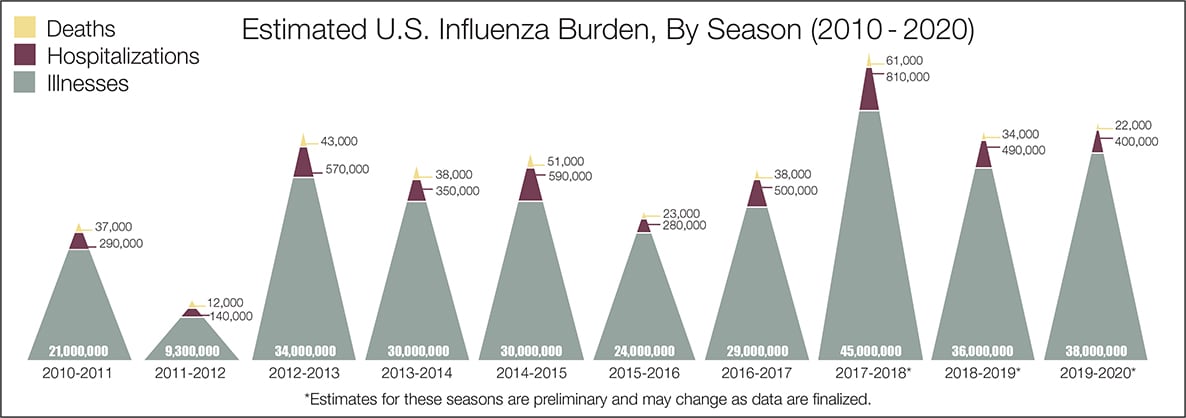
What we do not know about the coronavirus [actually there is little scientifically proven information]. Most of our knowledge is anecdotal, from studies with limited subjects, or from studies without peer review.
- How many people have been infected as many do not show symptoms?
- Masks do work.
- Do we develop lasting immunity to the coronavirus? Another coronavirus – the simple cold – does not develop long term immunity.
- To what degree do people who never develop symptoms contribute to transmission?
- The US has scaled up coronavirus testing – and the accuracy of the tests has been improving. However, if one loses immunity – the coronavirus testing value is reduced.
- Can children widely spread coronavirus? [current thinking is that they are becoming a major source of the pandemic spread]
- Why have some places avoided big coronavirus outbreaks – and others hit hard?
- What effect will the weather have? At this point, it does not seem hot weather slows this coronavirus down – and it seems air conditioning contributes to its spread.
- Outdoor activities seem to be a lower risk than indoor activities.
- Can the world really push out an effective vaccine in 12 to 18 months?
- Will other medical treatments for Covid-19 ease symptoms and reduce deaths? So far only one drug (remdesivir) is approved for treatment.
- A current scientific understanding of the way the coronavirus works can be found [here].
Heavy breakouts of coronavirus have hit farm workers. Farmworkers are essential to the food supply. They cannot shelter at home. Consider:
- they have high rates of the respiratory disease [occupational hazard]
- they travel on crowded buses chartered by their employers
- few have health insurance
- they cannot social distance and live two to four to a room – and they eat together
- some reports say half are undocumented
- they are low paid and cannot afford not to work – so they will go to work sick
- they do not have access to sanitation when working
- a coronavirus outbreak among farmworkers can potentially shutter entire farm
The bottom line is that COVID-19 so far has been shown to be much more deadly than the data on the flu. Using CDC data, the flu has a mortality rate between 0.06 % and 0.11 % Vs. the coronavirus which to date has a mortality rate of 4 % [the 4% is the average of overall statistics – however in the last few months it has been hovering around 1.0%] – which makes it between 10 and 80 times more deadly. The reason for ranges:
Because influenza surveillance does not capture all cases of flu that occur in the U.S., CDC provides these estimated ranges to better reflect the larger burden of influenza.
There will be a commission set up after this pandemic ends to find fault [it is easy to find fault when a once-in-a-lifetime event occurs] and to produce recommendations for the next time a pandemic happens. Those that hate President Trump will conclude the virus is his fault.
Resources:
- Get the latest public health information from CDC: https://www.coronavirus.gov .
- Get the latest research from NIH: https://www.nih.gov/coronavirus.
- Find NCBI SARS-CoV-2 literature, sequence, and clinical content: https://www.ncbi.nlm.nih.gov/sars-cov-2/.
- List of studies: https://icite.od.nih.gov/covid19/search/#search:searchId=5ee124ed70bb967c49672dad
include(“/home/aleta/public_html/files/ad_openx.htm”); ?>


