


Written by Steven Hansen
The U.S. new cases 7-day rolling average is 19.3 % HIGHER than the 7-day rolling average one week ago. U.S. deaths due to coronavirus are now 4.2 % HIGHER than the rolling average one week ago. U.S. hospitalizations due to COVID-19 are now 11.1 % HIGHER than the rolling average one week ago. Today’s headlines include:
- Germany says remdesivir useful for some COVID-19 patients
- Lung damage found in Covid dead may shed light on ‘long Covid’
- South Korea OKs single test for COVID-19 and flu
- The real coronavirus risk on airlines
- There’s no extra Covid risk from living with kids, study finds
- Deborah Birx, MD, one of President Trump’s COVID-19 advisers, is urging an all-out response to the virus as cases soar
- Lack of nationwide policies keeps pandemic going, experts argue
- Don’t get a false sense of security with Covid-19 testing.
- Britain says the two vaccine candidates – developed by Oxford University and AstraZeneca and Pfizer and BioNTech – should be available by early December.
- Mass. Governor Announces New Coronavirus Restrictions As State Infections Surge

The recent worsening of the trendlines for new cases should be attributed to going back to college/university, cooler weather causing more indoor activities, possible mutation of the virus, fatigue from wearing masks / social distancing, holiday activities, and continued loosening of regulations designed to slow the coronavirus spread.
My continuing advice is to continue to wash your hands, wear masks, avoid crowds, and maintain social distancing. No handwashing, mask, or social distancing will guarantee you do not get infected – but it sure as hell lowers the risk in all situations – and the evidence to-date shows a lower severity of COVID-19. In addition, certain activities are believed to carry higher risk – like being inside in air conditioning and removing your mask (such as restaurants, around your children/grandchildren, bars, and gyms). It is all about viral load – and outdoor activities are generally safe if you can maintain social distance.
include($_SERVER[‘DOCUMENT_ROOT’].’/pages/coronavirus1.htm’); ?>
Hospitalizations (grey line) and Mortality (green line) For Week ending 24OCT2020
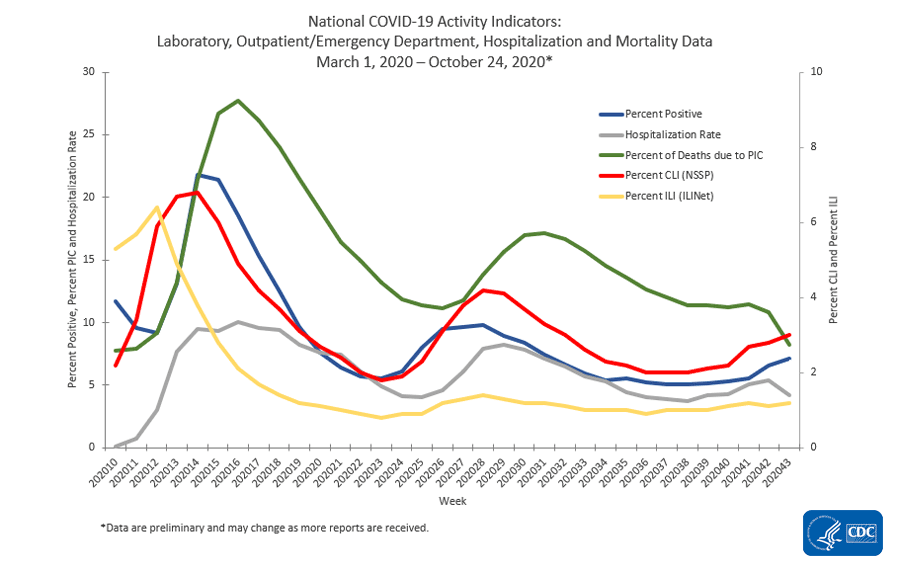
source: https://www.cdc.gov/coronavirus/2019-ncov/covid-data/covidview/index.html
Coronavirus News You May Have Missed
No Winner for President Yet, and Health Care Hangs in the Balance – Kaiser Health News
With the winner of the presidency and party control of the Senate still unclear the morning after Election Day, the future of the nation’s health system remains uncertain. At stake is whether the federal government will play a stronger role in financing and setting the ground rules for health care coverage or cede more authority to states and the private sector.
Should President Donald Trump win and Republicans retain control of the Senate, Trump still may not be able to make sweeping changes through legislation as long as the House is still controlled by Democrats. But — thanks to rules set up by the Senate GOP — the ability to continue to stack the federal courts with conservative jurists who are likely to uphold Trump’s expansive use of executive power could effectively remake the government’s relationship with the health care system even without signed legislation.
The president has also pledged to continue his efforts to get rid of the Affordable Care Act, and if the Supreme Court overturns the sweeping law as part of a challenge it will hear next week, the Republicans’ promise to protect people with preexisting medical conditions will be put to the test. In a second term, the administration would also likely push to continue to revamp Medicaid with its efforts to institute work requirements for adult enrollees and provide more flexibility for states to change the contours of the program.
If former Vice President Joe Biden wins and Democrats gain a Senate majority, it would represent the first time the party has controlled the White House and both houses of Congress since 2010 — the year the ACA was passed. A top priority will be dealing with the COVID-19 pandemic and the economic fallout. Biden made that a keystone of his campaign, promising to implement policies based on advice from medical and scientific advisers and provide more directives and aid to the states.
But also high on his agenda will be addressing parts of the ACA that haven’t worked as well as its authors hoped. He pledged to add a government-run “public option,” which would be an alternative to private insurance plans on the marketplaces, and to lower the eligibility age for Medicare to 60.
[editor’s note: as of 1500 hours EST the senate looks to remain in Republican majority. This means whoever wins the Presidency, a single party will not control congress. And likely the politicization of the response to the pandemic will continue. The following chart is from AP]

Election results could point to a smaller coronavirus stimulus deal. – CNBC
- Senate Majority Leader Mitch McConnell, R-Ky., said on Wednesday that he thinks more stimulus aid should be a priority before the end of the year.
- But because a so-called blue wave, where Democrats gain control of the House, Senate and Oval Office, is likely out of reach, the total amount of funding will likely be smaller, according to one analyst.
But that federal aid could be reduced, Gardner wrote in an analyst note on Wednesday, based on the fact that Democrats were not able to secure the Oval Office, Senate and House.
“A stimulus package is still possible, maybe probable, but it will likely be a smaller deal than in a blue wave scenario,” Gardner wrote. “We think it will be under $2 trillion, which could disappoint investors.”
It could also disappoint Americans who are waiting for more federal aid, depending on what would make the cut in a smaller bill.
Germany says remdesivir useful for some COVID-19 patients – Reuters
Germany’s health minister defended on Tuesday his decision to purchase additional supplies of remdesivir for treating COVID-19, saying Gilead’s antiviral drug was useful especially early in the course of the disease.
“Because it makes sense in some situations and because the need has risen enormously we have procured additional supplies of remdesivir,” Jens Spahn told a news conference.
Germany said on Monday that it has requested around 5% of the supply of remdesivir under a six-month European Union supply deal with Gilead, despite criticism of the deal due to a lack of evidence about the drug’s effectiveness in treating COVID-19.
Medical experts have called on Brussels to renegotiate the 1 billion euro ($1.17 billion) deal agreed last month after remdesivir showed poor results in a large trial conducted by the World Health Organization.
Uwe Janssens, head of the German DIVI association for intensive care medicine, said the WHO’s Solidarity Trial on remdesivir had not yet been peer reviewed by external experts.
“This is a reason for us to look at it cautiously,” he said, adding however that he believed it did make sense to use the medicine in the early stages of treatment.
Lung damage found in Covid dead may shed light on ‘long Covid,’ study found – CNBC
A study of the lungs of people who have died from Covid-19 has found persistent and extensive lung damage in most cases and may help doctors understand what is behind a syndrome known as “long Covid,” in which patients suffer ongoing symptoms for months.
Scientists leading the research said they also found some unique characteristics of SARS-CoV-2, the virus that causes Covid-19, which may explain why it is able to inflict such harm.
“The findings indicate that Covid-19 is not simply a disease caused by the death of virus-infected cells, but is likely the consequence of these abnormal cells persisting for long periods inside the lungs,” said Mauro Giacca, a professor at King’s College London who co-led the work.
The research team analyzed samples of tissue from the lungs, heart, liver and kidneys of 41 patients who died of Covid-19 at Italy’s University Hospital of Trieste between February and April 2020.
In a telephone interview, Giacca said that, while his research team found no overt signs of viral infection or prolonged inflammation in other organs, they discovered “really vast destruction of the architecture of the lungs,” with healthy tissue “almost completely substituted by scar tissue.”
South Korea OKs single test for COVID-19 and flu – AP
Health officials in South Korea have approved a new test that’s designed to detect both COVID-19 and seasonal influenza from the same samples, which would help prevent disruption at hospitals as the pandemic stretches into the flu season.
The country has struggled to stem the coronavirus, which some experts say could spread more broadly during cold weather when people spend more time indoors.
The Korea Disease Control and Prevention Agency on Wednesday reported 118 new cases of COVID-19, most of them in the densely populated Seoul metropolitan area. The national caseload is now at 26,925, including 474 deaths.
People have been increasingly venturing out in public after the government eased social distancing restrictions last month to support the weak economy.
“Despite efforts by health authorities to trace contacts and suppress transmissions, such efforts have been outpaced by the speed of viral spread,” senior Health Ministry official Yoon Taeho said during a virus briefing.
The new test, which targets genes that are specific to both COVID-19 and seasonal flu, is an evolved version of PCR tests that are used to detect COVID-19 from samples taken from noses or throats. Laboratories use machines to amplify genetic materials so that even tiny quantities of the virus can be detected.
The illnesses are hard to tell apart by their symptoms, so having a diagnosis for both in three to six hours “would be convenient for patients and also reduce the burden of medical workers,” Yoon said.
The real coronavirus risk on airlines – The Hill
Some American airlines have upped the ante in describing how safe it is to fly during the pandemic. United Airlines declared that the coronavirus risk is “nearly nonexistent” even on its full flights, while Southwest Airlines has proclaimed the risk “virtually nonexistent” on its aircraft. The airlines argue that high efficiency particulate air filters and universal masking have reduced transmission risk essentially to zero. To say the least, however, their assertions are highly exaggerated.
The airlines are keen to discuss experiments with dummies on widebody Boeing jets, which suggest the transmission of the coronavirus is minimal. They are less eager to mention a slew of recent papers in medical journals that report the experiences of actual passengers. One such paper discussed a flight from London to Vietnam on which a person with the coronavirus who boarded infected almost a dozen business class passengers within two meters of her.
Another told of an Australian flight from Sydney to Perth on which passengers with prior coronavirus infections caused eight new infections on board. Yet a third paper analyzed a flight from Tel Aviv to Frankfurt on which two passengers contracted the coronavirus. A fourth paper considered two rescue flights from Italy to South Korea, on each of which one passenger contracted the coronavirus. Because all of these planes had modern high efficiency particulate air filters, they demonstrate that the filters can reduce transmission of the coronavirus but cannot eliminate it.
On none of these flights were passengers wearing the cloth and surgical masks that US passengers now wear. The best study about the effectiveness of these masks was a “meta-analysis” that synthesized dozens of studies about viral transmission and estimated that such masks reduced by 66 percent the chance of becoming infected. On the Vietnamese, Australian, and Israeli flights masks were not worn, so masks that are 66 percent effective would have reduced new cases on these flights from eleven to four, eight to three, and two to one, respectively.
However, the passengers on the Korean flight wore N95 masks that offer far greater protection (estimated effectiveness 96 percent) than cloth/surgical masks. Because several infected people boarded these flights, it is likely that the number of new infections would have risen from one to five or more with the masks worn on US planes.
Mass. Governor Announces New Coronavirus Restrictions As State Infections Surge – NPR
Massachusetts Republican Gov. Charlie Baker announced a series of new coronavirus restrictions Monday–including requiring face coverings for all residents over the age of five, in an attempt to curb the rising cases of Covid-19 in the state.
Baker announced Massachusetts would revise current public health emergency rules to require everyone to wear face coverings in all public places, indoors or outdoors, even where they are able to maintain six feet of distance from others, according to the executive order released today. This still allows for an exception for residents who can’t wear masks due to a medical or disabling condition.
The decision to implement one of the strongest mask mandates in the country stems from the state’s rising trends in confirmed coronavirus cases and hospitalizations.
Deborah Birx, MD, one of President Trump’s COVID-19 advisers, is urging an all-out response to the virus as cases soar – Washington Post
… Birx’s internal report, shared with top White House and agency officials, contradicts Trump on numerous points: While the president holds large campaign events with hundreds of attendees, most without masks, she explicitly warns against them. While the president blames rising cases on more testing, she says testing is “flat or declining” in many areas where cases are rising. And while Trump says the country is “rounding the turn,” Birx notes that the country is entering its most dangerous period yet and will see more than 100,000 new cases a day this week.
… Other health experts, including Anthony S. Fauci, director of the National Institute of Allergy and Infectious Diseases, have warned of record surges in cases and hospitalizations as the United States records more than 9 million cases and 230,000 deaths.
Lack of nationwide policies keeps pandemic going, experts argue – MedPage
Lack of a cohesive national strategy is hampering U.S. efforts to control the pandemic, mainly because standardized guidance and adequate testing are both lacking, said experts from the Infectious Diseases Society of America (IDSA).
A national strategy “would make a world of difference,” said Amesh Adalja, MD, IDSA fellow, and senior scholar at Johns Hopkins University Center for Health Security, who lives in Pittsburgh.
“Most infectious disease outbreaks that we deal with … it’s the CDC that is the leader, coordinating with states in a two-way conversation. You don’t get a hodgepodge of policies” and it’s easier to deal with surges that occur, he said at a recent IDSA briefing.
He illustrated this by saying he couldn’t sit in a bar where he lives in Pennsylvania, but the guidelines are different if he drives 40 miles west to Ohio.
[editor’s note: I do NOT believe a uniform national policy is scientific. We need each state to do different things so we know what works BEST. However, that is not to say that the CDC et al should not issue guidelines they believe are the “best” to moderate the impact of the pandemic. My view is that the CDC has been chaotic in their approach guidance concerning issues on the way the virus spreads (aerosols). I am far from happy on the way the pandemic has been handled on all levels INCLUDING the politicizing the pandemic.]
There’s no extra Covid risk from living with kids, study finds – MedRxiv
Findings Among 9,157,814 adults ≤65 years, living with children 0-11 years was not associated with increased risks of recorded SARS-CoV-2 infection, COVID-19 related hospital or ICU admission but was associated with reduced risk of COVID-19 death (HR 0.75, 95%CI 0.62-0.92). Living with children aged 12-18 years was associated with a small increased risk of recorded SARS-CoV-2 infection (HR 1.08, 95%CI 1.03-1.13), but not associated with other COVID-19 outcomes. Living with children of any age was also associated with lower risk of dying from non-COVID-19 causes. Among 2,567,671 adults >65 years there was no association between living with children and outcomes related to SARS-CoV-2. We observed no consistent changes in risk following school closure.
Interpretation For adults living with children there is no evidence of an increased risk of severe COVID-19 outcomes. These findings have implications for determining the benefit-harm balance of children attending school in the COVID-19 pandemic.
If you think a negative test result means you don’t have coronavirus, you could be wrong.
It can take days before a new infection shows up on a Covid-19 test.
“We know that the incubation period for Covid-19 is up to 14 days. And before that, you can be testing negative, and have no symptoms,” emergency medicine physician Dr. Leana Wen told CNN. “But you could actually be harboring the virus and be able to transmit it to others.”
So if you want to get tested as a precaution before seeing friends or family, here’s what you need to know:
- If I got infected yesterday, would a test today pick that up? Probably not. A study in the medical journal Annals of Internal Medicine examined false-negative test results of people who actually had Covid-19.
- Could I be contagious while testing negative? Absolutely. “People sort of feel like if you test (negative), you’re out of the woods. And you’re kind of not,” said Dr. Rochelle Walensky, chief of the infectious diseases division at Massachusetts General Hospital. … One reason why this virus spreads so easily is that people can be infectious without any symptoms. The US Centers for Disease Control and Prevention estimates 40% of infections are asymptomatic, and 50% of transmissions happen before symptoms begin.
- Do different kinds of Covid-19 tests matter? When it comes to diagnostic tests — those that detect whether you have an active coronavirus infection — there are two main types:
- Molecular tests, such as PCR tests, look for the virus’ genetic material. Most of these tests are performed with nasal swabs or throat swabs, though some can be done using saliva, the US Food and Drug Administration says. “This test is typically highly accurate and usually does not need to be repeated,” the FDA says. Antigen tests are often known as rapid tests (though some molecular tests are rapid, too). Antigen tests are not antibody tests, which tell you whether you’ve previously had the virus and have already developed antibodies against the infection. Antigen tests don’t look for the virus’ genetic material, like molecular tests do. Instead, they look for specific proteins on the surface of the virus. The good news is you can get antigen test results in less than an hour. The bad news is you’re more likely to get a false negative with a rapid antigen test.
- Can I test myself at home? Yes. There are some at-home testing kits available, such at the Everlywell Covid-19 molecular test. Users take their own nasal swab samples and mail them to a lab, which will send results digitally within 24 to 48 hours of receiving the samples. But taking any kind of Covid-19 test too early might miss an infection, said Dr. Frank Ong, chief medical and scientific officer at Everlywell.
- So what should I do if I want to see friends or relatives? If you insist on seeing loved ones for Thanksgiving, self-quarantining for 14 days beforehand is probably your safest bet, Walensky said. “A 14-day quarantine — with a real quarantine — if you do that properly, you don’t need a test,” she said. “That’s probably the cleanest way to do it.” To be clear: Quarantining means staying home. It does not mean you can run errands. “‘Grocery store’ and ‘quarantine’ don’t belong in the same sentence,” Walensky said.
Britain to evaluate data for potential coronavirus vaccines – WWSB
The chair of Britain’s coronavirus vaccine task force says data evaluating the efficacy and safety of the two most advanced candidates should be available in early December.
Kate Bingham told a Parliamentary committee on Wednesday that data on the two vaccine candidates — developed by Oxford University and AstraZeneca and Pfizer and BioNTech — should be available by then.
After that, the vaccine candidates will need regulatory approval, Bingham says.
“If we get that, we have the possibility of deploying by year end,” she says.
The following are foreign headlines with hyperlinks to the posts
As the virus rages in Mexico, one town put its “best mourner” contest online
Belgium, the country is facing the highest rate of coronavirus cases in all of Europe, with 1,735 cases per 100,000 inhabitants over a 14-day period.
Denmark to cull entire mink population after coronavirus mutation spreads to humans
Europe saw 43% increase of Covid-19 deaths in past week, says WHO
Hungary in talks with China, Russia and Israel to buy vaccine as fatalities surge
Austrian daily coronavirus infections reach new record above 6,000
Indonesia wants to vaccinate 9 million people with China’s experimental vaccine in late December
Australia to Lift COVID-19 Border Restrictions in Most Populous States
Delhi Records Highest Single-day Spike of Over 6,000 COVID-19 Cases in 24 Hours
The following are additional national and state headlines with hyperlinks to the posts
While daily infections are rising in all but three states, the surge is most pronounced in the Midwest and Southwest. Missouri, Oklahoma, Iowa, Indiana, Nebraska, North Dakota, Colorado and New Mexico reported record hospitalizations this week.
As many as 10,000 people attended a Halloween party in Utah, in defiance of coronavirus restrictions there.
In Iowa, cases are surging and hospital administrators are warning of bed and staffing shortages.
Attention music buffs: German researchers had 1,200 volunteers attend a 10-hour concert using strict hygiene protocols and various social-distancing scenarios; they found that the risk of COVID-19 transmission was “low” to “very low.” However, the study has not been peer-reviewed.
North Dakota GOP state lawmaker who died of COVID-19 wins election
Trump will be in charge of the U.S. pandemic response until at least January. Experts are worried.
Voters who saw containing the coronavirus as the most important issue favored Biden
Denver Broncos cancel practice after practice squad player put on reserve/COVID-19 list
49ers close facility for the day following a positive COVID-19 test
GOP Candidate for Indiana Attorney General Has COVID-19
Today’s Posts On Econintersect Showing Impact Of The Pandemic With Hyperlinks
October 2020 ISM and Markit Services Surveys Remain Modestly In Expansion
September 2020 Trade Data Shows Some Recovery

October 2020 ADP Employment Gains 365,000

Why There’s So Much Legal Uncertainty About Resolving A Disputed Presidential Election
Winning Margins In U.S. Elections
Warning to Readers
The amount of politically biased articles on the internet continues to increase. And studies and opinions of the experts continue to contradict other studies and expert opinions. Honestly, it is difficult to believe anything anymore. A study usually cannot establish cause and effect – but only correlation. Be very careful what you believe about this pandemic.

I assemble this coronavirus update daily – sifting through the posts on the internet. I try to avoid politically slanted posts (mostly from CNN, New York Times, and the Washington Post) and can usually find unslanted posts on that subject from other sources on the internet. I wait to publish posts on subjects that I cannot validate across several sources. But after all this extra work, I do not know if I have conveyed the REAL facts. It is my job to provide information so that you have the facts necessary – and then it is up to readers to draw conclusions.
Analyst Opinion of Coronavirus Data
There are several takeaways that need to be understood when viewing coronavirus statistical data:
- The global counts are suspect for a variety of reasons including political. Even the U.S. count has issues as it is possible that as much as half the population has had coronavirus and was asymptomatic. It would be a far better metric using a random sampling of the population weekly. In short, we do not understand the size of the error in the tracking numbers.
- Just because some of the methodology used in aggregating the data in the U.S. is flawed – as long as the flaw is uniformly applied – you establish a baseline. This is why it is dangerous to compare two countries as they likely use different methodologies to determine who has (and who died) from coronavirus.
- COVID-19 and the flu are different but can have similar symptoms. For sure, COVID-19 so far is much more deadly than the flu. [click here to compare symptoms]
- From an industrial engineering point of view, one can argue that it is best to flatten the curve only to the point that the health care system is barely able to cope. This solution only works if-and-only-if one can catch this coronavirus once and develops immunity. In the case of COVID-19, herd immunity may need to be in the 80% to 85% range. WHO warns that few have developed antibodies to COVID-19. At this point, herd immunity does not look like an option although there is now a discussion of whether T-Cells play a part in immunity [which means one might have immunity without antibodies]
- Older population countries will have a higher death rate.
- There are at least 8 strains of the coronavirus. New York may have a deadlier strain imported from Europe, compared to less deadly viruses elsewhere in the United States.
- Each publication uses different cutoff times for its coronavirus statistics. Our data uses 11:00 am London time. Also, there is an unexplained variation in the total numbers both globally and in the U.S.
- The real question remains if the U.S. is over-reacting to this virus. The following graphic from the CDC puts the annual flu burden in perspective [click on image to enlarge]. Note that using this data is dangerous as the actual flu cases are estimated and not counted – nobody knows how accurate these guesses are.
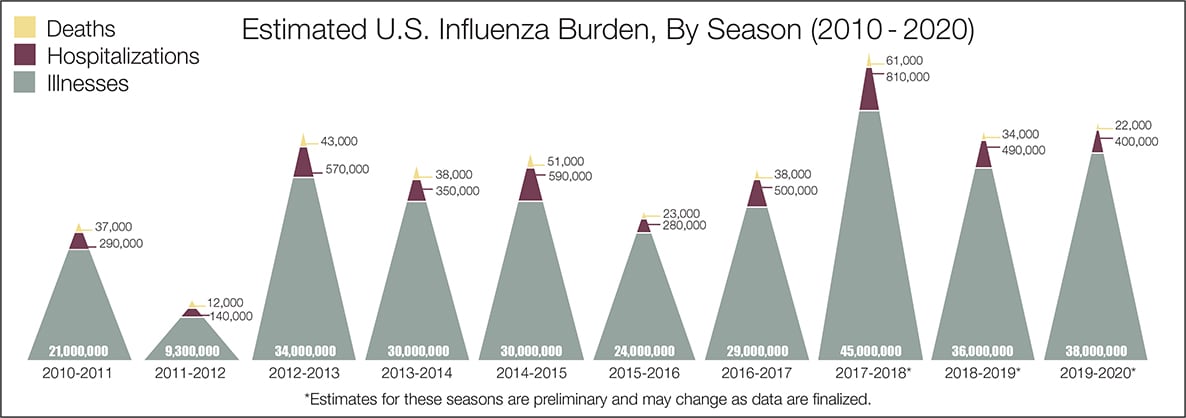
What we do not know about the coronavirus [actually there is little scientifically proven information]. Most of our knowledge is anecdotal, from studies with limited subjects, or from studies without peer review.
- How many people have been infected as many do not show symptoms?
- Masks do work.
- Do we develop lasting immunity to the coronavirus? Another coronavirus – the simple cold – does not develop long term immunity.
- To what degree do people who never develop symptoms contribute to transmission?
- The US has scaled up coronavirus testing – and the accuracy of the tests has been improving. However, if one loses immunity – the coronavirus testing value is reduced.
- Can children widely spread coronavirus? [current thinking is that they are becoming a major source of the pandemic spread]
- Why have some places avoided big coronavirus outbreaks – and others hit hard?
- What effect will the weather have? At this point, it does not seem hot weather slows this coronavirus down – and it seems air conditioning contributes to its spread.
- Outdoor activities seem to be a lower risk than indoor activities.
- Can the world really push out an effective vaccine in 12 to 18 months?
- Will other medical treatments for Covid-19 ease symptoms and reduce deaths? So far only one drug (remdesivir) is approved for treatment.
- A current scientific understanding of the way the coronavirus works can be found [here].
Heavy breakouts of coronavirus have hit farm workers. Farmworkers are essential to the food supply. They cannot shelter at home. Consider:
- they have high rates of the respiratory disease [occupational hazard]
- they travel on crowded buses chartered by their employers
- few have health insurance
- they cannot social distance and live two to four to a room – and they eat together
- some reports say half are undocumented
- they are low paid and cannot afford not to work – so they will go to work sick
- they do not have access to sanitation when working
- a coronavirus outbreak among farmworkers can potentially shutter entire farm
The bottom line is that COVID-19 so far has been shown to be much more deadly than the data on the flu. Using CDC data, the flu has a mortality rate between 0.06 % and 0.11 % Vs. the coronavirus which to date has a mortality rate of 4 % [the 4% is the average of overall statistics – however in the last few months it has been hovering around 1.0%] – which makes it between 10 and 80 times more deadly. The reason for ranges:
Because influenza surveillance does not capture all cases of flu that occur in the U.S., CDC provides these estimated ranges to better reflect the larger burden of influenza.
There will be a commission set up after this pandemic ends to find fault [it is easy to find fault when a once-in-a-lifetime event occurs] and to produce recommendations for the next time a pandemic happens. Those that hate President Trump will conclude the virus is his fault.
Resources:
- Get the latest public health information from CDC: https://www.coronavirus.gov .
- Get the latest research from NIH: https://www.nih.gov/coronavirus.
- Find NCBI SARS-CoV-2 literature, sequence, and clinical content: https://www.ncbi.nlm.nih.gov/sars-cov-2/.
- List of studies: https://icite.od.nih.gov/covid19/search/#search:searchId=5ee124ed70bb967c49672dad
include(“/home/aleta/public_html/files/ad_openx.htm”); ?>


