


Written by Steven Hansen
The U.S. new cases 7-day rolling average is 18.6 % HIGHER than the 7-day rolling average one week ago. U.S. deaths due to coronavirus are now 4.0 % HIGHER than the rolling average one week ago. U.S. hospitalizations due to COVID-19 are now 10.8 % HIGHER than the rolling average one week ago. Today’s headlines include:
- Don’t Use N95 Masks for More Than 2 Days
- Pre-election virus spike creates concerns for polling places
- In the hunt for the source of the virus, the W.H.O. let China take charge.
- About 17% of COVID-19 Survivors Retest Positive on Follow-Up
- Wear A Mask Inside Your House At First Sign Of COVID
- ‘CommonPass’: New COVID-19 Security Measures Will Make Health A Prerequisite For Travel
- The best COVID-19 warning system? Poop and pooled spit, says one Colorado university
- Pickup truck buyers: ‘This is what I need’ during coronavirus pandemic
- Internal Documents Reveal COVID-19 Hospitalization Data The Government Keeps Hidden
- Italy imposes additional coronavirus restrictions

The recent worsening of the trendlines for new cases should be attributed to going back to college/university, cooler weather causing more indoor activities, possible mutation of the virus, fatigue from wearing masks / social distancing, holiday activities, and continued loosening of regulations designed to slow the coronavirus spread.
My continuing advice is to continue to wash your hands, wear masks, avoid crowds, and maintain social distancing. No handwashing, mask, or social distancing will guarantee you do not get infected – but it sure as hell lowers the risk in all situations – and the evidence to-date shows a lower severity of COVID-19. In addition, certain activities are believed to carry higher risk – like being inside in air conditioning and removing your mask (such as restaurants, around your children/grandchildren, bars, and gyms). It is all about viral load – and outdoor activities are generally safe if you can maintain social distance.
include($_SERVER[‘DOCUMENT_ROOT’].’/pages/coronavirus1.htm’); ?>
Hospitalizations (grey line) and Mortality (green line) For Week ending 24OCT2020
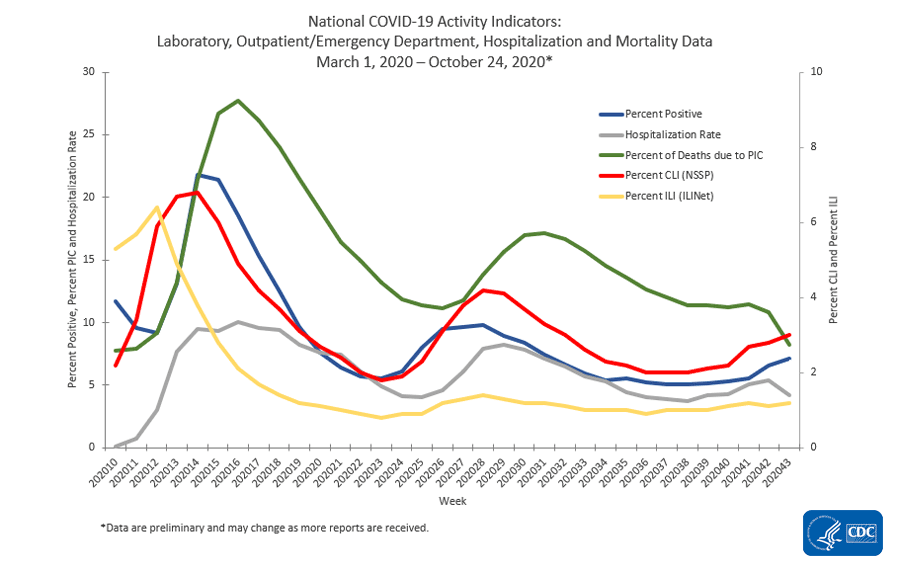
source: https://www.cdc.gov/coronavirus/2019-ncov/covid-data/covidview/index.html
Coronavirus News You May Have Missed
About 17% of COVID-19 Survivors Retest Positive on Follow-Up – Medscape
For reasons unknown, about 1-in-6 people who recovered from COVID-19 subsequently retested positive at least 2 weeks later, researchers reported in a study in Italy.
Sore throat and rhinitis were the only symptoms associated with a positive result. “Patients who continued to have respiratory symptoms, especially, were more likely to have a new positive test result,” lead author Francesco Landi, MD, PhD, told Medscape Medical News.
“This suggests the persistence of respiratory symptoms should not be underestimated and should be adequately assessed in all patients considered recovered from COVID-19,” he said.
“The study results are interesting,” Akiko Iwasaki, PhD, an immunobiologist at Yale University and the Howard Hughes Medical Institute, told Medscape Medical News. “There are other reports of RNA detection postdischarge, but this study…found that only two symptoms out of many — sore throat and rhinitis — were higher in those with PCR-positive status.”
In the hunt for the source of the virus, the W.H.O. let China take charge. – New York Times
On a cold weekend in mid-February, when the world still harbored hope that the coronavirus could be contained, a World Health Organization team arrived in Beijing to study the outbreak and investigate a critical question: How did the virus jump from animals to humans?
At that point, there were only three confirmed deaths from Covid-19 outside China, and scientists hoped that finding an animal source for the virus would unlock clues about how to stop it, treat it and prevent similar outbreaks.
“If we don’t know the source, then we’re equally vulnerable in the future to a similar outbreak,” Dr. Michael Ryan, the emergency director of the W.H.O., had said that week.
What the team members did not know was that they would not be allowed to investigate the source at all. Despite Dr. Ryan’s pronouncements, and against the advice of its emergency committee, the organization’s leadership had quietly negotiated terms that sidelined its own experts. They would not question China’s initial response or even visit the live-animal market in the city of Wuhan where the outbreak seemed to have originated.
Nine months and more than 1.1 million deaths later, there is still no transparent, independent investigation into the source of the virus. China has impeded the effort, while leaders of the W.H.O., if privately frustrated, have largely ceded control, even as the Trump administration has fumed.
From the earliest days of the outbreak, the W.H.O. — the only public health body with a global remit — has been both indispensable and impotent. The Geneva-based agency has delivered key information about testing, treatment and vaccine science. When the Trump administration decided to develop its own test kits, rather than rely on the W.H.O. blueprint, the botched result led to delays.
At the same time, the health organization pushed misleading and contradictory information about the risk of spread from symptomless carriers. Its experts were slow to accept that the virus could be airborne. Top health officials encouraged travel as usual, advice that was based on politics and economics, not science.
The W.H.O.’s staunchest defenders note that, by the nature of its constitution, it is beholden to the countries that finance it. And it is hardly the only international body bending to China’s might.
Now, as a new Covid-19 wave engulfs Europe and the United States, the organization is in the middle of a geopolitical standoff between the world’s two greatest powers, the United States and China.
China’s authoritarian leaders want to constrain the organization; President Trump, who formally withdrew the United States from the body in July, seems intent on destroying it; and European leaders are scrambling to reform and empower it.
[editor’s note: There is little question the China was not transparent during the beginning of the outbreak. ]
Pre-election virus spike creates concerns for polling places – AP
A surge in coronavirus cases across the country, including in key presidential battleground states, is creating mounting health and logistical concerns for voters, poll workers and political parties ahead of Election Day.
In Iowa, where both presidential campaigns are competing feverishly, county officials said they were preparing for scores of confirmed or potentially infected people to vote curbside. It’s an option typically used by disabled people that must be available outside every polling place.
Linn County – Stacey Walker, in Cedar Rapids, encouraged people to cast their ballot but said they should take safety precautions at polling places to protect themselves and their neighbors.
Pickup truck buyers: ‘This is what I need’ during coronavirus pandemic – USA Today
Attitudes of pickup truck owners have shifted in a big way with COVID-19, based on a new study from CarGurus.com.
“We learned how the pandemic may have helped to spur pickup truck purchases,” said Madison Gross, director of customer insights at the automotive research and shopping site.
Part of the reason is the time to do more home improvement projects and the need for a vehicle to haul bulky stuff. If people were pondering a truck, they pulled the trigger.
“According to the study, 26% of pandemic truck buyers said they hadn’t intended to buy one before, yet they opted to do so. Younger shoppers helped fuel this demand, noting that trucks offered a fun escape and a way to treat themselves, and stimulus checks helped them make these purchases,” she told the Free Press. “Given the higher price point that trucks tend to carry compared to other categories and the overall economic climate, it was interesting to see this trend towards more expensive vehicles.”
Internal Documents Reveal COVID-19 Hospitalization Data The Government Keeps Hidden – NPR
As coronavirus cases rise swiftly around the country, surpassing both the spring and summer surges, health officials brace for a coming wave of hospitalizations and deaths. Knowing which hospitals in which communities are reaching capacity could be key to an effective response to the growing crisis. That information is gathered by the federal government — but not shared openly with the public.
NPR has obtained documents that give a snapshot of data the U.S. Department of Health and Human Services collects and analyzes daily. The documents — reports sent to agency staffers — highlight trends in hospitalizations and pinpoint cities nearing full hospital capacity and facilities under stress. They paint a granular picture of the strain on hospitals across the country that could help local citizens decide when to take extra precautions against COVID-19.
Withholding this information from the public and the research community is a missed opportunity to help prevent outbreaks and even save lives, say public health and data experts who reviewed the documents for NPR.
… The daily reports show county, city and hospital-level details, as well as national analyses that HHS does not post online.
A page from a report shared internally to HHS staffers presents hospital data from Oct. 27, including a list of cities where hospital and ICU beds are filling up.
[editor’s note: this post deserves a full read as there is too much data to summarize]

T-cell study adds to debate over duration of COVID-19 immunity – Reuters
A small UK study has found that “cellular immunity” to the pandemic SARS-CoV-2 virus is present after six months in people who had mild or asymptomatic COVID-19 infections – suggesting they might have some level of protection for at least that time.
Scientists presenting the findings, from 100 non-hospitalised COVID-19 patients in Britain, said they were “reassuring” but did not mean people cannot in rare cases be infected twice with the disease.
“While our findings cause us to be cautiously optimistic about the strength and length of immunity generated after SARS-CoV-2 infection, this is just one piece of the puzzle,” said Paul Moss, a professor of haematology at Britain’s Birmingham University who co-led the study.
“There is still a lot for us learn before we have a full understanding of how immunity to COVID-19 works.”
… The study also found the size of T-cell response differed, and was considerably higher in people who had had symptomatic COVID-19 than those who had no symptoms when infected.
The researchers said this could be interpreted in two ways: It is possible that higher cellular immunity might give better protection against re-infection in people who had symptoms, or equally, that asymptomatic patients are better able to fight off the virus without the need to generate a large immune response.
Pulse Oximeters and Oxygen Concentrators: What to Know About At-Home Oxygen Therapy – FDA
You should not to use an oxygen concentrator at home unless it has been prescribed by a health care provider. Giving yourself oxygen without talking to a doctor first may do more harm than good. You may end up taking too much or too little oxygen. Deciding to use an oxygen concentrator without a prescription can lead to serious health problems such as oxygen toxicity caused by receiving too much oxygen. It can also lead to a delay in receiving treatment for serious conditions like COVID-19.
Even though oxygen makes up about 21 percent of the air around us, breathing high concentrations of oxygen may damage your lungs. On the other hand, not getting enough oxygen into the blood, a condition called hypoxia, could damage the heart, brain, and other organs.
Find out if you really need oxygen therapy by checking with your health care provider. If you do, your health care provider can determine how much oxygen you should take and for how long.
Italy imposes additional coronavirus restrictions, cites ‘terrifying’ surge – The Hill
Italy’s premier on Monday announced a new set of national measures aimed at stemming the spread of COVID-19 after his moves to implement some restrictions in October failed to prevent what his health minister called a “terrifying” surge in cases.
The Associated Press reported that Giuseppe Conte told Italian lawmakers that the newest set of restrictions would vary by region but would include a “late evening” curfew for many regions in the country currently not under such a restriction, as well as the closure of some businesses.
High schools in Italy will move to full-time distance learning, while shopping malls will close across the country on weekends, according to the AP.
Conte’s decision comes a day after Reuters reported that his top health minister warned an alarming rise in COVID-19 cases presented an immediate danger to be addressed by state officials.
The best COVID-19 warning system? Poop and pooled spit, says one Colorado university. – USA Today
According to data collected in mid-September, only about 6% of large universities with in-person classes are routinely testing all students, according to an NPR analysis of his group’s data.
The University of Illinois at Urbana-Champaign has been leading the pack, testing about 10,000 students each day using a streamlined spit-testing method. But it’s pricey. Despite driving down the cost of an individual test to about $10, Paul Hergenrother, a chemist leading the effort, said the school is still spending about $1 million a week.
At Colorado State University, Lori Lynn, co-chair of the school’s pandemic response team, said initially the school was paying $93 a pop to test students using the usual nose swab method.
“We quickly spent several million dollars on testing,” said Lynn, who added that cost is just one limiting factor.
Instead, Mark Zabel, a CSU molecular biologist and immunologist who typically studies neurodegenerative diseases, said his group recently figured out how to screen saliva for less than $20 a person. It involves pooling drool samples in a strategic way reminiscent of the children’s game Battleship.
In people without symptoms, a rapid test misses more infections than it spots, a study says. – New York Times
A new study casts doubt on whether rapid coronavirus tests, widely hailed as a potential solution to the nation’s testing woes, perform as promised under real-world conditions, especially when used in people without symptoms.
In a head-to-head comparison, researchers at the University of Arizona found that, in symptomatic people, a rapid test made by Quidel could detect more than 80 percent of coronavirus infections found by a slower, lab-based P.C.R. test. But when the rapid test, called the Sofia, was used instead to randomly screen students and staff members who did not feel sick, it detected only 32 percent of the positive cases identified by the P.C.R. test.
“That’s worse than flipping a coin,” said Jennifer Dien Bard, the director of the clinical microbiology and virology laboratory at Children’s Hospital Los Angeles, who was not involved in the study.
When asked about the Sofia’s poorer performance in asymptomatic people, David Harris, an author on the study, said, “I think everybody expected that.”
The ‘dose’ of coronavirus a person gets may determine how sick they get; masks could help – CNN
“The dose makes the poison” is an adage credited to Paracelsus, a Swiss physician-philosopher from the early Renaissance.
Basically, it means that any substance can become toxic if given at a high enough concentration. Even too much water can throw off your electrolytes and be potentially fatal.
Viewing the coronavirus through that lens — that the “dose” of the virus you receive might make the difference between being asymptomatic, getting mildly sick or becoming critically ill — may be helpful when thinking about protection against Covid-19 as the colder temperatures arrive and cases spike.
The concept of needing a certain dose of a pathogen — a disease-causing organism — to trigger an infection has been shown to be the case for many viruses, such as the influenza virus, poxviruses and others, explained Erin Bromage, an associate professor of biology at the University of Massachusetts, Dartmouth.
“If you hit an animal with a low enough dose, they’ll be able to fend that off without developing any disease at all. If you get a magic number of an infectious dose, an infection will establish and that animal will then succumb to the disease from that particular pathogen. But if you hit them with more than the infectious dose, in most situations a high dose of pathogens — like a high dose of a virus, for example — leads to more severe outcomes. So, dose becomes really important,” he said, calling the relationship “dose-dependent.”
It’s not because you need a certain number of particles of virus to infect a cell — it just increases the odds that one of those viral particles will make it into the cell and infect it, setting off the chain reaction.
CDC Says Wear a Mask Inside Your Household at First Sign of COVID – Medscape
A CDC report says the coronavirus spreads quickly among people living together — so quickly that you should start wearing a facial covering inside shared spaces as soon as you think you or someone in your household is infected.
The CDC’s Morbidity and Mortality Weekly Report says more than 100 households in Nashville and Marshfield, WI, were studied from April to September to determine the rate of COVID transmission within a household.
Fifty-three percent of people living with somebody who tested positive ended up becoming infected themselves within a week, with 75% of the secondary infections confirmed within 5 days or less, the CDC said.
“Because prompt isolation of persons with COVID-19 can reduce household transmission, persons who suspect that they might have COVID-19 should isolate, stay at home, and use a separate bedroom and bathroom if feasible,” the study said
‘CommonPass’: New COVID-19 Security Measures Will Make Health A Prerequisite For Travel – ZeroHedge
As the multi-sector, global response to the coronavirus tightens the noose around civil liberties, CommonPass stands out as one of the most appalling and dangerous attacks on basic human rights in the name of public health.
… A new digital certificate called CommonPass, designed to serve as a clearance mechanism for passengers based on a health diagnosis underwent its first transatlantic test on October 21 under the watchful eye of the Centers for Disease Control (CDC) and U.S. Customs and Border Protection (CBP) at Heathrow Airport in London. There, a group of select participants embarked on United flight 15 to Newark, New Jersey after being screened and tested for COVID-19 at the point of departure in a largely ceremonial exercise that included initiative co-founders, Paul Meyer and Bradley Perkins.
The app’s first trial run took place with much less media fanfare last month on a Cathay Pacific Airways flight from Hong Kong to Singapore and marked the beginning of the CommonPass pilot project launched by The Commons Project non-profit organization in-tandem with the World Economic Forum.
Travel industry insiders claim that CommonPass will allow international travel to resume before a COVID-19 vaccine is made widely available by applying standard methods for certification of lab results and vaccination records of travelers through the CommonPass Framework, based on criteria set by the governments of each port of entry.
… Just as Bush’s Aviation and Transportation Security Act opened the doors for certain technology and security sectors to flourish in the wake of 9/11, this novel health-focused expansion of the national security state has bypassed all levers of democratic power to allow for the entrenchment of a far larger and more dangerous group of entities, within the health, technology and life sciences industries together with an increasingly more powerful clique of federal health agencies and officials, like Robert Kadlec, who are pushing for a full spectrum surveillance society.
Taking your shoes off at the airport and exposing your body to radiation has become routine now at every airport in the nation and most ‘temporary’ laws passed through emergency legislation remain on the books nearly two decades later. Precedent demands that we assume the same will occur with the majority of the new restrictions on our freedom of movement and quality of life currently being implemented throughout the country and the world.
[editor’s note: this post is worth a read – I do not subscribe to the paranoia relating to CommonPass- but civil liberties are being eroded daily in our lives. You cannot live your life based on litmus tests,]
Don’t Use N95 Masks for More Than 2 Days, Research Suggests – Medscape
When reused for more than 2 days, nearly half of N95 masks fail, new research shows.
“N95 respirators used past day 2 had significant failure rates,” Ronald Check, MD, St. Luke’s University Hospital, Bethlehem, Pennsylvania, said in a presentation of his research at the American College of Emergency Physicians (ACEP) 2020, which was held online.
In the study, investigators evaluated masks that had been reused by healthcare workers in a single-center trauma unit. They recruited individuals who had been assigned masks that were of the correct size and that had been fit tested. Persons whose mask had not been fit tested were excluded from the study. Fit testing continued periodically throughout the workers’ shift. At those times, the masks were checked for fit and for the quality of the seal.
For 5 days, the researchers evaluated masks using Occupational Safety and Health Administration qualitative fit-test guidelines.
States undercount positive rapid tests, masking the spread of disease. – New York Times
As rapid coronavirus tests are becoming more widely available, delivering results in minutes, officials warn of a significant undercount, blurring the virus’s spread in the United States and in communities where such tests are more commonly used.
Public health officials say that antigen tests, which are faster than polymerase chain reaction (P.C.R.) tests but less able to detect low levels of the virus, are an important tool for limiting the spread of the virus. But they caution that with inconsistent public reporting, the case undercount may worsen as more “point-of-care” antigen tests, as well as D.I.Y. and home test kits, come on the market.
“We want to be sure that we’re not now saying, ‘there’s no disease,’ when there is lots of disease. All that’s happened is that the science with which we identify it has evolved,” said Janet Hamilton, the executive director of the Council of State and Territorial Epidemiologists, the group that helps the Centers for Disease Control and Prevention define cases of the coronavirus.
Despite C.D.C. guidance to report cases based on P.C.R. and antigen testing, Washington, D.C., and seven states don’t publicly share case counts for those with antigen positive tests, including California, New Jersey and Texas.

The following are foreign headlines with hyperlinks to the posts
UK Lockdown: The British government says a new national lockdown in England may have to last longer than the planned four weeks if infection rates don’t fall quickly enough. The lockdown announced by Prime Minister Boris Johnson is to run from Thursday until Dec. 2..
In Germany, bars, restaurants, gyms, museums close their doors to the public today as new restrictions, a partial four-week shutdown, come into effect in an attempt to reverse the virus’ spread.
Schools throughout Cambodia have reopened for the first time since March but with class sizes and hours limited by virus precautions.
Prince William had coronavirus in April, kept diagnosis under wraps
Australia reports no new COVID-19 cases for first time in five months
A mass testing campaign in China’s tightly-controlled western region of Xinjiang has revealed the country’s worst coronavirus outbreak in months.
Australia records zero local coronavirus cases for first time since June
Half of Slovakia’s population tested for coronavirus in one day
The following are additional national and state headlines with hyperlinks to the posts
“Fire Fauci” was the rallying cry for some at a Sunday campaign stop in Florida for President Donald Trump, who replied, saying “Don’t tell anybody, but let me wait until a little bit after the election.”
Rent prices drop again in S.F. and other Bay Area cities, but ‘freefall’ may be slowing
The Pandemic Is in Uncharted Territory
Rent prices drop again in S.F. and other Bay Area cities, but ‘freefall’ may be slowing
Plasma Contract: An AP investigation has found that the Trump administration awarded emergency coronavirus funds to a well-connected Republican donor’s company to test a possible COVID-19-fighting blood plasma technology.
Several airlines have recently shown optimism about holiday booking numbers.
Ravens All-Pro announces he has COVID-19
Doctors Begin to Crack Covid’s Mysterious Long-Term Effects
El Paso, Texas, Gets 4th Mobile Morgue As COVID-19 Deaths Rise
Despite Strains, Small Colleges Find Advantages In Dealing With COVID-19 On Campus
13-year-old boy becomes Missouri’s youngest COVID-19 death
Washington, DC, postpones schools returning to in-person learning
Nearly 150 COVID Cases Linked to Church in Massachusetts
Coronavirus Found in Lungs of Victim During Autopsy a Month after Death
Texas COVID Hospitalizations Highest Since August
Tests show the genetic signature of the virus that may have infected Trump.
Americans are still eager to shop even as the pandemic stretches on, the National Retail Federation’s chief economist Jack Kleinhenz said
Oil prices tumble as lockdowns stoke recession fears
Today’s Posts On Econintersect Showing Impact Of The Pandemic With Hyperlinks
October 2020 ISM and Markit Manufacturing Surveys Remain In Expansion
September 2020 Construction Spending Again Marginally Improves
Challenges To The Feds New Monetary Policy Strategy
COVID, Election Uncertainty Weigh Heavily On Firms’ Outlook
Warning to Readers
The amount of politically biased articles on the internet continues to increase. And studies and opinions of the experts continue to contradict other studies and expert opinions. Honestly, it is difficult to believe anything anymore. A study usually cannot establish cause and effect – but only correlation. Be very careful what you believe about this pandemic.

I assemble this coronavirus update daily – sifting through the posts on the internet. I try to avoid politically slanted posts (mostly from CNN, New York Times, and the Washington Post) and can usually find unslanted posts on that subject from other sources on the internet. I wait to publish posts on subjects that I cannot validate across several sources. But after all this extra work, I do not know if I have conveyed the REAL facts. It is my job to provide information so that you have the facts necessary – and then it is up to readers to draw conclusions.
Analyst Opinion of Coronavirus Data
There are several takeaways that need to be understood when viewing coronavirus statistical data:
- The global counts are suspect for a variety of reasons including political. Even the U.S. count has issues as it is possible that as much as half the population has had coronavirus and was asymptomatic. It would be a far better metric using a random sampling of the population weekly. In short, we do not understand the size of the error in the tracking numbers.
- Just because some of the methodology used in aggregating the data in the U.S. is flawed – as long as the flaw is uniformly applied – you establish a baseline. This is why it is dangerous to compare two countries as they likely use different methodologies to determine who has (and who died) from coronavirus.
- COVID-19 and the flu are different but can have similar symptoms. For sure, COVID-19 so far is much more deadly than the flu. [click here to compare symptoms]
- From an industrial engineering point of view, one can argue that it is best to flatten the curve only to the point that the health care system is barely able to cope. This solution only works if-and-only-if one can catch this coronavirus once and develops immunity. In the case of COVID-19, herd immunity may need to be in the 80% to 85% range. WHO warns that few have developed antibodies to COVID-19. At this point, herd immunity does not look like an option although there is now a discussion of whether T-Cells play a part in immunity [which means one might have immunity without antibodies]
- Older population countries will have a higher death rate.
- There are at least 8 strains of the coronavirus. New York may have a deadlier strain imported from Europe, compared to less deadly viruses elsewhere in the United States.
- Each publication uses different cutoff times for its coronavirus statistics. Our data uses 11:00 am London time. Also, there is an unexplained variation in the total numbers both globally and in the U.S.
- The real question remains if the U.S. is over-reacting to this virus. The following graphic from the CDC puts the annual flu burden in perspective [click on image to enlarge]. Note that using this data is dangerous as the actual flu cases are estimated and not counted – nobody knows how accurate these guesses are.
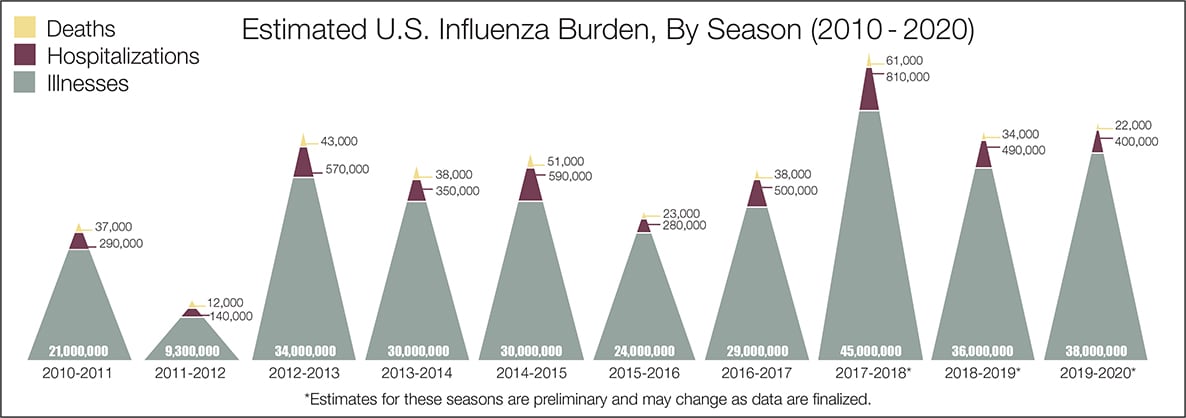
What we do not know about the coronavirus [actually there is little scientifically proven information]. Most of our knowledge is anecdotal, from studies with limited subjects, or from studies without peer review.
- How many people have been infected as many do not show symptoms?
- Masks do work.
- Do we develop lasting immunity to the coronavirus? Another coronavirus – the simple cold – does not develop long term immunity.
- To what degree do people who never develop symptoms contribute to transmission?
- The US has scaled up coronavirus testing – and the accuracy of the tests has been improving. However, if one loses immunity – the coronavirus testing value is reduced.
- Can children widely spread coronavirus? [current thinking is that they are becoming a major source of the pandemic spread]
- Why have some places avoided big coronavirus outbreaks – and others hit hard?
- What effect will the weather have? At this point, it does not seem hot weather slows this coronavirus down – and it seems air conditioning contributes to its spread.
- Outdoor activities seem to be a lower risk than indoor activities.
- Can the world really push out an effective vaccine in 12 to 18 months?
- Will other medical treatments for Covid-19 ease symptoms and reduce deaths? So far only one drug (remdesivir) is approved for treatment.
- A current scientific understanding of the way the coronavirus works can be found [here].
Heavy breakouts of coronavirus have hit farm workers. Farmworkers are essential to the food supply. They cannot shelter at home. Consider:
- they have high rates of the respiratory disease [occupational hazard]
- they travel on crowded buses chartered by their employers
- few have health insurance
- they cannot social distance and live two to four to a room – and they eat together
- some reports say half are undocumented
- they are low paid and cannot afford not to work – so they will go to work sick
- they do not have access to sanitation when working
- a coronavirus outbreak among farmworkers can potentially shutter entire farm
The bottom line is that COVID-19 so far has been shown to be much more deadly than the data on the flu. Using CDC data, the flu has a mortality rate between 0.06 % and 0.11 % Vs. the coronavirus which to date has a mortality rate of 4 % [the 4% is the average of overall statistics – however in the last few months it has been hovering around 1.0%] – which makes it between 10 and 80 times more deadly. The reason for ranges:
Because influenza surveillance does not capture all cases of flu that occur in the U.S., CDC provides these estimated ranges to better reflect the larger burden of influenza.
There will be a commission set up after this pandemic ends to find fault [it is easy to find fault when a once-in-a-lifetime event occurs] and to produce recommendations for the next time a pandemic happens. Those that hate President Trump will conclude the virus is his fault.
Resources:
- Get the latest public health information from CDC: https://www.coronavirus.gov .
- Get the latest research from NIH: https://www.nih.gov/coronavirus.
- Find NCBI SARS-CoV-2 literature, sequence, and clinical content: https://www.ncbi.nlm.nih.gov/sars-cov-2/.
- List of studies: https://icite.od.nih.gov/covid19/search/#search:searchId=5ee124ed70bb967c49672dad
include(“/home/aleta/public_html/files/ad_openx.htm”); ?>


