


Written by Steven Hansen
The U.S. new cases 7-day rolling average is 13.7 % HIGHER than the 7-day rolling average one week ago. U.S. deaths due to coronavirus are now 12.1 % HIGHER than the rolling average one week ago. At the end of this post is a set of interactive graphs and tables for the world and individual States – as well as today’s headlines which include;
- Global daily new coronavirus cases continue at record levels
- The U.S. again reported its second-highest daily case total since the start of the pandemic.
- AstraZeneca’s COVID-19 vaccine trial resumes in US; J&J’s to start soon
- Covid-19 “could be here for years” if only half of Americans take the vaccine, NIH director says
- A guide to overcoming COVID-19 misinformation
- Fauci says US may want to mandate masks amid COVID-19 surges
- The C.D.C. offers tips for voting safely during a pandemic
- Half a million COVID related deaths by the end of February?
- Risk of Inflight Spread of COVID-19 ‘Very Low,’ Not Zero
- CEO Confidence Buoyed by Improvements in the Economy

The recent worsening of the trendlines for new cases should be attributed to going back to college/university, cooler weather causing more indoor activities, fatigue from wearing masks / social distancing, holiday activities, and continued loosening of regulations designed to slow the coronavirus spread.
My continuing advice is to continue to wash your hands, wear masks, avoid crowds, and maintain social distancing. No handwashing, mask, or social distancing will guarantee you do not get infected – but it sure as hell lowers the risk in all situations – as the evidence to-date shows a lower severity of COVID-19. In addition, certain activities are believed to carry higher risk – like being inside in air conditioning and removing your mask (such as restaurants, around your children/grandchildren, bars, and gyms). It is all about viral load – and outdoor activities are generally safe.
The daily number of new cases in the U.S. is remaining stubbornly and embarrassedly high – and is currently increasing.
The following graphs show the 7-day rolling average for new coronavirus cases and deaths have been updated through 24 October 2020:


z coronavirus.png
Hospitalizations (grey line) and Mortality (green line) For Week ending 17OCT2020
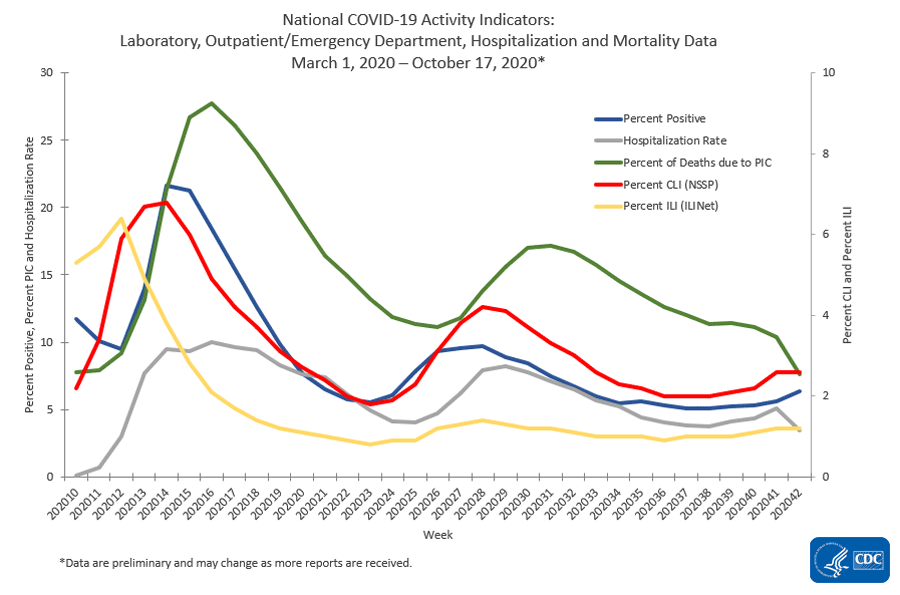
source: https://www.cdc.gov/coronavirus/2019-ncov/covid-data/covidview/index.html
Coronavirus Statistics For 24 October 2020 |
| U.S. Only | Global | U.S Percentage of Total | ||||
| Today*** | Cumulative | Today*** | Cumulative | Today | Cumulative | |
| New Confirmed Cases | 63,361 | 8,490,000 | 405,745 | 42,280,000 | 15.6% | 20.1% |
| Deaths** | 953 | 223,995 | 6,250 | 1,150,000 | 15.2% | 19.5% |
| Mortality Rate | 1.4% | 2.6% | 1.5% | 2.7% | ||
total COVID-19 Tests per 1,000 people | 2.23* | 415.63* | ||||
Source: EU CDC – The data insignificantly varies from the data produced by Johns Hopkins
* as of 20 Oct 2020
** evidently several States included “probable” deaths today in the number
*** red color indicates record number
Coronavirus News You May Have Missed
A guide to overcoming COVID-19 misinformation – National Geographic
… to disseminate information about COVID-19 to public authorities as rapidly as possible, scientific journals are under pressure to rush the careful vetting normally required to publish new science.
“We have published [studies] within a week of submission,” says Jennifer Zeis, the director of communications at the New England Journal of Medicine. “This is unusual—we’re not a breaking news organization, and this is a big stretch for our resources.”
Under COVID-19, this push for life-saving information also led to a flurry of articles appearing on what are known as preprint servers. These online platforms allow researchers to share their work almost as soon as the experiments are done, unlike academic publications that are more exclusive and require a time-consuming review process from a would-be author’s scientific peers.
“A tremendous amount of important science [on COVID-19] has appeared. It has been quite unprecedented,” says John Inglis, cofounder of medRxiv, the largest medical preprint server. “Obviously, some of it is wrong.“
Pronounced “med archive,” this particular preprint server has been flooded with new research about SARS-CoV-2. In January, the site posted 390 papers on various subjects, but by May, that number had jumped to 2,200, most about COVID-19.
MedRxiv employs a screening process to make sure a submitted research paper includes results, and is not an editorial or unsubstantiated hypothesis. The site then runs a plagiarism check and examines whether the paper makes a harmful claim. But, Inglis says, this process doesn’t determine whether the study is accurate, reliable, or prone to misinterpretation.
Inglis views preprint servers as a natural part of the scientific process, but he says their audience has likely expanded beyond just academics as COVID-19 has sparked lay interest. In May, medRxiv had 10 million page views and around six million downloads. That means people who are not experts can access the papers, interpret them in ways that fit with their existing beliefs, and then share their opinions with others.
“Preprint is not evil and peer review is not perfect. It’s all very gray,” says Ivan Oransky, a medical journalism lecturer at New York University and the co-founder of Retraction Watch, a news database dedicated to highlighting when studies are retracted or corrected.
Out of around 50,000 coronavirus papers and preprints published since January about SARS-CoV-2 and COVID-19, Retraction Watch has tracked 36 retracted COVID-19 papers, but Oransky notes it usually takes around three years for a study to be corrected.
… In an early April analysis of COVID-19 misinformation, researchers at Oxford University found that while the majority of fake news about the pandemic is spread by average social media users, top politicians or celebrities receive more attention and engagement on their posts.
… That’s been especially true for COVID-19. In a study published in September, Evanega and her team analyzed a database of 38 million pieces of English-language content published between January 1 and May 26. They found just over a million news articles that either spread or reported on misinformation related to the pandemic.
The most popular misinformation centered on miracle cures—drugs with no proven clinical benefit that are nonetheless touted as effective. Notably, her team also found that the president was the primary individual driver of misinformation, showing up in 38 percent of those misleading articles, and the biggest spikes in misinformation came when he made pronouncements about COVID-19 remedies.
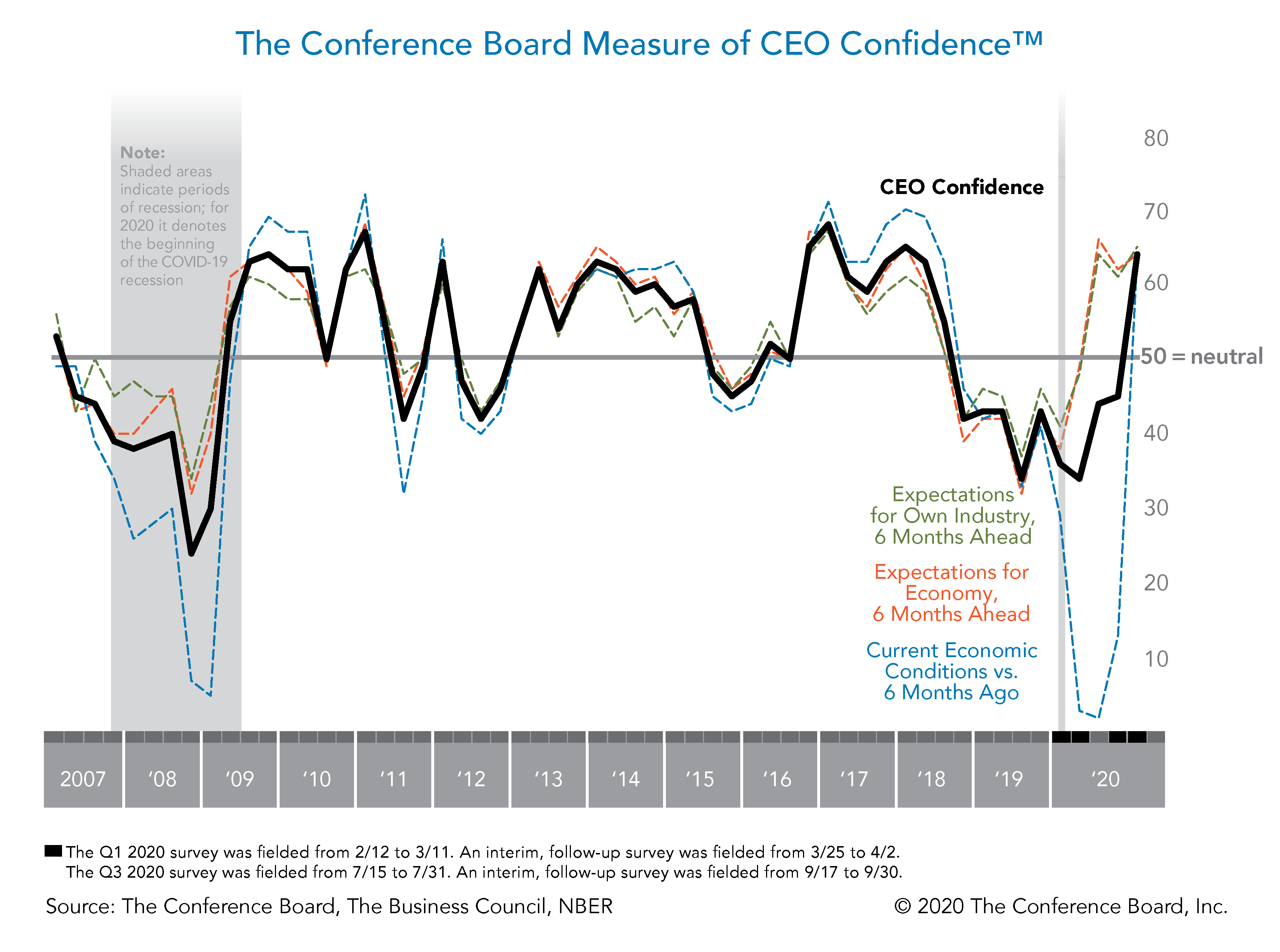
CEO Confidence Buoyed by Improvements in the Economy – The Conference Board
The Conference Board Measure of CEO Confidence™ in collaboration with The Business Council rose sharply in the final month of Q3 to the highest level recorded since Q1 2018. The measure stands at 64, up from 45. (A reading above 50 reflects more positive than negative responses.) While CEOs’ future expectations about the economy (orange line) and their own industries (green line) rose above the critical 50 point in Q2 2020, their assessment of current economic conditions (blue line) had remained poor until just recently. This component of the headline index improved markedly in September, in tandem with the lower COVID-19 transmission rates and steadily improving economic indicators that month.
Looking ahead, hiring plans have cooled, and the potential for layoffs remains, with one-third of CEOs saying they anticipate reducing their workforce over the next 12 months. However, they also reported that their plans for future capital spending have improved significantly. Finally, when asked what the most important long-term impact of the pandemic would be on their business, more than eight out of ten CEOs cited acceleration of digital transformation.
Fauci says US may want to mandate masks amid COVID-19 surges – The Hill
In a CNN interview on Friday, Fauci was asked if he thought Democratic presidential candidate Joe Biden‘s plan to fight for mandates on mask-wearing across the country would be helpful.
Fauci told CNN’s Erin Burnett that it would be a “great idea” to have everybody wearing masks uniformly. He also responded to criticism that mandates on masks would be difficult to enforce.
“If everyone agrees that this is something that’s important and they mandate and everybody pulls together, and says ‘we’re gonna mandate it, but let’s just do it,’ I think that would be a great idea to have everybody do it uniformly,” Fauci said.
Fauci further said that one of the arguments he hears against masks mandates is that enforcing it would create more of an issue.
“One of the issues though, I get the argument that ‘Well, if you mandate a mask, you’re going to have to enforce it and that’s going to create more of a problem,'” Fauci said. “Well, if people are not wearing masks, then maybe we should be mandating it.”
Risk of Inflight Spread of COVID-19 ‘Very Low,’ Not Zero – Medscape
The risk of COVID-19 spreading on flights appears “very low” but cannot be ruled out, despite studies showing only a small number of cases, the World Health Organization (WHO) said.
“In-flight transmission is possible but the risk appears to be very low, given the volume of travellers and the small number of case reports. The fact that transmission is not widely documented in the published literature does not, however, mean it does not happen,” the WHO said in a statement to Reuters.
The characterisation of the risk echoes the findings of a U.S. Defense Department study that last week described the probability of catching the disease on airliners as “very low” (https://bit.ly/2H3o5FB).
Some airlines have however used more robust language to describe the risk of onboard transmission.
Southwest Airlines and United Airlines have both said that recent studies had found that the risk was “virtually non-existent”.
The C.D.C. offers tips for voting safely during a pandemic. – New York Times
With early voting underway and the election days away, many U.S. cities and states have imposed safety measures to protect voters and poll workers from exposure to the coronavirus.
But polling places could still become “mass gathering events,” the Centers for Disease Control and Prevention warned in an advisory released on Friday, adding that measures to prevent the spread of Covid-19 could be improved.
The C.D.C. based its latest advice on a survey of 522 poll workers in Delaware’s statewide primary in September. That survey did not indicate whether any cases of Covid-19 were linked to the voting centers.
Guidelines issued by the agency in June recommended various ways to minimize crowds at polling locations, including absentee voting, extended voting hours and the use of protective gear by poll workers assisting voters with coronavirus symptoms.
The C.D.C. also recommended putting up physical barriers between voting machines, spacing the machines apart from one another, indicating 6-foot distances with signs or floor markings for those waiting in line to vote and allowing curbside voting for people who are ill, among other measures.
The advisory published on Friday said that “a substantial proportion” of poll workers in the Delaware study saw incorrect mask use by voters, and said that “further messaging on proper mask use, including at polling locations, might be needed to strengthen the effectiveness of masks during upcoming elections.”
Covid-19 “could be here for years” if only half of Americans take the vaccine, NIH director says – CNN
The percentage of Americans willing to take a Covid-19 vaccine appears to be falling – and if only half of the country is willing to get vaccinated, Covid-19 could stick around for years, Dr. Francis Collins, director of the National Institutes of Health, warned on Friday.
“When I look at the attitudes that are out there now about this vaccine and about who would be interested in taking it – it’s really, really troubling,” Collins said, speaking at a National Press Club in a virtual event.
“I’ve been talking so optimistically about how we are likely to have a vaccine by the end of the year, but if only 50% of Americans are interested in taking it, we’re never going to get to that point of immunity across the population where Covid-19 goes away. It could be here for years,” Collins said.
Only 51% of Americans said they would try to get a Covid-19 vaccine once one is widely available at a low cost, according to a CNN poll conducted by SSRS earlier this month, and that percentage has dropped since May.
Half a million deaths by the end of February? – USA Today
The nation’s patchwork of differing COVID-19 mandates and the inconsistent use of masks to prevent virus spread could lead to the cumulative loss of more than half a million lives by the end of February, scientists say.
Researchers from the University of Washington’s School of Medicine predicted that current state strategies surrounding social distancing, phased reopenings and mask mandates could lead to 511,373 deaths by Feb. 28, 2021, according to a study published Friday in the peer-reviewed journal Nature Medicine.
However, scientists also predicted nearly 130,000 lives could be saved from the end of September through the end of February if at least 95% of the population wore masks in public. If only 85% wore masks, still nearly 96,000 deaths could be prevented.
“We are heading into a very substantial fall-winter surge,” said Christopher Murray, director of the Institute for Health Metrics and Evaluation at the University of Washington’s School of Medicine. “We expect that surge to steadily grow throughout different states, and at the national level continue to increase as we head towards quite high levels of daily death in late December and January.”
… While model predictions are never perfect, the study’s findings are on track with other recently published data.
A study by researchers at Virginia Commonwealth University in Richmond found the pandemic caused an excess of 225,000 deaths from March to July, suggesting deaths could reach as high as 400,000 by the end of the year as the University of Washington had previously predicted.
Though they may shock the public, Bednarczyk says the projection models should serve as a wake-up call to reinforce the value of masks so death tolls falls short of these numbers.
AstraZeneca’s COVID-19 vaccine trial resumes in US; J&J’s to start soon – The Hill
AstraZeneca announced on Friday that the Food and Drug Administration (FDA) has allowed the company to restart its phase 3 COVID-19 vaccine trial in the U.S.
The company has said the FDA has reviewed all data and concluded that it is safe to resume the trial. It expects results from its trials later this year.
The Wall Street Journal first reported the approval on Friday.
“The restart of clinical trials across the world is great news as it allows us to continue our efforts to develop this vaccine to help defeat this terrible pandemic,” AstraZeneca CEO Pascal Soriot said in a statement. “We should be reassured by the care taken by independent regulators to protect the public and ensure the vaccine is safe before it is approved for use.”
The news comes just days after a volunteer who was a part of the trial in Brazil died. Reuters reported on Wednesday that Brazil’s health regulatory Anvisa said the trial would still continue.
Reuters cited a Brazilian news outlet that reported the volunteer was part of the placebo group, and did not receive the actual vaccine.
… Also on Friday, Johnson & Johnson announced that it is preparing to restart its trial following consultation with the FDA.
The company became the second to pause its trial earlier this month after a person suffered an “unexplained illness.
The company said that no clear cause of the incident was identified following review by an independent safety committee, and that there was “no evidence that the vaccine caused the event.”
Johnson & Johnson said preparations to resume the trial in the U.S. are now underway, and that “discussions with other regulators around the world to resume the clinical trial program are progressing.”
Drug-resistant superbug thriving in hospitals hit hard by COVID-19 – National Geographic
Candida auris is a superbug, a pathogen that can evade drugs made to kill it—and early signs suggest the COVID-19 pandemic may be propelling infections of the highly dangerous yeast. That’s because C. auris is particularly prominent in hospital settings, which have been flooded with people this year due to the coronavirus.
The superbug sticks stubbornly to surfaces such as sheets, bed railings, doors, and medical devices—making it easier to colonize skin and pass from one person to another. Moreover patients who have tubes that go into their body, such as catheters or ones for breathing or feeding, are at the highest risk for C. auris infections, and these invasive procedures have become more common because of the respiratory failure associated with COVID-19.
“Unfortunately, there have been places where we’ve seen a resurgence of C. auris,” says Tom Chiller, head of the mycotic diseases branch at the U.S. Centers for Disease Control and Prevention. “We’ve also seen it get into some of the acute care hospitals and also into some COVID-19 units … the concern there is that once it sets up shop in a place, it’s hard to get rid of.”
… Both she and Chowdhary emphasize the importance of testing and contact tracing—key interventions in the control of COVID-19 that are also critical in the fight against the spread of C. auris. They’re pushing for patients to be routinely screened for the superbug, which involves collecting a skin swab, blood, or urine to test for the yeast’s DNA. After a patient tests positive for C. auris, a medical procedure known as susceptibility testing is done to determine if any of the three classes of antifungal drugs can alleviate the infection.
These tactics can help track the deaths caused by the superbug, a process that is often complicated because the germ tends to be acquired in hospitals among people who are already sick with something else.
[editor’s note: this post deserves a full read]
The following are foreign headlines with hyperlinks to the posts
Poland president tests positive for COVID-19
Doctors in Delhi See Jump in Breathing Issues Amid COVID-19, Pollution
Europe also is bracing for a dark winter as the virus surges across the continent.
Colombian vice president tests positive for COVID-19
The following are additional national and state headlines with hyperlinks to the posts
U.S. reports more than 83,000 coronavirus cases, record daily total, as experts warn of difficult winter [note that our website uses Europe CDC data which reports NET change in the totals from the previous day]
500 Passengers Now Banned From Flying on Delta for Refusing Masks
How Wisconsin Docs Are Handling the COVID Onslaught
Healthcare Workers Ask OSHA for More Oversight on COVID-19 Safety
Today’s Posts On Econintersect Showing Impact Of The Pandemic With Hyperlinks
September 2020 Coincident Indices Mostly Improve But Most Remain In Contraction Year-over-Year
Unconventional Monetary Policy And International Interest Rate Spillovers
Labor Market Rebounds Surprisingly
Worldwide COVID-19 Cases And Deaths 23 October 2020
Warning to Readers
The amount of politically biased articles on the internet continues to increase. And studies and opinions of the experts continue to contradict other studies and expert opinions. Honestly, it is difficult to believe anything anymore. A study usually cannot establish cause and effect – but only correlation. Be very careful what you believe about this pandemic.

I assemble this coronavirus update daily – sifting through the posts on the internet. I try to avoid politically slanted posts (mostly from CNN, New York Times, and the Washington Post) and can usually find unslanted posts on that subject from other sources on the internet. I wait to publish posts on subjects that I cannot validate across several sources. But after all this extra work, I do not know if I have conveyed the REAL facts. It is my job to provide information so that you have the facts necessary – and then it is up to readers to draw conclusions.
Coronavirus INTERACTIVE Charts
include($_SERVER[‘DOCUMENT_ROOT’].’/pages/coronavirus.htm’); ?>
Analyst Opinion of Coronavirus Data
There are several takeaways that need to be understood when viewing coronavirus statistical data:
- The global counts are suspect for a variety of reasons including political. Even the U.S. count has issues as it is possible that as much as half the population has had coronavirus and was asymptomatic. It would be a far better metric using a random sampling of the population weekly. In short, we do not understand the size of the error in the tracking numbers.
- Just because some of the methodology used in aggregating the data in the U.S. is flawed – as long as the flaw is uniformly applied – you establish a baseline. This is why it is dangerous to compare two countries as they likely use different methodologies to determine who has (and who died) from coronavirus.
- COVID-19 and the flu are different but can have similar symptoms. For sure, COVID-19 so far is much more deadly than the flu. [click here to compare symptoms]
- From an industrial engineering point of view, one can argue that it is best to flatten the curve only to the point that the health care system is barely able to cope. This solution only works if-and-only-if one can catch this coronavirus once and develops immunity. In the case of COVID-19, herd immunity may need to be in the 80% to 85% range. WHO warns that few have developed antibodies to COVID-19. At this point, herd immunity does not look like an option although there is now a discussion of whether T-Cells play a part in immunity [which means one might have immunity without antibodies]
- Older population countries will have a higher death rate.
- There are at least 8 strains of the coronavirus. New York may have a deadlier strain imported from Europe, compared to less deadly viruses elsewhere in the United States.
- Each publication uses different cutoff times for its coronavirus statistics. Our data uses 11:00 am London time. Also, there is an unexplained variation in the total numbers both globally and in the U.S.
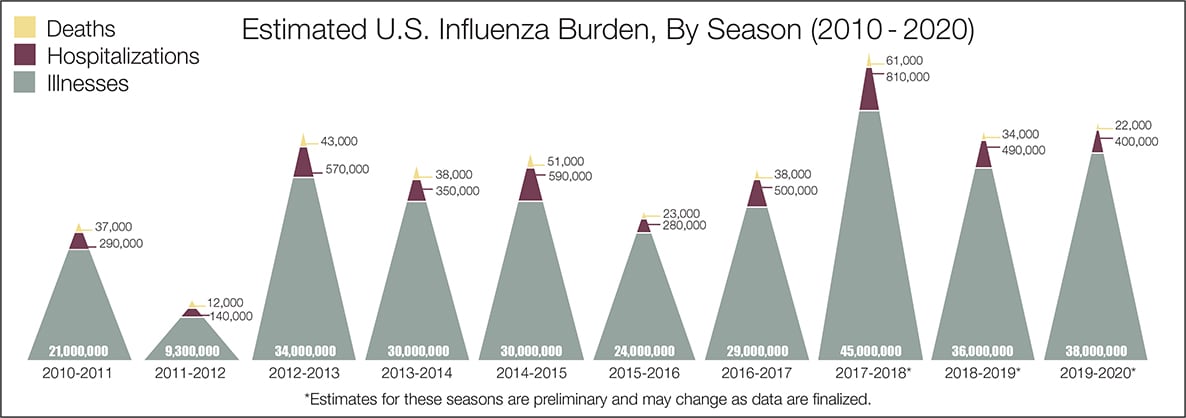
- The real question remains if the U.S. is over-reacting to this virus. The following graphic from the CDC puts the annual flu burden in perspective [click on image to enlarge]. Note that using this data is dangerous as the actual flu cases are estimated and not counted – nobody knows how accurate these guesses are.
What we do not know about the coronavirus [actually there is little scientifically proven information]. Most of our knowledge is anecdotal, from studies with limited subjects, or from studies without peer review.
- How many people have been infected as many do not show symptoms?
- Masks do work.
- Do we develop lasting immunity to the coronavirus? Another coronavirus – the simple cold – does not develop long term immunity.
- To what degree do people who never develop symptoms contribute to transmission?
- The US has scaled up coronavirus testing – and the accuracy of the tests has been improving. However, if one loses immunity – the coronavirus testing value is reduced.
- Can children widely spread coronavirus? [current thinking is that they are becoming a major source of the pandemic spread]
- Why have some places avoided big coronavirus outbreaks – and others hit hard?
- What effect will the weather have? At this point, it does not seem hot weather slows this coronavirus down – and it seems air conditioning contributes to its spread.
- Outdoor activities seem to be a lower risk than indoor activities.
- Can the world really push out an effective vaccine in 12 to 18 months?
- Will other medical treatments for Covid-19 ease symptoms and reduce deaths? So far only one drug (remdesivir) is approved for treatment.
- A current scientific understanding of the way the coronavirus works can be found [here].
Heavy breakouts of coronavirus have hit farm workers. Farmworkers are essential to the food supply. They cannot shelter at home. Consider:
- they have high rates of the respiratory disease [occupational hazard]
- they travel on crowded buses chartered by their employers
- few have health insurance
- they cannot social distance and live two to four to a room – and they eat together
- some reports say half are undocumented
- they are low paid and cannot afford not to work – so they will go to work sick
- they do not have access to sanitation when working
- a coronavirus outbreak among farmworkers can potentially shutter entire farm
The bottom line is that COVID-19 so far has been shown to be much more deadly than the data on the flu. Using CDC data, the flu has a mortality rate between 0.06 % and 0.11 % Vs. the coronavirus which to date has a mortality rate of 4 % [the 4% is the average of overall statistics – however in the last few months it has been hovering around 1.0%] – which makes it between 10 and 80 times more deadly. The reason for ranges:
Because influenza surveillance does not capture all cases of flu that occur in the U.S., CDC provides these estimated ranges to better reflect the larger burden of influenza.
There will be a commission set up after this pandemic ends to find fault [it is easy to find fault when a once-in-a-lifetime event occurs] and to produce recommendations for the next time a pandemic happens. Those that hate President Trump will conclude the virus is his fault.
Resources:
- Get the latest public health information from CDC: https://www.coronavirus.gov .
- Get the latest research from NIH: https://www.nih.gov/coronavirus.
- Find NCBI SARS-CoV-2 literature, sequence, and clinical content: https://www.ncbi.nlm.nih.gov/sars-cov-2/.
- List of studies: https://icite.od.nih.gov/covid19/search/#search:searchId=5ee124ed70bb967c49672dad
include(“/home/aleta/public_html/files/ad_openx.htm”); ?>


