


Written by Steven Hansen
The U.S. new cases 7-day rolling average is 18.1 % HIGHER than the 7-day rolling average one week ago. U.S. deaths due to coronavirus are now 1.7 % HIGHER than the rolling average one week ago. At the end of this post is a set of interactive graphs and tables for the world and individual States – as well as today’s headlines which include;
- Early lockdowns prevented additional COVID-19 deaths in multiple countries
- NIH Starts Clinical Trial Testing Antibody Drugs in COVID-19 Patients
- Europe Reports Record-High 700,000 COVID-19 Cases Last Week
- Dutch woman dies after catching Covid-19 twice, the first reported reinfection death
- Lopinavir-Ritonavir Does Not Improve COVID-19 Outcomes
- New reports show coronavirus immunity can last for months
- FDA faults quality control at Lilly plant making Trump-touted COVID drug
- “Most transmission is actually still happening in households” WHO says
- Cases emerge of rare hearing loss after Covid-19

The recent worsening of the trendlines for new cases should be attributed to going back to school (especially at college/university level) and continued loosening of regulations designed to slow the coronavirus spread.
My continuing advice is to continue to wash your hands, wear masks, and maintain social distancing. No handwashing, mask, or social distancing will guarantee you do not get infected – but it sure as hell lowers the risk in all situations – and evidence to-date shows a lower severity of COVID-19. In addition, certain activities are believed to carry a higher risk – like being inside in air conditioning and removing your mask (such as restaurants, around your children/grandchildren, bars, and gyms). It is all about viral load – and outdoor activities are generally very safe.
The daily number of new cases in the U.S. is remaining stubbornly and embarrassedly high.
The following graphs show the 7-day rolling average for new coronavirus cases and deaths have been updated through 14 October 2020:


z coronavirus.png
Coronavirus Statistics For 14 October 2020 |
| U.S. Only | Global | U.S Percentage of Total | ||||
| Today*** | Cumulative | Today*** | Cumulative | Today | Cumulative | |
| New Confirmed Cases | 50,728 | 7,860,000 | 332,122 | 38,200,000 | 15.3% | 20.6% |
| Deaths** | 817 | 215,902 | 5,291 | 1,090,000 | 15.4% | 19.8% |
| Mortality Rate | 1.6% | 2.7% | 1.6% | 2.9% | ||
total COVID-19 Tests per 1,000 people | 2.76* | 378.67* | ||||
Source: EU CDC
* as of 08 Oct 2020
** evidently several States included “probable” deaths today in the number
*** red color indicates record number

Coronavirus News You May Have Missed
U.S. pauses Eli Lilly’s trial of a coronavirus antibody treatment over safety concerns – CNBC
- Eli Lilly’s phase three trial of its ACTIV-3 monoclonal antibody treatment for the coronavirus has been paused due to potential safety concerns.
- The ACTIV-3 trial is designed to test a monoclonal antibody developed by Eli Lilly in combination with remdesivir, an antiviral with emergency use authorization for the virus.
- It’s one of several ongoing trials, as part of the National Institute of Health’s “Activ” program, designed to accelerate the development of vaccine treatments in partnership with the pharmaceutical industry.
J&J says review of illness that led to pause of coronavirus vaccine trial could take days – Reuters
Johnson & Johnson said on Tuesday it would take a few days at least to hear from a safety monitoring panel about its review of the company’s late-stage COVID-19 vaccine trial after announcing that the large study had been paused due to an unexplained illness in one participant.
The pause comes around a month after AstraZeneca Plc also suspended trials of its experimental coronavirus vaccine – which uses a similar technology – due to a participant falling ill. That trial remains on pause.
U.S.-based J&J, whose vaccine effort is among the high profile attempts to fight the coronavirus pandemic, said on Monday the illness was being reviewed by an independent data and safety monitoring board as well as its own clinical and safety team. The data board is then required to submit its findings to the U.S. Food and Drug administration before the study can be restarted.
Mathai Mammen, head of research & development at J&J’s drugs business, said the company informed the safety board about the ill trial participant on Sunday. The board has asked for more information, he said, adding that the company is collecting information to answer its questions.
“It will be a few days at minimum for the right set of information to be gathered and evaluated,” Mammen said during a conference call to discuss the company’s quarterly results.
Three Covid-19 trials have been paused for safety, and experts say that’s a good thing. – New York Times
This week, two high-profile, late-stage clinical trials — Johnson & Johnson’s test of a coronavirus vaccine and Eli Lilly’s study of a Covid-19 drug — were put on pause because of possible safety concerns. Just a month earlier, AstraZeneca’s vaccine trial was paused after two volunteers became seriously ill.
Clinical trials experts said these delays were comforting, in a way: They show that the researchers were following proper safety procedures. But for now, details about the nature of the volunteers’ illnesses are scant. And although pauses of vaccine trials are not unusual, some experts said that pausing treatment trials — like that of Eli Lilly’s antibody drug — is rarer, and perhaps more worrisome.
That trial was testing the treatment on hospitalized patients — a group that was already sick, and in which declines in health would not be surprising. So for a trial like that one to be paused, the safety concerns must have been significant, they said.
Early lockdowns prevented additional COVID-19 deaths in multiple countries – The Hill
Early lockdowns in developed countries that suffered coronavirus outbreaks were a determining factor in lessening the number of excess deaths from the pandemic, according to a study published Wednesday in the journal Nature Medicine.
The study from researchers at Imperial College London found that the timing and extent of state-ordered lockdown procedures contributed to the length of time it took for infection levels to return to low rates.
“The timing of the lockdown in relation to when initial infections occurred affects the peak number of people who are infected, which drives both the number of deaths from COVID-19 and the pressure on the healthcare system that displaces routine care for other diseases,” its authors wrote.
“The stringency of the lockdown, together with the extent and effectiveness of testing, contract tracing and isolation, determines how long it takes for the number of cases to return to low levels and can therefore account for some of the variations in the intensity and duration of excess deaths observed here,” they continued.
Authors of the study pointed to early lockdown measures implemented by leaders in Bulgaria, the Czech Republic, Hungary, Norway, Finland, New Zealand and Slovakia as being particularly effective in keeping infection rates to low enough levels where national contact tracing programs could be effective.
Other European countries in the 21-nation study were less willing to implement lockdown measures early on, resulting in greater stress on their health care systems.
[editor’s note: this is the type of bullshit post where the author’s started with a bias. WHO says lockdowns are not effective. I think lockdowns can be effective if targetted and not general. Note that Bulgaria, the Czech Republic, Hungary, Finland, and Slovakia currently have massive outbreaks which now exceed the levels before the initial lockdown. For a variety of reasons, you cannot lockdown forever, and at some point when there is a persistent pandemic – you gotta face the music with tools other than lockdown. ]
FDA faults quality control at Lilly plant making Trump-touted COVID drug – Reuters
U.S. drug inspectors uncovered serious quality control problems at an Eli Lilly and Co pharmaceutical plant that is ramping up to manufacture one of two promising COVID-19 drugs touted by President Trump as “a cure” for the disease, according to government documents and three sources familiar with the matter.
The Lilly antibody therapy, which is experimental and not yet approved by regulators as safe and effective, is similar to a drug from Regeneron Pharmaceuticals that was given to the president during his bout with COVID-19.
Trump, who credits the Regeneron drug with speeding his recovery, has called for both therapies to become available immediately on an emergency basis, raising expectations among some scientists and policy experts that the administration will imminently release an Emergency Use Authorization (EUA) for the drug. The president’s push is key to his efforts to convince voters he has an answer to the pandemic that has killed more than 215,000 Americans.
But the findings by the U.S. Food and Drug Administration inspectors at the Lilly manufacturing facility, which have not been disclosed previously, could complicate the drugmaker’s bid for a so-called emergency use authorization (EUA) from the federal agency, two of the sources and two outside legal experts told Reuters. That’s because U.S. law generally requires compliance with manufacturing standards for authorization of a drug.
NIH Starts Clinical Trial Testing Antibody Drugs in COVID-19 Patients – Reuters
The U.S. National Institutes of Health (NIH) said on Tuesday it has started a study to evaluate two monoclonal antibody drugs in hospitalized COVID-19 patients as part of the agency’s program to identify promising therapeutics to help tackle the new coronavirus.
The trial will test AbbVie Inc’s psoriasis drug risankizumab along with Gilead Sciences’ antiviral remdesivir, compared to a placebo and remdesivir.
The study will also test Humanigen’s experimental drug lenzilumab with remdesivir, compared to placebo and remdesivir. (bit.ly/3lKi1km)
“The goal here is to identify as quickly as possible the experimental therapeutics that demonstrate the most clinical promise as COVID-19 treatments and move them into larger-scale testing,” said NIAID Director and U.S. infectious diseases expert Anthony Fauci.
Gilead’s remdesivir, which was among the first to be used to treat COVID-19 and received emergency use authorization from the U.S. Food and Drug Administration in May, has since been authorized for use in several other countries.
Coronavirus cases are rising in U.S., sparking worries the next big wave has begun – Washington Post
U.S. coronavirus cases are rising again, driven by rapid transmission in Midwestern states and sparking fears that a forewarned wave of infections this fall and winter has begun.
For almost a month, new U.S. cases have been trending upward. Since Saturday, more than 20 states have hit a new high in their seven-day average of case counts, and more than half of those states set records again on Tuesday, according to data tracked by The Washington Post.
The rising numbers are especially concerning because they set the stage for an even greater surge this winter when the virus will be helped by drier conditions and people spending more time indoors. The upward trend comes before the increased mingling of people expected to arrive with Halloween, Thanksgiving and Christmas.
The virus has become especially rampant in Midwestern states after dominating U.S. coastal and urban areas in the spring, according to data tracked by The Washington Post.
Europe Reports Record-High 700,000 COVID-19 Cases Last Week – NPR
Europe is seeing record numbers of new coronavirus cases.
The continent reported over 700,000 new coronavirus cases last week — its highest weekly total yet, according to the World Health Organization.
This surge represents a 36% increase from the week prior, in which Europe reported fewer than 520,000 cases. Europe’s population is about 740 million.
Across Europe, many countries have the same goal now: to slow the spread of the virus but avoid the economically costly decision of a national lockdown.
England has seen new coronavirus cases quadruple in the last three weeks and has more patients hospitalized now than before its lockdown in March, according to The Washington Post.
British Prime Minister Boris Johnson told Parliament on Monday that he was trying to avoid “shuttering our lives and our society.”
Dutch woman dies after catching Covid-19 twice, the first reported reinfection death – CNN
An elderly Dutch woman has become the first known person to die from catching Covid-19 twice, according to experts, raising serious questions about how long immunity and antibodies can last.
The woman, 89, suffered from a rare type of bone marrow cancer called Waldenström’s macroglobulinemia. Her immune system was compromised due to the cell-depleting therapy she received, the researchers at Maastricht University Medical Center in the Netherlands wrote in a paper accepted for publication in the journal Clinical Infectious Diseases.
However, the researchers said her natural immune response could still have been “sufficient” to fight-off Covid-19, as the type of treatment she received for cancer “does not necessarily result in life threatening disease.”
The patient was initially admitted into hospital earlier this year with a severe cough and fever, testing positive for Covid-19.
7 looming questions about the rollout of a Covid-19 vaccine – STAT
The design, testing, and mass production of multiple vaccines has never been attempted on this type of timeline, making this moment a turning point in the development of vaccines to respond to new disease threats.
… Some of the looming problems aren’t foreseeable. But here are some potential hurdles that might complicate this very important effort.
[editor’s note: this list is far from comprehensive. My biggest worry is that we will not know from the get-go if any approved vaccine will lower the incidence of hospitalization or death. Folks, we have a long way to go to get this pandemic under control.]
- How do you define high-risk health workers? Essential workers?
- High-risk medical conditions push you to the front of the vaccine line. How do you prove you have them when you get there?
- How do you vaccinate special populations when there are little or no data on how the vaccines work for them?
- How widely can Pfizer and BioNTech’s vaccine be used, given its taxing storage requirements?
- An additional constraint of Pfizer’s vaccine relates to how much you have to order if you’re going to use it. The smallest possible order is 975 doses.
- With air travel slowed, can vaccines get where they need to go quickly?
- How can officials keep a highly coveted resource safe from theft — and prevent counterfeits?
How to Tell If Socializing Indoors Is Safe – The Atlantic
… No indoor gathering will be perfectly safe. Although many states have allowed indoor public settings such as gyms and restaurants to reopen at least in some capacity, experts don’t recommend spending a lot of time indoors with others, especially in situations where masking isn’t possible. The odds of catching the coronavirus are about 20 times higher indoors, and private, indoor gatherings have been linked to several coronavirus outbreaks. In June, a surprise birthday party in Texas resulted in 18 coronavirus cases. In July, a house party in Michigan led to 43 cases, and a family gathering in North Carolina led to 40 cases because the attendees “went about their daily lives” before they started showing symptoms. In some places, in-home gatherings are now responsible for the majority of new coronavirus cases. A recent Centers for Disease Control and Prevention report showed how a chain of family gatherings in Chicago led to three deaths.
But it’s unrealistic to expect Americans to stay inside all winter without seeing anyone. Even if people could do that without going batty, it’s likely that, with January feeling endless and no stay-at-home order in place, people will take their chances. “Making a rule that says zero indoor gatherings until we have a vaccine is totally impractical,” says Julia Marcus, an infectious-disease epidemiologist at Harvard Medical School.
In the absence of such a rule, “we have a mishmash of risk communication and guidelines from different entities,” Marcus told me, “and people are continuing to muddle through. It’s funny, because now I’m sitting here thinking, What are the rules in my city? I actually don’t know.”
[editor’s note: this post was written in a way that it is hard to summarize, but it seems to me the theme is only “Watch your distance, Wear a mask when you can’t watch your distance, and Wash your hands”]
Lopinavir-Ritonavir Does Not Improve COVID-19 Outcomes – Reuters
Lopinavir-ritonavir is not associated with improved outcomes in patients hospitalized with COVID-19, a new trial shows.
Dr. Peter W. Horby from the RECOVERY Central Coordinating Office, Oxford, UK and colleagues assessed whether lopinavir-ritonavir improves outcomes in their randomized trial of 5040 hospitalized patients (1616 allocated to lopinavir-ritonavir and 3424 allocated to usual care).
There was no significant difference in the proportion of patients who met the primary outcome of 28-day mortality between the lopinavir-ritonavir group (23%) and the usual care group (22%), according to the report in The Lancet.
Results were similar in a post hoc exploratory analysis restricted to the 4423 patients who tested positive for SARS-CoV-2.
There was no difference between the groups in the time until discharge alive from hospital, the probability of discharge alive from hospital within 28 days, or the number of patients who progressed to the prespecified composite secondary outcome of invasive mechanical ventilation or death.
“The results of this large randomized trial indicate that lopinavir-ritonavir is not an effective treatment for patients admitted to hospital with COVID-19,” the authors conclude.
New reports show coronavirus immunity can last for months – 7News Boston
Three new reports show coronavirus immunity can last for months — and maybe even longer.
The findings suggest that many, if not most, people who recover from coronavirus infections are protected for at least a period of time. They also suggest that coronavirus vaccines may be able to protect people for more than just a few weeks.
One study found that people produce antibodies that protect against infection and last for at least five to seven months.
“We have one person that is seven months out. We have a handful of people that are five to seven months out,” Deepta Bhattacharya, an immunobiologist at the University of Arizona College of Medicine, told CNN.
“We conclude that neutralizing antibodies are stably produced for at least 5-7 months after SARS-CoV-2 infection,” his team wrote in a report published in the journal Immunity on Tuesday.
[editor’s note: CNN published Richard Quest: After recovering from Covid-19, I thought I was safe. Now my antibodies are waning. This post states that Quest recovered from coronavirus in April and had been testing for antibodies regularily – but his test last week came back negative. Please note that antibody tests MAY NOT guage the level of immunity one carries – hopefully we will know the real answer to this question soon.]
“Most transmission is actually still happening in households,” WHO says – CNN
The World Health Organization on Wednesday underscored that most transmission of Covid-19 is still happening in households.
Speaking during a social media Q&A, Maria Van Kerkhove, a WHO infectious disease epidemiologist, said if someone tests positive for Covid-19, that they should be cared for in a medical facility – but she said she understands that cannot always happen.
“We realize that that is not possible globally, with so many cases that we are seeing, but it is important that if you are in a high risk group – if you are over 60, if you have any underlying conditions – that you are cared for in a medical facility,” she said. “The reason for that is because you are at a higher risk of developing severe disease and of death.”
If an infected person is cared for at home, “There’s the possibility that the virus will spread within the household,” she said.
“Most transmission is actually still happening in households,” Van Kerkhove said. “This we knew from the beginning, from the outbreaks that were detected in China. And one of the most important things that they did in China was recognizing this, and then isolating individuals who are infected outside of the home.”
The following are foreign headlines with hyperlinks to the posts
Germany providing $662M to help Holocaust survivors amid pandemic
Russia records more than 14K new coronavirus cases, setting single-day record
Russian Hospitals Near Capacity as COVID Cases Spike: ‘We Are Out of Beds’
Europe Passes U.S. in New COVID-19 Cases
Mexico Aims to Vaccinate 116 Million Against Coronavirus by End of 2021
Northern Ireland will lock down for four weeks, as England begins new restrictions.
France declares public health emergency as hospitalizations and cases spike
Healthy young people might not get vaccine until 2022, WHO says
The Pan American Health Organization’s top health official warned that Canada is facing a second wave of coronavirus cases as the provinces of Quebec and Ontario report the bulk of the country’s Covid-19 death toll.
Russia President Vladimir Putin announced the approval of the country’s second Covid-19 vaccine, a shot that has not yet started a large-scale, Phase III trial, Reuters reports.
Germany’s economic prospects for 2020 are looking increasingly bleak, with the country’s leading research institutes downgrading growth forecasts for this year and beyond.
Soccer superstar Cristiano Ronaldo flies to Italy after testing positive for coronavirus
Portugal prime minister declares “state of calamity” because of Covid-19
The following are additional national and state headlines with hyperlinks to the posts
Roche announced plans to launch a SARS-CoV-2 laboratory antigen test to support high-volume testing of suspected COVID-19 patients.
Only 50% of Americans are willing to get an FDA-backed COVID-19 vaccine — down from 66% in July — a Gallup poll showed.
Coronavirus Reinfections Are Real but Very, Very Rare
In unlit lab conditions, SARS-CoV-2 remained infectious on phone screens, stainless steel, and other surfaces for 28 days, researchers said.
Senate Majority Leader Mitch McConnell said the Senate will vote on more COVID-19 relief when it returns to Washington on Monday.
Travelers planning a trip to Hawaii will no longer have to quarantine for 14 days if they tested negative for the coronavirus at least 72 hours before their departure from the mainland.
Facebook said Tuesday that it would begin a campaign to encourage flu shots and ban anti-vaccination advertisements.
Judge Blocks Wisconsin Governor’s Indoor Capacity Limits Amid Spike In COVID-19 Cases
Delta Loses $5 Billion In 3rd Quarter, May Soon Furlough 1,700 Pilots
YouTube bans COVID-19 vaccine misinformation
Small gatherings causing new COVID-19 infections, CDC director warns
Cue Health Awarded $481 Mln to Scale Up Production of COVID-19 Test: HHS
GOP Governor Mandates Masks Statewide After Calling It ‘Overkill’
New York Sweet 16 Party Deemed COVID Superspreader, Linked to 37 Cases
Fauci reviews Trump’s virus test results and says he is past the point of infectiousness.
Coronavirus hospitalizations in New York have more than doubled in the last month, with the state reporting 923 on Tuesday, the highest daily total since June 25
Walmart said it’s breaking Black Friday into three separate events, staggered throughout the month of November.
Cases emerge of rare hearing loss after Covid-19
Pfizer to start testing its Covid-19 vaccine in children as young as 12
NFL cancels 2021 Pro Bowl Game due to COVID-19
Today’s Posts On Econintersect Showing Impact Of The Pandemic With Hyperlinks
September 2020 Producer Price Final Demand Year-over-Year Growth Now Slightly In Expansion
The Banking Industry And COVID-19: Lifeline Or Life Support?
Public Investment For The Recovery
How The IMF And World Bank Turned A Pandemic Into A Public Relations Stunt
Warning to Readers
The amount of politically biased articles on the internet continues to increase. And studies and opinions of the experts continue to contradict other studies and expert opinions. Honestly, it is difficult to believe anything anymore. A study usually cannot establish cause and effect – but only correlation. Be very careful what you believe about this pandemic.

I assemble this coronavirus update daily – sifting through the posts on the internet. I try to avoid politically slanted posts (mostly from CNN, New York Times, and the Washington Post) and can usually find unslanted posts on that subject from other sources on the internet. I wait to publish posts on subjects that I cannot validate across several sources. But after all this extra work, I do not know if I have conveyed the REAL facts. It is my job to provide information so that you have the facts necessary – and then it is up to readers to draw conclusions.
Coronavirus INTERACTIVE Charts
include($_SERVER[‘DOCUMENT_ROOT’].’/pages/coronavirus.htm’); ?>
Analyst Opinion of Coronavirus Data
There are several takeaways that need to be understood when viewing coronavirus statistical data:
- The global counts are suspect for a variety of reasons including political. Even the U.S. count has issues as it is possible that as much as half the population has had coronavirus and was asymptomatic. It would be a far better metric using a random sampling of the population weekly. In short, we do not understand the size of the error in the tracking numbers.
- Just because some of the methodology used in aggregating the data in the U.S. is flawed – as long as the flaw is uniformly applied – you establish a baseline. This is why it is dangerous to compare two countries as they likely use different methodologies to determine who has (and who died) from coronavirus.
- COVID-19 and the flu are different but can have similar symptoms. For sure, COVID-19 so far is much more deadly than the flu. [click here to compare symptoms]
- From an industrial engineering point of view, one can argue that it is best to flatten the curve only to the point that the health care system is barely able to cope. This solution only works if-and-only-if one can catch this coronavirus once and develops immunity. In the case of COVID-19, herd immunity may need to be in the 80% to 85% range. WHO warns that few have developed antibodies to COVID-19. At this point, herd immunity does not look like an option although there is now a discussion of whether T-Cells play a part in immunity [which means one might have immunity without antibodies]
- Older population countries will have a higher death rate.
- There are at least 8 strains of the coronavirus. New York may have a deadlier strain imported from Europe, compared to less deadly viruses elsewhere in the United States.
- Each publication uses different cutoff times for its coronavirus statistics. Our data uses 11:00 am London time. Also, there is an unexplained variation in the total numbers both globally and in the U.S.
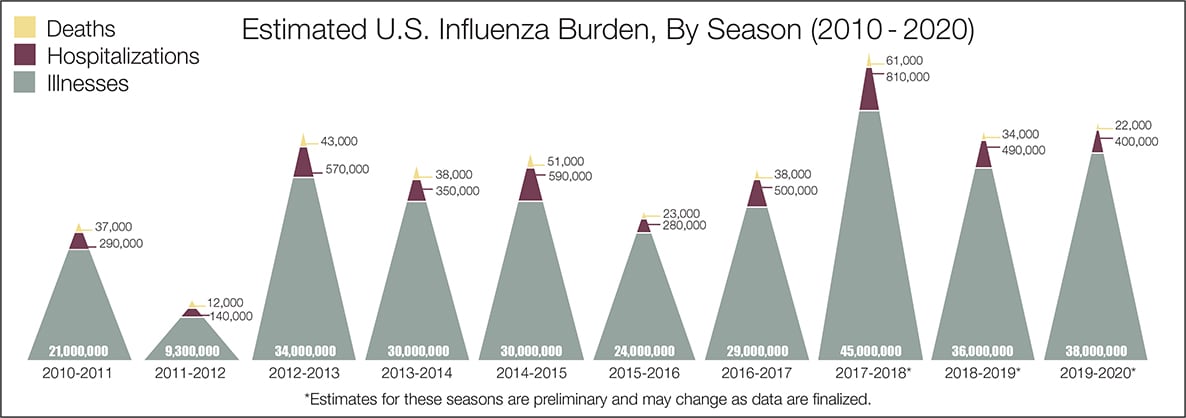
- The real question remains if the U.S. is over-reacting to this virus. The following graphic from the CDC puts the annual flu burden in perspective [click on image to enlarge]. Note that using this data is dangerous as the actual flu cases are estimated and not counted – nobody knows how accurate these guesses are.
What we do not know about the coronavirus [actually there is little scientifically proven information]. Most of our knowledge is anecdotal, from studies with limited subjects, or from studies without peer review.
- How many people have been infected as many do not show symptoms?
- Masks do work.
- Do we develop lasting immunity to the coronavirus? Another coronavirus – the simple cold – does not develop long term immunity.
- To what degree do people who never develop symptoms contribute to transmission?
- The US has scaled up coronavirus testing – and the accuracy of the tests has been improving. However, if one loses immunity – the coronavirus testing value is reduced.
- Can children widely spread coronavirus? [current thinking is that they are becoming a major source of the pandemic spread]
- Why have some places avoided big coronavirus outbreaks – and others hit hard?
- What effect will the weather have? At this point, it does not seem hot weather slows this coronavirus down – and it seems air conditioning contributes to its spread.
- Outdoor activities seem to be a lower risk than indoor activities.
- Can the world really push out an effective vaccine in 12 to 18 months?
- Will other medical treatments for Covid-19 ease symptoms and reduce deaths? So far only one drug (remdesivir) is approved for treatment.
- A current scientific understanding of the way the coronavirus works can be found [here].
Heavy breakouts of coronavirus have hit farm workers. Farmworkers are essential to the food supply. They cannot shelter at home. Consider:
- they have high rates of the respiratory disease [occupational hazard]
- they travel on crowded buses chartered by their employers
- few have health insurance
- they cannot social distance and live two to four to a room – and they eat together
- some reports say half are undocumented
- they are low paid and cannot afford not to work – so they will go to work sick
- they do not have access to sanitation when working
- a coronavirus outbreak among farmworkers can potentially shutter entire farm
The bottom line is that COVID-19 so far has been shown to be much more deadly than the data on the flu. Using CDC data, the flu has a mortality rate between 0.06 % and 0.11 % Vs. the coronavirus which to date has a mortality rate of 4 % [the 4% is the average of overall statistics – however in the last few months it has been hovering around 1.0%] – which makes it between 10 and 80 times more deadly. The reason for ranges:
Because influenza surveillance does not capture all cases of flu that occur in the U.S., CDC provides these estimated ranges to better reflect the larger burden of influenza.
There will be a commission set up after this pandemic ends to find fault [it is easy to find fault when a once-in-a-lifetime event occurs] and to produce recommendations for the next time a pandemic happens. Those that hate President Trump will conclude the virus is his fault.
Resources:
- Get the latest public health information from CDC: https://www.coronavirus.gov .
- Get the latest research from NIH: https://www.nih.gov/coronavirus.
- Find NCBI SARS-CoV-2 literature, sequence, and clinical content: https://www.ncbi.nlm.nih.gov/sars-cov-2/.
- List of studies: https://icite.od.nih.gov/covid19/search/#search:searchId=5ee124ed70bb967c49672dad
include(“/home/aleta/public_html/files/ad_openx.htm”); ?>


