


Written by Steven Hansen
The U.S. new cases 7-day rolling average is 15.7 % HIGHER than the 7-day rolling average one week ago. U.S. deaths due to coronavirus are now 1.2 % LOWER than the rolling average one week ago. At the end of this post is a set of interactive graphs and tables for the world and individual States – as well as today’s headlines which include;
- Did 75,000 additional Americans die from the pandemic -This means the U.S. numbers could be raised 35%.
- NIH’s guidelines were updated with remdesivir as first-line treatment for hospitalized patients
- US Expects Over 1M COVID-19 Antibody Doses From Regeneron, Lilly in 2020
- Pfizer trying to defuse critics amid push for vaccine before Election Day
- Schools Aren’t Super-Spreaders
- COVID Outbreak at Nursery Shows Toddlers Can Spread Disease:
- COVID-19 virus can survive on some surfaces for nearly a month in lab conditions
- Why don’t you need a negative coronavirus test to leave isolation?
- China’s Qingdao orders city-wide testing after new COVID-19 infections

The recent worsening of the trendlines for new cases should be attributed to going back to school (especially at college/university level) and continued loosening of regulations designed to slow the coronavirus spread.
My continuing advice is to continue to wash your hands, wear masks, and maintain social distancing. No handwashing, mask, or social distancing will guarantee you do not get infected – but it sure as hell lowers the risk in all situations – and evidence to-date shows a lower severity of COVID-19. In addition, certain activities are believed to carry a higher risk – like being inside in air conditioning and removing your mask (such as restaurants, around your children/grandchildren, bars, and gyms). It is all about viral load – and outdoor activities are generally very safe.
The daily number of new cases in the U.S. is remaining stubbornly and embarrassedly high.
The following graphs show the 7-day rolling average for new coronavirus cases and deaths have been updated through 12 October 2020:


z coronavirus.png
Coronavirus Statistics For 12 October 2020 |
| U.S. Only | Global | U.S Percentage of Total | ||||
| Today*** | Cumulative | Today*** | Cumulative | Today | Cumulative | |
| New Confirmed Cases | 49,242 | 7,760,000 | 327,314 | 37,570,000 | 15.0% | 20.7% |
| Deaths** | 394 | 214,771 | 3,824 | 1,080,000 | 10.3% | 19.9% |
| Mortality Rate | 0.8% | 2.8% | 1.2% | 2.9% | ||
total COVID-19 Tests per 1,000 people | 2.11* | 367.35* | ||||
Source: EU CDC
* as of 05 Oct 2020
** evidently several States included “probable” deaths today in the number
*** red color indicates record number


Coronavirus News You May Have Missed
NIH’s COVID-19 therapeutic management guidelines were updated with remdesivir as first-line treatment for hospitalized patients – NIH
COVID-19 therapeutic management guidelines were updated with remdesivir as first-line treatment for hospitalized patients requiring supplemental oxygen, and dexamethasone with or without remdesivir for patients requiring oxygen through a high-flow device or mechanical ventilation.
[editor’s note: the post also explains the rationale for the changes. See post below also.]

US Expects Over 1M COVID-19 Antibody Doses From Regeneron, Lilly in 2020 – Medscape
The U.S. government expects to be able to provide at no cost more than 1 million doses of antibody treatments for COVID-19 similar to the one President Donald Trump received to treat his illness, according to a top U.S. health official on Friday.
The government’s Operation Warp Speed program currently has “a couple of hundred thousand doses” of the monoclonal antibody treatments being developed by drugmakers Regeneron Pharmaceutical Inc and Eli Lilly & Co, U.S. Department of Health and Human Services official Paul Mango said on a call with reporters. That would top 1 million doses by the end of the year, he said.
Trump received Regeneron’s treatment last week. In a radio interview with Rush Limbaugh on Friday, Trump said he is working to get both drugs approved quickly and that he may not have recovered without the treatments he received.
Both companies have said the drugs were shown to work in clinical trials and that they have submitted an emergency use authorization to the U.S. Food and Drug Administration (FDA).
The drugs are not identical: Regeneron’s treatment is a cocktail of two antibodies meant to protect against the virus, while Lilly’s is a single antibody. Because they have not been tested against the other, it is difficult to know if one is more effective than the other.
Pfizer trying to defuse critics amid push for vaccine before Election Day – Politico
The company behind President Donald Trump’s last hope for a vaccine by Election Day has quietly begun courting influential health experts, including some of its toughest critics, to head off charges that it’s moving too fast in the face of intense political pressure.
The campaign by Pfizer comes amid growing scrutiny of CEO Albert Bourla’s predictions that the company will know this month whether it has a viable vaccine — making it the only major vaccine developer that says it could know whether its shot works by Nov. 3. And even though chances are slim that the company can meet the Food and Drug Administration’s tough new standards for vaccine safety data by that date, Bourla hasn’t backed down.
That could set up a high-stakes clash between a president eager to declare vaccine success and government regulators charged with safeguarding the American public.
“I think we should have it before the election, but frankly the politics gets involved,” Trump said this week, expressing frustration over the FDA’s emergency authorization process. “They want to play their game.”
It’s against that backdrop that Pfizer is attempting to convince top health experts that it’s not skimping on safety — and that its record-fast progress developing a vaccine has been driven purely by science, rather than a desire to deliver on Trump’s demands.
Schools Aren’t Super-Spreaders – The Atlantic
In early August, the first kids in America went back to school during the pandemic. Many of these openings happened in areas where cases were high or growing: in Georgia, Indiana, Florida. Parents, teachers, and scientists feared what might happen next. The New York Times reported that, in parts of Georgia, a school of 1,000 kids could expect to see 20 or 30 people arrive with COVID-19 during week one. Many assumed that school infections would balloon and spread outward to the broader community, triggering new waves. On social media, people shared pictures of high schools with crowded hallways and no masking as if to say I told you so.
Fear and bad press slowed down or canceled school reopenings elsewhere. Many large urban school districts chose not to open for in-person instruction, even in places with relatively low positivity rates. Chicago, L.A., Houston—all remote, at least so far.
It’s now October. We are starting to get an evidence-based picture of how school reopenings and remote learning are going (those photos of hallways don’t count), and the evidence is pointing in one direction. Schools do not, in fact, appear to be major spreaders of COVID-19.
School-based data from other sources show similarly low rates. Texas reported 1,490 cases among students for the week ending on September 27, with 1,080,317 students estimated at school—a rate of about 0.14 percent. The staff rate was lower, about 0.10 percent.
These numbers are not zero, which for some people means the numbers are not good enough. But zero was never a realistic expectation. We know that children can get COVID-19, even if they do tend to have less serious cases. Even if there were no spread in schools, we’d see some cases, because students and teachers can contract the disease off campus. But the numbers are small—smaller than what many had forecasted.
[editor’s note: see post below 🙂 ]
COVID Outbreak at Nursery Shows Toddlers Can Spread Disease: CDC Report – Newsweek
A nursery in Poland has been linked to an outbreak of the coronavirus involving over two dozen people, raising questions about how easily the virus spreads among young children.
Twenty-nine people caught the virus at the nursery, which was cited in a research letter published in the journal Emerging Infectious Diseases, published by the CDC. Cases included eight children who went to the nursery, and 12 family members who did have contact with the facility: three siblings, eight parents, and one grandparent. The children at the nursery were aged between one and two years old. Two of the children in their respective families were aged eight and five.
The authors affiliated with Poland’s Medical University of Warsaw noted the cluster represented a “surprisingly high spread” of the coronavirus in the nursery, and called into question the “presumed negligible role of children” driving the pandemic. “Children 1-2 years of age might be effective SARS-CoV-2 spreaders,” they wrote.
China’s Qingdao orders city-wide testing after new COVID-19 infections – Reuters
The Chinese city of Qingdao said on Monday it will test its entire population of more than 9 million people for coronavirus, after discovering 12 new infections that appeared to be linked to a hospital treating imported infections.
Daily COVID-19 infections in mainland China have fallen drastically since early in the outbreak, which first emerged in the city of Wuhan. China had reported no new domestically transmitted cases since early August, but has remained on high alert.
Qingdao reported a total of six new COVID-19 cases and six asymptomatic infections on Sunday, all linked to the Qingdao Chest Hospital, where infected travellers arriving from overseas have been treated in an isolated area.
The specific source of infection was still under investigation, the city government said on Sunday.
The testing would cover the city in five days, the city said.
COVID-19 Antibodies Raise Unanswered Clinical Questions – MedPage
While monoclonal antibody treatment may hold promise for COVID-19, its clinical benefit has yet to be proven, said experts from the Infectious Diseases Society of America (IDSA).
In a media briefing, IDSA experts discussed that while manufacturers of monoclonal antibody treatment, Regeneron and Eli Lilly, both applied for emergency use authorization (EUA) from the FDA to treat COVID-19, the data on both so far have yet to demonstrate any impact on patient care.
Reviewing the data, Adarsh Bhimraj, MD, co-chair of the IDSA COVID-19 Treatment and Management Guidelines Expert panel, noted how the endpoints of both trials examined decreases in viral load for patients. He characterized these as surrogate endpoints, or “disease-oriented endpoints,” which are only meaningful if they translate into patient-oriented outcomes, such as preventing death or disability.
“Curing the virus is not the same thing as curing the patient and making them better,” he said.
Bhimraj even compared these antibody therapies to the saga of hydroxychloroquine, which was also shown to have “a very fast reduction in viral load” in early studies, “but randomized controlled trials did not translate into patients getting better or not dying.”
About 75,000 more Americans died from COVID-19 pandemic than reported in spring and summer – USA Today
The coronavirus pandemic may have caused tens of thousands of more deaths in the spring and summer than previously thought, a new study says.
Researchers at Virginia Commonwealth University in Richmond found nearly 75,000 more people may have died from the pandemic than what was recorded in March to July, according to the report published Monday in the peer-reviewed journal JAMA.
By examining death certificates, the study found more than 150,000 deaths were officially attributed to COVID-19 during that period. But researchers determined that nearly 75,000 additional deaths were indirectly caused by the pandemic, bringing the total number of deaths for those four months to more than 225,000.
Johns Hopkins University data puts the total COVID-19 death toll in the U.S. at just below 215,000.
“There have been some conspiracy theories that the number of deaths from COVID-19 have been exaggerated,” said Dr. Steven Woolf, director emeritus of the Center on Society and Health at Virginia Commonwealth University in Richmond. “The opposite is the case. We’re actually experiencing more death than we thought we were.”
COVID-19 virus can survive on some surfaces for nearly a month in lab conditions – The Hill
The virus that causes COVID-19 can survive for nearly a month in cooler, dark conditions on some nonporous surfaces such as glass and money in controlled laboratory conditions, according to a study published Monday that notes that the primary source of spread still appears to be through airborne aerosols and droplets caused by talking, singing, breathing or laughing.
The study, completed by experts at the Australian Centre for Disease Preparedness, and published in “Virology Journal,” found that the virus was detectable after 28 days on surfaces such as glass, stainless steel, paper and polymer banknotes in lab experiments at room temperature — 68 degrees Fahrenheit.
The authors of the study wrote that the findings are important because phones, ATMS and other high-touch surfaces may not be regularly cleaned and therefore pose risks for transmission.
The experts concluded that surface or “fomite” transmission could play some role in the spread of COVID-19, though the degree is unknown.
“While the primary spread of SARS-CoV-2 appears to be via aerosols and respiratory droplets, fomites may also be an important contributor in transmission of the virus,” the authors wrote.
COVID Takes Challenge of Tracking Infectious College Students to New Level – MedScape
As the return of college students to campuses has fueled as many as 3,000 COVID-19 cases a day, keeping track of them is a logistical nightmare for local health departments and colleges.
Some students are putting down their home addresses instead of their college ones on their COVID testing forms — slowing the transfer of case data and hampering contact tracing across state and county lines.
The address issue has real consequences, as any delay in getting the case to the appropriate authorities allows the coronavirus to continue to spread unchecked. Making matters worse, college-age people already tend to be hard to trace because they are unlikely to answer a phone call from an unknown number.
“With that virus, you really need to be able to identify that case and their contacts in 72 hours,” said Indiana University’s assistant director for public health, Graham McKeen.
And if the students do go home once infected, where should their cases be counted? The Centers for Disease Control and Prevention highlighted this issue in a recent study of an unnamed North Carolina university’s COVID outbreak, stating that the number of cases was likely an underestimate. “For example, some cases were reported to students’ home jurisdictions, some students did not identify themselves as students to the county health department, some students did not report to the student health clinic, and not all students were tested,” it said.
Why don’t you need a negative coronavirus test to leave isolation? – CNN
According to the CDC, research has shown that people aren’t likely to be infectious 10 to 20 days after symptoms first began, regardless of test results.
To figure that out, scientists have taken samples from coronavirus patients and tried to infect living cells. Even though PCR tests can come back positive, people don’t tend to be infectious after that 10- to 20-day window has passed.
Think of it this way: A PCR test is looking for the blueprint of the virus — its “genome” — and not for the virus itself. In fact, the test is just looking for fragments of that blueprint.
It’s like a recipe for chocolate cake; finding the recipe in someone’s kitchen doesn’t mean you’ll find a cake.
People with mild to moderate Covid-19 are thought to remain infectious “no longer than 10 days after symptom onset,” according to the CDC, although people with severely weakened immune systems may need to isolate for longer.
Before leaving isolation, people’s symptoms should have improved and they should have gone 24 hours with no fever, the CDC says (still being on fever-reducing medication doesn’t count).
Take a look at how to make sense of Sweden’s approach to the coronavirus. – New York Times
… people in other countries who favor a more lax approach have held up Sweden as a model. Recently, as new cases have surged in other European countries, some of Sweden’s defenders have claimed vindication. How are you supposed to make sense of all this?
… Over all, Sweden’s decision to let many activities continue unabated and its hope that growing immunity to the virus would protect people does not look good. The country has suffered more than five times as many deaths per capita as neighboring Denmark and about 10 times as many as Finland or Norway.
… Sweden’s leaders do not seem to have found the ideal strategy, but they are asking a reasonable question. “We see a disease that we’re going to have to handle for a long time,” Anders Tegnell, Sweden’s top epidemiologist, told The Financial Times, “and we need to build up systems for doing that.”
The fact that Sweden is no longer an extreme outlier in new virus cases — even as life there looks more normal than in most places — offers a new opportunity to assess risk.
[editor’s note: see post below on herd immunity]

UN warns against pursuing herd immunity to stop coronavirus – AP
The head of the World Health Organization warned against the idea that herd immunity might be a realistic strategy to stop the pandemic, dismissing such proposals as “simply unethical.”
At a media briefing on Monday, WHO Director-General Tedros Adhanom Ghebreyesus said health officials typically aim to achieve herd immunity by vaccination. Tedros noted that to obtain herd immunity from a highly infectious disease such as measles, for example, about 95% of the population must be immunized.
“Herd immunity is achieved by protecting people from a virus, not by exposing them to it,” he said. Some researchers have argued that allowing COVID-19 to spread in populations that are not obviously vulnerable will help build up herd immunity and is a more realistic way to stop the pandemic, instead of the restrictive lockdowns that have proved economically devastating.
“Never in the history of public health has herd immunity been used as a strategy for responding to an outbreak,” Tedros said.
Tedros said that too little was known about immunity to COVID-19 to know if herd immunity is even achievable.
“We have some clues, but we don’t have the complete picture,” he said, noting that WHO had documented instances of people becoming reinfected with coronavirus after recovering from an initial bout of the virus. Tedros said that while most people appear to develop some kind of immune response, it’s unclear how long that lasts or how robust that protection is — and that different people have varying responses.
Confidential coronavirus outbreak data shows thousands of undisclosed incidents across Illinois – USA Today
Like many Midwestern states, Illinois has struggled with rising coronavirus cases and death counts recently, surpassing 300,000 confirmed cases this month and recording its highest daily death count since late June on Friday.
Public health officials issued a “warning list” for 28 Illinois counties at risk for coronavirus surges and blamed, in part, businesses who were “blatantly disregarding mitigation measures, people not social distancing, gathering in large groups and not using face coverings.”
Now, confidential statewide coronavirus outbreak data, obtained by the Documenting COVID-19 project at the Brown Institute for Media Innovation as part of a collaboration with the Midwest Center for Investigative Reporting, shows workplace, school and prison outbreaks are driving the increases – and that many of these outbreaks have never been made public.
The Illinois Department of Public Health, citing a state communicable disease code, does not release details about where many outbreaks have occurred, limiting its disclosures to long-term care and assisted living facilities. Separately, the Illinois Department of Corrections and some county health departments regularly release numbers of infected inmates and prison staff.
But the internal statewide data we obtained – prepared by the state health department and covering four different dates between July and September – gives detailed information and case counts for nearly 2,600 separate outbreaks across Illinois.
- Some U.S.-based doctors and nurses are fleeing the country because the lack of PPE and coordinated U.S. response made them feel unsafe during the coronavirus pandemic.
- Some have been feeling burned out for years due to the complex U.S. health system.
- New Zealand, which led with science, has declared victory over Covid-19 yet again and hasn’t reported a positive case in more than a week.
Most people try to avoid Covid-19. But thousands are signing up to be deliberately exposed – CNN
As most of us obsess with avoiding Covid-19 at all costs, a rapidly growing group of people around the world say they are prepared to deliberately take on the virus.
Tens of thousands of people have signed up to a campaign by a group called 1 Day Sooner to take an experimental vaccine candidate and then face coronavirus in a controlled setting.
Among them is Estefania Hidalgo, 32, a photography student in Bristol, England, who works at a gas station to pay the bills.
“I do night shifts there, and it can be very lonely,” she recalled on a sunny day near her home. Passing those long lockdown hours with just podcasts to keep her company, she describes discovering the challenge trial movement — and hearing volunteers’ motivations — as a revelatory moment.
“I was shaken,” she said. “No one should be left behind. Old people, poor people, people of color. Everyone just deserves to be healthy.”
“This was a way for me to take back control of the situation, to feel like I was in a less hopeless place, and a less hopeless world, and be like, OK, I can do this. To make it better, I chose not to be in fear.”
The following are foreign headlines with hyperlinks to the posts
Iran sets record for coronavirus deaths, cases for second straight day
Pope’s elite security team reports COVID-19 cases
Daily COVID Cases Double in a Week as UK Struggles With COVID
German Hospitals Warn of Staff Shortages Amid Surge in COVID
Swiss Expand Quarantine List as Virus Toll Hits Record
England Reintroduces COVID-19 Restrictions as Second Wave Sweeps Europe
United Arab Emirates begins human trials of Russia’s coronavirus vaccine
Russia reports more than 13,000 new Covid-19 cases
The following are additional national and state headlines with hyperlinks to the posts
WHO Flip-Flops: Urges World Leaders To Stop Using Lockdowns To Fight COVID Contagion
A month ago, the CDC proposed making face masks mandatory on all planes, trains, subways and airports, but the White House blocked the order.
Younger people drive transmission of COVID-19 in hotspot counties. Percent positivity among those 24 and younger began increasing a month before areas became official hotspots.
The NBA boasted zero COVID-19 cases inside its 6,500-person “bubble” during the restarted season, now completed with the Los Angeles Lakers as champions
HHS Testing Czar Rips Nevada for Stopping Rapid Tests in Nursing Homes
NFL reshuffles eight teams’ schedules amid positive COVID-19 tests
Police Arrest Anti-Lockdown Protest Leader In New York’s Orthodox Jewish Community
Funeral Home Hands Out Flyers at COVID Denier Protest
Since reopening, Disney World has kept the coronavirus at bay.
Carnival Cruise Line Cancels Miami And Port Canaveral Cruises For November 2020
The $700 billion Hispanic business market in the U.S. is now at the tipping point
North Dakota has less than 20 beds available as Covid-19 cases surge, public health official says
Today’s Posts On Econintersect Showing Impact Of The Pandemic With Hyperlinks
The Most Common Coronavirus Conspiracies
Warning to Readers
The amount of politically biased articles on the internet continues to increase. And studies and opinions of the experts continue to contradict other studies and expert opinions. Honestly, it is difficult to believe anything anymore. A study usually cannot establish cause and effect – but only correlation. Be very careful what you believe about this pandemic.

I assemble this coronavirus update daily – sifting through the posts on the internet. I try to avoid politically slanted posts (mostly from CNN, New York Times, and the Washington Post) and can usually find unslanted posts on that subject from other sources on the internet. I wait to publish posts on subjects that I cannot validate across several sources. But after all this extra work, I do not know if I have conveyed the REAL facts. It is my job to provide information so that you have the facts necessary – and then it is up to readers to draw conclusions.
Coronavirus INTERACTIVE Charts
include($_SERVER[‘DOCUMENT_ROOT’].’/pages/coronavirus.htm’); ?>
Analyst Opinion of Coronavirus Data
There are several takeaways that need to be understood when viewing coronavirus statistical data:
- The global counts are suspect for a variety of reasons including political. Even the U.S. count has issues as it is possible that as much as half the population has had coronavirus and was asymptomatic. It would be a far better metric using a random sampling of the population weekly. In short, we do not understand the size of the error in the tracking numbers.
- Just because some of the methodology used in aggregating the data in the U.S. is flawed – as long as the flaw is uniformly applied – you establish a baseline. This is why it is dangerous to compare two countries as they likely use different methodologies to determine who has (and who died) from coronavirus.
- COVID-19 and the flu are different but can have similar symptoms. For sure, COVID-19 so far is much more deadly than the flu. [click here to compare symptoms]
- From an industrial engineering point of view, one can argue that it is best to flatten the curve only to the point that the health care system is barely able to cope. This solution only works if-and-only-if one can catch this coronavirus once and develops immunity. In the case of COVID-19, herd immunity may need to be in the 80% to 85% range. WHO warns that few have developed antibodies to COVID-19. At this point, herd immunity does not look like an option although there is now a discussion of whether T-Cells play a part in immunity [which means one might have immunity without antibodies]
- Older population countries will have a higher death rate.
- There are at least 8 strains of the coronavirus. New York may have a deadlier strain imported from Europe, compared to less deadly viruses elsewhere in the United States.
- Each publication uses different cutoff times for its coronavirus statistics. Our data uses 11:00 am London time. Also, there is an unexplained variation in the total numbers both globally and in the U.S.
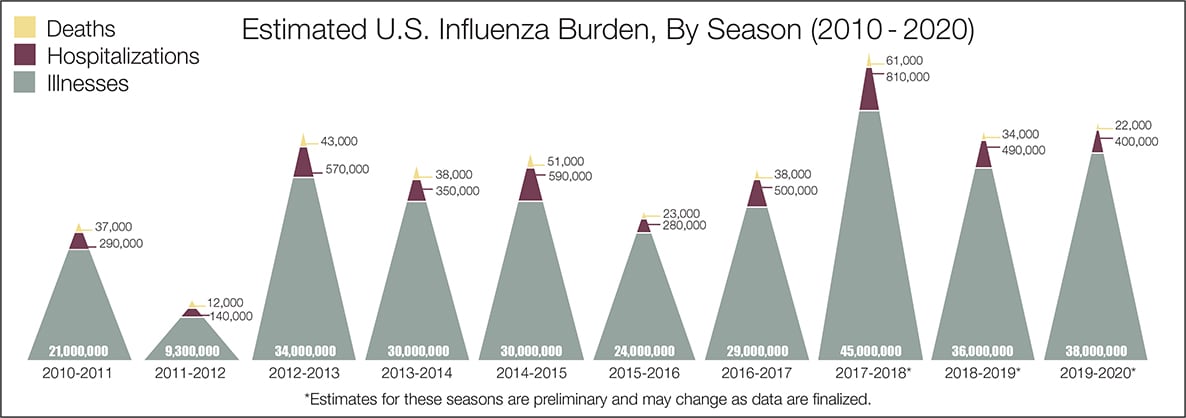
- The real question remains if the U.S. is over-reacting to this virus. The following graphic from the CDC puts the annual flu burden in perspective [click on image to enlarge]. Note that using this data is dangerous as the actual flu cases are estimated and not counted – nobody knows how accurate these guesses are.
What we do not know about the coronavirus [actually there is little scientifically proven information]. Most of our knowledge is anecdotal, from studies with limited subjects, or from studies without peer review.
- How many people have been infected as many do not show symptoms?
- Masks do work.
- Do we develop lasting immunity to the coronavirus? Another coronavirus – the simple cold – does not develop long term immunity.
- To what degree do people who never develop symptoms contribute to transmission?
- The US has scaled up coronavirus testing – and the accuracy of the tests has been improving. However, if one loses immunity – the coronavirus testing value is reduced.
- Can children widely spread coronavirus? [current thinking is that they are becoming a major source of the pandemic spread]
- Why have some places avoided big coronavirus outbreaks – and others hit hard?
- What effect will the weather have? At this point, it does not seem hot weather slows this coronavirus down – and it seems air conditioning contributes to its spread.
- Outdoor activities seem to be a lower risk than indoor activities.
- Can the world really push out an effective vaccine in 12 to 18 months?
- Will other medical treatments for Covid-19 ease symptoms and reduce deaths? So far only one drug (remdesivir) is approved for treatment.
- A current scientific understanding of the way the coronavirus works can be found [here].
Heavy breakouts of coronavirus have hit farm workers. Farmworkers are essential to the food supply. They cannot shelter at home. Consider:
- they have high rates of the respiratory disease [occupational hazard]
- they travel on crowded buses chartered by their employers
- few have health insurance
- they cannot social distance and live two to four to a room – and they eat together
- some reports say half are undocumented
- they are low paid and cannot afford not to work – so they will go to work sick
- they do not have access to sanitation when working
- a coronavirus outbreak among farmworkers can potentially shutter entire farm
The bottom line is that COVID-19 so far has been shown to be much more deadly than the data on the flu. Using CDC data, the flu has a mortality rate between 0.06 % and 0.11 % Vs. the coronavirus which to date has a mortality rate of 4 % [the 4% is the average of overall statistics – however in the last few months it has been hovering around 1.0%] – which makes it between 10 and 80 times more deadly. The reason for ranges:
Because influenza surveillance does not capture all cases of flu that occur in the U.S., CDC provides these estimated ranges to better reflect the larger burden of influenza.
There will be a commission set up after this pandemic ends to find fault [it is easy to find fault when a once-in-a-lifetime event occurs] and to produce recommendations for the next time a pandemic happens. Those that hate President Trump will conclude the virus is his fault.
Resources:
- Get the latest public health information from CDC: https://www.coronavirus.gov .
- Get the latest research from NIH: https://www.nih.gov/coronavirus.
- Find NCBI SARS-CoV-2 literature, sequence, and clinical content: https://www.ncbi.nlm.nih.gov/sars-cov-2/.
- List of studies: https://icite.od.nih.gov/covid19/search/#search:searchId=5ee124ed70bb967c49672dad
include(“/home/aleta/public_html/files/ad_openx.htm”); ?>


