


Written by Steven Hansen
The U.S. new cases 7-day rolling average is 7.2 % HIGHER than the 7-day rolling average one week ago. U.S. deaths due to coronavirus are now 2.8 % HIGHER than the rolling average one week ago. At the end of this post is a set of interactive graphs and tables for the world and individual States – as well as today’s headlines which include;
- Polio campaign of the 1950s is a sound model for what America needs for COVID-19
- One in four pregnant people with COVID-19 may have lingering ‘long-haul’ illness
- Aerosols Driving COVID-19 Spread
- Could stereotypes about masks as unmanly explain why the virus has infected more men?
- COVID Could Add 20K+ Americans a Day to ‘Preexisting Conditions’
- A Coronavirus Vaccine Could Kill Half A Million Sharks
- Trump claims he got COVID from Gold Star event. Evidence shows he likely was already sick by then
- Who infected President Trump? This genetics tool could easily pinpoint the source

The recent worsening of the trendlines for new cases should be attributed to going back to school (especially at college/university level) and continued loosening of regulations designed to slow the coronavirus spread.
My continuing advice is to continue to wash your hands, wear masks, and maintain social distancing. No handwashing, mask, or social distancing will guarantee you do not get infected – but it sure as hell lowers the risk in all situations – and evidence to-date shows a lower severity of COVID-19. In addition, certain activities are believed to carry a higher risk – like being inside in air conditioning and removing your mask (such as restaurants, around your children/grandchildren, bars, and gyms). It is all about viral load – and outdoor activities are generally very safe.
The daily number of new cases in the U.S. is remaining stubbornly and embarrassedly high.
The following graphs show the 7-day rolling average for new coronavirus cases and deaths have been updated through 10 October 2020:


z coronavirus.png
Coronavirus Statistics For 10 October 2020 |
| U.S. Only | Global | U.S Percentage of Total | ||||
| Today*** | Cumulative | Today*** | Cumulative | Today | Cumulative | |
| New Confirmed Cases | 54,968 | 7,670,000 | 341,973 | 36,920,000 | 16.1% | 20.8% |
| Deaths** | 1022 | 213,795 | 8,059 | 1,068,000 | 12.8% | 20.0% |
| Mortality Rate | 1.9% | 2.8% | 2.3% | 2.9% | ||
total COVID-19 Tests per 1,000 people | 1.80* | 364.57* | ||||
Source: EU CDC
* as of 04 Oct 2020
** evidently several States included “probable” deaths today in the number
*** red color indicates record number
New case trend by state:

source: Johns Hopkins
Coronavirus News You May Have Missed
First it was toilet paper—now we’re running out of fridges. Here’s why – CNBC
If you’re looking to buy a new fridge you may be out of luck. Earlier in the pandemic, there was a run on toilet paper. Now it seems that customers looking to buy a refrigerator are facing long waiting times as models are back-ordered across the country. There are also shortages for other major appliances including dishwashers, dryers and some microwaves.
John Taylor, senior vice president of LG Electronics USA told TODAY Food that the industry as a whole is experiencing unprecedented demand when it comes to major appliances. “There are a variety of factors largely related to coronavirus,” he said.
“People are spending more time at home and we’ve seen a record number not just for fridges but dishwashers, washing machines and dryers. If appliances are 15 to 20 years old, the more people they use them, the more likely they need to be replaced.”
Taylor said that in lieu of spending on family vacations, dinners out or movies and concerts, people are looking to invest in their homes and focus on energy savings.
“When you’re looking at how to invest in your home, appliances are at the top of the list,” he said.
Panel: Aerosols Driving COVID-19 Spread – MedPage
Compelling evidence indicates that COVID-19 transmission via small-particle aerosols, not droplets, may be driving the pandemic, a panel of aerosol researchers said on Thursday.
At a virtual press conference of the American Association for Aerosol Research, researchers argued the reason both the World Health Organization (WHO) and the CDC are reluctant to embrace aerosol transmission is in part due to “historical bias,” despite outsized evidence of aerosol transmission.
Linsey Marr, PhD, of Virginia Tech University in Blacksburg, noted the CDC’s recent acknowledgement that SARS-CoV-2 can “sometimes” be spread through aerosols, though she crossed out the word “sometimes” to write “commonly.”
“The definitions are still resting on epidemiology, but it doesn’t really reflect what we understand about mechanisms” of transmission, she said. “Understanding mechanisms is important [for] how we can best apply interventions and slow this down.”
As evidence of historical bias, Jose-Luis Jimenez, PhD, of the University of Colorado in Boulder, cited research from as recently as 1985 that measles, for which airborne aerosol spread is now commonly acknowledged, was thought to mainly be spread by large respiratory droplets, and “close contact” between patients was required.
In fact, he argued there may be more evidence for aerosol spread of COVID-19 than via droplets, noting there is no evidence for droplets in super-spreading events, impact of reduced ventilation, or transmission by asymptomatic people without a cough.
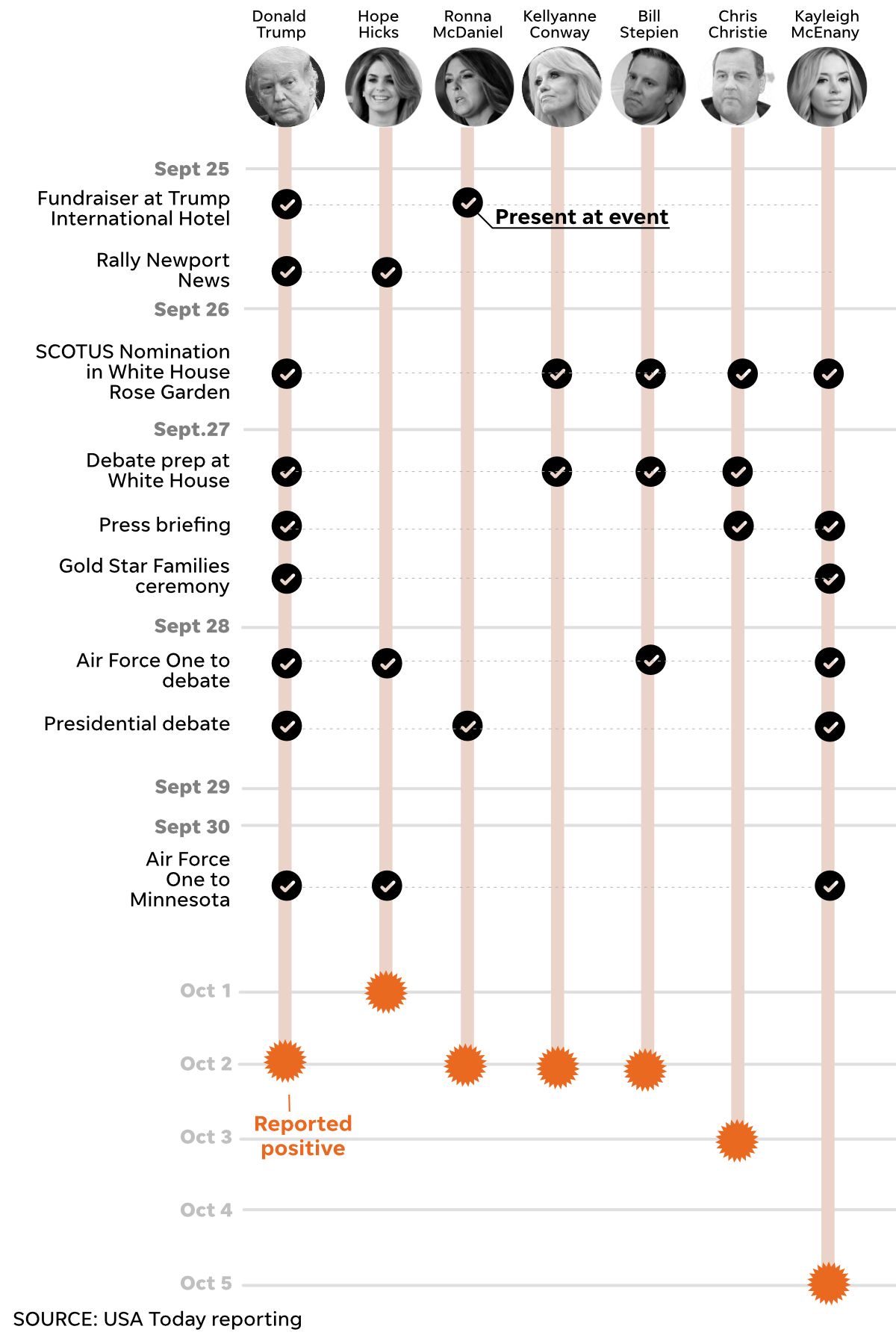
Trump claims he got COVID from Gold Star event. Evidence shows he likely was already sick by then. – USA Today
Epidemiologists familiar with USA TODAY’s efforts to trace the contacts of White House officials say that Trump likely was in the early stages of COVID-19 days before hosting a series of events leading up to the ceremony for the Gold Star families on Sunday, Sept. 27.
Reporters have scoured photos, video, social media and travel schedules to identify and trace the whereabouts of White House officials, aides and those in their orbit who have recently contracted the novel coronavirus.
Aside from the president and first lady, so far the only others from the Gold Star event known to have tested positive are Coast Guard Adm. Charles Ray and Press Secretary Kayleigh McEnany.
By contrast, at least a dozen people who attended the announcement of the president’s nominee for the Supreme Court the previous day, Saturday, have tested positive.
COVID Could Add 20K+ Americans a Day to ‘Preexisting Conditions’ – Medscape
Every day, another 20,000 Americans between 20 and 60 years of age could be classified as living with a “preexisting condition” because of COVID-19, researchers from the Commonwealth Fund report.
Overall, the pandemic could cause almost 3.5 million Americans to be added to this category, a fact that has important implications approximately 1 month before the US Supreme Court is expected to weigh in on the constitutionality of the Affordable Care Act (ACA), the investigators note.
“Polls show that most Americans are worried that preexisting conditions could lead to loss of insurance coverage. People are surprised and even more worried when they realize that the pandemic is adding to this problem,” lead author Eric Schneider, MD, PhD, told Medscape Medical News.
The study was posted online in a blog post on October 8 by the Commonwealth Fund.
Who infected President Trump? This genetics tool could easily pinpoint the source – National Geographic
… Trump and his cadre may have been exposed before the Barrett ceremony, given social distancing and mask wearing aren’t always practiced at their campaign events. Using viral genome sequencing would not only help public health officials sketch the timeline of how the disease spread, but could convey whether the afflicted were exposed at various moments and places on the campaign trail, or all at once.
Here’s how that would work. The virus that causes COVID-19 has a genome based on RNA, which like DNA, is made up of a sequence of chemical “letters” called nucleotides. As the coronavirus invades people’s cells and multiplies, it naturally makes mistakes when replicating its genetic code, swapping a few of those letters. “Imagine having to copy 30,000 letters by hand,” says Stephanie Spielman, assistant professor of biological sciences at Rowan University. “You might make a mistake, and that’s what a mutation is.”
Once a mutation occurs, it remains in future copies, creating a lineage called a variant. Just swab a bunch of infected noses, compare the variants, and you can trace the origins.
“If you have clusters of people with similar sequences, that’s a strong indication they had a common source,” says Joshua Michaud, associate director for Global Health Policy at the Kaiser Family Foundation. This procedure could even narrow down where in the country Trump’s contingent caught the coronavirus. (National Geographic contacted the White House for comment but received no reply.)
For both contact tracing and genome sequencing, timing is very important. Rapidly finding people who could potentially expose others to infection is critical to stopping chains of transmission. A recent Lancet paper found that reducing delays in contact tracing after a positive test could prevent as many as 80 percent of new infections. That’s why 10 local health departments in the capital region—including the District of Columbia’s—took the unusual step of issuing an open letter imploring all White House staff and Rose Garden attendees to seek medical advice and take a COVID-19 test.
A Coronavirus Vaccine Could Kill Half A Million Sharks, Conservationists Warn – NPR
A conservation group is warning that the development of an effective coronavirus vaccine on a global scale could ravage shark populations worldwide, as researchers race to produce a vaccine using an oil derived from sharks.
Squalene, a compound that is harvested from the livers of sharks, is a common moisturizing ingredient in cosmetics. It’s also used in malaria and flu vaccines as an agent that boosts the immune system’s response.
Shark Allies, a nonprofit that advocates for the protection of sharks, projects that some 500,000 sharks could be killed if a coronavirus vaccine with shark squalene proves to be effective. Already, an estimated 2.7 million sharks are killed annually for their squalene to make cosmetics, according to the group.
“The problem is that squalene, used as an ingredient in a COVID-19 vaccine, will be seen as something that’s unavoidable, and then as it becomes tested, it becomes the normal ingredient, and nothing else will be tested,” Shark Allies executive director Stefanie Brendl told NPR’s Weekend Edition Saturday.
As of Oct. 2, there were 193 coronavirus vaccines in clinical and pre-clinical evaluation, according to data released by the World Health Organization. At least five of those vaccines contain shark squalene, according to Shark Allies.
Polio campaign of the 1950s is a sound model for what America needs for COVID-19 – USA Today
Polio was the coronavirus of the mid-20th century. Potentially fatal and disabling, this viral infection was transmitted person to person around the world and driven by asymptomatic carriers. Social distancing protocols were put in place each summer, and there was a run on iron lung machines, which were that period’s version of ventilators. The race to develop a vaccine was funded by the National Foundation for Infantile Paralysis (now March of Dimes), and it became one of the most rapid examples of bench‐to‐bedside translation in the history of medicine. March of Dimes organized the largest clinical trial in U.S. history, with 1.8 million children, that was funded by the donations of a concerned nation — one dime at a time.
The vaccine effort was nearly derailed in 1955, when Cutter Laboratories in California produced some batches of the vaccine with a live virus, resulting in thousands of cases of paralytic polio and sending a new wave of fear across the nation. The incident undercut the trust in government at precisely the wrong time. The transparency, independence and trust of our “outside” organization helped the United States overcome the vaccine hesitancy that existed even then, and in the wake of the Cutter incident, so the scourge of polio could be stopped.
… There’s an old African proverb: “If you want to go fast, go alone. If you want to go far, go together.” This fall and into winter, Americans need to come together and go far in protecting our health and saving lives. However, we can only do so by ensuring that truth, transparency and trust are embedded in the nation’s vaccination campaign.
Could stereotypes about masks as unmanly explain why the virus has infected more men? – New York Times
Some experts who study masculinity and public health say the perception that wearing masks and following social distancing guidelines are unmanly has carried a destructive cost. The virus has infected more men than women and killed far more of them.
Men’s resistance to showing weakness — and their tendency to take risks — was demonstrated by scientists long before Covid-19. Studies have shown men are less likely than women to wear seatbelts and helmets, or to get flu shots. They’re more likely to speed or drive drunk. They are less likely to seek out medical care.
Some initial research indicates a similar pattern is playing out with the coronavirus. Surveys have found that women are more likely than men to wear masks in the United States.
If you wear a mask, said Peter Glick, a professor of social sciences at Lawrence University, “the underlying message is: ‘I’m afraid of catching this disease.'”
U.S. sees highest number of new coronavirus cases in nearly two months – CNBC
[editor’s note: We use EU CDC data. Whilst the total numbers pretty much align with the Johns Hopkins numbers – the daily numbers vary.]
- The U.S. reported more than 57,000 new coronavirus cases on Friday, the highest daily totals since mid-August, according to data compiled by Johns Hopkins University.
- New cases are surging in states across the South, East and Midwest.
One in four pregnant people with COVID-19 may have lingering ‘long-haul’ illness – National Geographic
… in the largest analysis of its kind to date, Jacoby and her colleagues are filling in some of those blanks. They found that COVID-19 symptoms lingered in many of the study participants, which included 594 pregnant or recently pregnant people, most of whom were not hospitalized.
Half of the participants still reported illness after three weeks, while 25 percent were still recovering after two months or longer. (The typical duration for mild cases is two weeks).
The participants’ symptoms also manifested differently than those reported in non-pregnant populations, according to the study, which was published October 7 in Obstetrics & Gynecology. For one, fever was uncommon even though it has been a hallmark sign of this disease; it was an initial symptom in just 12 percent of the pregnant individuals and present only in 5 percent after one week of illness. Other signs of COVID-19—cough, loss of smell, fatigue, and shortness of breath—persisted in a small but significant proportion of individuals for up to two months.
Such clues about the progression of COVID-19 during pregnancy can help individuals and their providers better understand when to seek help, and what’s potentially in store for those who fall ill. It also gives another peek into the growing group of so-called COVID-19 “long-haulers” whose months of persistent symptoms have confounded many scientists.
The following are foreign headlines with hyperlinks to the posts
The world crosses an ominous milestone, recording more than 1 million new cases in three days.
Kim Jong Un insists North Korea has no Covid-19 victims
The following are additional national and state headlines with hyperlinks to the posts
[Chris] Christie released from the hospital after COVID-19 diagnosisHHS Testing Czar Rips Nevada for Stopping Rapid Tests in Nursing Homes
Nine people who attended Trump rally in Minnesota contracted coronavirus
Fauci: ‘We had a superspreader event in the White House’
Newborn Tests Negative After First-Time Mother Gets COVID Ahead of Due Date
In one Orthodox suburb, many positive tests but few masks.[Palm City, NY]
The White House blocked the C.D.C. from requiring masks on public transit.
Hawaiian Airlines cuts inter-island flights due to Covid-19
Today’s Posts On Econintersect Showing Impact Of The Pandemic With Hyperlinks
Fed Working To Solve Pandemic-Induced Coin Supply Disruptions
Economic Conditions And The Path Of Monetary Policy
Investigating The Effect Of Health Insurance In The COVID-19 Pandemic
Infographic Of The Day: America’s 2 Trillion Economic Drop, By State And Sector
Are We In The Stagnation Phase?
Warning to Readers
The amount of politically biased articles on the internet continues to increase. And studies and opinions of the experts continue to contradict other studies and expert opinions. Honestly, it is difficult to believe anything anymore. A study usually cannot establish cause and effect – but only correlation. Be very careful what you believe about this pandemic.

I assemble this coronavirus update daily – sifting through the posts on the internet. I try to avoid politically slanted posts (mostly from CNN, New York Times, and the Washington Post) and can usually find unslanted posts on that subject from other sources on the internet. I wait to publish posts on subjects that I cannot validate across several sources. But after all this extra work, I do not know if I have conveyed the REAL facts. It is my job to provide information so that you have the facts necessary – and then it is up to readers to draw conclusions.
Coronavirus INTERACTIVE Charts
include($_SERVER[‘DOCUMENT_ROOT’].’/pages/coronavirus.htm’); ?>
Analyst Opinion of Coronavirus Data
There are several takeaways that need to be understood when viewing coronavirus statistical data:
- The global counts are suspect for a variety of reasons including political. Even the U.S. count has issues as it is possible that as much as half the population has had coronavirus and was asymptomatic. It would be a far better metric using a random sampling of the population weekly. In short, we do not understand the size of the error in the tracking numbers.
- Just because some of the methodology used in aggregating the data in the U.S. is flawed – as long as the flaw is uniformly applied – you establish a baseline. This is why it is dangerous to compare two countries as they likely use different methodologies to determine who has (and who died) from coronavirus.
- COVID-19 and the flu are different but can have similar symptoms. For sure, COVID-19 so far is much more deadly than the flu. [click here to compare symptoms]
- From an industrial engineering point of view, one can argue that it is best to flatten the curve only to the point that the health care system is barely able to cope. This solution only works if-and-only-if one can catch this coronavirus once and develops immunity. In the case of COVID-19, herd immunity may need to be in the 80% to 85% range. WHO warns that few have developed antibodies to COVID-19. At this point, herd immunity does not look like an option although there is now a discussion of whether T-Cells play a part in immunity [which means one might have immunity without antibodies]
- Older population countries will have a higher death rate.
- There are at least 8 strains of the coronavirus. New York may have a deadlier strain imported from Europe, compared to less deadly viruses elsewhere in the United States.
- Each publication uses different cutoff times for its coronavirus statistics. Our data uses 11:00 am London time. Also, there is an unexplained variation in the total numbers both globally and in the U.S.
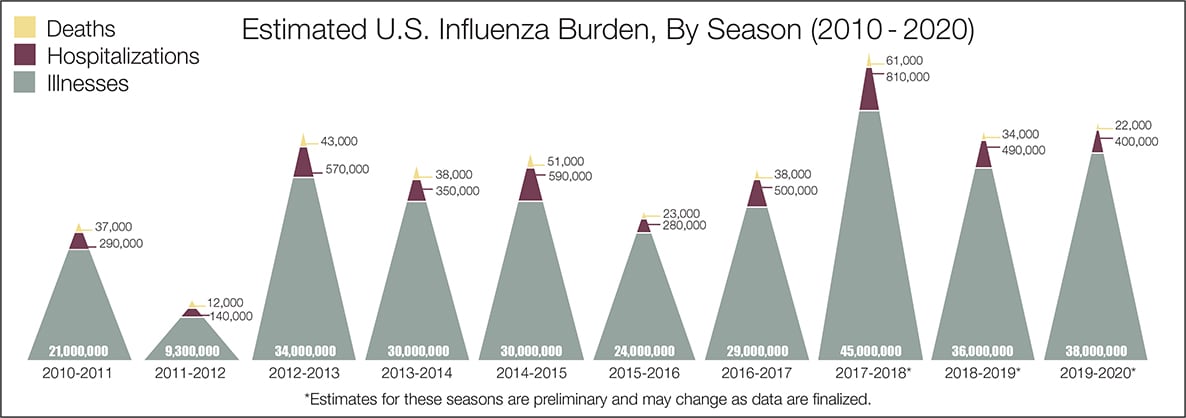
- The real question remains if the U.S. is over-reacting to this virus. The following graphic from the CDC puts the annual flu burden in perspective [click on image to enlarge]. Note that using this data is dangerous as the actual flu cases are estimated and not counted – nobody knows how accurate these guesses are.
What we do not know about the coronavirus [actually there is little scientifically proven information]. Most of our knowledge is anecdotal, from studies with limited subjects, or from studies without peer review.
- How many people have been infected as many do not show symptoms?
- Masks do work.
- Do we develop lasting immunity to the coronavirus? Another coronavirus – the simple cold – does not develop long term immunity.
- To what degree do people who never develop symptoms contribute to transmission?
- The US has scaled up coronavirus testing – and the accuracy of the tests has been improving. However, if one loses immunity – the coronavirus testing value is reduced.
- Can children widely spread coronavirus? [current thinking is that they are becoming a major source of the pandemic spread]
- Why have some places avoided big coronavirus outbreaks – and others hit hard?
- What effect will the weather have? At this point, it does not seem hot weather slows this coronavirus down – and it seems air conditioning contributes to its spread.
- Outdoor activities seem to be a lower risk than indoor activities.
- Can the world really push out an effective vaccine in 12 to 18 months?
- Will other medical treatments for Covid-19 ease symptoms and reduce deaths? So far only one drug (remdesivir) is approved for treatment.
- A current scientific understanding of the way the coronavirus works can be found [here].
Heavy breakouts of coronavirus have hit farm workers. Farmworkers are essential to the food supply. They cannot shelter at home. Consider:
- they have high rates of the respiratory disease [occupational hazard]
- they travel on crowded buses chartered by their employers
- few have health insurance
- they cannot social distance and live two to four to a room – and they eat together
- some reports say half are undocumented
- they are low paid and cannot afford not to work – so they will go to work sick
- they do not have access to sanitation when working
- a coronavirus outbreak among farmworkers can potentially shutter entire farm
The bottom line is that COVID-19 so far has been shown to be much more deadly than the data on the flu. Using CDC data, the flu has a mortality rate between 0.06 % and 0.11 % Vs. the coronavirus which to date has a mortality rate of 4 % [the 4% is the average of overall statistics – however in the last few months it has been hovering around 1.0%] – which makes it between 10 and 80 times more deadly. The reason for ranges:
Because influenza surveillance does not capture all cases of flu that occur in the U.S., CDC provides these estimated ranges to better reflect the larger burden of influenza.
There will be a commission set up after this pandemic ends to find fault [it is easy to find fault when a once-in-a-lifetime event occurs] and to produce recommendations for the next time a pandemic happens. Those that hate President Trump will conclude the virus is his fault.
Resources:
- Get the latest public health information from CDC: https://www.coronavirus.gov .
- Get the latest research from NIH: https://www.nih.gov/coronavirus.
- Find NCBI SARS-CoV-2 literature, sequence, and clinical content: https://www.ncbi.nlm.nih.gov/sars-cov-2/.
- List of studies: https://icite.od.nih.gov/covid19/search/#search:searchId=5ee124ed70bb967c49672dad
include(“/home/aleta/public_html/files/ad_openx.htm”); ?>


