


Written by Steven Hansen
The U.S. new cases 7-day rolling average is 0.6 % LOWER than the 7-day rolling average one week ago. U.S. deaths due to coronavirus are now 6.5 % LOWER than the rolling average one week ago. At the end of this post is a set of interactive graphs and tables for the world and individual States – as well as today’s headlines which include;
- New cases, Deaths, and the Infection Fatality Rate Improved this Past Week
- Trump could leave hospital as early as Monday, doctors say
- Trump says he’s feeling better but real test to come
- White House official says Trump got first positive result after returning from Bedminster on Thursday
- Trump ‘doing well’ after blood oxygen level ‘dropped rapidly’
- Coronavirus outbreak likely began at Supreme Court announcement
- Trump’s personal assistant tests positive for coronavirus
- Trump Will Spend Days In Isolation Despite Saying Otherwise
- Trump’s Orbit Now Has More New COVID Cases Than Numerous Countries
- Advisers made last-minute push to get reluctant Trump to Walter Reed
- Why COVID-19 is more deadly in people with obesity – even if they’re young
- This biologist helped trace SARS to bats. Now, he’s working to uncover the origins of COVID-19
​​ 
The recent worsening of the trendlines for new cases should be attributed to going back to school (especially at college/university level) and continued loosening of regulations designed to slow the coronavirus spread.
My continuing advice is to continue to wash your hands, wear masks, and maintain social distancing. No handwashing, mask, or social distancing will guarantee you do not get infected – but it sure as hell lowers the risk in all situations – and evidence to-date shows a lower severity of COVID-19. In addition, certain activities are believed to carry a higher risk – like being inside in air conditioning and removing your mask (such as restaurants, around your children/grandchildren, bars, and gyms). It is all about viral load – and outdoor activities are generally very safe.
The daily number of new cases in the U.S. is remaining stubbornly and embarrassedly high.
The following graphs show the 7-day rolling average for new coronavirus cases and deaths have been updated through 04 October 2020:


z coronavirus.png​
Coronavirus Statistics For 04 October 2020 |
| U.S. Only | Global | U.S Percentage of Total | ||||
| Today*** | Cumulative | Today*** | Cumulative | Today | Cumulative | |
| New Confirmed Cases | 43,449 | 7,380,000 | 295,016 | 34,990,000 | 14.7% | 21.1% |
| Deaths** | 678 | 209,394 | 4,706 | 1,030,000 | 14.4% | 20.3% |
| Mortality Rate | 1.6% | 2.8% | 1.6% | 2.9% | ||
total COVID-19 Tests per 1,000 people | 0.92* | 345.84* | ||||
* as of 29 Sep 2020
** evidently several States included “probable” deaths today in the number
*** red color indicates record number
Coronavirus Summary For The Past Week
Coronavirus new cases insignificantly declined this past week in the U.S. and globally.

Coronavirus deaths declined this past week in the U.S. but grew globally.

Coronavirus infection fatality rate declined this past week in the U.S. and was unchanged globally.

Today, Econintersect published two summary articles on coronavirus news this past week:
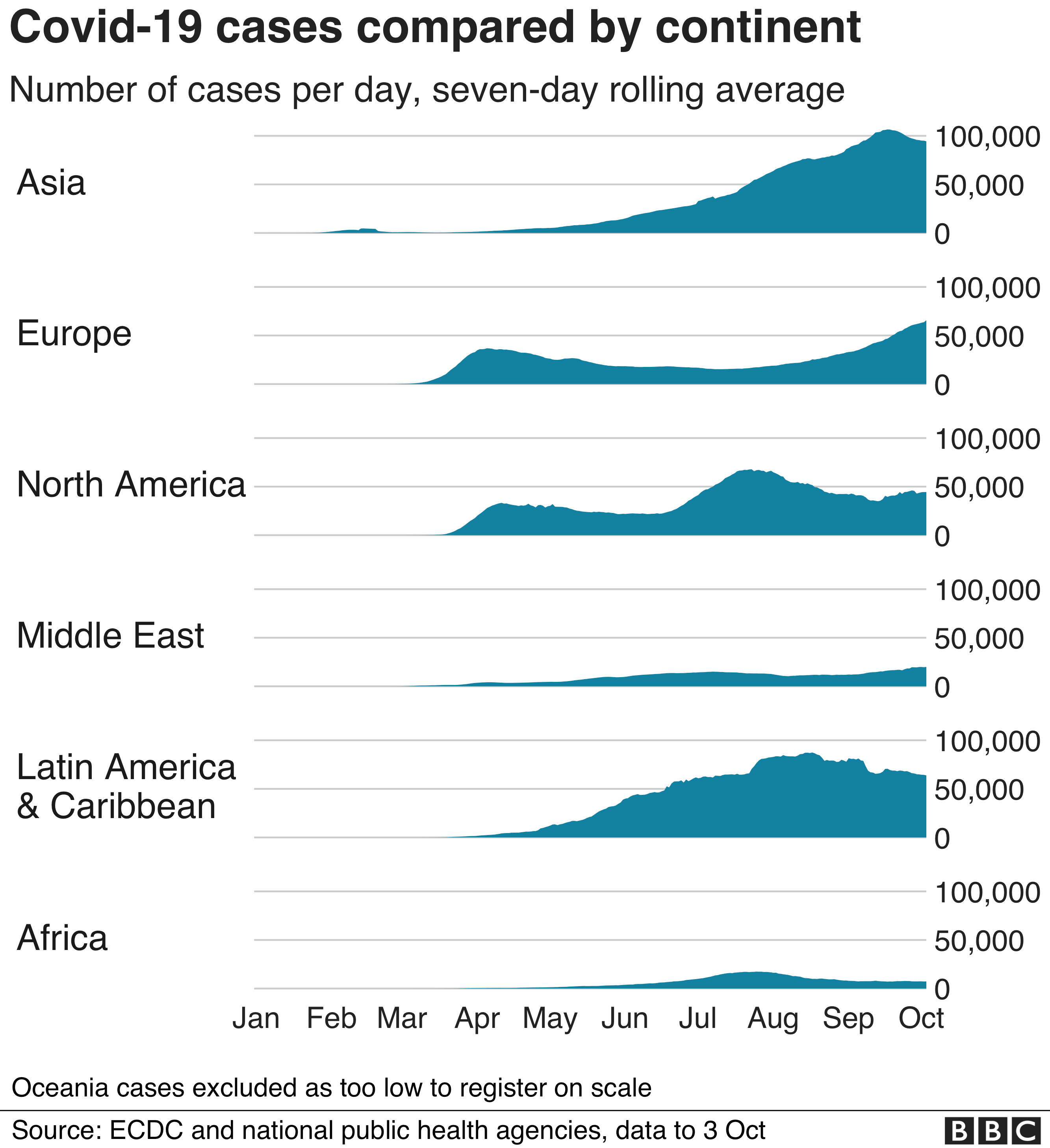
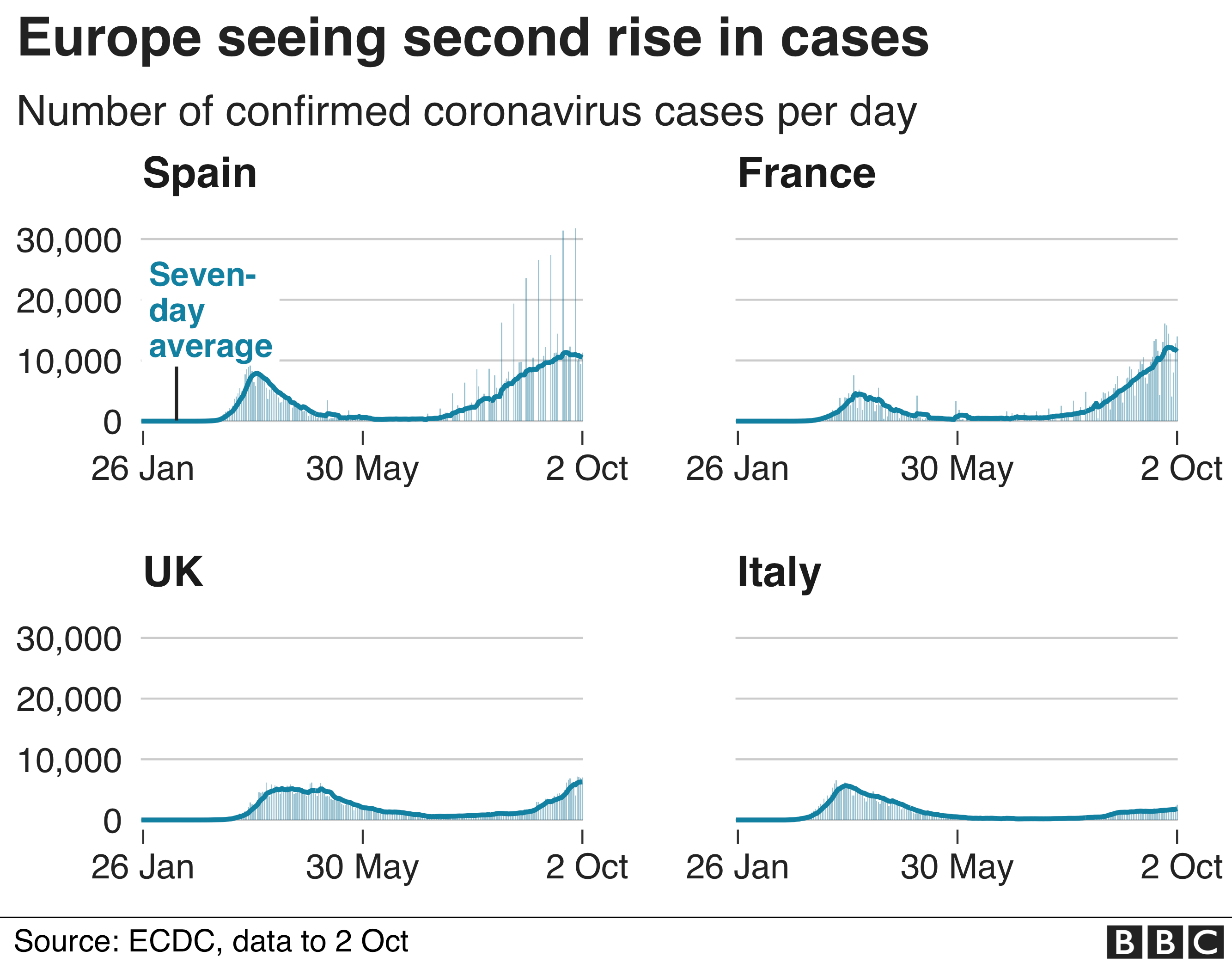
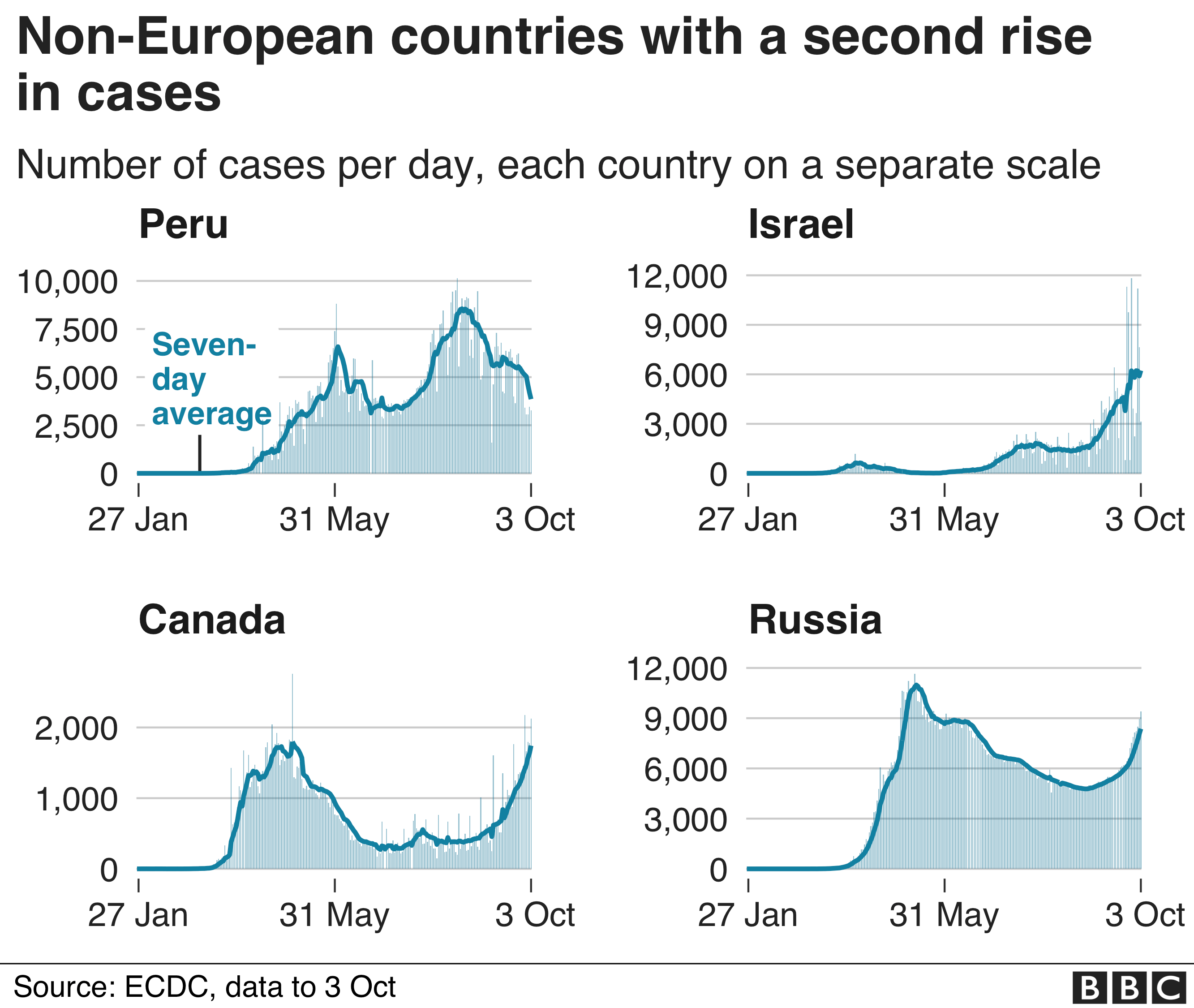
Coronavirus News You May Have Missed
Trump could leave hospital as early as Monday, doctors say – CBS News
President Trump has “continued to improve” and respond to treatment for COVID-19 at Walter Reed National Military Medical Center, his doctors said Sunday, suggesting he could return to the White House as early as Monday if he continues to make progress.
“If he continues to look and feel as well as he does today, our hope is that we can plan for a discharge as early as tomorrow to the White House where he can continue his treatment course,” said Dr. Brian Garibaldi of Johns Hopkins University, who is consulting the president’s medical treatment.
Dr. Sean Conley, the White House physician, said the president’s move to Walter Reed on Friday was prompted by Conley’s concern for the “rapid progression” of his symptoms from Thursday night into Friday morning, with a high fever and low oxygen levels. Conley said Mr. Trump was given supplemental oxygen on Friday before he was brought to the medical center.
In a statement late Saturday, Conley said the president was “not yet out of the woods” but that the medical team was “cautiously optimistic.”
… Conley also confirmed to reporters that the president had two episodes of falling oxygen saturation levels and received supplemental oxygen Friday at the White House. While Mr. Trump was “fairly adamant” he did not need the supplemental oxygen, Conley said it was administered for roughly an hour.
In response to the two episodes of drops in his oxygen saturation, doctors gave Mr. Trump dexamethasone, a steroid. His first dose was administered Saturday, Garibaldi said.
The first drop in Mr. Trump’s oxygen saturation occurred Friday and the second occurred Saturday, Conley said.
Trump Started on Dexamethasone, Has ‘Expected’ Lung Findings – MedPage
President Trump was administered dexamethasone therapy for COVID-19 treatment, and had two episodes of low oxygen saturation levels that required supplemental oxygen, said doctors at Walter Reed Medical Center at a press conference on Sunday.
“In response to transient low oxygen levels, we did initiate dexamethasone therapy [and] our plan is to continue that for the time being,” said Brian Garibaldi, MD, of Johns Hopkins University. He also confirmed the president received his second dose of remdesivir.
White House physician Sean Conley, DO, said the team “debated on whether or not to start” dexamethasone, but added, “the potential benefits probably outweighed any risk at this time.”
Dexamethasone is a low-cost steroid that has shown the most benefit for the sickest patients with COVID-19. According to the U.K.’s RECOVERY trial, incidence of mortality was significantly lower for patients receiving mechanical ventilation, and those receiving supplemental oxygen without mechanical ventilation, but there was no significant benefit for those not receiving respiratory support.
The NIH currently recommends dexamethasone for hospitalized patients with “severe COVID-19.”
Doctors also said the president was receiving X-rays and CT scans. When asked by reporters if there were signs of pneumonia, lung involvement or damage to the lungs, Conley said there were some, “expected findings, but nothing of any clinical concern.”
Conley confirmed that President Trump’s oxygen levels dropped to 93%, that he did receive supplemental oxygen on Friday “for about an hour,” though he continued to stress “it wasn’t in the low 80s or anything like that.”
After he was asked if the president’s oxygen levels ever dipped below 90%, Conley responded, “we don’t have any records here of that.” He described President Trump’s current oxygen levels at 98%.
Conley also confirmed the president had “a momentary episode of high fever and temporary drop in [oxygen] saturation” on Friday, which prompted the medical team to move him to Walter Reed.
Garibaldi said the president’s liver and kidney function remain normal. Conley said that like every patient, lung spirometry was performed on President Trump and it was “over 2,500 ml each time.”
Trump’s personal assistant tests positive for coronavirus – The Hill
Nick Luna, one of President Trump‘s personal assistants, is the latest White house aide to receive a positive coronavirus diagnosis, Bloomberg reports.
The new outlet noted that Luna works closely with Trump and serves as one of the president’s “body men.”
The Hill has reached out to the White House for comment on the aide’s reported diagnosis, which comes several days after Trump and first lady Melania Trump were confirmed to have tested positive for coronavirus.
The first couple’s diagnosis was announced shortly after it was discovered White House adviser Hope Hicks had also tested positive for the illness. In the days since, a number of top Republicans have also tested positive for the coronavirus.
Republican Sens. Mike Lee (Utah), Thom Tillis (N.C.) and Ron Johnson (Wis.) have all received positive diagnoses in the past week.
Lee and Tillis both serve on the Senate Judiciary Committee. Their diagnoses come as the committee is scheduled to meet in the days ahead to commence hearings for the president’s Supreme Court nominee to replace the late Justice Ruth Bader Ginsburg, Amy Coney Barrett.
This biologist helped trace SARS to bats. Now, he’s working to uncover the origins of COVID-19 – Science
By pure chance, Linfa Wang, one of the world’s foremost experts on emerging viruses, was in the Chinese city of Wuhan in January. The biologist was visiting collaborators at the Wuhan Institute of Virology (WIV) just as SARS-CoV-2 was starting to spread from the city to the rest of the world. Even among those experts there was little fear then. “I was mixing with all the lab people,” Wang says. “We would go to a restaurant every night.”
Only when he left on 18 January did he realize how serious the situation was. At the airport, staff checked his temperature three times before he could board his flight home to Singapore. Five days later, Wuhan, a city of 11 million people, was shut down. Wang later learned that a woman on his plane had carried the virus; luckily, he was not infected.
… Now, Wang hopes to home in on the origin of SARS-CoV-2-an effort that will likely require screening thousands of animals and humans for signs of a prior infection. The gold standard for doing that is called a virus neutralization assay, which combines human cells and live virus with a blood sample to see whether the sample contains antibodies that keep the virus from binding to the cells. But using live virus means working in a high-level biosafety lab-expensive and very slow work. An alternative called an enzyme-linked immunosorbent assay (ELISA) is much easier to handle, but a distinct version must be developed for every animal species. “You need to have a whole panel of ELISAs that are optimized for different bat species, and raccoon dogs, and civet cats, and pangolins, and God knows what,” says Malik Peiris of the University of Hong Kong. “It’s a never-ending business.”
Wang’s new assay, published in July in Nature Biotechnology and now produced by Genscript Biotech, replaces the human cells and live SARS-CoV-2 virus of the gold standard assay with human and viral proteins, eliminating the need for a high-security lab. The sample is tested on a plate impregnated with angiotensin-converting enzyme 2 (ACE2), the human receptor protein that SARS-CoV-2 attaches to when it invades cells. Researchers then add a solution containing the fragment of the viral spike protein that can bind to ACE2. If the binding takes place, an enzyme turns the solution blue and then yellow. But when a sample contains antibodies against SARS-CoV-2, they prevent the binding, blocking the colorful reaction. Wang’s assay works on a variety of species almost as well as the gold standard, says Peiris, who has been using it for several weeks in infected cats, dogs, and hamsters.
Trump Will Spend Days In Isolation Despite Saying Otherwise – Newsweek
President Donald Trump said he didn’t want to be locked up in the White House following his COVID-19 diagnosis, but will now spend the next few days in a special suite at a military hospital.
The president arrived at the Walter Reed National Military Medical Center in Bethesda, Maryland on Friday just a day after news emerged that he had tested positive for the disease.
On Saturday, Trump released a video message from his suite, saying he had “no choice” but to leave the White House.
“I just didn’t want to stay in the White House, I was given that alternative. Stay in the White House, lock yourself in, don’t ever leave. Don’t even go to the Oval Office, just stay upstairs and enjoy it. Don’t see people, don’t talk to people and just be done with it. And i can’t do that, I had to be out front,” he said.
“This is America, this is the greatest country in the world, this is the most powerful country in the world. I can’t be locked up in a room upstairs and totally safe, and just say, ‘Hey, whatever happens, happens. I can’t do that. As a leader you have to confront problems.”
Due to his age and weight, the 74-year-old president is in one of the highest risk categories for COVID-19. In the video message, he said his wife Melania Trump-who is 24 years his junior-was “doing very well” after she also tested positive for COVID-19.
Senior administration official: Coronavirus outbreak likely began at Supreme Court announcement – CNN
A senior administration official told CNN’s Jake Tapper on Saturday that the cluster of coronavirus cases among top Republican officials likely began at President Donald Trump’s Rose Garden event announcing the nomination of Judge Amy Coney Barrett to the Supreme Court.
The official said it “seems highly likely this (outbreak) originated at the SCOTUS announcement last week. It may have come from the Hill. The next major concern will be securing Capitol Hill and protecting lawmakers.”
The ceremony last Saturday brought together top White House aides and allies, cabinet members, Republican lawmakers and friends and family of Barrett, who has since tested negative, but was revealed this week to have contracted the disease, along with her husband, earlier this year. Both have recovered. Trump, who announced he tested positive early Friday, was moved to Walter Reed National Military Medical Center later that day and was expected to be there for the next few days. The Supreme Court announcement took place outdoors, but Barrett and others also gathered inside the White House.
Both indoors and out, participants were observed without masks and not practicing recommended social distancing measures.
Trump ‘doing well’ after blood oxygen level ‘dropped rapidly’ – The Hill
White House chief of staff Mark Meadows said in an interview late Saturday that President Trump is “doing well” at Walter Reed National Military Medical Center, where the president is being treated for COVID-19, after his blood oxygen level “dropped rapidly” Friday morning.
“He is doing extremely well. In fact, I’m very, very optimistic, based on the current results,” Meadows told Fox News host Jeanine Pirro, echoing earlier comments from White House physician Sean Conley.
“And as the doctor said, he’s not out of the woods. The next 48 hours or so, with the history of this virus, we know, can be tough. But he’s made unbelievable improvements from yesterday morning, when I know a number of us, the doctor and I, were very concerned,” Meadows said.
“The biggest thing that we see is that, with no fever now and with him doing really well with his oxygen saturation levels, we — yesterday morning, we were real concerned with that. You know, he had a fever and his blood oxygen level had dropped rapidly, … and yet, in typical style, this president was up and walking around and, even as the experts from the medical facilities not only at Walter Reed but also Johns Hopkins, got there, they looked at his situation and recommended that, out of an abundance of caution, that he come here to Walter Reed,” Meadows added.
Conley in an update on Trump’s treatment said Saturday evening that Trump had received a second dose of Remdesivir “without complications.” The president received his first dose of the antiviral drug Friday night at the hospital in Bethesda, Md.
Conley also said that Trump “remains fever free and off supplemental oxygen with a saturation level between 96 and 98% all day.”
Earlier in the day, he said Trump had symptoms including a mild cough, congestion and fatigue, adding that the president was improving.
President Donald Trump received his first positive coronavirus test result on Thursday after returning from Bedminster, New Jersey, according to a White House official.
That result was via a rapid test. The President then took a more thorough PCR test which also came back positive, according to the official.
He had just returned from a fundraiser at his New Jersey golf club, which went on as planned Thursday night despite the President and staff knowing he had been exposed to coronavirus.
Donors that gave $250,000 were able to participate in a roundtable, photo opportunity and reception with the President, according to the event invite.
Three attendees told CNN that most people at the fundraiser were not wearing masks; all three say they have not been contacted by any contact tracers.
The President announced he and first lady Melania Trump tested positive for coronavirus roughly eight hours after leaving the fundraiser, when he was back at the White House.
Source tells reporters Trump’s vitals were “very concerning” – CNBC
Minutes after White House physician Dr. Sean Conley sought to assure the public on President Donald Trump’s condition, a conflicting account of the president’s health emerged.
A person familiar with the matter told White House reporters that the president’s “vitals over the last 24 hours were very concerning. The next 48 hours will be critical in terms of his care.”
“We are still not on a clear path to a full recovery,” the person added.
These comments followed Dr. Conley’s update, during which he said he’s “extremely happy” with Trump’s progress.
Trump’s Orbit Now Has More New COVID Cases Than Numerous Countries – Newsweek
Fourteen people in the president’s orbit have reported positive diagnoses since Friday-more than the number of newly reported cases in the last 24 hours in Belgium, New Zealand, Singapore, Sweden, Taiwan, Thailand or Vietnam.
Trump says he’s feeling better but real test to come – CNBC
President Donald Trump, in a video posted to his Twitter account, said he’s starting to feel better but the real test will come over the next few days as he receives treatment at Walter Reed Medical Center.
“I’m starting to feel good,” Trump said. “You don’t know over the next period of a few days. I guess that’s the real test, so we’ll be seeing what happens over the next couple of days. I just want to be so thankful for all the support I’ve seen.”
Why COVID-19 is more deadly in people with obesity – even if they’re young – Science
Since the pandemic began, dozens of studies have reported that many of the sickest COVID-19 patients have been people with obesity. In recent weeks, that link has come into sharper focus as large new population studies have cemented the association and demonstrated that even people who are merely overweight are at higher risk. For example, in the first metaanalysis of its kind, published on 26 August in Obesity Reviews, an international team of researchers pooled data from scores of peer-reviewed papers capturing 399,000 patients. They found that people with obesity who contracted SARS-CoV-2 were 113% more likely than people of healthy weight to land in the hospital, 74% more likely to be admitted to an ICU, and 48% more likely to die.
A constellation of physiological and social factors drives those grim numbers. The biology of obesity includes impaired immunity, chronic inflammation, and blood that’s prone to clot, all of which can worsen COVID-19. And because obesity is so stigmatized, people with obesity may avoid medical care.
“We didn’t understand early on what a major risk factor obesity was. … It’s not until more recently that we’ve realized the devastating impact of obesity, particularly in younger people,” says Anne Dixon, a physician-scientist who studies obesity and lung disease at the University of Vermont. That “may be one reason for the devastating impact of COVID-19 in the United States, where 40% of adults are obese.”
People with obesity are more likely than normal-weight people to have other diseases that are independent risk factors for severe COVID-19, including heart disease, lung disease, and diabetes. They are also prone to metabolic syndrome, in which blood sugar levels, fat levels, or both are unhealthy and blood pressure may be high. A recent study from Tulane University of 287 hospitalized COVID-19 patients found that metabolic syndrome itself substantially increased the risks of ICU admission, ventilation, and death.
Advisers made last-minute push to get reluctant Trump to Walter Reed – CNN
Marine One was idling on the South Lawn Friday as President Donald Trump’s advisers were inside the White House making a last-minute push to get him to board the helicopter.
The President, who had recently tested positive for coronavirus, was reluctant to go to the hospital, multiple sources familiar with what happened later told CNN. Though Trump had developed symptoms and was now on experimental drugs, he didn’t want to be “hospitalized,” he said.
Aware of his hesitancy to appear seriously ill or convey the serious nature of his condition, Trump’s aides now appear to be scrambling to provide a portrait of a mildly ill commander-in-chief. But on Friday, medical officials were concerned about his vitals and thought it would be better to monitor his response with the vast resources that Walter Reed National Military Medical Center provided. Trump was told the facility was a more prudent place for him to be in case his condition deteriorated.
“The White House is fully committed to providing transparent and regular updates on the President’s condition and recovery,” Judd Deere, a White House spokesman, said in a statement.
A decision was made by senior officials to schedule his departure after markets closed to avoid an inevitable tumble, two people familiar with the matter said.
The following are foreign headlines with hyperlinks to the posts
UK Prime Minister tells Trump: “The most important thing to do is follow his doctors’ advice”
The following are additional national and state headlines with hyperlinks to the posts
‘Saturday Night Live’ Returns With An Audience
Michigan Supreme Court Rules Against Governor’s Emergency Powers
Trump COVID-19 result raises pressure on Pompeo
Democrats warn Supreme Court confirmation would endanger senators’ health, call for delay
3 Minn. Congressmen Blasted for Return Flight Home After Trump Diagnosis
Trump in Walter Reed Photo-Op Appears to Show He’s ‘Relentless’
The president of Notre Dame tests positive, less than a week after a White House visit.
New York City is ‘on the edge of a precipice’ as coronavirus cases grow, former CDC director says
Opinion: The two test results Trump’s doctors should be sharing at every briefing
Today’s Posts On Econintersect Showing Impact Of The Pandemic With Hyperlinks
Viewing The U.S. Financial Structure From The Financial Crisis To The Pandemic
Market Failures And Official Sector Interventions – Part 2 Of 3
Infographic Of The Day: Measuring The Emotional Impact Of COVID-19 On The U.S. Population
The Fed’s Bazooka Is Broken – Will Direct Lending Be Next?
Coronavirus Disease Weekly News 03October 2020
Coronavirus Economic Weekly News 03October 2020
A Brief History Of Presidents Disclosing – Or Trying To Hide – Health Problems
The Fed Checks Into The Hotel California
Warning to Readers
The amount of politically biased articles on the internet continues to increase. And studies and opinions of the experts continue to contradict other studies and expert opinions. Honestly, it is difficult to believe anything anymore. A study usually cannot establish cause and effect – but only correlation. Be very careful what you believe about this pandemic.

I assemble this coronavirus update daily – sifting through the posts on the internet. I try to avoid politically slanted posts (mostly from CNN, New York Times, and the Washington Post) and can usually find unslanted posts on that subject from other sources on the internet. I wait to publish posts on subjects that I cannot validate across several sources. But after all this extra work, I do not know if I have conveyed the REAL facts. It is my job to provide information so that you have the facts necessary – and then it is up to readers to draw conclusions.
Coronavirus INTERACTIVE Charts
include($_SERVER[‘DOCUMENT_ROOT’].’/pages/coronavirus.htm’); ?>
Analyst Opinion of Coronavirus Data
There are several takeaways that need to be understood when viewing coronavirus statistical data:
- The global counts are suspect for a variety of reasons including political. Even the U.S. count has issues as it is possible that as much as half the population has had coronavirus and was asymptomatic. It would be a far better metric using a random sampling of the population weekly. In short, we do not understand the size of the error in the tracking numbers.
- Just because some of the methodology used in aggregating the data in the U.S. is flawed – as long as the flaw is uniformly applied – you establish a baseline. This is why it is dangerous to compare two countries as they likely use different methodologies to determine who has (and who died) from coronavirus.
- COVID-19 and the flu are different but can have similar symptoms. For sure, COVID-19 so far is much more deadly than the flu. [click here to compare symptoms]
- From an industrial engineering point of view, one can argue that it is best to flatten the curve only to the point that the health care system is barely able to cope. This solution only works if-and-only-if one can catch this coronavirus once and develops immunity. In the case of COVID-19, herd immunity may need to be in the 80% to 85% range. WHO warns that few have developed antibodies to COVID-19. At this point, herd immunity does not look like an option although there is now a discussion of whether T-Cells play a part in immunity [which means one might have immunity without antibodies]
- Older population countries will have a higher death rate.
- There are at least 8 strains of the coronavirus. New York may have a deadlier strain imported from Europe, compared to less deadly viruses elsewhere in the United States.
- Each publication uses different cutoff times for its coronavirus statistics. Our data uses 11:00 am London time. Also, there is an unexplained variation in the total numbers both globally and in the U.S.
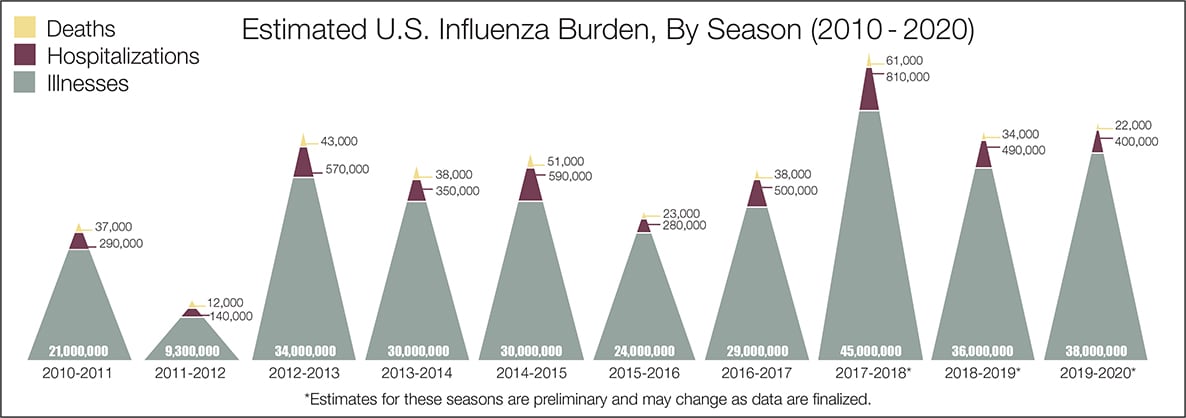
- The real question remains if the U.S. is over-reacting to this virus. The following graphic from the CDC puts the annual flu burden in perspective [click on image to enlarge]. Note that using this data is dangerous as the actual flu cases are estimated and not counted – nobody knows how accurate these guesses are.
What we do not know about the coronavirus [actually there is little scientifically proven information]. Most of our knowledge is anecdotal, from studies with limited subjects, or from studies without peer review.
- How many people have been infected as many do not show symptoms?
- Masks do work.
- Do we develop lasting immunity to the coronavirus? Another coronavirus – the simple cold – does not develop long term immunity.
- To what degree do people who never develop symptoms contribute to transmission?
- The US has scaled up coronavirus testing – and the accuracy of the tests has been improving. However, if one loses immunity – the coronavirus testing value is reduced.
- Can children widely spread coronavirus? [current thinking is that they are becoming a major source of the pandemic spread]
- Why have some places avoided big coronavirus outbreaks – and others hit hard?
- What effect will the weather have? At this point, it does not seem hot weather slows this coronavirus down – and it seems air conditioning contributes to its spread.
- Outdoor activities seem to be a lower risk than indoor activities.
- Can the world really push out an effective vaccine in 12 to 18 months?
- Will other medical treatments for Covid-19 ease symptoms and reduce deaths? So far only one drug (remdesivir) is approved for treatment.
- A current scientific understanding of the way the coronavirus works can be found [here].
Heavy breakouts of coronavirus have hit farm workers. Farmworkers are essential to the food supply. They cannot shelter at home. Consider:
- they have high rates of the respiratory disease [occupational hazard]
- they travel on crowded buses chartered by their employers
- few have health insurance
- they cannot social distance and live two to four to a room – and they eat together
- some reports say half are undocumented
- they are low paid and cannot afford not to work – so they will go to work sick
- they do not have access to sanitation when working
- a coronavirus outbreak among farmworkers can potentially shutter entire farm
The bottom line is that COVID-19 so far has been shown to be much more deadly than the data on the flu. Using CDC data, the flu has a mortality rate between 0.06 % and 0.11 % Vs. the coronavirus which to date has a mortality rate of 4 % [the 4% is the average of overall statistics – however in the last few months it has been hovering around 1.0%] – which makes it between 10 and 80 times more deadly. The reason for ranges:
Because influenza surveillance does not capture all cases of flu that occur in the U.S., CDC provides these estimated ranges to better reflect the larger burden of influenza.
There will be a commission set up after this pandemic ends to find fault [it is easy to find fault when a once-in-a-lifetime event occurs] and to produce recommendations for the next time a pandemic happens. Those that hate President Trump will conclude the virus is his fault.
Resources:
- Get the latest public health information from CDC: https://www.coronavirus.gov .
- Get the latest research from NIH: https://www.nih.gov/coronavirus.
- Find NCBI SARS-CoV-2 literature, sequence, and clinical content: https://www.ncbi.nlm.nih.gov/sars-cov-2/.
- List of studies: https://icite.od.nih.gov/covid19/search/#search:searchId=5ee124ed70bb967c49672dad
include(“/home/aleta/public_html/files/ad_openx.htm”); ?>


