


Written by Steven Hansen
The U.S. new cases 7-day rolling average is 12.4 % HIGHER than the 7-day rolling average one week ago. U.S. deaths due to coronavirus are now 7.0 % LOWER than the rolling average one week ago. At the end of this post is a set of interactive graphs and tables for the world and individual States – as well as today’s headlines which include;
- The U.S. has had more than 7 million COVID-19 cases.
- Johnson and Johnson vaccine produced strong immune response, early results say
- Breakthrough Research On Severe COVID-19 Infections Opens Door To New Treatment
- About 9% of Americans exposed to COVID-19 by mid-summer. That’s a long way from herd immunity
- Scientists are seeing an ‘acceleration of pandemics’: They are looking at climate change
- Kids Half as Likely to Catch COVID-19 as Adults
- Novavax Researcher Says No Chance Of A ‘Shortcut’ In Vaccine Safety
- Dozens of COVID-19 vaccines are in development. Here are the ones to follow
- COVID-19 vaccine ‘will be ready by early 2021’, says Chinese company

The recent worsening of the trendlines for new cases should be attributed to going back to school – especially at college/university level.
My continuing advice is to continue to wash your hands, wear masks, and maintain social distancing. No handwashing, mask, or social distancing will guarantee you do not get infected – but it sure as hell lowers the risk in all situations – and evidence to-date shows a lower severity of COVID-19. In addition, certain activities are believed to carry higher risk – like being inside in air conditioning and removing your mask (such as restaurants, around your children/grandchildren, bars, and gyms). It is all about viral load – and outdoor activities are generally very safe.
The daily number of new cases in the U.S. is remaining stubbornly and embarrassedly high.
The following graphs show the 7-day rolling average for new coronavirus cases and deaths have been updated through 26 September 2020:


z coronavirus.png
Coronavirus Statistics For 26 September 2020 |
| U.S. Only | Global | U.S Percentage of Total | ||||
| Today*** | Cumulative | Today*** | Cumulative | Today | Cumulative | |
| New Confirmed Cases | 44,108 | 7,030,000 | 295,538 | 32,610,000 | 14.9% | 21.6% |
| Deaths** | 962 | 203,774 | 5,568 | 989,728 | 17.3% | 20.6% |
| Mortality Rate | 2.2% | 2.9% | 1.9% | 3.0% | ||
total COVID-19 Tests per 1,000 people | 0.91* | 324.17* | ||||
* as of 22 Sep 2020
** evidently several States included “probable” deaths today in the number
*** red color indicates record number
Coronavirus News You May Have Missed
Kids Half as Likely to Catch COVID-19 as Adults – Medpage
But transmission from children to others remains unclear.
Children were less likely than adults to acquire a COVID-19 infection from an index case, a meta-analysis found.
Across 32 contact tracing or population testing studies comparing SARS-CoV-2 prevalence in children and adults, children younger than 14 were less likely to be infected from an index case overall (odds ratio 0.56, 95% CI 0.37-0.85), and specifically in studies examining household transmission (OR 0.41, 95% CI 0.22-0.76), reported Russell M. Viner, PhD, of the UCL Great Ormond Street Institute of Child Health in London, and colleagues.
However, adolescents 14 and older did not have a significantly lower risk of infection compared with adults (OR 1.23, 95% CI 0.64-2.36), they wrote in JAMA Pediatrics.
Seroprevalence appeared to be lower in children than adults, especially for children younger than 14, who had 48% lower odds of infection compared with young adults 20 and over, they reported.
While “we found few data that were informative on the onward transmission of SARS-CoV-2 from children to others,” the findings suggest “children and adolescents have less opportunity for onward transmission,” Viner and co-authors noted.
Children tend to be less vulnerable to serious complications of COVID-19 than adults, but a recent CDC analysis demonstrated that the median age of coronavirus patients is trending downward, with people in their 20s accounting for more than one in five infections reported from June to August.
A COVID vaccine, every year, for the rest of your life? It’s starting to look that way – Salon
It’s a conundrum for vaccine researchers and producers alike: what’s the best strategy for vaccinating against a deadly virus if the immune system will forget how to protect itself against it a year later?
Recent research that suggests that novel coronavirus immunity doesn’t last very long have thrown a wrench in the global plans to develop and roll out a vaccine. The duration of protective immunity, which is how long a person is naturally protected from the coronavirus following an infection, is believed to be anywhere between four to twelve months at the moment, based on current research.
Since the coronavirus which causes COVID-19 is so new to science, it is still impossible to study long-term immunity using human data just yet. However, as Salon has previously reported, a conservative prediction suggests that a previously-infected person is immune to the coronavirus for at least three months. More recently, researchers published a study in the scientific journal Nature Medicine suggesting that people who contract the novel coronavirus and then become immune may stay that way for up to twelve months, based on studying four different seasonal coronaviruses.
Neither of these are definitive, but whether immunity lasts three months, one year, or even slightly longer, the evidence points to the conclusion that immunity protection is temporary.
“I think right now the data really supports and is strongly pointing to, but not proving, to the possibility that protection is likely not to be lifelong,” Dr. Charles Chiu, a professor of infectious diseases at the University of California-San Francisco, told Salon.
Breakthrough Research On Severe COVID-19 Infections Opens Door To New Treatment – ZeroHedge
So far, scientists have figured out that being male, elderly, and having underlying medical conditions can all raise risk factors for patients. But even patients who check all these boxes don’t always experience serious symptoms. Scientists suspect that several factors influence severity, including pre-existing levels of inflammation, natural immunity levels, and the amount and strain of virus that starts the infection – along with variations in patients’ genetic makeup.
As has been previously reported, many patients suffer the worst of the symptoms for COVID-19 due to an immune system overreaction called a “cytokine storm”. As Dr. Fauci once explained, while “too little immunity is no good”…“too much immunity is really, really bad”.
Now, researchers have discovered the role of a critical protein which could open the door to a new potential COVID-19 treatment.
Studies comparing reactions to COVID-19 in siblings have unearthed an interesting detail: the availability of a substance called interferon. Interferons are signaling proteins that help orchestrate the body’s defense against viral pathogens; they’re used to treat diseases like Hepatitis C.
A growing body of evidence, including twin landmark studies published Thursday in the journal “Science” showed that “insufficient” interferon levels may be a dangerous precursor to a serious infection. As one researcher explained, the data suggest the virus uses this “one big trick” to slip past the body’s initial defense systems.
“It looks like this virus has one big trick,” said Shane Crotty, a professor in the Center for Infectious Disease and Vaccine Research at the La Jolla Institute for Immunology in California. “That big trick is to avoid the initial innate immune response for a significant period of time and, in particular, avoid an early type-1 interferon response.”
The research highlights the potential for interferon-based therapies to expand a range of non-vaccine-related treatments, like Gilead’s remdesivir and convalescent plasma.
About 9% of Americans exposed to COVID-19 by mid-summer. That’s a long way from herd immunity. – USA Today
By the end of July, about 9% of American adults had been exposed to the coronavirus that causes COVID-19, according to a new study of dialysis patients, the largest yet looking for evidence of the disease in people’s blood.
The infection rates varied from essentially zero in some states that avoided infection by mid-summer, to more than one-third of residents in parts of New York hard-hit in the spring.
The upshot is the American public is a long way from achieving “herd immunity” – having enough infections to prevent further spread of the virus.
Infection rates are so patchy that even if some areas have had high infection rates, people there are unlikely to be protected because others will bring the virus in from elsewhere, said William Hanage, an epidemiologist at the Harvard T.H. Chan School of Public Health.
Hanage is also concerned communities not yet hit by COVID-19 will feel a false sense of security.
“We expect small-town America not to be in the first surge,” he said, but over time, as people move around more and it gets introduced multiple times, more communities will have outbreaks.
Not Much Progress on PPE ‘Reshoring’ – Medpage
U.S. production said to be up, but what will it take to keep it up?
Let’s look at a standard N95 mask to understand why the U.S. is so dependent on overseas suppliers for personal protective equipment (PPE).
It has several individual components: filter, shell, coverweb, nose clip, nose foam, and straps.
Each of those requires raw materials, chiefly polyester, polypropylene, and aluminum.
So while the N95 is made by one company, even one based in the U.S., those components and materials can and mostly do come from many places around the world.
And N95s are just one part of the PPE equation for frontline healthcare workers during a pandemic. Also needed are surgical masks, bonnets, gowns, goggles, gloves, faceshields, powered air purifying respirators (PAPRs), and more.
Despite calls from politicians to bring PPE manufacturing back to U.S. shores, the global and secretive nature of the supply chain has made it difficult to reverse decades of offshore sourcing and production. As well, offshoring has always been driven by cost, and that advantage for overseas suppliers isn’t going away. Manufacturers and buyers of finished products will always be looking for the best deal — which in recent decades has come from low-wage foreign countries.
Why our minds can’t make sense of COVID-19’s enormous death toll – National Geographic
WHEN THE COVID-19 pandemic started nine months ago, the current reported death tolls were unthinkable. Yet this week, the fatality count has reached 200,000 people in the United States, and global deaths are approaching one million.
Although health officials say the real toll is likely much higher, due to a percentage of coronavirus deaths not being officially classified, the 200,000 statistic is a heartbreaking milestone. It’s a symbolic grim number that’s seared into the public’s consciousness and marks another alarming level of escalation in the pandemic.
The tally means a U.S. death has happened every 1.5 minutes, on average, since the first official fatality in late February. It’s also the equivalent of wiping out a small city—such as Salt Lake City, Utah or Akron, Ohio—or a quarter of Washington, D.C. It means we have lost 1,450 plane loads full of people. (Here’s where cases are growing and declining in the U.S.)
“If you think about it like that, assuming there are 138 seats in a classic 737, that would mean eight planes have crashed on U.S. soil every day,” says David Kessler, Los Angeles-based grief specialist and author of Finding Meaning: The Sixth Stage of Grief. “Can you even imagine that?”
Although that number is fodder for disturbing mental images, what’s unknown is how it will affect people’s collective and individual psyches. Is 200,000 deaths an important threshold that kicks us in the gut and creates a new level of urgency and outrage? Or will it lead to numbness and disengagement?
[editor’s note: this post worth a full read as it is difficult to summarize]
First RCT in COVID Anticoagulation Says Go Full Dose – Medpage
Therapeutic-level dosing of enoxaparin (Lovenox) improved respiratory outcomes in severe COVID-19, a pilot randomized trial showed.
Gas exchange measured by the PaO2/FiO2 ratio improved significantly over time in the 10-patient therapeutic group (from 163 at baseline to 209 at 7 days and 261 at 14 days, P=0.0004) but not in the 10-patient control group receiving lower prophylactic-level doses in the open-label study (184, 168, and 195, respectively, P=0.487).
Compared with prophylactic dosing of the drug, therapeutic dosing also led to four-fold more patients being weaned off of mechanical ventilation (P=0.031) and more ventilator-free days (15 vs 0 days, P=0.028), Carlos Henrique Miranda, MD, PhD, of São Paulo University in Brazil, and colleagues reported in Thrombosis Research.
Three patients died within 28 days with therapeutic anticoagulation (two secondary to healthcare-associated infections) versus one with prophylactic dosing, but the difference wasn’t statistically significant. The study wasn’t powered for clinical outcomes, the researchers noted.
There were no major bleeding events, but numerically more minor bleeding with the higher dose anticoagulation.
“It’s a remarkable step forward in the sense that now for the first time we are having randomized trial data related to antithrombotic therapy for COVID-19,” commented Behnood Bikdeli, MD, of Brigham and Women’s Hospital and Harvard in Boston.
Scientists are seeing an ‘acceleration of pandemics’: They are looking at climate change – USA Today
- “We have entered a pandemic era,” a recent study in the journal Cell said.
- Almost certainly, the impacts of pandemics like COVID-19 are exacerbated by climate change.
- “It is hard to imagine that climate change will be anything good for human health.”
Novavax Researcher Says No Chance Of A ‘Shortcut’ In Vaccine Safety – NPR
Novavax, a vaccine maker in Maryland, is becoming the 10th coronavirus vaccine candidate to enter the final phase of testing, called phase 3.
The trial is taking place in the U.K., where researchers plan to enroll up to 10,000 adults of various ages in the next four to six weeks. Half the participants will get a placebo and half will get the company’s vaccine.
At least a quarter of participants will be over the age of 65, the company says, and it will also “prioritize groups that are most affected by COVID-19, including racial and ethnic minorities.”
The company expects to start a U.S. trial with 30,000 volunteers in mid-October.
Companies are working to develop vaccines at an unprecedented pace. Many Americans are concerned about the safety of a fast-tracked process, done under the purview of a president who contradicts his own health officials.
Novavax was one of nine companies to publicly pledge to not submit their vaccines for Food and Drug Administration review until they’ve been shown to be safe in trials. Novavax has never before brought a vaccine to market.
Johnson and Johnson vaccine produced strong immune response, early results say – CNN
There is some good news on Johnson & Johnson’s coronavirus vaccine.
Early results from a Phase 1/2a clinical trial show it was well tolerated and even one dose appeared to produce a strong immune response in almost all of the 800 participants.
The trial included two age groups: 18- to 55-year-olds and 65 and older, and looked at the safety and side effects of two different doses. Initial findings from the trials suggest the vaccine does provoke an immune response and is safe enough to move into large-scale trials.
The study was posted on MedRxiv, but it has not been peer-reviewed or published in a medical journal yet.
The researchers found that 99% of the participants age 18 to 55 in both dose groups had developed antibodies against the virus 29 days after getting vaccinated. The analysis found that most of the side effects, like fever, headache, fatigue, body aches and injection-site pain, were mild and resolved after a couple of days.
Some of the participants will be receiving a second shot of the vaccine as part of the trial.
The vaccine — called Ad26.COV2.S — uses the same technology used for Johnson & Johnson’s Ebola, Zika, HIV and RSV vaccines.
Phase 3 trials will examine the safety and effectiveness of a single dose against a placebo to prevent symptomatic Covid-19. Johnson & Johnson says it plans to enroll 60,000 adult volunteers at more than 200 sites in the US and internationally.
The fact that the trial will examine the efficacy of a single dose of the vaccine, instead of two doses, should expedite results, according to Dr. Paul Stoffels, Johnson & Johnson’s chief scientific officer.
Dozens of COVID-19 vaccines are in development. Here are the ones to follow. – National Geographic
More than 150 coronavirus vaccines are in development across the world—and hopes are high to bring one to market in record time to ease the global crisis. Several efforts are underway to help make that possible, including the U.S. government’s Operation Warp Speed initiative, which has pledged $10 billion and aims to develop and deliver 300 million doses of a safe, effective coronavirus vaccine by January 2021. The World Health Organization is also coordinating global efforts to develop a vaccine, with an eye toward delivering two billion doses by the end of 2021.
It can typically take 10 to 15 years to bring a vaccine to market; the fastest-ever—the vaccine for mumps—required four years in the 1960s. Vaccines go through a three-stage clinical trial process before they are sent to regulatory agencies for approval—which can be a lengthy process itself.
… Though it’s too soon to say which candidates will ultimately be successful, here’s a look at the prospects that have reached phase three and beyond—including a quick primer on how they work and where they stand.
[editor’s note: this post does a good job of summarizing the top 9 vaccines and worth a full read]
COVID-19 vaccine ‘will be ready by early 2021’, says Chinese company – Euronews
A Chinese pharmaceutical company said Thursday the coronavirus vaccine it is developing should be ready by early 2021 for distribution worldwide.
Yin Weidong, the CEO of SinoVac, said he personally has been given the experimental vaccine.
“At the very beginning, our strategy was designed for China and for Wuhan. Soon after that in June and July we adjusted our strategy, that is to face the world,” Yin said, referring to the Chinese city where the virus first emerged.
“Our goal is to provide the vaccine to the world including the U.S., EU and others,” Yin said.
Stringent regulations in the U.S., European Union, Japan and Australia have historically blocked the sale of Chinese vaccines. But Yin said that could change.
More than 24,000 people are participating in clinical trials of CoronaVac in Brazil, Turkey, and Indonesia, with additional trials scheduled for Bangladesh and possibly Chile, Yin said. SinoVac chose those countries because they all had serious outbreaks, large populations and limited research and development capacity, he said.
The following are foreign headlines with hyperlinks to the posts
World COVID deaths could double to 2M without a vaccine
India’s leader says his country’s vaccine industry will ‘help all humanity’ in fighting the virus.
China gives unproven vaccines to thousands, with risks unknown.
The French Open adjusts ambitious plans amid the country’s surging caseload.
Coronavirus: 1,700 Manchester students told to isolate after coronavirus outbreak
The following are additional national and state headlines with hyperlinks to the posts
Leaders Indicted At Soldiers’ Home Where At Least 76 People Died In COVID-19 Outbreak
About 900 CSU Students Quarantined After Wastewater Reveals COVID
100,000 Lives Can Be Saved by Jan. 1 If 95% of Americans Wear Masks: IHME
CDC Ends COVID-19 Door-to-Door Survey After Residents Shout Racist Slurs
This is what happens to your body over months in isolation
Today’s Posts On Econintersect Showing Impact Of The Pandemic With Hyperlinks
The Effects Of Pandemic-Related Legislation On Output
Remote Work Takes A Toll. Avoiding Burnout
Did State Reopenings Increase Consumer Spending?
Shocking Chart On Low Income Consumers
Reaching The End Of Early Stimulus – What’s Ahead?
Warning to Readers
The amount of politically biased articles on the internet continues to increase. And studies and opinions of the experts continue to contradict other studies and expert opinions. Honestly, it is difficult to believe anything anymore. A study usually cannot establish cause and effect – but only correlation. Be very careful what you believe about this pandemic.

I assemble this coronavirus update daily – sifting through the posts on the internet. I try to avoid politically slanted posts (mostly from CNN, New York Times, and the Washington Post) and can usually find unslanted posts on that subject from other sources on the internet. I wait to publish posts on subjects that I cannot validate across several sources. But after all this extra work, I do not know if I have conveyed the REAL facts. It is my job to provide information so that you have the facts necessary – and then it is up to readers to draw conclusions.
Coronavirus INTERACTIVE Charts
include($_SERVER[‘DOCUMENT_ROOT’].’/pages/coronavirus.htm’); ?>
Analyst Opinion of Coronavirus Data
There are several takeaways that need to be understood when viewing coronavirus statistical data:
- The global counts are suspect for a variety of reasons including political. Even the U.S. count has issues as it is possible that as much as half the population has had coronavirus and was asymptomatic. It would be a far better metric using a random sampling of the population weekly. In short, we do not understand the size of the error in the tracking numbers.
- Just because some of the methodology used in aggregating the data in the U.S. is flawed – as long as the flaw is uniformly applied – you establish a baseline. This is why it is dangerous to compare two countries as they likely use different methodologies to determine who has (and who died) from coronavirus.
- COVID-19 and the flu are different but can have similar symptoms. For sure, COVID-19 so far is much more deadly than the flu. [click here to compare symptoms]
- From an industrial engineering point of view, one can argue that it is best to flatten the curve only to the point that the health care system is barely able to cope. This solution only works if-and-only-if one can catch this coronavirus once and develops immunity. In the case of COVID-19, herd immunity may need to be in the 80% to 85% range. WHO warns that few have developed antibodies to COVID-19. At this point, herd immunity does not look like an option although there is now a discussion of whether T-Cells play a part in immunity [which means one might have immunity without antibodies]
- Older population countries will have a higher death rate.
- There are at least 8 strains of the coronavirus. New York may have a deadlier strain imported from Europe, compared to less deadly viruses elsewhere in the United States.
- Each publication uses different cutoff times for its coronavirus statistics. Our data uses 11:00 am London time. Also, there is an unexplained variation in the total numbers both globally and in the U.S.
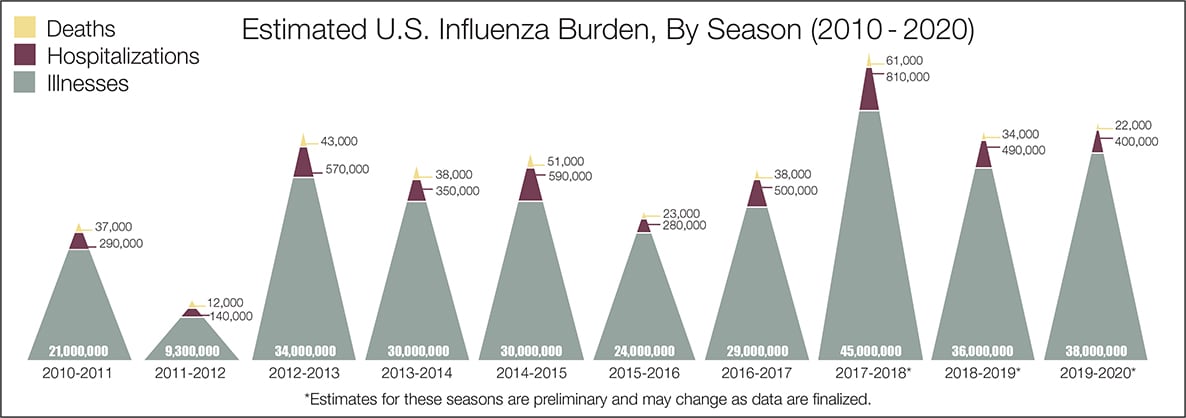
- The real question remains if the U.S. is over-reacting to this virus. The following graphic from the CDC puts the annual flu burden in perspective [click on image to enlarge]. Note that using this data is dangerous as the actual flu cases are estimated and not counted – nobody knows how accurate these guesses are.
What we do not know about the coronavirus [actually there is little scientifically proven information]. Most of our knowledge is anecdotal, from studies with limited subjects, or from studies without peer review.
- How many people have been infected as many do not show symptoms?
- Masks do work.
- Do we develop lasting immunity to the coronavirus? Another coronavirus – the simple cold – does not develop long term immunity.
- To what degree do people who never develop symptoms contribute to transmission?
- The US has scaled up coronavirus testing – and the accuracy of the tests has been improving. However, if one loses immunity – the coronavirus testing value is reduced.
- Can children widely spread coronavirus? [current thinking is that they are becoming a major source of the pandemic spread]
- Why have some places avoided big coronavirus outbreaks – and others hit hard?
- What effect will the weather have? At this point, it does not seem hot weather slows this coronavirus down – and it seems air conditioning contributes to its spread.
- Outdoor activities seem to be a lower risk than indoor activities.
- Can the world really push out an effective vaccine in 12 to 18 months?
- Will other medical treatments for Covid-19 ease symptoms and reduce deaths? So far only one drug (remdesivir) is approved for treatment.
- A current scientific understanding of the way the coronavirus works can be found [here].
Heavy breakouts of coronavirus have hit farm workers. Farmworkers are essential to the food supply. They cannot shelter at home. Consider:
- they have high rates of the respiratory disease [occupational hazard]
- they travel on crowded buses chartered by their employers
- few have health insurance
- they cannot social distance and live two to four to a room – and they eat together
- some reports say half are undocumented
- they are low paid and cannot afford not to work – so they will go to work sick
- they do not have access to sanitation when working
- a coronavirus outbreak among farmworkers can potentially shutter entire farm
The bottom line is that COVID-19 so far has been shown to be much more deadly than the data on the flu. Using CDC data, the flu has a mortality rate between 0.06 % and 0.11 % Vs. the coronavirus which to date has a mortality rate of 4 % [the 4% is the average of overall statistics – however in the last few months it has been hovering around 1.0%] – which makes it between 10 and 80 times more deadly. The reason for ranges:
Because influenza surveillance does not capture all cases of flu that occur in the U.S., CDC provides these estimated ranges to better reflect the larger burden of influenza.
There will be a commission set up after this pandemic ends to find fault [it is easy to find fault when a once-in-a-lifetime event occurs] and to produce recommendations for the next time a pandemic happens. Those that hate President Trump will conclude the virus is his fault.
Resources:
- Get the latest public health information from CDC: https://www.coronavirus.gov .
- Get the latest research from NIH: https://www.nih.gov/coronavirus.
- Find NCBI SARS-CoV-2 literature, sequence, and clinical content: https://www.ncbi.nlm.nih.gov/sars-cov-2/.
- List of studies: https://icite.od.nih.gov/covid19/search/#search:searchId=5ee124ed70bb967c49672dad
include(“/home/aleta/public_html/files/ad_openx.htm”); ?>


