


Written by Steven Hansen
The U.S. new cases 7-day rolling average is 14.3 % HIGHER than the 7-day rolling average one week ago. U.S. deaths due to coronavirus are now 0.5 % HIGHER than the rolling average one week ago. At the end of this post is a set of interactive graphs and tables for the world and individual States – as well as today’s headlines which include;
- Promising COVID-19 study shows Vitamin D Improves ICU Outcomes
- Medicare Wouldn’t Cover Costs of Administering Coronavirus Vaccine Approved Under Emergency-Use Authorization
- The U.S. coronavirus death count is being reported by some as over 200,000 – our numbers are 199,881
- A vote on vaccine rollout plans by a group that advises the C.D.C. has been delayed
- Charting the coronavirus pandemic over the next 12 months
- Vaccinating whole world against Covid-19 won’t happen until 2024, manufacturer says
- Up to 70% of KN95 masks imported from China don’t meet filtration standards
- Britain imposes six-month curbs against second wave
- Is Halloween canceled? As parents and attractions gear up to celebrate, CDC stresses caution
- Americans have lost $145 million to scams linked to Covid-19

The recent worsening of the trendlines for new cases should be attributed to going back to school – especially at college/university level.
My continuing advice is to continue to wash your hands, wear masks, and maintain social distancing. No handwashing, mask, or social distancing will guarantee you do not get infected – but it sure as hell lowers the risk in all situations – and evidence to-date shows a lower severity of COVID-19. In addition, certain activities are believed to carry higher risk – like being inside in air conditioning and removing your mask (such as restaurants, around your children/grandchildren, bars, and gyms). It is all about viral load – and outdoor activities are generally very safe.
The daily number of new cases in the U.S. is remaining stubbornly and embarrassedly high.
The following graphs show the 7-day rolling average for new coronavirus cases and deaths have been updated through 22 September 2020:


z coronavirus.png
Coronavirus Statistics For 22 September 2020 |
| U.S. Only | Global | U.S Percentage of Total | ||||
| Today*** | Cumulative | Today*** | Cumulative | Today | Cumulative | |
| New Confirmed Cases | 43,306 | 6,860,000 | 293,496 | 31,380,000 | 14.8% | 21.9% |
| Deaths** | 372 | 199,881 | 4,146 | 965,681 | 9.0% | 20.7% |
| Mortality Rate | 0.9% | 2.9% | 1.4% | 3.1% | ||
total COVID-19 Tests per 1,000 people | 2.02* | 311.1* | ||||
* as of 17 Sep 2020
** evidently several States included “probable” deaths today in the number
*** red color indicates record number

Coronavirus News You May Have Missed
Is Halloween canceled? As parents and attractions gear up to celebrate, CDC stresses caution – USA Today
Halloween as we knew it is pretty much canceled. But there are still some ways to have fun.
The Centers for Disease Control and Prevention released updated guidelines highlighting different levels of risk for Halloween activities:
- Lower risk: Pumpkin carving at home or outside at a distance from others; virtual costume contest; or a scavenger hunt in or around your home rather than going house-to-house.
- Moderate risk: Leaving grab-and-go goodie bags outside for trick-or-treaters; having a small, outdoor and socially distant costume parade; or visiting a one-way, socially distant haunted forest with masks (greater distance is advised “if screaming will likely occur”).
- Highest risk: Traditional trick-or-treating, indoor costume parties or haunted houses.
UV Lamp Which Kills Coronavirus Without Harming Humans Launched – Newsweek
A Japanese lamp maker has launched an ultraviolet product which it claims can kill coronavirus without harming humans.
Ushio, said its “Care 222” UV lamp, which was developed with Columbia University, can be used to disinfect enclosed spaces where people frequently come in and out of—such as public transport and offices—by using a wavelength of 222 nanometers.
That wavelength is lower than the conventional 254 nanometer UV lights—used to disinfect unoccupied spaces such as empty hospital rooms—which are hazardous to humans.
The company said at 222 nanometers the UV rays are effective in killing the virus, but cannot damage humans eyes or skin, or cause genetic defects which may result in cancer.
When attached to a ceiling, Ushio said that the Care 222 can eliminate 99 percent of any virus or bacteria. The lamp can also kill viruses over an area of up to a three-square-meters on surfaces around two and a half meters away, reported The Japan Times.
New Study Shows Short Relaxation Techniques Reduce Mental And Physical Stress – Forbes
[editor’s note: although this post is not about coronavirus – the stress levels of the American worker is elevated during the pandemic. Anything one can do to reduce stress is good]
We’ve always known that downtime is important to reduce job stress and recharge your batteries so you’re on top of your game at work. Now neuroscientists have gotten in on the act with a new study in Scientific Reports that shows short, easy-to-apply relaxation techniques can activate your body’s regenerative system (parasympathetic nervous system or the rest and digest response) for offsetting stress (your sympathetic nervous system or stress response)—offering a new perspective on how we can treat stress-related disease.
Scientists have known for years that stress has debilitating physical and mental consequences, but until now haven’t studied brief bouts of relaxation. Research by psychologists at the University of Konstanz observed higher levels of psychological and physiological relaxation in people after only 10 minutes of receiving a massage. Even 10 minutes of simple rest increased relaxation, albeit to a lesser degree than massage.
The researchers applied two different 10-minute massages on participants in the laboratory to test: A head-and-neck massage was designed to actively stimulate the PNS by applying moderate pressure on the vagal nerve, which is the largest nerve running to the PNS. Then a neck-and-shoulder massage with soft stroking movements was designed to examine whether just touch can also be relaxing. A control group of participants sitting quietly at a table was tested for the effect of rest without tactile stimulation. Physiological relaxation was gauged by monitoring the heart rate of participants and measuring heart rate variability, which indicates how flexibly the PNS can respond to changes in the environment. The higher the heart rate variability, the more the body is relaxed. Psychological relaxation was gauged by asking participants to describe how relaxed or stressed they felt.
As little as 10 minutes of resting or receiving massage resulted in psychological and physiological reduction in stress. All participants reported that they felt more relaxed, and less stressed, compared with before the treatments. Plus, all participants showed significant increases in heart rate variability, which demonstrates that the PNS was activated and the body physiologically relaxed just by resting alone. The physiological effect was more pronounced when participants received a massage. It was, however, not important whether the massage was soft or moderate—tactile contact in general seemed to improve the relaxation of the body.
Coronavirus complicates efforts to help homeless veterans – Military Times
Housing advocates aren’t wondering whether the ongoing coronavirus pandemic will lead to an increase in homeless veterans, but instead how big the increase will be.
“There’s major anxiety already, because of what we’re seeing in communities,” said Kathryn Monet, CEO of the National Coalition for Homeless Veterans. “We’re seeing increases in unemployment, eviction moratoriums not being honored.
“The worry is that it took nearly a decade to see a 50-percent decrease in homelessness. To see that all potentially evaporate in a year is concerning.”
In past years, the annual NCHV conference has brought hundreds of community leaders and housing activists to Washington, D.C. to discuss progress and challenges in the effort to get at-risk veterans in stable, safe homes. Often, federal officials also give a preview of the annual national estimates of veterans currently on the streets.
Americans have lost $145 million to scams linked to Covid-19 – CNBC
- Consumers have filed more than 205,000 reports of fraud linked to the coronavirus since the beginning of the year, according to the Federal Trade Commission.
- The average loss was $300. It was more than double for seniors who are at least 80 years old.
- The prevalence of fraud is likely much higher than federal figures suggest, since they don’t reflect scams unreported by consumers.
Promising COVID-19 study shows Vitamin D Improves ICU Outcomes – ELSEVIER
Promising Covid-19 study. Blinded pilot trial comparing vit. D supplementation in hospitalised Covid patients. Outcome: needing ICU or not. Results: 13/26 (50%) untreated needed ICU compared to 1/50 (2%) in treated group (p < 0.001; Fisher test).

The Road Ahead: Charting the coronavirus pandemic over the next 12 months — and beyond – STAT
This road map is informed by insights from more than three dozen experts, including Anthony Fauci and Bill Gates, people on the frontlines at schools and hospitals, as well as STAT reporters. It largely focuses on the U.S.
- Fall starts: Will it be wrenching, or really wrenching?
- Sept. 28: A college quarantine strategy faces the test
- Sept. 29: At first debate, Trump and Biden square off over Covid
- Oct. 2: ‘A lost generation of workers’?
- Early October: After 100 million tests, it’s still not enough
- Mid-October: Can more K-12 schools get students back?
- Mid-October: SARS-2 treatments start to arrive
- Oct. 22: The FDA’s vaccine advisory committee meets in a showdown over scientific integrity
- Oct. 23: A vaccine gets a divisive FDA emergency authorization
- Oct. 31: A scary Halloween indeed
- Nov. 3: A momentous election indeed
- November: Covid, meet flu
- Thanksgiving: Will holiday travel set us back?
- Late November: 50,000 deaths among Black Americans
- December: The results of crucial vaccine trials arrive
- Dec. 31: New Year’s Eve in a very different Times Square
- January 2021: One year after cases exploded in China
- Jan. 20: Masks or MAGA hats
- Feb. 7: Are you ready for some (fanless?) football?
- March: One year after major U.S. outbreaks, will long-haulers have recovered?
- March 19: Match Day illuminates how the pandemic has remodeled medicine
- April 25: And the Oscar goes to …
- April: Vaccines, round 2
- May: Celebrate good times, come on?
- June: We need Americans ‘lining up to get the vaccine’
- July: As office employees return, what will greet them downtown?
- July 6: The U.S. withdraws from the WHO — maybe
- July 23: The 2020, erm 2021, Olympics begin in Japan
- August through December, and beyond: Living with SARS-2
COVID ‘firepower’: Britain imposes six-month curbs against second wave – Reuters
British Prime Minister Boris Johnson told people on Tuesday to work from home where possible and ordered bars and restaurants to close early to tackle a fast-spreading second wave of COVID-19 with new restrictions lasting probably six months.
After scientific warnings that deaths could soar without urgent action, Johnson stopped short of another full lockdown as he did in March, but warned that further measures could come if the disease was not suppressed.
“We reserve the right to deploy greater firepower, with significantly greater restrictions,” he told parliament following emergency meetings with ministers and leaders of the United Kingdom’s devolved governments.
Majority of Americans expect to not pay for COVID-19 vaccine – IPSOS
The latest Axios/Ipsos Coronavirus Index shows that the number of Americans who say it is likely to get the first generation COVID-19 vaccine as soon as it is available has declined from late August. Furthermore, approximately half of Americans expect that the vaccine will be provided to them at no cost, and if they had to pay, a majority would pay less than $50, or nothing at all.
1. A majority of Americans would not get a first generation COVID-19 vaccine as soon as it is available.
2. Most expect to pay nothing out of pocket for the cost of the COVID-19 vaccine, and there is little willingness to spend money to get the vaccine.
3. With the school year in full swing, more parents are reporting COVID-19 scares in their district, and more are turning to distance learning.
Medicare Wouldn’t Cover Costs of Administering Coronavirus Vaccine Approved Under Emergency-Use Authorization – The Wall Street Journal
Medicare wouldn’t cover the cost of administering any coronavirus vaccine approved for emergency use, leaving Trump administration officials exploring options to quickly fix the government’s plan to make the vaccine free for all Americans.
Lawmakers in March passed the Coronavirus Aid, Relief, and Economic Security Act, or Cares Act, which ensures free coronavirus vaccine coverage, including no out-of-pocket costs for people on Medicare. But Medicare doesn’t cover costs for drugs approved under emergency-use designations.
Up to 70% of KN95 masks imported from China don’t meet filtration standards, study says – USA Today
U.S. hospitals purchased hundreds of thousands of KN95 masks produced in China over the past six months.
“We’re finding that many aren’t safe and effective against the spread of COVID-19,” said Dr. Marcus Schabacker, ECRI’s president and chief executive office. “Using masks that don’t meet U.S. standards puts patients and front-line health care workers at risk of infections.”
ECRI tested nearly 200 masks from 15 different manufacturer models purchased by some of the largest health systems in the country. Schabacker said there was not only variability among the different brands but also inconsistencies among masks made by the same manufacturer.
Study Finds Just 1 in 5 People with Coronavirus Are Asymptomatic – Newsweek
{editor’s note: the number of asymptomatic people are a big deal in understanding the spread of coronavirus. I have little faith that “experts” understand coronavirus]
Just one in five people who catch the coronavirus never go on to show symptoms, a study has found. This figure is far lower than some previous estimates of how many people are asymptomatic, however experts told Newsweek the findings should not affect whether people follow guidelines to prevent the germ from spreading.
Over the course of the pandemic, our understanding of how many people infected with the virus are asymptomatic has evolved as more data has emerged. For example, earlier this month Dr. Anthony Fauci said around 40 to 45 percent of people infected were asymptomatic, medscape reports. However, in July he said this figure was between 20 and 40 percent.
It is important to understand the extent of asymptomatic cases to ensure measures to stop transmission are effective.
A vote on vaccine rollout plans by a group that advises the C.D.C. has been delayed – New York Times
A committee that advises the Centers for Disease Control and Prevention has delayed a vote on plans to prioritize initial doses of a coronavirus vaccine, should one prove safe and effective.
The vote was initially planned for Tuesday, at a meeting of the Advisory Committee on Immunization Practices, or ACIP. The committee’s next meeting is planned for October, by which point more data will have likely emerged from several vaccines in late-stage clinical trials around the world.
The results of the vote, when it does occur, will help determine who receives the first doses of any coronavirus vaccine that shows promising results in late-stage clinical trials that test whether the product helps prevent severe cases of Covid-19 or perhaps even infection by the virus. Typically, the committee votes on these recommendations only after they have been greenlit by the Food and Drug Administration.
Two federal officials familiar with the C.D.C.’s vaccine committee said that it was a smart move to delay the vote until more data emerges from clinical trials and the F.D.A. has begun its vetting process. Some of the vaccines have very different logistical requirements and might perform better in certain subsets of the population, factors that will influence the details of the rollout plan.
Europe tries to avoid lockdowns by turning to other measures – CNBC
Europe is confronting a much-feared “second wave” of coronavirus cases after a lull in new infections during summer came to an end.
To date, there have been almost 2.9 million confirmed cases of the virus in Europe and over 186,000 people have died, data from the European Centre for Disease Control and Prevention shows, and cases are rapidly rising again.
Despite the risks, leaders in the region are reluctant to impose a second round of nationwide lockdowns, given the economic and societal implications of such moves. Instead, they are looking at more targeted, localized measures, from curfews curtailing the opening hours of bars and fines for failing to self-isolate, to calling in the army to help manage acute outbreaks in cities.
Vaccinating whole world against Covid-19 won’t happen until 2024, manufacturer says – CNN
India’s Serum Institute, the world’s largest vaccine manufacturer, says it will take until 2024 for the whole world to get vaccinated against the novel coronavirus.
“Realistically, for the whole world, for everyone on this planet – or at least 90% – to get it, it’s going to be at least 2024,” Adar Poonawalla, CEO and executive director of the Serum Institute of India, told CNN.
Poonawalla said some of the challenges of getting vaccines from the point of research and approval to administering them to patients include scaling up manufacturing of the vaccines and raising billions of dollars to fund procurement of the necessary doses.
He said administering the vaccines in certain complex geographies and countries is also a challenge.
The Serum Institute of India is working with five Covid-19 vaccine developers and is gearing up to make hundreds of millions of doses. But even then, the vaccine supply will only go so far in the short term
The following are foreign headlines with hyperlinks to the posts
In U.N. Speech, Trump Blasts China And WHO, Blaming Them For Spread Of COVID-19
Rhino poaching plummets amid South Africa coronavirus lockdown
Russia Approves First COVID-19 Prescription Drug for Sale in Pharmacies
Hong Kong Disneyland set to reopen for a second time while California parks remain shuttered
The following are additional national and state headlines with hyperlinks to the posts
NIH official to ‘retire’ after being ID’d as author of anti-Fauci posts on right-wing blog
Racial and ethnic disparities in COVID‐19 infections and deaths across U.S. nursing homes
COVID‐19 Pandemic in Assisted Living Communities: Results from Seven States
NFL Hits 3 Coaches And Teams With Large Fines For Not Wearing Face Masks
Ralph Lauren laying off thousands in pandemic slowdown
Hollywood unions announce broad deal to allow movie production to resume
Fauci warns of fall coronavirus dangers: ‘We are entering into a risk period’
Parents And Teen Charged Over Party Which Forced School To Remote Learning [Massachusetts]
High Prevalence of SARS-CoV-2 Antibodies in Mass. Community
Coronavirus vaccine won’t bring about ‘fairytale’ ending to pandemic, expert warns
NIH expands clinical trials to test convalescent plasma against COVID-19
Today’s Posts On Econintersect Showing Impact Of The Pandemic With Hyperlinks
August 2020 Headline Existing Home Sales Third Month Of Significant Sales Gain
September 2020 Richmond Fed Manufacturing Survey Improvement Continues
Average Gasoline Prices for Week Ending 21 September 2020 Down $0.48 From A Year Ago
Warning to Readers
The amount of politically biased articles on the internet continues to increase. And studies and opinions of the experts continue to contradict other studies and expert opinions. Honestly, it is difficult to believe anything anymore. A study usually cannot establish cause and effect – but only correlation. Be very careful what you believe about this pandemic.

I assemble this coronavirus update daily – sifting through the posts on the internet. I try to avoid politically slanted posts (mostly from CNN, New York Times, and the Washington Post) and can usually find unslanted posts on that subject from other sources on the internet. I wait to publish posts on subjects that I cannot validate across several sources. But after all this extra work, I do not know if I have conveyed the REAL facts. It is my job to provide information so that you have the facts necessary – and then it is up to readers to draw conclusions.
Coronavirus INTERACTIVE Charts
include($_SERVER[‘DOCUMENT_ROOT’].’/pages/coronavirus.htm’); ?>
Analyst Opinion of Coronavirus Data
There are several takeaways that need to be understood when viewing coronavirus statistical data:
- The global counts are suspect for a variety of reasons including political. Even the U.S. count has issues as it is possible that as much as half the population has had coronavirus and was asymptomatic. It would be a far better metric using a random sampling of the population weekly. In short, we do not understand the size of the error in the tracking numbers.
- Just because some of the methodology used in aggregating the data in the U.S. is flawed – as long as the flaw is uniformly applied – you establish a baseline. This is why it is dangerous to compare two countries as they likely use different methodologies to determine who has (and who died) from coronavirus.
- COVID-19 and the flu are different but can have similar symptoms. For sure, COVID-19 so far is much more deadly than the flu. [click here to compare symptoms]
- From an industrial engineering point of view, one can argue that it is best to flatten the curve only to the point that the health care system is barely able to cope. This solution only works if-and-only-if one can catch this coronavirus once and develops immunity. In the case of COVID-19, herd immunity may need to be in the 80% to 85% range. WHO warns that few have developed antibodies to COVID-19. At this point, herd immunity does not look like an option although there is now a discussion of whether T-Cells play a part in immunity [which means one might have immunity without antibodies]
- Older population countries will have a higher death rate.
- There are at least 8 strains of the coronavirus. New York may have a deadlier strain imported from Europe, compared to less deadly viruses elsewhere in the United States.
- Each publication uses different cutoff times for its coronavirus statistics. Our data uses 11:00 am London time. Also, there is an unexplained variation in the total numbers both globally and in the U.S.
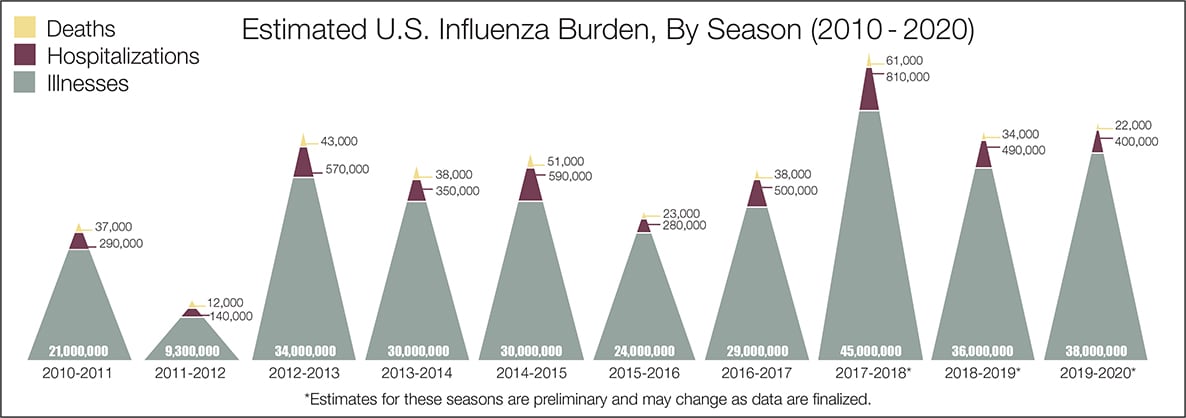
- The real question remains if the U.S. is over-reacting to this virus. The following graphic from the CDC puts the annual flu burden in perspective [click on image to enlarge]. Note that using this data is dangerous as the actual flu cases are estimated and not counted – nobody knows how accurate these guesses are.
What we do not know about the coronavirus [actually there is little scientifically proven information]. Most of our knowledge is anecdotal, from studies with limited subjects, or from studies without peer review.
- How many people have been infected as many do not show symptoms?
- Masks do work.
- Do we develop lasting immunity to the coronavirus? Another coronavirus – the simple cold – does not develop long term immunity.
- To what degree do people who never develop symptoms contribute to transmission?
- The US has scaled up coronavirus testing – and the accuracy of the tests has been improving. However, if one loses immunity – the coronavirus testing value is reduced.
- Can children widely spread coronavirus? [current thinking is that they are becoming a major source of the pandemic spread]
- Why have some places avoided big coronavirus outbreaks – and others hit hard?
- What effect will the weather have? At this point, it does not seem hot weather slows this coronavirus down – and it seems air conditioning contributes to its spread.
- Outdoor activities seem to be a lower risk than indoor activities.
- Can the world really push out an effective vaccine in 12 to 18 months?
- Will other medical treatments for Covid-19 ease symptoms and reduce deaths? So far only one drug (remdesivir) is approved for treatment.
- A current scientific understanding of the way the coronavirus works can be found [here].
Heavy breakouts of coronavirus have hit farm workers. Farmworkers are essential to the food supply. They cannot shelter at home. Consider:
- they have high rates of the respiratory disease [occupational hazard]
- they travel on crowded buses chartered by their employers
- few have health insurance
- they cannot social distance and live two to four to a room – and they eat together
- some reports say half are undocumented
- they are low paid and cannot afford not to work – so they will go to work sick
- they do not have access to sanitation when working
- a coronavirus outbreak among farmworkers can potentially shutter entire farm
The bottom line is that COVID-19 so far has been shown to be much more deadly than the data on the flu. Using CDC data, the flu has a mortality rate between 0.06 % and 0.11 % Vs. the coronavirus which to date has a mortality rate of 4 % [the 4% is the average of overall statistics – however in the last few months it has been hovering around 1.0%] – which makes it between 10 and 80 times more deadly. The reason for ranges:
Because influenza surveillance does not capture all cases of flu that occur in the U.S., CDC provides these estimated ranges to better reflect the larger burden of influenza.
There will be a commission set up after this pandemic ends to find fault [it is easy to find fault when a once-in-a-lifetime event occurs] and to produce recommendations for the next time a pandemic happens. Those that hate President Trump will conclude the virus is his fault.
Resources:
- Get the latest public health information from CDC: https://www.coronavirus.gov .
- Get the latest research from NIH: https://www.nih.gov/coronavirus.
- Find NCBI SARS-CoV-2 literature, sequence, and clinical content: https://www.ncbi.nlm.nih.gov/sars-cov-2/.
- List of studies: https://icite.od.nih.gov/covid19/search/#search:searchId=5ee124ed70bb967c49672dad
include(“/home/aleta/public_html/files/ad_openx.htm”); ?>


