


Written by Steven Hansen
The U.S. new cases 7-day rolling average is 6.0 % HIGHER than the 7-day rolling average one week ago. U.S. deaths due to coronavirus are now 7.6 % HIGHER than the rolling average one week ago. At the end of this post is a set of interactive graphs and tables for the world and individual States – as well as today’s headlines which include;
- New Coronavirus Case Increased In THe U.S. This Week
- Deaths Due To Coronavirus Increased This Week
- Coronavirus Infection Fatality Rate Worsened This Week
- Trump’s top health official alters the approval process for new rules
- Viruses that come to stay
- As virus pummels US, Europe sees its own spike
- After coming under fire for vaccine safety, AstraZeneca releases trial blueprints
Coronavirus recession ends for the rich but is far from over for lower-income communities

The recent worsening of the trendlines for new cases and deaths likely should be attributed to going back to school – especially at college/university level.
My continuing advice is to continue to wash your hands, wear masks, and maintain social distancing. No handwashing, mask, or social distancing will guarantee you do not get infected – but it sure as hell lowers the risk in all situations – and evidence to-date shows a lower severity of COVID-19. In addition, certain activities are believed to carry higher risk – like being inside in air conditioning and removing your mask (such as restaurants, around your children/grandchildren, bars, and gyms). It is all about viral load – and outdoor activities are generally very safe.
The daily number of new cases in the U.S. is remaining stubbornly and embarrassedly high.
The following graphs show the 7-day rolling average for new coronavirus cases and deaths have been updated through 20 September 2020:


z coronavirus.png
Coronavirus Statistics For 20 September 2020 |
| U.S. Only | Global | U.S Percentage of Total | ||||
| Today*** | Cumulative | Today*** | Cumulative | Today | Cumulative | |
| New Confirmed Cases | 39,836 | 6,760,000 | 289,831 | 30,840,000 | 13.7% | 21.9% |
| Deaths** | 669 | 199,258 | 5,064 | 957,790 | 13.2% | 20.8% |
| Mortality Rate | 1.7% | 2.9% | 1.7% | 3.1% | ||
total COVID-19 Tests per 1,000 people | 2.23* | 305.27* | ||||
* as of 15 Sep 2020
** evidently several States included “probable” deaths today in the number
*** red color indicates record number
A Look At Last Week
Global and U.S. new cases increased this week:

Coronavirus deaths declined globally but increased in the U.S.:

The coronavirus infection fatality rate declined globally but worsened in the U.S.:

Also today, we published two summary posts for news over the past week:
The Uneven Recovery Making The Rich Richer And The Poor Poorer
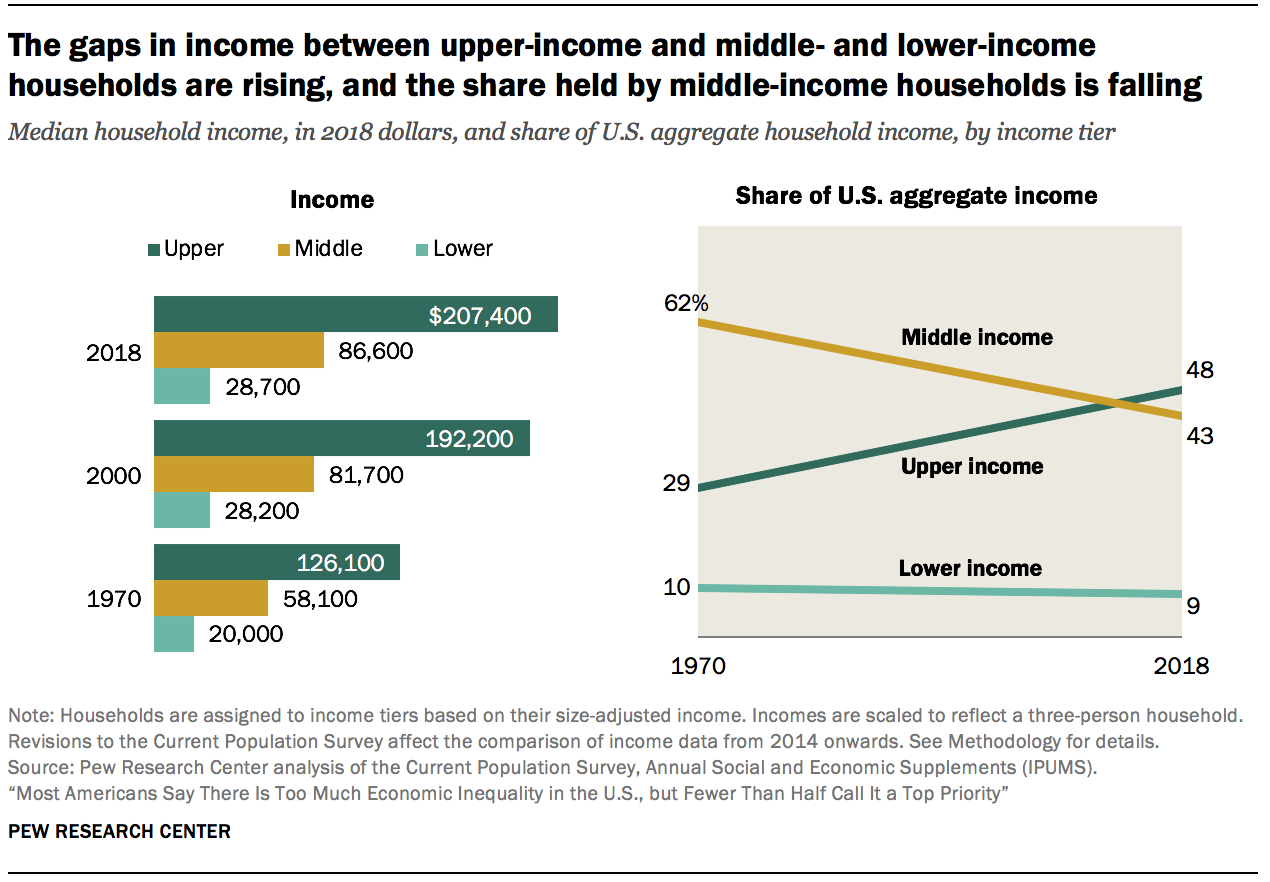
Today, CNBC published a post centered on my pet peeve with the U.S. economy – equal opportunity to grow income and wealth for all. The bottom line here is that the rich continue to get richer whilst most other groups of people get poorer. From Pew Research [this post deserves a full read]:
The growth in income in recent decades has tilted to upper-income households. At the same time, the U.S. middle class, which once comprised the clear majority of Americans, is shrinking. Thus, a greater share of the nation’s aggregate income is now going to upper-income households and the share going to middle- and lower-income households is falling.9
The share of American adults who live in middle-income households has decreased from 61% in 1971 to 51% in 2019. This downsizing has proceeded slowly but surely since 1971, with each decade thereafter typically ending with a smaller share of adults living in middle-income households than at the beginning of the decade.
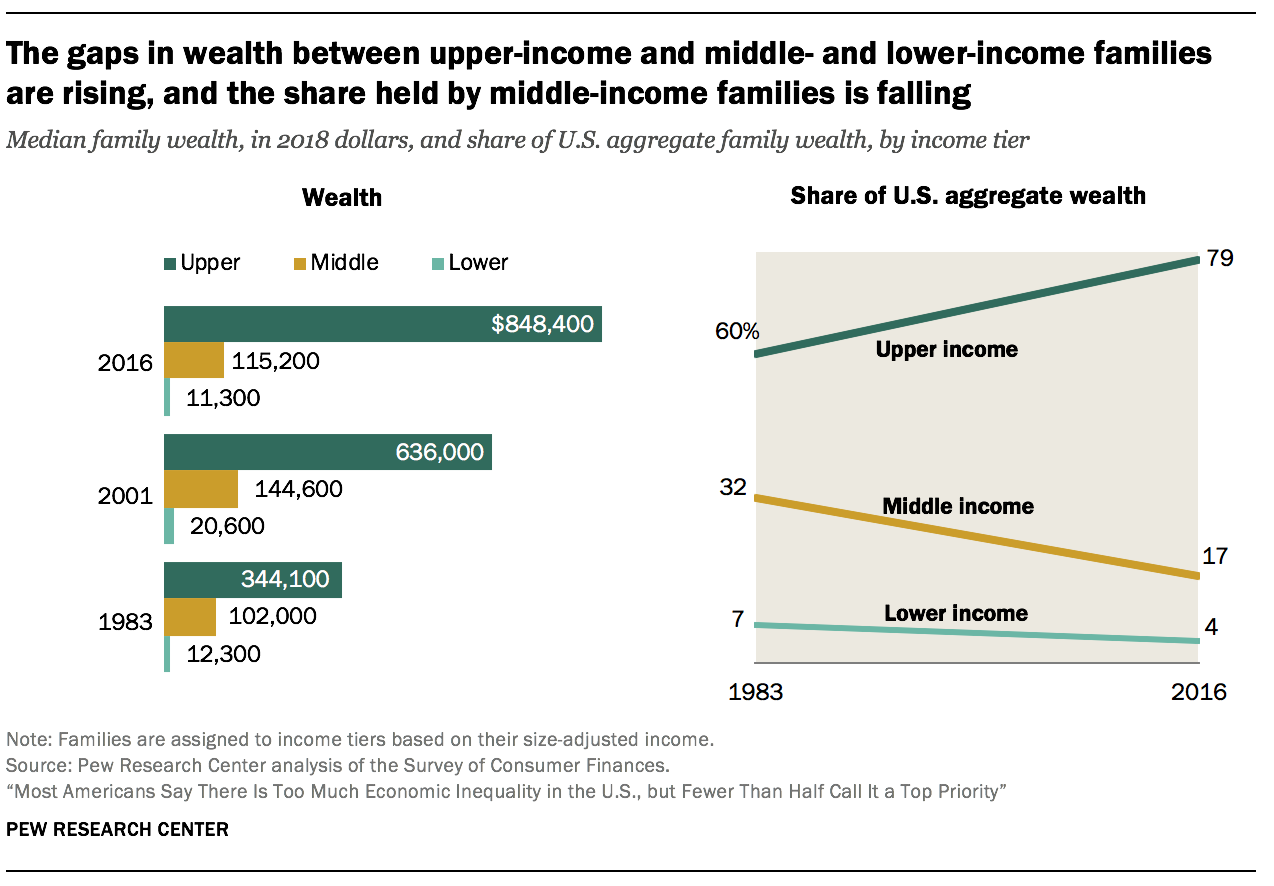
… The wealth gap among upper-income families and middle- and lower-income families is sharper than the income gap and is growing more rapidly.
The period from 1983 to 2001 was relatively prosperous for families in all income tiers, but one of rising inequality. The median wealth of middle-income families increased from $102,000 in 1983 to $144,600 in 2001, a gain of 42%. The net worth of lower-income families increased from $12,3oo in 1983 to $20,600 in 2001, up 67%. Even so, the gains for both lower- and middle-income families were outdistanced by upper-income families, whose median wealth increased by 85% over the same period, from $344,100 in 1983 to $636,000 in 2001. (Figures are expressed in 2018 dollars.)
The issues of income and wealth disparity have been a noose around the economy’s neck for many decades while the pandemic induced recession has exasperated the disparity.
The following graphics illustrate the pandemic induced worsening of the inequality.

“Sectors like leisure and hospitality that took the biggest beating during the downturn disproportionately hire women and people of color and tend to pay lower wages …”

“The unemployment rate, a traditional measure of financial hardship, among Asian and Black Americans peaked at nearly 15% and 17%, respectively, in April. Latino unemployment ballooned to almost 19% — meaning about 1 in 5 adults who wanted a job couldn’t find work.”

The poorer end of the economy is having housing issues.

People on the lower end of the economy are having problems getting enough to eat.

Wealth and income disparity are the drivers of homelessness, unrest, growth of government spending to create a safety net, and a movement to the left on social issues.
The pandemic has exposed the growing inequities.
Coronavirus News You May Have Missed
Trump’s top health official alters the approval process for new rules. – New York Times
In a stunning declaration of authority, Alex M. Azar II, the secretary of health and human services, this week barred the nation’s health agencies, including the Food and Drug Administration, from signing any new rules regarding the nation’s foods, medicines, medical devices and other products, including vaccines.
Going forward, Mr. Azar wrote in a memorandum dated Sept. 15, such power “is reserved to the Secretary.” The bulletin was sent to heads of operating and staff divisions within H.H.S.
It’s unclear if or how the memo would change the vetting and approval process for coronavirus vaccines, three of which are in advanced clinical trials in the United States.
Outside observers were alarmed by the new memo and worried that it could contribute to a public perception of political meddling in science-based regulatory decisions. Dr. Mark McClellan, who formerly headed the F.D.A. and now runs Duke University’s health policy center, praised the agency’s work on vaccine development but said the policy change was ill timed.
“We’re in the midst of a pandemic, when trust in the public health agency is needed more than ever,” he said. “So I’m not sure what is to be gained with a management change with respect to F.D.A. when they are doing such critical work.”
[editor’s note: obviously a slanted post but it is important to understand this change]
Viruses that come to stay – Knowable
Some linger in the body for a lifetime. The one causing Covid-19 probably isn’t one of them, but it and others can create mischief long after the immune system appears to have banished them.
Virologists call the ability of certain viruses to stick around for months or years, even after a person feels better, “persistence.” A subset of persistent viruses can go “latent,” when the viruses all but disappear, leaving only their genetic material around so they can reemerge later.
So far, at least, there’s not much evidence to indicate that this happens with SARS-CoV-2, says Jason Kindrachuk, a virologist at the University of Manitoba in Canada, “but we still want to look into it.” After all, even if SARS-CoV-2 persistence were a rare event, those cases could add up, given the huge numbers of people (more than 29 million as of September 15) who have contracted Covid-19 so far, notes Jonathan Karn, a virologist at Case Western Reserve University School of Medicine in Cleveland.
… Karn explains that persistent viruses of the non-latent kind often find safe spaces to hang out — sanctuary sites, as virologists term these spots. Viruses can lie low in many places, but certain body parts are favored because immune cells don’t surveil or protect them as closely as the rest of the body. These “immunoprivileged sites” include the eyes, brain and testes, and there’s a good biological reason for their underprotected nature: Immune cells can damage body tissues, and beating an infection often isn’t worth the risk of destroying nerves or a chance at parenthood.

As virus pummels US, Europe sees its own spike – The Hill
Major European countries are seeing new spikes in coronavirus cases, illustrating how easily the virus can snap back after periods of relative calm.
The U.S. is averaging about 40,000 new cases and 850 new deaths every day, among the worst numbers in the world. After declining for weeks, cases across the United States are now starting to tick back up.
But now some countries that were successful in suppressing the early wave of the virus are seeing resurgences, showing that easing up on restrictions too forcefully can lead to new spikes.
Israel, which was earlier seen as a success story, is now imposing a new three-week lockdown as it tries to halt a surge in cases.
France and Spain, which had flattened their initial outbreaks with strict lockdowns early this year, are experiencing new spikes after reopening, and both countries now have more new cases per day than the U.S., when adjusted for population, according to data compiled by Our World in Data.
After coming under fire for vaccine safety, AstraZeneca releases trial blueprints. – New York Times
AstraZeneca revealed details of its large coronavirus vaccine trial on Saturday, the third in a wave of rare disclosures by drug companies under pressure to be more transparent about how they are testing products that are the world’s best hope for ending the pandemic.
Polls are finding Americans increasingly wary of accepting a virus vaccine. And scientists inside and outside the government are worried that regulators, pressured by President Trump for results before Election Day on Nov. 3, might release an unproven or unsafe vaccine.
“The release of these protocols seems to reflect some public pressure to do so,” said Natalie Dean, a biostatistician and expert in clinical trial design for vaccines at the University of Florida. “This is an unprecedented situation, and public confidence is such a huge part of the success of this endeavor.”
Pfizer and Moderna revealed details of their vaccine trials on Thursday.
Experts have been particularly concerned about AstraZeneca’s trials because of the company’s refusal to provide details about serious neurological illnesses in two participants, both women, who received its experimental vaccine in Britain, where the company’s trials began in April.
Coronavirus recession ends for the rich but is far from over for lower-income communities – CNBC
- The recession caused by the coronavirus pandemic is largely over for some groups, like rich, White and college-educated Americans.
- They were less likely to become unemployed and their jobs rebounded quickly. They were more likely to save stimulus money. Financial assets like stocks and real estate have boomed.
- Some economists have called this a “K-shaped” recovery as other groups have a much different experience.
The following are foreign headlines with hyperlinks to the posts
Australia on track to report fewest new coronavirus cases in months
UK imposing fines of up to $13,000 for not self-quarantining
UK reports highest daily COVID-19 cases in four months
In South Korea, Covid-19 comes with another risk: online bullying.
Argentina’s outbreak moves beyond Buenos Aires and grows more severe.
The following are additional national and state headlines with hyperlinks to the posts
California COVID-19 hospitalizations fall to lowest rate since April
‘We Are Helping Homeless People Get Stimulus Checks’
300 Students Quarantining After COVID Found in Sewage at NJ College Dorm
A month after Sturgis, another motorcycle rally this weekend in Missouri is worrying health experts.
Today’s Posts On Econintersect Showing Impact Of The Pandemic With Hyperlinks
Companies Slow To Announce Seasonal Hiring Plans
Charting A Path For A Resilient Recovery In Sub Saharan Africa
Coronavirus Disease Weekly News 20September 2020
Coronavirus Economic Weekly News 20September 2020
Majority Of Americans Say Economy Is Recovering
Warning to Readers
The amount of politically biased articles on the internet continues to increase. And studies and opinions of the experts continue to contradict other studies and expert opinions. Honestly, it is difficult to believe anything anymore. A study usually cannot establish cause and effect – but only correlation. Be very careful what you believe about this pandemic.

I assemble this coronavirus update daily – sifting through the posts on the internet. I try to avoid politically slanted posts (mostly from CNN, New York Times, and the Washington Post) and can usually find unslanted posts on that subject from other sources on the internet. I wait to publish posts on subjects that I cannot validate across several sources. But after all this extra work, I do not know if I have conveyed the REAL facts. It is my job to provide information so that you have the facts necessary – and then it is up to readers to draw conclusions.
Coronavirus INTERACTIVE Charts
include($_SERVER[‘DOCUMENT_ROOT’].’/pages/coronavirus.htm’); ?>
Analyst Opinion of Coronavirus Data
There are several takeaways that need to be understood when viewing coronavirus statistical data:
- The global counts are suspect for a variety of reasons including political. Even the U.S. count has issues as it is possible that as much as half the population has had coronavirus and was asymptomatic. It would be a far better metric using a random sampling of the population weekly. In short, we do not understand the size of the error in the tracking numbers.
- Just because some of the methodology used in aggregating the data in the U.S. is flawed – as long as the flaw is uniformly applied – you establish a baseline. This is why it is dangerous to compare two countries as they likely use different methodologies to determine who has (and who died) from coronavirus.
- COVID-19 and the flu are different but can have similar symptoms. For sure, COVID-19 so far is much more deadly than the flu. [click here to compare symptoms]
- From an industrial engineering point of view, one can argue that it is best to flatten the curve only to the point that the health care system is barely able to cope. This solution only works if-and-only-if one can catch this coronavirus once and develops immunity. In the case of COVID-19, herd immunity may need to be in the 80% to 85% range. WHO warns that few have developed antibodies to COVID-19. At this point, herd immunity does not look like an option although there is now a discussion of whether T-Cells play a part in immunity [which means one might have immunity without antibodies]
- Older population countries will have a higher death rate.
- There are at least 8 strains of the coronavirus. New York may have a deadlier strain imported from Europe, compared to less deadly viruses elsewhere in the United States.
- Each publication uses different cutoff times for its coronavirus statistics. Our data uses 11:00 am London time. Also, there is an unexplained variation in the total numbers both globally and in the U.S.
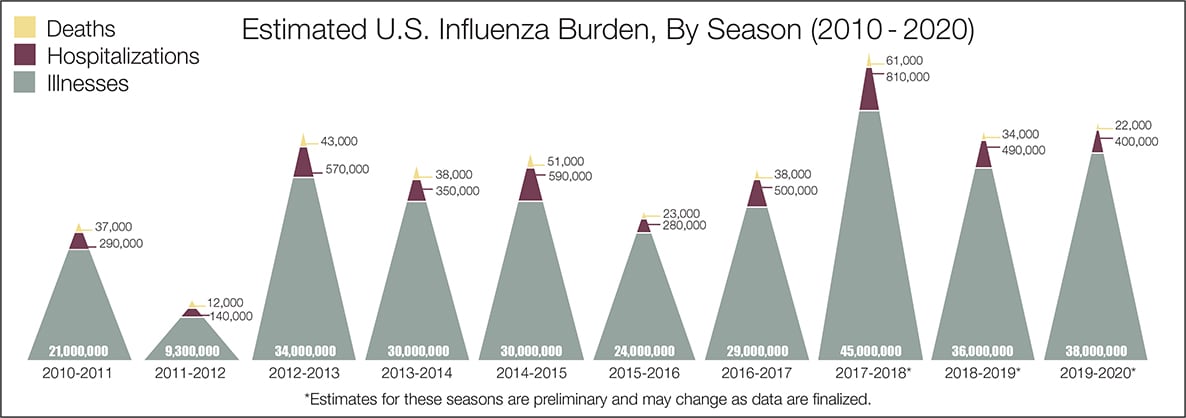
- The real question remains if the U.S. is over-reacting to this virus. The following graphic from the CDC puts the annual flu burden in perspective [click on image to enlarge]. Note that using this data is dangerous as the actual flu cases are estimated and not counted – nobody knows how accurate these guesses are.
What we do not know about the coronavirus [actually there is little scientifically proven information]. Most of our knowledge is anecdotal, from studies with limited subjects, or from studies without peer review.
- How many people have been infected as many do not show symptoms?
- Masks do work.
- Do we develop lasting immunity to the coronavirus? Another coronavirus – the simple cold – does not develop long term immunity.
- To what degree do people who never develop symptoms contribute to transmission?
- The US has scaled up coronavirus testing – and the accuracy of the tests has been improving. However, if one loses immunity – the coronavirus testing value is reduced.
- Can children widely spread coronavirus? [current thinking is that they are becoming a major source of the pandemic spread]
- Why have some places avoided big coronavirus outbreaks – and others hit hard?
- What effect will the weather have? At this point, it does not seem hot weather slows this coronavirus down – and it seems air conditioning contributes to its spread.
- Outdoor activities seem to be a lower risk than indoor activities.
- Can the world really push out an effective vaccine in 12 to 18 months?
- Will other medical treatments for Covid-19 ease symptoms and reduce deaths? So far only one drug (remdesivir) is approved for treatment.
- A current scientific understanding of the way the coronavirus works can be found [here].
Heavy breakouts of coronavirus have hit farm workers. Farmworkers are essential to the food supply. They cannot shelter at home. Consider:
- they have high rates of the respiratory disease [occupational hazard]
- they travel on crowded buses chartered by their employers
- few have health insurance
- they cannot social distance and live two to four to a room – and they eat together
- some reports say half are undocumented
- they are low paid and cannot afford not to work – so they will go to work sick
- they do not have access to sanitation when working
- a coronavirus outbreak among farmworkers can potentially shutter entire farm
The bottom line is that COVID-19 so far has been shown to be much more deadly than the data on the flu. Using CDC data, the flu has a mortality rate between 0.06 % and 0.11 % Vs. the coronavirus which to date has a mortality rate of 4 % [the 4% is the average of overall statistics – however in the last few months it has been hovering around 1.0%] – which makes it between 10 and 80 times more deadly. The reason for ranges:
Because influenza surveillance does not capture all cases of flu that occur in the U.S., CDC provides these estimated ranges to better reflect the larger burden of influenza.
There will be a commission set up after this pandemic ends to find fault [it is easy to find fault when a once-in-a-lifetime event occurs] and to produce recommendations for the next time a pandemic happens. Those that hate President Trump will conclude the virus is his fault.
Resources:
- Get the latest public health information from CDC: https://www.coronavirus.gov .
- Get the latest research from NIH: https://www.nih.gov/coronavirus.
- Find NCBI SARS-CoV-2 literature, sequence, and clinical content: https://www.ncbi.nlm.nih.gov/sars-cov-2/.
- List of studies: https://icite.od.nih.gov/covid19/search/#search:searchId=5ee124ed70bb967c49672dad
include(“/home/aleta/public_html/files/ad_openx.htm”); ?>


