


Written by Steven Hansen
The U.S. new cases 7-day rolling average is 10.5 % lower than the 7-day rolling average one week ago. U.S. deaths due to coronavirus are now 12.4 % lower than the rolling average one week ago. At the end of this post is a set of interactive graphs and tables for the world and individual States – as well as today’s headlines which include;
- How has the pandemic affected people’s honesty?
- Private autopsies are on the rise during the COVID-19 pandemic
- Kids Catch Coronavirus and Give It to Their Parents
- Getting Real on COVID-19 Vaccine Timeline
- What is ‘friluftsliv’? How an idea of outdoor living could help us this winter
- Prominent vaccine researchers say pausing a trial is unusual
- About 40%-45% of Infections Are Asymptomatic
- Face-mask recognition has arrived – for better or worse

My continuing advice is to continue to wash your hands, wear masks, and maintain social distancing. No handwashing, mask, or social distancing will guarantee you do not get infected – but it sure as hell lowers the risk in all situations – and evidence to-date shows a lower severity of COVID-19. In addition, certain activities are believed to carry higher risk – like being inside in air conditioning and removing your mask (such as restaurants, around your children/grandchildren, bars, and gyms). It is all about viral load – and outdoor activities are generally very safe.
The daily number of new cases in the U.S. is remaining stubbornly and embarrassedly high.
The following graphs show the 7-day rolling average for new coronavirus cases and deaths have been updated through 12 September 2020:


z coronavirus.png
Coronavirus Statistics For 12 September 2020 |
| U.S. Only | Global | U.S Percentage of Total | ||||
| Today*** | Cumulative | Today*** | Cumulative | Today | Cumulative | |
| New Confirmed Cases | 34,794 | 6,450,000 | 267,832 | 28,520,000 | 13.0% | 22.6% |
| Deaths** | 1,227 | 193,016 | 5,878 | 916,005 | 20.9% | 21.1% |
| Mortality Rate | 3.5% | 3.0% | 2.2% | 3.2% | ||
total COVID-19 Tests per 1,000 people | 1.39* | 286.20* | ||||
* as of 08 Sep 2020
** evidently several States included “probable” deaths today in the number
*** red color indicates record number
Coronavirus News You May Have Missed
Getting Real on COVID-19 Vaccine Timeline – Medpage
As drug companies and the U.S. government scramble to develop a COVID-19 vaccine, experts on vaccine production and distribution questioned whether a vaccine could be in public hands by the end of the year and dismissed the idea that it could be ready before the Nov. 3 general election, which President Trump has openly championed.
… Once the trials theoretically yield results demonstrating a vaccine’s efficacy and safety, experts said manufacturing doses should be the easiest part of the whole process. Investments in production capacity have substantially increased, Bar-Zeev said, and RNA vaccines especially are easier to replicate reliably. He estimates doses will be available for 20% of the global population by the end of next year and the U.S. will have a large amount of doses by then. Several manufacturers have promised to have hundreds of millions of doses ready in 2020 alone.
… Distribution figures to be an even bigger obstacle. The leading vaccine candidates would have to be shipped and stored at temperatures ranging from -20 to -70 °C. These conditions are not readily available at the scale needed, Bar-Zeev said. According to the IFPMA technical sheet, “This could be a challenge going forwards in terms of distribution.”
… Offit, citing a CDC Advisory Committee on Immunization Practices presentation, said the first wave of U.S. vaccine recipients could number 150 million — healthcare workers, other essential workers, people with pre-existing conditions, and the elderly. With two doses needed, that would require 300 million just for those high-risk individuals.
… Once manufacturing and distribution are complete, Americans would still not be safe from the disease, experts cautioned. The vaccines are unlikely to protect against shedding, Offit said; vaccinated people may still get mild or asymptomatic infections, and thus shed the virus and possibly spread it to others. “People who are vaccinated still need to wear masks and that’s going to be a hard message to send,” Offit said. “You may take a step backwards.”
Face-mask recognition has arrived—for better or worse – National Geographic
When Akash Takyar heard those early stories trickle out of China, he was shocked at how things were being handled, and he wondered if his software company—LeewayHertz—could offer a more peaceful way. Takyar recognized how important it is to wear a mask to slow the spread of SARS-CoV-2, the virus that causes COVID-19. But rather than leave members of the public to monitor each other, he wanted to develop a computer program that could look at images and detect whether people are wearing masks.
His San Francisco-based company is one of many now pioneering mask recognition as a way to get people to comply for the public good. So far, masks have been confounding traditional facial recognition software—but these new machine learning tools could conceivably be used in private or public spaces to measure compliance and ostensibly take that out of the hands of individuals.
To date, 34 states and the District of Columbia have mask mandates for public spaces, both outdoors and indoors. But compliance can vary depending on a range of factors, from personal politics to an individual’s financial ability to purchase masks. For the most part, people who flout the mandates even if they can afford to follow them get away with that noncompliance. Only a few reports—from Nevada, Louisiana, and Indiana—show that law enforcement has stepped in to arrest people who were indoors in private businesses without a mask.
For businesses that have workers returning to indoor facilities, noncompliance could lead to others in the workplace getting infected. Ultimately, it could be a great loss for a business if there was an outbreak because someone was asymptomatic and failed to wear a mask, says Takyar.
But “face data is as precious as a fingerprint,” says Deborah Raji, a fellow at the AI Now Institute at New York University. And those who have had qualms about facial recognition wonder whether mask recognition software, as well intentioned as it may be, should have a place in today’s society.
Fauci: ‘About 40%-45% of Infections Are Asymptomatic’ – Medscape
Anthony Fauci, MD, highlighting the latest COVID-19 developments on Friday, said, “It is now clear that about 40%-45% of infections are asymptomatic.”
Asymptomatic carriers can account for a large proportion — up to 50% — of virus transmissions, Fauci, director of the National Institute of Allergy and Infectious Diseases, told a virtual crowd of critical care clinicians gathered by the Society of Critical Care Medicine (SCCM).
Such transmissions have made response strategies, such as contact tracing, extremely difficult, he said.
Lew Kaplan, MD, president of SCCM, told Medscape Medical News after the presentation, “That really supports the universal wearing of masks and the capstone message from that — you should protect one another.
“That kind of social responsibility that sits within the public health domain to me is as important as the vaccine candidates and the science behind the receptors. It underpins the necessary relationship and the interdependence of the medical community with the public,” Kaplan added.
Prominent vaccine researchers say pausing a trial is unusual – CNN
Vaccine clinical trials are notoriously difficult to conduct. They involve thousands, or even tens of thousands, of participants, and typically go on for years. The chances that one or more of these study volunteers will develop a health issue is quite high.
Most of the time, that health problem is not related to the vaccine being investigated, and the trial can continue. But sometimes there is a chance that the issue — called an “adverse event” in medical parlance — could be related to the vaccine.
On Wednesday, it came to light that pharmaceutical giant AstraZeneca had paused its coronavirus vaccine trial not once but twice because of adverse events. The second pause is still in effect while researchers look into one volunteer’s “unexplained illness.”
While Dr. Robert Redfield, director of the US Centers for Disease Control and Prevention, on Wednesday implied that pausing a Phase 3 trial was a somewhat common occurrence, vaccine trial experts interviewed by CNN say it is not common.
“It’s unusual to pause a Phase 3 trial on a safety basis,” said Dr. Carl Fichtenbaum, an infectious disease expert at the University of Cincinnati College of Medicine. “It’s uncommon.”
COVID-19 Storms: Bradykinin In, Cytokine Out? – MedPage
In the last week, questions have been raised about whether cytokine storm is indeed a culprit in severe COVID-19, while a paper from a government lab has made an intriguing and much-discussed case for a new mechanism, bradykinin storm.
While the concepts are not necessarily mutually exclusive, scientists trying to understand how COVID-19 wreaks its damage on the human body have been buzzing about the new possibilities.
The bradykinin theory was outlined in a July research paper published in eLife, but it was recently featured in a widely read article published on Medium‘s science website, Elemental.
The theory connects many of the disparate symptoms of COVID-19, from a loss of sense of smell and taste, to a gel-like substance forming in the lungs, and abnormal coagulation. It posits that SARS-CoV-2 disrupts both the renin-angiotensin system (RAS) and the kinin-kallikrein pathways, sending bradykinin — a peptide that dilates blood vessels and makes them leaky — out of whack. The process impedes the transfer of oxygen from the lung to the blood and subsequently to all other tissues, a common abnormality in COVID-19 patients.
… They found the COVID-19 cases had extremely high levels (increased nearly 200-fold) of angiotensin-converting enzyme 2 (ACE2), the surface protein used by the coronavirus to enter the cell.
When the virus interacts with ACE2, it triggers an abnormal response in the bradykinin pathway, Jacobson said. At the same time, levels of angiotensin-converting enzyme, which is involved in the breakdown of bradykinin, were lower in COVID-19 patients than in controls.
“This is the perfect storm, where all the things that could go wrong will lead the system to really go out of control,” Jacobson told MedPage Today. “When that happens, you’re going to get hyper-permeable blood vessel fluid pouring out of these infected areas and into the lungs.”
… In effect, the bradykinin dysregulation will cause blood vessels to leak, and the hyaluronic acid dysregulation will pour massive quantities of a gel-like substance into the alveoli. This aligns with autopsy reports that detail the lungs of patients with COVID-19 feeling “like a water balloon that is filled with Jell-O,” Jacobson said.
“That explains why ventilation has been so difficult,” he noted. “At some point when you have enough of this hyaluronic acid in your lungs, with all the water you’ve captured, it kind of doesn’t matter how much oxygen you’re pumping into the lungs — it can’t get through to do gas exchange in the capillaries and alveoli.”
Yes, you can have Covid-19 and the flu at the same time. Here’s what that could do to your body – CNN
As doctors worry about a coronavirus-and-flu “twin-demic” that could overwhelm the health care system, Americans must contend with another possibility: fighting both viruses at the same time.
“You can certainly get both the flu and Covid-19 at the same time, which could be catastrophic to your immune system,” said Dr. Adrian Burrowes, a family medicine physician in Florida.
In fact, getting infected with one can make you more vulnerable to getting sick with the other, epidemiologist Dr. Seema Yasmin said.
“Once you get infected with the flu and some other respiratory viruses, it weakens your body,” said Yasmin, director of the Stanford Health Communication Initiative.
What is ‘friluftsliv’? How an idea of outdoor living could help us this winter – National Geographic
From the remote Arctic to urban Oslo, friluftsliv means a commitment to celebrating time outdoors, no matter the weather forecast. “It’s the most natural thing for me because I’m Norwegian,” says Alexander, who documents their father-daughter journeys on Instagram.
The idea is as Norwegian as cross-country skis and aquavit. But amid a pandemic that’s upended rhythms of daily life around the globe, friluftsliv might also be a model for coming more safely—and sanely—through the northern hemisphere’s approaching winter season.
While early lockdown measures have succeeded in keeping Norway’s coronavirus case numbers relatively low (less than 12,000 to date), there have been some recent spikes. That has Norwegians looking to the country’s outdoorsy traditions for respite from the enclosed spaces where the virus transmits more easily.
… But winter is coming, and those pandemic-friendly arrangements will soon bring a chill. This has left some contemplating a choice between risking infection at indoor gatherings or spending a long, cold season in relative isolation.
Norwegian friluftsliv offers an alternative, full of cold-hardy inspiration for a frigid time of year. Like the cabin-cozy word hygge, which spurred a worldwide run on candles and fuzzy blankets, it’s proof that mindset can transform the way we experience our world.
How has the pandemic affected people’s honesty? – New York Times
A recent Brock University study of 451 adults ages 20 to 82 in the United States found that people who believed they had contracted the coronavirus weren’t always honest about it. Thirty-four percent of participants who had tested positive said they had denied having symptoms when asked by others, and 55 percent reported some level of concealment of their symptoms.
Twenty-five percent of participants reported that they had in some way concealed their physical distancing practices. That rate increased among those with Covid-19, according to the study, published last month in The Journal of Health Psychology.
Women were more likely to disclose health symptoms than men were, researchers said, and older adults were more honest about their virus status and behaviors.
But the exact reasoning behind lying during the pandemic is complicated and may be related to the environment, according to David M. Castro, a psychotherapist and adjunct professor of psychology at Adelphi University and the City College of New York.
Kids Catch Coronavirus and Give It to Their Parents – MedPage
Children in childcare facilities not only contracted COVID-19, but they spread the virus to other close contacts, including their parents, siblings, and potentially their teachers, CDC researchers found.
In three outbreaks in Utah, 54% of cases linked to childcare facilities occurred in children, and transmission likely occurred from children with confirmed COVID-19 to 25% of their “non-facility contacts,” such as parents and siblings, with one parent hospitalized, reported Cuc Tran, PhD, of the CDC, and colleagues.
Moreover, transmission to adults was confirmed in two of three children with asymptomatic infection, the authors wrote in an early edition of the Morbidity and Mortality Weekly Report.
Ten adults who worked at the childcare facility also contracted the infection, with contact tracing showing they were facility-associated cases, Tran and colleagues noted.
Of the 12 children who acquired the virus in childcare facilities, transmission was documented to at least 12 of 46 non-facility contacts, according to this report.
The role of children in spreading COVID-19 continues to be a hot-button topic as schools reopen around the country, though the authors noted the data about transmission from young children are “limited.”
The tourists are leaving Italy. Now catastrophe looms – CNN
For all too brief a time, the Italian summer offered a glimmer of hope. After emerging from what was in early 2020, one of the world’s harshest coronavirus lockdowns, Italy managed to dust itself down in time to welcome visitors.
But as the sun begins to cool, so do hopes of a full recovery for Italy’s decimated 2020 tourism season. Winter is coming, and with it what is expected to be a full-blown economic catastrophe.
The Italian government, like many across the world, has been doling out cash to help support many ailing businesses and individuals, but with many global travel restrictions still in place, lost revenues from the country’s faltering travel industry leaves a gaping financial hole that must now be filled.
“Tourists are what we need to keep going,” says Cassandra Santoro CEO and founder of travel planning service, Travel Italian Style. “Our guides, drivers and workers from Piedmont to Sicily who thought they would be out of work for a season, are now exploring other jobs and income sources.”
Anyone visiting Italy in August could’ve been forgiven for thinking almost everything was back to normal, bar the facemasks and social distancing. Culturally set in stone as a holiday month for Italians, it saw many locals enjoying a hard-earned break as best they could.
But even with 60% of Italians managing a break — almost all of them in Italy — and the influx of some northern European visitors, the forecast is abysmal.
Private autopsies are on the rise during the COVID-19 pandemic – National Geographic
Even before the pandemic, the autopsy rate in the U.S. had been in decline. Now, infection control guidelines, increased caseloads, and fewer pathologists who are comfortable performing the task have created an autopsy shortage. Vidal Herrera, owner of the company 1-800-AUTOPSY in East Los Angeles, says that public officials such as coroners and medical examiners can be so overwhelmed by the COVID-19 death toll that they’re sometimes giving non-COVID fatalities what is called a “predictable cause of death” rather than requesting an autopsy.
“There’s a perception about autopsies that it’s not useful, that it’s not going to help, and that we already know how to determine the cause of death without an autopsy,” says Mary Fowkes, director of neuropathology and autopsy service at Mt. Sinai School of Medicine in New York City. “That’s absolutely not true.”
As a result of the shortage, private autopsy companies around the country have seen a surge of business from families like the Calloways, who are searching for answers about their loved ones. Herrera says that he is busier now than at any other time in his company’s 32-year history. He adds that his decades of hands-on experience have confirmed the power of autopsy in understanding how the human body works, and how it ultimately fails.
Demand for disposable gloves — the kind often associated with sterile hospital rooms — has surged during the coronavirus pandemic as health care workers rush to secure the supplies they need to treat the disease and protect themselves.
The Malaysia-based Top Glove and its local rivals have benefited enormously from that need: Some 60% of the world’s glove supply comes from Malaysia, according to the Malaysian Rubber Glove Manufacturers Association (MARGMA).
More than a third are exported to the United States, which for months has led the world in coronavirus cases and deaths. But with extra demand comes renewed scrutiny of how these Malaysian companies treat their workers, particularly foreign staff recruited from neighboring countries.
Labor rights activists who spoke to CNN Business said that practices reported by former workers contain elements of forced labor. Some authorities have taken note of such concerns, putting pressure on Top Glove and other manufacturers to ensure their workers are treated well.
The following are foreign headlines with hyperlinks to the posts
Canada reports zero Covid-19 deaths in a 24-hour period.
How China brought nearly 200 million students back to school.
The following are additional national and state headlines with hyperlinks to the posts
‘People Will Die, But Not Me’: What We Heard This Week
Ohio Students Host Large House Party, Tell Police They ‘All’ Have COVID-19
Andrew Cuomo Faces More COVID Legal Challenges Than Any Other U.S. Gov.
Fauci says the virus might disrupt U.S. life until toward ‘the end of 2021.’
Kroger CEO sees prices stabilizing, cooking demand lasting: Our customers ‘actually enjoy it’
Today’s Posts On Econintersect Showing Impact Of The Pandemic With Hyperlinks
How Strong Infrastructure Governance Can End Waste In Public Investment
COVID-19 Over Time And Across States: Predictions From A Statistical Model
Pandemic Straining Organizations Serving Low- To Moderate-Income Communities
Daily Case Toll Plateaus But Pandemic Far From Over
Coronavirus INTERACTIVE Charts
include($_SERVER[‘DOCUMENT_ROOT’].’/pages/coronavirus.htm’); ?>
Analyst Opinion of Coronavirus Data
There are several takeaways that need to be understood when viewing coronavirus statistical data:
- The global counts are suspect for a variety of reasons including political. Even the U.S. count has issues as it is possible that as much as half the population has had coronavirus and was asymptomatic. It would be a far better metric using a random sampling of the population weekly. In short, we do not understand the size of the error in the tracking numbers.
- Just because some of the methodology used in aggregating the data in the U.S. is flawed – as long as the flaw is uniformly applied – you establish a baseline. This is why it is dangerous to compare two countries as they likely use different methodologies to determine who has (and who died) from coronavirus.
- COVID-19 and the flu are different but can have similar symptoms. For sure, COVID-19 so far is much more deadly than the flu. [click here to compare symptoms]
- From an industrial engineering point of view, one can argue that it is best to flatten the curve only to the point that the health care system is barely able to cope. This solution only works if-and-only-if one can catch this coronavirus once and develops immunity. In the case of COVID-19, herd immunity may need to be in the 80% to 85% range. WHO warns that few have developed antibodies to COVID-19. At this point, herd immunity does not look like an option although there is now a discussion of whether T-Cells play a part in immunity [which means one might have immunity without antibodies]
- Older population countries will have a higher death rate.
- There are at least 8 strains of the coronavirus. New York may have a deadlier strain imported from Europe, compared to less deadly viruses elsewhere in the United States.
- Each publication uses different cutoff times for its coronavirus statistics. Our data uses 11:00 am London time. Also, there is an unexplained variation in the total numbers both globally and in the U.S.
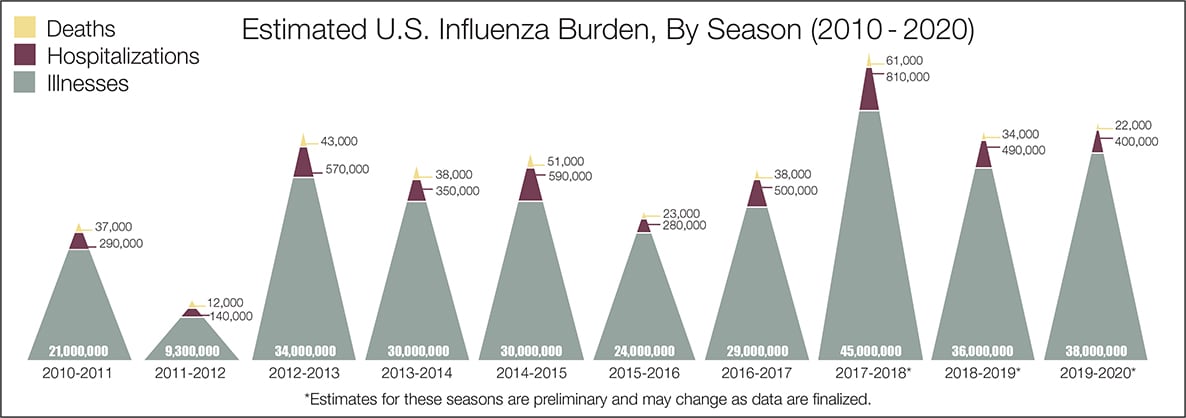
- The real question remains if the U.S. is over-reacting to this virus. The following graphic from the CDC puts the annual flu burden in perspective [click on image to enlarge]. Note that using this data is dangerous as the actual flu cases are estimated and not counted – nobody knows how accurate these guesses are.
What we do not know about the coronavirus [actually there is little scientifically proven information]. Most of our knowledge is anecdotal, from studies with limited subjects, or from studies without peer review.
- How many people have been infected as many do not show symptoms?
- Masks do work.
- Do we develop lasting immunity to the coronavirus? Another coronavirus – the simple cold – does not develop long term immunity.
- To what degree do people who never develop symptoms contribute to transmission?
- The US has scaled up coronavirus testing – and the accuracy of the tests has been improving. However, if one loses immunity – the coronavirus testing value is reduced.
- Can children widely spread coronavirus? [current thinking is that they are becoming a major source of the pandemic spread]
- Why have some places avoided big coronavirus outbreaks – and others hit hard?
- What effect will the weather have? At this point, it does not seem hot weather slows this coronavirus down – and it seems air conditioning contributes to its spread.
- Outdoor activities seem to be a lower risk than indoor activities.
- Can the world really push out an effective vaccine in 12 to 18 months?
- Will other medical treatments for Covid-19 ease symptoms and reduce deaths? So far only one drug (remdesivir) is approved for treatment.
- A current scientific understanding of the way the coronavirus works can be found [here].
Heavy breakouts of coronavirus have hit farm workers. Farmworkers are essential to the food supply. They cannot shelter at home. Consider:
- they have high rates of the respiratory disease [occupational hazard]
- they travel on crowded buses chartered by their employers
- few have health insurance
- they cannot social distance and live two to four to a room – and they eat together
- some reports say half are undocumented
- they are low paid and cannot afford not to work – so they will go to work sick
- they do not have access to sanitation when working
- a coronavirus outbreak among farmworkers can potentially shutter entire farm
The bottom line is that COVID-19 so far has been shown to be much more deadly than the data on the flu. Using CDC data, the flu has a mortality rate between 0.06 % and 0.11 % Vs. the coronavirus which to date has a mortality rate of 4 % [the 4% is the average of overall statistics – however in the last few months it has been hovering around 1.0%] – which makes it between 10 and 80 times more deadly. The reason for ranges:
Because influenza surveillance does not capture all cases of flu that occur in the U.S., CDC provides these estimated ranges to better reflect the larger burden of influenza.
There will be a commission set up after this pandemic ends to find fault [it is easy to find fault when a once-in-a-lifetime event occurs] and to produce recommendations for the next time a pandemic happens. Those that hate President Trump will conclude the virus is his fault.
Resources:
- Get the latest public health information from CDC: https://www.coronavirus.gov .
- Get the latest research from NIH: https://www.nih.gov/coronavirus.
- Find NCBI SARS-CoV-2 literature, sequence, and clinical content: https://www.ncbi.nlm.nih.gov/sars-cov-2/.
- List of studies: https://icite.od.nih.gov/covid19/search/#search:searchId=5ee124ed70bb967c49672dad
email article

In the last week, questions have been raised about whether cytokine storm is indeed a culprit in severe COVID-19, while a paper from a government lab has made an intriguing and much-discussed case for a new mechanism, bradykinin storm.
While the concepts are not necessarily mutually exclusive, scientists trying to understand how COVID-19 wreaks its damage on the human body have been buzzing about the new possibilities.
The bradykinin theory was outlined in a July research paper published in eLife, but it was recently featured in a widely read article published on Medium‘s science website, Elemental.
The theory connects many of the disparate symptoms of COVID-19, from a loss of sense of smell and taste, to a gel-like substance forming in the lungs, and abnormal coagulation. It posits that SARS-CoV-2 disrupts both the renin-angiotensin system (RAS) and the kinin-kallikrein pathways, sending bradykinin — a peptide that dilates blood vessels and makes them leaky — out of whack. The process impedes the transfer of oxygen from the lung to the blood and subsequently to all other tissues, a common abnormality in COVID-19 patients.
Piecing together the hypothesis was a “eureka moment,” said the study’s lead author, Daniel Jacobson, PhD, of Oak Ridge National Laboratory in Tennessee.
Jacobson and co-authors used a supercomputer to compare gene expression in lung cells from nine infected and 40 uninfected individuals.
They found the COVID-19 cases had extremely high levels (increased nearly 200-fold) of angiotensin-converting enzyme 2 (ACE2), the surface protein used by the coronavirus to enter the cell.
When the virus interacts with ACE2, it triggers an abnormal response in the bradykinin pathway, Jacobson said. At the same time, levels of angiotensin-converting enzyme, which is involved in the breakdown of bradykinin, were lower in COVID-19 patients than in controls.
“This is the perfect storm, where all the things that could go wrong will lead the system to really go out of control,” Jacobson told MedPage Today. “When that happens, you’re going to get hyper-permeable blood vessel fluid pouring out of these infected areas and into the lungs.”
include(“/home/aleta/public_html/files/ad_openx.htm”); ?>


