


Written by Steven Hansen
The U.S. new cases 7-day rolling average is 10.7 % lower than the 7-day rolling average one week ago. U.S. deaths due to coronavirus are now 6.7 % lower than the rolling average one week ago. At the end of this post is a set of interactive graphs and tables for the world and individual States – as well as today’s headlines which include;
- Total global cases of coronavirus now exceed 25 million
- Table of Death Rate per million for each state and country
- Comparing The Statistics Of Last Week To Previous Weeks
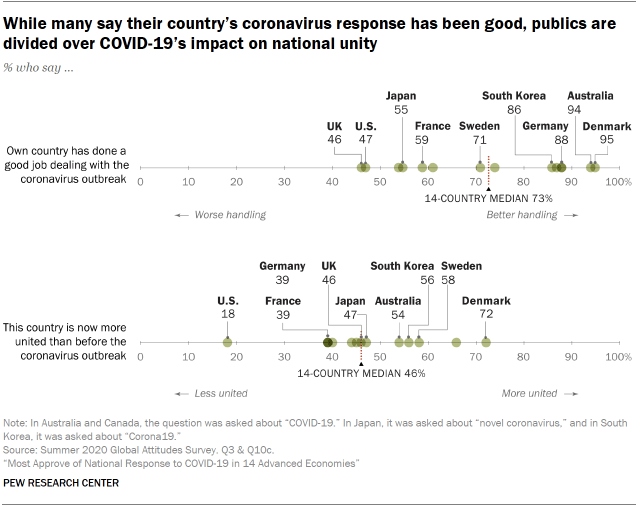
- There Was Little National Unity To The Coronavirus in the U.S.
- Patchwork approach to contact tracing hampers national recovery
- The look of ‘Covid toes’ varies on different skin colors. But the sample images were mostly white.
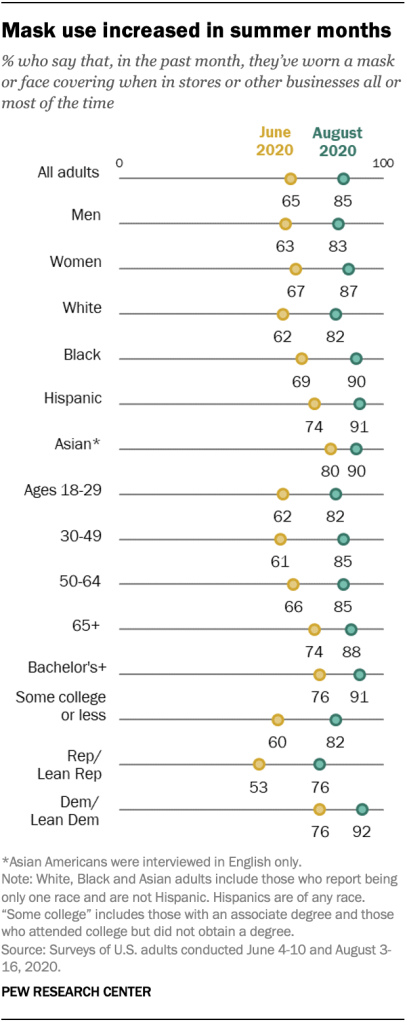
- More Americans say they are regularly wearing masks in stores and other businesses
- Remote American outpost, cut off by COVID-19, gets a ferry service
- Elites are flouting coronavirus restrictions — and that could hurt us all

People living in the United States are Americans and are not Germans, Brits, Chinese or Africans
I have lived and worked overseas the majority of my life mainly in the Middle East, Asia, and Europe – but have lived on every continent. My perspectives are very different from most other people. I have worked alongside, supervised, and managed literally hundreds of thousands of people from around the world. There are some things that everyone in the world wants – but it is hard to find people who want to change their customs and the way they live.
Americans (in this post, Americans are people living in the USA) have different work behavior, different expectations of what is wanted from government, and different social behavior.
In spite of globalists wanting to homogenize the world, these differences are real. My favorite example:
I had design teams from many countries competing to design structures in a new city of a half-million people. Americans firms changed the design of duplicate structures whilst every other nationalty held the same design for duplicate structures. Americans want to innovate even if innovation is not necessary (or even cost effective). At that time, the majority of the supervisory level on this project was American. My team recommended a designer who was American. The client went ballistic – and stated this was the straw which broke the camels back. They did not understand WHY we thought each design needed to be different – and pointed out how we Americans did not force standardization and homogenization.
We tried to change American’s approach – but there was too much resistance and the entire supervisory level was changed out with other nationalities which were part of our company’s international staff. Everything became proceduralized to suppress innovation at the supervisory level and below. Innovation could only be directed by management. The project was very successful after the changeout.
In the American system:
- innovation is important
- maximizing individuality – forcing conformity only where necessary
In many instances, the innovative approach yields better overall results – but with the pandemic, individual innovation caused a chaotic response and was compounded by the resistance by American’s to follow new directions.
Wearing masks is almost universal in Asia for decades due mostly to viruses and dirty air – but in the U.S. masks carry a negative connotation. Americans do NOT like being told what to do. Americans believe each person unique – and, at least at the beginning, resist any effort to force conformity – even if it is their own interests.
The coronavirus pandemic ran headlong into American individuality. No matter what the federal, state, and local governments want to enforce – it runs into resistance. [Making matters worse, many aspects of the response to the pandemic became politicized which fostered resistance to many of the pandemic directions by government.]
This resistance to conformity cost lives during this pandemic.
It did not matter whether the state was run by a Republican or Democrat – Americans generally did not do as well as the rest of the world. [table source CDC and author calculations]. Analyze the table below and understand that Texas and Florida which received considerable mass media attention for their “poor” coronavirus response – did better than the U.S. average death rate of 549 per million. And the Northeast States which are now looking down at the rest of the States did the worst.
State/Territory | Death Rate per Million |
| New York City | 2810 |
| New Jersey | 1780 |
| Massachusetts | 1300 |
| Connecticut | 1240 |
| Louisiana | 1050 |
| Rhode Island | 980 |
| District of Columbia | 860 |
| Mississippi | 800 |
| New York | 800 |
| Arizona | 690 |
| Michigan | 670 |
| Illinois | 640 |
| Delaware | 620 |
| Maryland | 610 |
| Pennsylvania | 590 |
| Georgia | 520 |
| South Carolina | 520 |
| Florida | 510 |
| Indiana | 480 |
| Alabama | 430 |
| Nevada | 430 |
| Texas | 420 |
| New Mexico | 360 |
| Ohio | 350 |
| Colorado | 340 |
| Iowa | 340 |
| Minnesota | 330 |
| California | 320 |
| New Hampshire | 310 |
| Virginia | 300 |
| Arkansas | 250 |
| North Carolina | 250 |
| Tennessee | 250 |
| Washington | 250 |
| Missouri | 230 |
| Idaho | 200 |
| Kentucky | 200 |
| Nebraska | 200 |
| Oklahoma | 190 |
| Wisconsin | 190 |
| North Dakota | 180 |
| South Dakota | 180 |
| Kansas | 150 |
| Puerto Rico | 130 |
| Virgin Islands | 130 |
| Utah | 120 |
| West Virginia | 110 |
| Oregon | 100 |
| Maine | 90 |
| Montana | 90 |
| Vermont | 90 |
| Guam | 60 |
| Wyoming | 60 |
| Alaska | 50 |
| Hawaii | 40 |
| Northern Mariana Islands | 30 |
| American Samoa | 0 |
| Federated States of Micronesia | 0 |
| Palau | 0 |
| Republic of Marshall Islands | 0 |
And here is global coronavirus death statistics [table source is Europe CDC]:
State/Territory | Death Rate per Million |
| Peru | 863.49 |
| Belgium | 853 |
| Spain | 620.49 |
| United Kingdom | 611.11 |
| Italy | 586.68 |
| Chile | 582.33 |
| Sweden | 576.38 |
| Brazil | 562.21 |
| United States | 549.16 |
| Mexico | 489.76 |
| France | 468.74 |
| Panama | 455.64 |
| Bolivia | 415.15 |
| Colombia | 368.83 |
| Ecuador | 368.64 |
| Netherlands | 362.48 |
| Ireland | 359.88 |
| Armenia | 293.26 |
| Macedonia | 280.31 |
| Iran | 252.99 |
| Kosovo | 252.49 |
| Moldova | 243.19 |
| Canada | 241.32 |
| South Africa | 231.72 |
| Switzerland | 199.2 |
| Portugal | 187.81 |
| Honduras | 184.46 |
| Romania | 182.3 |
| Bosnia and Herzegovina | 180.14 |
| Argentina | 179.86 |
| Iraq | 169.41 |
| Kyrgyzstan | 162.01 |
| Dominican Republic | 151.92 |
| Guatemala | 151.21 |
| Puerto Rico | 148.21 |
| Oman | 127.29 |
| Kuwait | 122.93 |
| Russia | 115.9 |
| Bahrain | 111.07 |
| Germany | 110.87 |
| Saudi Arabia | 109.53 |
| El Salvador | 108.23 |
| Denmark | 107.73 |
| Serbia | 104.19 |
| Israel | 103.29 |
| Kazakhstan | 94.85 |
| Albania | 94.17 |
| Bulgaria | 86.78 |
| Austria | 81.39 |
| Costa Rica | 79.9 |
| Swaziland | 78.44 |
| Turkey | 74.05 |
| Belarus | 70.59 |
| Qatar | 68.03 |
| Hungary | 63.56 |
| Slovenia | 61.57 |
| Finland | 60.46 |
| Equatorial Guinea | 59.16 |
| Ukraine | 55.75 |
| Poland | 53.32 |
| Egypt | 52.4 |
| Azerbaijan | 51.98 |
| Norway | 48.7 |
| Estonia | 48.25 |
| India | 45.33 |
| Croatia | 43.85 |
| Gambia | 39.72 |
| Paraguay | 39.26 |
| Czech Republic | 39.13 |
| United Arab Emirates | 38.32 |
| Afghanistan | 36.01 |
| Mauritania | 33.98 |
| Algeria | 33.82 |
| Libya | 32.89 |
| Lithuania | 31.59 |
| Palestine | 31.36 |
| Philippines | 30.34 |
| Morocco | 28.5 |
| Pakistan | 28.45 |
| Indonesia | 26.21 |
| Namibia | 25.58 |
| Bangladesh | 25.34 |
| Greece | 24.85 |
| Cyprus | 23.98 |
| Gabon | 23.81 |
| Australia | 22.86 |
| Lebanon | 21.68 |
| Nicaragua | 20.68 |
| Yemen | 18.88 |
| Sudan | 18.77 |
| Latvia | 18.03 |
| Haiti | 17.63 |
| Guinea-Bissau | 16.77 |
| Senegal | 16.66 |
| Liberia | 16.21 |
| Cameroon | 15.48 |
| Zambia | 15.39 |
| Lesotho | 14.47 |
| Congo | 14.14 |
| Trinidad and Tobago | 13.58 |
| Zimbabwe | 13.12 |
| Central African Republic | 12.63 |
| Venezuela | 12.59 |
| Uruguay | 12.38 |
| Kenya | 10.54 |
| Japan | 9.92 |
| Uzbekistan | 9.11 |
| Malawi | 9.1 |
| Sierra Leone | 8.78 |
| Ghana | 8.69 |
| Cuba | 8.12 |
| Mauritius | 7.86 |
| Tajikistan | 7.13 |
| Madagascar | 6.75 |
| Nepal | 6.69 |
| Ethiopia | 6.59 |
| Jamaica | 6.42 |
| South Korea | 6.26 |
| Tunisia | 6.26 |
| Mali | 6.22 |
| Slovakia | 6.04 |
| Somalia | 5.98 |
| Syria | 5.89 |
| Nigeria | 4.9 |
| Georgia | 4.76 |
| Chad | 4.69 |
| Singapore | 4.62 |
| New Zealand | 4.56 |
| Guinea | 4.49 |
| Cote d’Ivoire | 4.36 |
| South Sudan | 4.2 |
| Malaysia | 3.86 |
| Benin | 3.3 |
| China | 3.28 |
| Togo | 3.26 |
| Angola | 3.23 |
| Niger | 2.85 |
| Democratic Republic of Congo | 2.84 |
| Burkina Faso | 2.63 |
| Botswana | 2.55 |
| Jordan | 1.47 |
| Rwanda | 1.24 |
| Thailand | 0.83 |
| Mozambique | 0.67 |
| Uganda | 0.61 |
| Papua New Guinea | 0.56 |
| Sri Lanka | 0.56 |
| Tanzania | 0.35 |
| Vietnam | 0.32 |
| Taiwan | 0.29 |
| Myanmar | 0.11 |
| Burundi | 0.08 |
| Cambodia | 0 |
| Eritrea | 0 |
| Laos | 0 |
| Mongolia | 0 |
| Timor | 0 |
Maybe next Sunday I will rant on the non-existence and politicization of science from the “experts”.
My continuing advice is to continue to wash your hands, wear masks, and maintain social distancing. No handwashing, mask, or social distancing will guarantee you do not get infected – but it sure as hell lowers the risk in all situations. In addition, certain activities are believed to carry higher risk – like being inside in air conditioning and removing your mask (such as restaurants, around your children/grandchildren, bars, and gyms). It is all about viral load – and outdoor activities are generally very safe.
The daily number of new cases in the U.S. is remaining stubbornly and embarrassedly high.
The following graphs show the 7-day rolling average for new coronavirus cases and deaths have been updated through 30 August 2020:


z coronavirus.png
Coronavirus Statistics For 30 August 2020 |
| U.S. Only | Global | U.S Percentage of Total | ||||
| Today*** | Cumulative | Today*** | Cumulative | Today | Cumulative | |
| New Confirmed Cases | 41,925 | 5,960,000 | 256,504 | 25,030,000 | 16.3% | 23.8% |
| Deaths** | 1,006 | 182,779 | 5,682 | 843,158 | 17.7% | 21.7% |
| Mortality Rate | 2.4% | 3.1% | 2.2% | 3.4% | ||
total COVID-19 Tests per 1,000 people | 1.92* | 220.59* | ||||
* as of 25 Aug 2020
** evidently several States included “probable” deaths today in the number
*** red color indicates record number
Comparing Last Week To Previous Weeks
New cases of coronavirus declined in the U.S. but grew globally.

Deaths due to coronavirus declined in the U.S. and globally.

And the coronavirus infection fatality rate was unchanged in the U.S. for the last three weeks but have been improving globally.

Sunday’s are usually void of significant coronavirus news, and today Econintersect published two summary articles of last week’s news:
Coronavirus News You May Have Missed
There Was Little National Unity To The Coronavirus in the U.S. – Pew Research
Patchwork approach to contact tracing hampers national recovery – The Hill
A patchwork approach to contact tracing across state health departments is making it increasingly difficult to know where people are getting exposed to COVID-19.
While some states like Louisiana and Washington state publicly track detailed data related to COVID-19 cases in bars, camps, daycares, churches, worksites and restaurants, most states do not, creating obstacles to preventing future cases.
The extensive spread of the virus, combined with the country’s 50-state approach to pandemic response, has led to a dearth of information about where transmissions are occurring. Those shortcomings are in turn complicating efforts to safely open the economy and to understand the risks associated with certain activities and settings.
Experts know COVID-19 spreads in crowded indoor spaces, but more specifics could help state and local lawmakers strike a better balance between public health needs and those of the economy.
“If you want to take a more targeted approach to public health measures, the more information you have the better,” said Joshua Michaud, an associate director for global health policy at the Kaiser Fa
The look of ‘Covid toes’ varies on different skin colors. But the sample images were mostly white. – New York Times
In the spring, teenagers started showing up at U.S. doctors’ offices with angry red and purple blisters on their fingers and toes — the latest unexpected feature of the coronavirus. Suddenly photographs of so-called Covid toes were everywhere on social media.
But almost all of the images depicted glossy pink lesions on white skin. Though people of color have been affected disproportionately by the pandemic, pictures of Covid toes on dark skin were curiously hard to find.
The problem isn’t unique to Covid toes or social media. Although progress has been made in recent years, most textbooks that serve as road maps for diagnosing skin disorders often don’t include images of skin conditions as they appear on people of color.
It’s a glaring omission that can lead to misdiagnoses and unnecessary suffering.
More Americans say they are regularly wearing masks in stores and other businesses – Factank
As the coronavirus pandemic continues, a growing share of Americans say they are regularly wearing a mask or face covering in stores and other businesses. More than eight-in-ten U.S. adults (85%) say they have done so all or most of the time over the past month, according to a Pew Research Center survey conducted Aug. 3 to 16. When asked the same question in early June, 65% of Americans said they had been regularly wearing masks.
The partisan divide has narrowed during this period, and solid majorities in both party coalitions now report regularly wearing masks. In the new survey, 92% of Democrats and those who lean toward the Democratic Party say they usually wear masks in stores and other businesses, as do 76% of Republicans and GOP leaners. In June, 76% of Democrats said they had usually worn masks in stores and other businesses over the past month, compared with a little over half of Republicans and GOP leaners (53%). The partisan gap is now 16 percentage points, down from 23 points this spring.
Australian to Be Fitted With GPS Ankle Bracelet for Allegedly Breaking COVID-19 Quarantine – Newsweek
A 53-year-old man who caused a COVID-19 scare after absconding from hospital is reportedly set to be fitted with a GPS bracelet.
A top official from Western Australia Police Force has confirmed that the suspect will be charged with breaking the state’s self-quarantine requirements. He was found at a hotel in Northbridge on Friday night after ignoring orders to remain at a hospital.
The suspect, who has not been identified by name, had complained of “non-COVID-19 related symptoms” after flying to Perth on Friday following a visit to Queensland.
He was allowed to enter, then brought to a hospital by ambulance. After treatment, he was asked to wait for transport to take him to a state quarantine hotel but allegedly failed to do so, leaving on foot and later checking into a Northbridge lodge.
WA Police Acting Deputy Commissioner Paul Steel said in a media briefing yesterday the man was traced to the hotel by officers within 20 minutes of checking in. The hotel has since voluntarily closed its doors in order to conduct a deep clean.
Steel said the suspect has been determined to be “low risk” of COVID-19 infection and an initial test suggests that he does not have the infectious respiratory disease. But he is now under 24/7 police guard and should expect charges, the official added.
Remote American outpost, cut off by COVID-19, gets a ferry service – The Hill
Point Roberts juts just south of the 49th Parallel that marks the border between the United States and Canada, making it American soil that is accessible only by traveling through Canadian territory.
In ordinary times, residents drive a few miles to the largest mall in British Columbia, and the United States mainland is just a 40-minute drive to the border crossing in Blaine. Some residents run lucrative package delivery services for Canadians who want to order products from Amazon.com, often a cheaper option than ordering something from Amazon.ca, even after border duties.
But the coronavirus pandemic has been anything but ordinary in Point Roberts. A joint agreement between the United States and Canada closed the border in March, which also applied to the isolated community even though it has no coronavirus cases.
… On the few trips allowed into Canada, some Point Roberts residents have been harassed, their Washington State license plates marking them as outsiders to Canadians wary of the virus exploding south of their border.
… To alleviate the strain on Point Roberts residents, the Port of Bellingham and the Whatcom Transportation Authority this week debuted a free passenger ferry across Boundary Bay to Blaine. The once-weekly trip leaves Point Roberts at 9:30 a.m. every Tuesday and returns at 4 p.m. The first sailing sold out almost immediately. The next sailing, on September 1, is already full.
Officials said they may add a second sailing if demand remains high. But because it is a passenger-only ferry, residents cannot bring their cars to stock up at big box stores.
Elites are flouting coronavirus restrictions — and that could hurt us all – CNN
When countries impose restrictions to combat coronavirus, there’s an implicit pact between the government and people: we’re all in this together.
So when the powerful or influential break the rules, it provokes fierce public anger and puts society’s inequalities on full view.
… Such examples have a lasting impact on the public’s willingness to abide by restrictions, said Susan Michie, a professor of health psychology at University College London (UCL). Michie is part of the behavioral advisory group for the government’s Scientific Advisory Group for Emergencies (SAGE), which has been spearheading its coronavirus response. She is also part of a separate group of experts called Independent Sage.
“We know that trust and perceived fairness are both very important in terms of protecting adherence,” said Michie. “We also know from the data that’s collected from weekly surveys that trust diminished significantly, as did adherence, after the Dominic Cummings affair. Trust is very difficult to build up again — it’s easy to lose, difficult to build up.”
The following are foreign headlines with hyperlinks to the posts
New Delhi subway is reopening even as India’s daily cases set global records.
India records world’s highest single-day Covid-19 spike with 78,761 cases
The following are additional national and state headlines with hyperlinks to the posts
COVID-19 Lockdown Leading to Boom in Deadly Snake Encounters, Expert Warns
Anti-Masker Threatens to Sue Chipotle for Not Serving Him in Viral Video
ICE reports over 230 active COVID-19 infections at Arizona facility
California, as its infection rate falls, becomes the first state to top 700,000 known cases.
Retailers are reporting record online sales during the pandemic. But it won’t last forever

US venue tied to a Covid-19 outbreak says it made “an error” in interpreting social distancing rules
Today’s Posts On Econintersect Showing Impact Of The Pandemic With Hyperlinks
Why The Same Inflation Target May Not Fit All Countries
Monitoring The Inflationary Effects Of COVID-19
Coronavirus Disease Weekly News 30August 2020
Coronavirus Economic Weekly News 30August 2020
Coronavirus INTERACTIVE Charts
include($_SERVER[‘DOCUMENT_ROOT’].’/pages/coronavirus.htm’); ?>
Analyst Opinion of Coronavirus Data
There are several takeaways that need to be understood when viewing coronavirus statistical data:
- The global counts are suspect for a variety of reasons including political. Even the U.S. count has issues as it is possible that as much as half the population has had coronavirus and was asymptomatic. It would be a far better metric using a random sampling of the population weekly. In short, we do not understand the size of the error in the tracking numbers.
- Just because some of the methodology used in aggregating the data in the U.S. is flawed – as long as the flaw is uniformly applied – you establish a baseline. This is why it is dangerous to compare two countries as they likely use different methodologies to determine who has (and who died) from coronavirus.
- COVID-19 and the flu are different but can have similar symptoms. For sure, COVID-19 so far is much more deadly than the flu. [click here to compare symptoms]
- From an industrial engineering point of view, one can argue that it is best to flatten the curve only to the point that the health care system is barely able to cope. This solution only works if-and-only-if one can catch this coronavirus once and develops immunity. In the case of COVID-19, herd immunity may need to be in the 80% to 85% range. WHO warns that few have developed antibodies to COVID-19. At this point, herd immunity does not look like an option although there is now a discussion of whether T-Cells play a part in immunity [which means one might have immunity without antibodies]
- Older population countries will have a higher death rate.
- There are at least 8 strains of the coronavirus. New York may have a deadlier strain imported from Europe, compared to less deadly viruses elsewhere in the United States.
- Each publication uses different cutoff times for its coronavirus statistics. Our data uses 11:00 am London time. Also, there is an unexplained variation in the total numbers both globally and in the U.S.
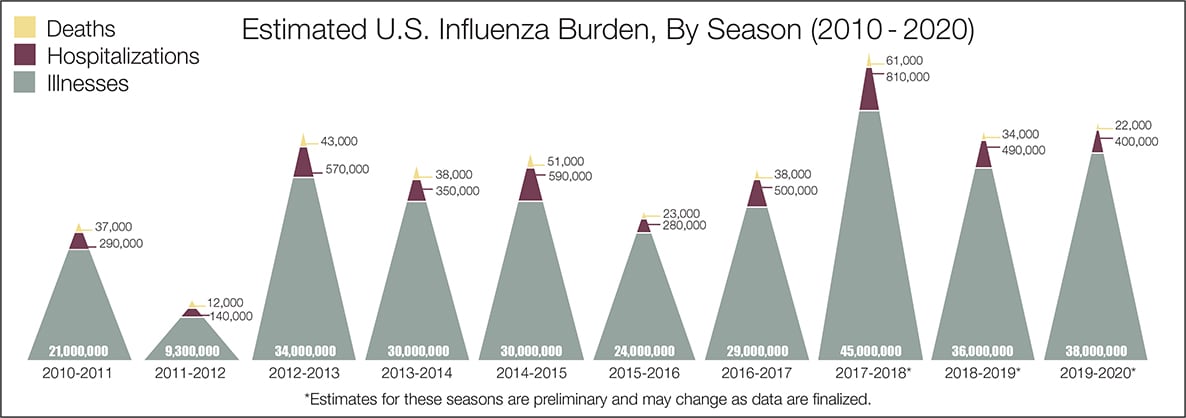
- The real question remains if the U.S. is over-reacting to this virus. The following graphic from the CDC puts the annual flu burden in perspective [click on image to enlarge]. Note that using this data is dangerous as the actual flu cases are estimated and not counted – nobody knows how accurate these guesses are.
What we do not know about the coronavirus [actually there is little scientifically proven information]. Most of our knowledge is anecdotal, from studies with limited subjects, or from studies without peer review.
- How many people have been infected as many do not show symptoms?
- Masks do work.
- Do we develop lasting immunity to the coronavirus? Another coronavirus – the simple cold – does not develop long term immunity.
- To what degree do people who never develop symptoms contribute to transmission?
- The US has scaled up coronavirus testing – and the accuracy of the tests has been improving. However, if one loses immunity – the coronavirus testing value is reduced.
- Can children widely spread coronavirus? [current thinking is that they are becoming a major source of the pandemic spread]
- Why have some places avoided big coronavirus outbreaks – and others hit hard?
- What effect will the weather have? At this point, it does not seem hot weather slows this coronavirus down – and it seems air conditioning contributes to its spread.
- Outdoor activities seem to be a lower risk than indoor activities.
- Can the world really push out an effective vaccine in 12 to 18 months?
- Will other medical treatments for Covid-19 ease symptoms and reduce deaths? So far only one drug (remdesivir) is approved for treatment.
- A current scientific understanding of the way the coronavirus works can be found [here].
Heavy breakouts of coronavirus have hit farm workers. Farmworkers are essential to the food supply. They cannot shelter at home. Consider:
- they have high rates of the respiratory disease [occupational hazard]
- they travel on crowded buses chartered by their employers
- few have health insurance
- they cannot social distance and live two to four to a room – and they eat together
- some reports say half are undocumented
- they are low paid and cannot afford not to work – so they will go to work sick
- they do not have access to sanitation when working
- a coronavirus outbreak among farmworkers can potentially shutter entire farm
The bottom line is that COVID-19 so far has been shown to be much more deadly than the data on the flu. Using CDC data, the flu has a mortality rate between 0.06 % and 0.11 % Vs. the coronavirus which to date has a mortality rate of 4 % [the 4% is the average of overall statistics – however in the last few months it has been hovering around 1.0%] – which makes it between 10 and 80 times more deadly. The reason for ranges:
Because influenza surveillance does not capture all cases of flu that occur in the U.S., CDC provides these estimated ranges to better reflect the larger burden of influenza.
There will be a commission set up after this pandemic ends to find fault [it is easy to find fault when a once-in-a-lifetime event occurs] and to produce recommendations for the next time a pandemic happens. Those that hate President Trump will conclude the virus is his fault.
Resources:
- Get the latest public health information from CDC: https://www.coronavirus.gov .
- Get the latest research from NIH: https://www.nih.gov/coronavirus.
- Find NCBI SARS-CoV-2 literature, sequence, and clinical content: https://www.ncbi.nlm.nih.gov/sars-cov-2/.
- List of studies: https://icite.od.nih.gov/covid19/search/#search:searchId=5ee124ed70bb967c49672dad
include(“/home/aleta/public_html/files/ad_openx.htm”); ?>


