


Written by Steven Hansen
The U.S. new cases 7-day rolling average are 6.2 % lower than the 7-day rolling average one week ago. U.S. deaths due to coronavirus are now 12.6 % lower the rolling average one week ago. At the end of this post is a set of interactive graphs and tables for the world and individual states – as well as today’s headlines which include;
- Herd Immunity May Be Slowing Spread in Some Parts of U.S.
- COVID-19 Death Rate For Black Americans Twice That For Whites
- COVID-19 symptoms often appear in this order
- Top U.S. Health Official Says Approval of COVID Vaccines Unlikely Before November
- Israeli hospital trials super-quick saliva test for COVID-19
- CDC Details COVID-19’s Massive Mental Health Impact
- How Likely Is It to Contract COVID-19 on a Plane?
- CDC Director Warns This Fall Could Be The Worst Ever For Public Health

My continuing advice is to continue to wash your hands, wear masks, and maintain social distancing. No handwashing, mask, or social distancing will guarantee you do not get infected – but it sure as hell lowers the risk in all situations. In addition, certain activities are believed to carry higher risk – like being inside in air conditioning and removing your mask (such as restaurants, around your children/grandchildren, bars, and gyms). It is all about viral load.
The daily number of new cases in the U.S. is remaining stubbornly and embarrassedly high.
The following graphs show the 7-day rolling average for new coronavirus cases and deaths have been updated through 14 August 2020:


z coronavirus.png
Coronavirus Statistics For 14 August 2020 |
| U.S. Only | Global | U.S Percentage of Total | ||||
| Today*** | Cumulative | Today*** | Cumulative | Today | Cumulative | |
| New Confirmed Cases | 51,094 | 5,250,000 | 278,593 | 20,900,000 | 18.3% | 25.1% |
| Deaths** | 1,083 | 167,110 | 9,879 | 759,385 | 11.0% | 22.0% |
| Mortality Rate | 2.1% | 3.2% | 3.5% | 3.6% | ||
total COVID-19 Tests per 1,000 people | 2.66* | 195.20* | ||||
* as of 13 Aug 2020
** evidently several states included “probable” deaths today in the number
*** red color indicates record number

Coronavirus News You May Have Missed
If you recover from the virus, you’re protected for up to three months, the C.D.C. says. – New York Times
The Centers for Disease Control and Prevention updated their guidance recently to suggest that people who have recovered from the virus can safely mingle with others for three months.
It was a remarkable addition to the body of guidance from the agency, and the first acknowledgment that immunity to the virus may persist for three months.
In June, a study found that antibody levels could wane over a course of two to three months in people with confirmed infections who experienced mild symptoms or no symptoms. They drop off, but they may still be present at low levels, including below the limit of detection.
Herd Immunity May Be Slowing Spread in Some Parts of U.S. – Newsweek
Herd immunity may be slowing the spread of COVID-19 in some parts of the U.S., scientists say, as a study finds that a population-wide infection rate of around 40 percent might be sufficient to achieve this form of community protection against the disease.
The U.S. has confirmed more than 5.4 million cases of COVID-19—although the true figure may be significantly higher—and recorded over 160,000 deaths, according to the Johns Hopkins Coronavirus Resource Center.
However, people may develop at least some form of immunity after infection, meaning the number of individuals who are vulnerable to the disease in hard-hit areas—such as southern states that have recently seen large spikes in infections—is dropping, according to pandemic analyst Trevor Bedford from the University of Washington.
“I wanted to discuss the degree to which population immunity may be contributing to curbing COVID-19 in Florida, Arizona and Texas, where recent surges have resulted in substantial epidemics,” Bedford wrote in a series of tweets. “After increasing dramatically in June and July, daily case counts in Florida, Arizona and Texas have begun to subside.”
COVID-19 symptoms often appear in this order, study finds – CBS
Researchers at the University of Southern California say they’ve found that the symptoms of COVID-19 tend to appear in a specific order, a discovery that could help enable earlier detection and treatment for numerous patients.
“This is a good guide of sorts,” Dr. Bob Lahita, a professor of medicine who is not affiliated with the study, told CBSN anchor Anne-Marie Green. “We can say safely, studying as they did, I think it was 55,000 patients from China, they looked at the data and looked at the symptoms and found that this order was pretty reproducible.”
According to the study, published in the medical journal Frontier Public Health, the most likely order of symptoms is as follows: fever, then cough and muscle pain, followed by nausea and/or vomiting, and then diarrhea.
“Fever is number one, followed by cough, followed by aches and pains — and they do not all have to appear in sequence, they can appear together,” Lahita said of the first grouping of symptoms. After that, he said, comes nausea and vomiting, followed by diarrhea.
U.S. to make coronavirus strain for possible human challenge trials – Reuters
U.S. government scientists have begun efforts to manufacture a strain of the novel coronavirus that could be used in human challenge trials of vaccines, a controversial type of study in which healthy volunteers would be vaccinated and then intentionally infected with the virus, Reuters has learned.
The work is preliminary and such trials would not replace large-scale, Phase 3 trials such as those now under way in the United States testing experimental COVID-19 vaccines from Moderna Inc (MRNA.O) and Pfizer Inc (PFE.N), according to a statement emailed to Reuters by the National Institute of Allergy and Infectious Diseases (NIAID), part of the National Institutes of Health.
U.S. officials organizing the fight against the pandemic have been under pressure from advocacy groups such as 1 Day Sooner and others that see challenge trials as a way to speed up tests of a COVID-19 vaccine. Most vaccine trials rely on inadvertent infection, which can take time to occur.
Some drugmakers, including AstraZeneca (AZN.L) and Johnson & Johnson (JNJ.N), have said they would consider human challenge trials to test COVID-19 vaccines if needed.
“Should there be a need for human challenge studies to fully assess candidate vaccines or therapeutics for SARS-CoV-2, NIAID has begun investigations of the technical and ethical considerations of conducting human challenge studies,” the agency statement said.
That includes efforts to manufacture a suitable SARS-CoV-2 strain, draft a clinical protocol and identify resources that would be required to conduct such studies.
Small challenge studies would be done in small isolation units to control the virus. Larger challenge studies involving 100 people or so would have to be done in multiple locations, adding months of preparations to coordinate the studies.
COVID-19 Death Rate For Black Americans Twice That For Whites, New Report Says – NPR
Black Americans are becoming infected with the coronavirus at a rate three times that of whites and they are twice as likely to die from COVID-19, according to a new report from the National Urban League, based partly on data from Johns Hopkins University.
A key focus of Thursday’s report is the impact of the pandemic and how the disease has followed the contours of the larger society in falling especially hard on Blacks, Latinos and Indigenous people.
State of Black America Unmasked paints a “bleak picture” of COVID-19 and people of color, the league’s CEO, Marc Morial, said.
The pandemic “exposed the fault lines in America’s social and economic institutions,” the authors of the report said.
The racial disparities that affect how the disease is spreading in America have been identified since the early days of the pandemic, and some of the numbers released Thursday track closely with earlier reports by NPR, The New York Times and other media outlets.
Top U.S. Health Official Says Approval of COVID Vaccines Unlikely Before November – US News
Any potential COVID-19 vaccine backed by the Trump administration’s “Operation Warp Speed” program is unlikely to receive a green light from regulators any earlier than November or December, given the time needed for a large-scale clinical trial, the National Institutes of Health director said on Thursday.
In a call with reporters, Francis Collins said he thinks testing a vaccine in at least 10,000 people could potentially give enough evidence of safety and efficacy to clear it for wider use. U.S. late-stage vaccine trials launched so far aim to recruit up to 30,000 people.
“I would not expect to see, on the basis of what we know scientifically, that we would be at the point where the FDA could make such a judgment until considerably later than October 1st,” Collins said, referring to the U.S. Food and Drug Administration. “Maybe November or December would be my best bet.”
He added that he is confident that at least one of the six vaccines funded by the initiative will be shown to be safe and effective by the end of the year.
Israeli hospital trials super-quick saliva test for COVID-19 – Reuters
A newly developed saliva test aims to determine in less than a second whether or not you are infected with the novel coronavirus, Israel’s largest medical center said on Thursday.
Patients rinse their mouth with a saline wash and spit into a vial. This is then examined by a small spectral device that, in simple terms, shines light on the specimen and analyses the reaction to see if it is consistent with COVID-19.
With machine learning it gets more accurate over time.
Eli Schwartz of the Center for Geographic Medicine and Tropical Diseases at Sheba Medical Center, who is leading the trial, said it was easier to use than PCR swabs commonly used to detect COVID-19.
As nursing homes battle coronavirus, study finds key defense: full staffs – ABC
At a time when nursing homes continue to be among the hardest hit settings in the coronavirus pandemic, new studies are beginning to offer insight as to why some facilities are seeing more cases than others — and, according to one, how important nursing home employees themselves are to the fight.
A study released on Monday by The Journal of the American Medical Association (JAMA), found that across eight states those facilities that were able to maintain more staffing in the homes had fewer COVID-19 cases than staffing in homes the study rated as low-performing.
The study, by Harvard researchers, looked into outbreaks of coronavirus in California, Connecticut, Florida, Illinois, Maryland, Massachusetts, New Jersey, and Pennsylvania. Researchers used federal reviews based on health inspections, quality measures and nurse staffing to see if facilities with poor performance ratings in those categories had more viral infections or deaths.
When it came to health inspection or quality measure ratings, the study found no significant difference in the burden of COVID-19 cases between the homes. But the data did suggest one interesting data point: Facilities with nurse staffing shortages may be more susceptible to the spread of the virus.
Russian doctors wary of rapidly approved COVID-19 vaccine, survey shows – Reuters
A majority of Russian doctors would not feel comfortable being injected with Russia’s new COVID-19 vaccine due to the lack of sufficient data about it and its super-fast approval, a survey of more than 3,000 medical professionals showed on Friday.
Russia has said that the world’s first vaccine for the novel coronavirus will be rolled out by the end of this month, with doctors among those set to be administered with it on a voluntary basis.
The vaccine, called “Sputnik V” in homage to the world’s first satellite launched by the Soviet Union in 1957, has yet to complete its final trials and some scientists said they fear Moscow may be putting national prestige before safety.
A survey of 3,040 doctors and health specialists, conducted by the “Doctor’s Handbook” mobile application and quoted on Friday by the RBC daily, showed 52% were not ready to be vaccinated, while 24.5% said they would agree to be given the vaccine.
Just a fifth of respondents said they would recommend the vaccine to patients, colleagues or friends.
Africa begins continent-wide study of COVID-19 antibodies – Philadelphia Tribune
An Africa-wide study of antibodies to the coronavirus has begun, while evidence from a smaller study indicates that many more people have been infected than official numbers show, the Africa Centers for Disease Control and Prevention said Thursday.
Experts are eager to know the real number of COVID-19 cases in Africa, as confirmed cases and deaths have been relatively low on the continent of 1.3 billion people. Poor data collection, however, has complicated efforts.
But recent surveys in Mozambique found antibodies — proteins the body makes when an infection occurs — to the virus in 5% of households in the city of Nampula and 2.5% in the city of Pemba. That’s while Mozambique has just 2,481 confirmed virus cases. Further studies are underway in the capital, Maputo, and the city of Quelimane.
“What is important is far fewer people are coming down with the disease,” Africa CDC director John Nkengasong told reporters. “How many people are infected and asymptomatic on our continent? We don’t know that.”
Africa’s young population, with a median age of 19, has been called a possible factor.
CDC Details COVID-19’s Massive Mental Health Impact – MedPage
Nearly 11% of American adults seriously considered suicide this June, according to CDC data.
Among 5,470 people surveyed in the last week of June, 30.9% reported symptoms of an anxiety or a depressive disorder, 25.3% reported a traumatic or stressor-related disorder (TSRD), and 13.3% said they were using substances to cope with the pandemic’s stressors, said Rashon Lane, MA, of the CDC’s COVID-19 Response Team.
And 10.7% reported seriously considering suicide in the prior month, more than double the rate reported in a 2018 CDC survey, the researchers wrote in the agency’s Morbidity and Mortality Weekly Report.
Specifically, the risk for suicidal ideation was elevated among respondents between ages 18 and 25 (25.5%), Hispanic respondents (18.6%), Black respondents (15.1%), unpaid adult caregivers (30.7%), and essential workers (21.7%).
The “markedly” high rates of mental and behavioral health conditions show the “broad impact of the pandemic and the need to prevent and treat these conditions,” the authors wrote, adding that interventions to reduce these numbers should target financial strain, racial discrimination, social connectedness, and community supports for patients considering suicide.
CDC Director Warns This Fall Could Be The Worst Ever For Public Health – NPR
The U.S. now has more than 5 million cases and 166,700 deaths from the coronavirus. And with flu season approaching, the director of the Centers for Disease Control and Prevention warned this week that things could get a lot more grim.
Robert Redfield said in an interview Wednesday with WebMD that if Americans don’t follow public health guidance, the country could be facing “the worst fall, from a public health perspective, we’ve ever had.”
“We’re going to have COVID in the fall, and we’re going to have flu in the fall,” he told John Whyte, chief medical officer at WebMD. “And either one of those by themselves can stress certain hospital systems.”
Redfield called on Americans to wear masks, social distance, wash their hands and “be smart about crowds” to bring the outbreak under control.
How Likely Is It to Contract COVID-19 on a Plane? – Newsweek
Is it safe to fly again? It’s the question on many travelers minds. Of course, many travel plans have been altered or canceled due to the coronavirus pandemic leaving some travelers wary of traveling at all, for the time being. A recent study found that 67 percent of American travelers are uncomfortable with air travel. With international borders continuing to open for tourism as well as the lifting of the State Department’s Level 4 Health Advisory, some travelers are considering flying once again.
In early July, the U.S. Department of Transportation released public health guidelines for both airports and airlines to follow in an effort to help stop the spread of COVID-19 in those settings. The guidelines were dubbed “The Runway to Recovery,” and they encourage enforcement of social distancing, wearing face coverings at all times and enhanced disinfecting and cleaning procedures—among other recommendations.
“The document provides guidance to airports and airlines for implementing measures to mitigate the public health risks associated with COVID-19 and prepare for an increase in travel volume, while ensuring that aviation safety and security are not compromised,” a spokesperson from the Federal Aviation Administration tells Newsweek. “It identifies measures that airports and airlines should implement across all operations and all stages of travel to, from and within the United States, along with a roadmap explaining how those measures should be adapted to the unique air travel environments.”
Clinical trials for potential virus treatments are taking longer than expected as once-ambitious deadlines slip. – New York Times
Clinical trials for some of the most promising experimental drugs are taking longer than expected, even as the pandemic continues to wreak havoc in the United States and treatments are needed more than ever.
Researchers at a dozen clinical trial sites said that testing delays, staffing shortages, space constraints and reluctant patients were complicating their efforts to test monoclonal antibodies — man-made drugs that mimic the molecular soldiers made by the human immune system.
As a result, once-ambitious deadlines are slipping. The drug maker Regeneron, which previously said it could have emergency doses of its antibody cocktail ready by the end of summer, has shifted to talking about how “initial data” could be available by the end of September.
And Eli Lilly’s chief scientific officer said in June that its antibody treatment might be ready in September, but in an interview this week, he said he now hopes for something before the end of the year.
The following are foreign headlines with hyperlinks to the posts
Spain Cracks Down On Outdoor Drinking, Smoking In Renewed Push Against COVID-19
Russia Claims Vaccine Will Protect From COVID-19 for 2 Years
Lockdown extended in New Zealand city as virus outbreak swells
Novavax strikes deal to provide 60 million doses of vaccine to U.K.
The following are additional national and state headlines with hyperlinks to the posts
Physical Intimate Partner Violence during COVID-19 Lockdown
Fauci says there is ‘no reason’ Americans can’t vote in person in November
Fauci defends voting by mail if ‘you don’t want to take the chance’ in person
NCAA Says No Championships This Fall, Except Maybe Football
Governor Drops Lawsuit Against Atlanta Mayor Over Masks, But Fight May Not Be Over
Joe Biden: For The Next 3 Months, All Americans Should Wear A Mask When Outside
U.S. Sees Deadly Drug Overdose Spike During Pandemic
Postal Service Warns States Mail in Ballots May Not Be Returned in Time
Fauci Says Trump’s Operation Warp Speed Suggests ‘Reckless Speed’
COVID-19 Vaccine Will Be Free for All Americans, Health Official Says
Less Than Half of the U.S. Got a Flu Shot in 2019, Prompting Major Concerns
Georgia Reports Over 1,600 Students and Teaching Staff in Quarantine
Anti-Vax Posts Against Future COVID-19 Vaccine ‘Increasing’
One in three Americans say they won’t get coronavirus vaccine: poll
Hawaii governor says he could delay tourist return amid spike in coronavirus cases
Long-term financial damage to states may be greater than that of the last recession, economists say.
The U.S., Canada and Mexico are extending limited travel bans again.
NY will allow bowling alleys, museums to reopen
Rent the Runway is closing its stores for good
Today’s Posts On Econintersect Showing Impact Of The Pandemic With Hyperlinks
New Tool Helps Calculate Risk Factors For Developing Severe Illness From COVID-19
07 August 2020 ECRI’s WLI Improvement Continues But Remains In Contraction
Preliminary August 2020 Michigan Consumer Sentiment Marginally Improves
June 2020 Business Inventories Decline Again
July 2020 Headline Industrial Production Improves But Remains In Contraction
2Q2020 Preliminary Headline Productivity Significantly Improved
Retail Sales Again Improves in July 2020
With Fewer Cars On US Streets, Now Is The Time To Reinvent Roadways And How We Use Them
The Effects Of The Current Economic Stability In Our Mental Health
I’m A COVID-19 Long-Hauler And An Epidemiologist: Here’s How It Feels When Symptoms Last For Months
Coronavirus INTERACTIVE Charts
include($_SERVER[‘DOCUMENT_ROOT’].’/pages/coronavirus.htm’); ?>
Analyst Opinion of Coronavirus Data
There are several takeaways that need to be understood when viewing coronavirus statistical data:
- The global counts are suspect for a variety of reasons including political. Even the U.S. count has issues as it is possible that as much as half the population has had coronavirus and was asymptomatic. It would be a far better metric using a random sampling of the population weekly. In short, we do not understand the size of the error in the tracking numbers.
- Just because some of the methodology used in aggregating the data in the U.S. is flawed – as long as the flaw is uniformly applied – you establish a baseline. This is why it is dangerous to compare two countries as they likely use different methodologies to determine who has (and who died) from coronavirus.
- COVID-19 and the flu are different but can have similar symptoms. For sure, COVID-19 so far is much more deadly than the flu. [click here to compare symptoms]
- From an industrial engineering point of view, one can argue that it is best to flatten the curve only to the point that the health care system is barely able to cope. This solution only works if-and-only-if one can catch this coronavirus once and develops immunity. In the case of COVID-19, herd immunity may need to be in the 80% to 85% range. WHO warns that few have developed antibodies to COVID-19. At this point, herd immunity does not look like an option although there is now a discussion of whether T-Cells play a part in immunity [which means one might have immunity without antibodies]
- Older population countries will have a higher death rate.
- There are at least 8 strains of the coronavirus. New York may have a deadlier strain imported from Europe, compared to less deadly viruses elsewhere in the United States.
- Each publication uses different cutoff times for its coronavirus statistics. Our data uses 11:00 am London time. Also, there is an unexplained variation in the total numbers both globally and in the U.S.
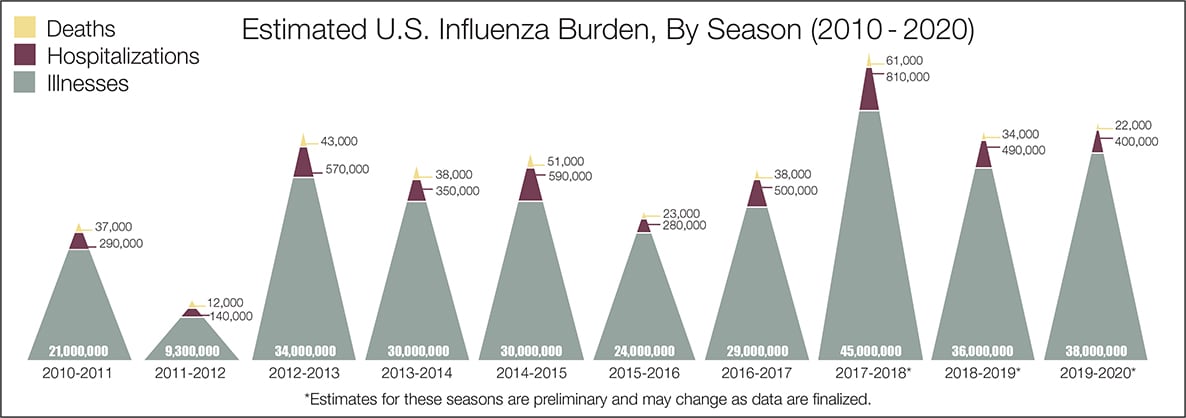
- The real question remains if the U.S. is over-reacting to this virus. The following graphic from the CDC puts the annual flu burden in perspective [click on image to enlarge]. Note that using this data is dangerous as the actual flu cases are estimated and not counted – nobody knows how accurate these guesses are.
What we do not know about the coronavirus [actually there is little scientifically proven information]. Most of our knowledge is anecdotal, from studies with limited subjects, or from studies without peer review.
- How many people have been infected as many do not show symptoms?
- Masks do work.
- Do we develop lasting immunity to the coronavirus? Another coronavirus – the simple cold – does not develop long term immunity.
- To what degree do people who never develop symptoms contribute to transmission?
- The US has scaled up coronavirus testing – and the accuracy of the tests has been improving. However, if one loses immunity – the coronavirus testing value is reduced.
- Can children widely spread coronavirus? [current thinking is that they are becoming a major source of the pandemic spread]
- Why have some places avoided big coronavirus outbreaks – and others hit hard?
- What effect will the weather have? At this point, it does not seem hot weather slows this coronavirus down – and it seems air conditioning contributes to its spread.
- Outdoor activities seem to be a lower risk than indoor activities.
- Can the world really push out an effective vaccine in 12 to 18 months?
- Will other medical treatments for Covid-19 ease symptoms and reduce deaths? So far only one drug (remdesivir) is approved for treatment.
- A current scientific understanding of the way the coronavirus works can be found [here].
Heavy breakouts of coronavirus have hit farm workers. Farmworkers are essential to the food supply. They cannot shelter at home. Consider:
- they have high rates of the respiratory disease [occupational hazard]
- they travel on crowded buses chartered by their employers
- few have health insurance
- they cannot social distance and live two to four to a room – and they eat together
- some reports say half are undocumented
- they are low paid and cannot afford not to work – so they will go to work sick
- they do not have access to sanitation when working
- a coronavirus outbreak among farmworkers can potentially shutter entire farm
The bottom line is that COVID-19 so far has been shown to be much more deadly than the data on the flu. Using CDC data, the flu has a mortality rate between 0.06 % and 0.11 % Vs. the coronavirus which to date has a mortality rate of 4 % [the 4% is the average of overall statistics – however in the last few months it has been hovering around 1.0%] – which makes it between 10 and 80 times more deadly. The reason for ranges:
Because influenza surveillance does not capture all cases of flu that occur in the U.S., CDC provides these estimated ranges to better reflect the larger burden of influenza.
There will be a commission set up after this pandemic ends to find fault [it is easy to find fault when a once-in-a-lifetime event occurs] and to produce recommendations for the next time a pandemic happens. Those that hate President Trump will conclude the virus is his fault.
Resources:
- Get the latest public health information from CDC: https://www.coronavirus.gov .
- Get the latest research from NIH: https://www.nih.gov/coronavirus.
- Find NCBI SARS-CoV-2 literature, sequence, and clinical content: https://www.ncbi.nlm.nih.gov/sars-cov-2/.
- List of studies: https://icite.od.nih.gov/covid19/search/#search:searchId=5ee124ed70bb967c49672dad
include(“/home/aleta/public_html/files/ad_openx.htm”); ?>


