


Written by Steven Hansen
The U.S. new cases 7-day rolling average are 1.5 % lower than the 7-day rolling average one week ago). U.S. deaths due to coronavirus continue to worsen and are 34.0 % higher than the rolling average one week ago. At the end of this post is a set of interactive graphs and tables for the world and individual states – as well as today’s headlines which include;
- Restaurant transactions plateau as coronavirus cases surge
- Physicians that work in ICU’s will be strained in eleven states
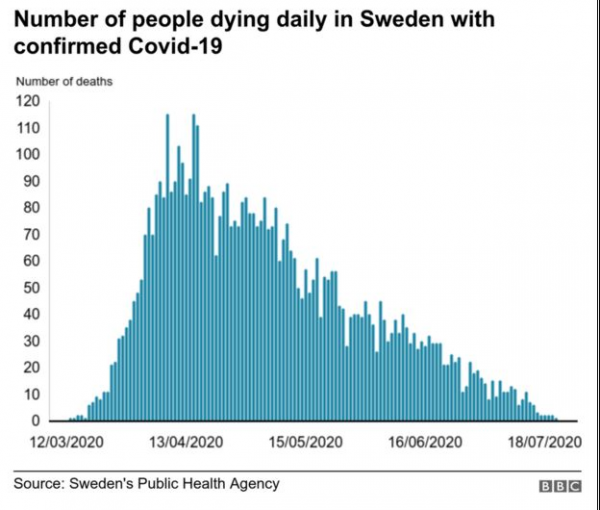
- Sweden’s fatalities have dropped to no more than 2 deaths per day for the last week
- Cost of Preventing The Next Pandemic Just 2% Of Covid-19 Bill
- Midwest Could See Surge In COVID-19 Cases
- Coronavirus relatives may pose threat to humans

My continuing advice is to continue to wash your hands, wear masks, and maintain social distancing. No handwashing, mask, or social distancing will guarantee you do not get infected – but it sure as hell lowers the risk in all situations. In addition, certain activities are believed to carry a higher risk – like being inside in air conditioning and removing your mask (such as restaurants, around your children/grandchildren, bars and gyms). It is all about viral load.
The daily number of new cases in the U.S. is remaining stubbornly and embarrassedly high.
The following graphs show the 7-day rolling average for new coronavirus cases and deaths has been updated through 28 July 2020:


z coronavirus.png
Coronavirus Statistics For 28 July 2020 |
| U.S. Only | Global | U.S Percentage of Total | ||||
| Today*** | Cumulative | Today*** | Cumulative | Today | Cumulative | |
| New Cases | 56,243 | 4,290,000 | 209,779 | 16,470,000 | 26.8% | 26.0% |
| Deaths** | 1,076 | 148,011 | 4,651 | 653,862 | 23.1% | 22.6% |
| Mortality Rate | 1.9% | 3.5% | 2.2% | 4.0% | ||
total COVID-19 Tests per 1,000 people | 2.41* | 152.98* | ||||
* as of 25 July 2020
** evidently several states included “probable” deaths today in the number
*** red color indicates record number
Coronavirus News You May Have Missed
Restaurant transactions plateau as coronavirus cases surge – CNBC
- The NPD Group tracks transactions at 75 restaurant chains that represent more than half of total U.S. commercial restaurant traffic.
- Its data shows that restaurant transactions have plateaued, without any significant improvements in weeks.
- As coronavirus cases surge in the U.S., some states have opted to close indoor dining again or place stricter limits on capacity.

WHO says COVID-19 pandemic is ‘one big wave’, not seasonal – Reuters
A World Health Organization official on Tuesday described the COVID-19 pandemic as “one big wave” and warned against complacency in the northern hemisphere summer since the infection does not share influenza’s tendency to follow seasons.
WHO officials have been at pains to avoid describing a resurgence of COVID-19 cases like those in Hong Kong as “waves” as this suggests the virus is behaving in ways beyond human control, when in fact concerted action can slow its spread.
Margaret Harris repeated that message in a virtual briefing in Geneva. “We are in the first wave. It’s going to be one big wave. It’s going to go up and down a bit. The best thing is to flatten it and turn it into just something lapping at your feet,” she said.
Pointing to high case numbers at the height of the U.S. summer, she urged vigilance in applying measures and warned against mass gatherings.
The U.S. Department of Health and Human Services today reserved the available advanced manufacturing capability and capacities of the Center for Innovation in Advanced Development and Manufacturing (CIADM) at the Texas A&M University System for use in manufacturing COVID-19 vaccines. The task order to the CIADM includes accelerating expansion of that manufacturing capacity for potential COVID-19 vaccines.
The approximately $265 million task order falls under an existing agreement with the Biomedical Advanced Research and Development Authority (BARDA), part of the HHS Office of the Assistant Secretary for Preparedness and Response. The CIADM is a public-private partnership between BARDA and the Texas A&M University System with manufacturing subcontracted to FUJIFILM Diosynth Biotechnologies.
With this task order, the U.S. government has reserved the CIADM’s capacity through December 2021 for U.S. government partners developing vaccines, such as Novavax, under Operation Warp Speed. The task order also enables FUJIFILM Diosynth Biotechnologies to more rapidly expand production capacity for vaccine manufacturing at the company’s CIADM facilities in Texas.
“Operation Warp Speed is one of the largest vaccine manufacturing efforts in recent history,” said HHS Secretary Alex Azar. “To ensure we have the needed capacity, we are engaging domestic centers for advanced manufacturing that HHS has helped build in recent years. Securing more manufacturing capacity here in America will help get a vaccine to Americans without a day wasted and prepare our nation for future emergencies.”
Louisiana and Mississippi are slated to run out of intensivists to treat non-COVID patients by week’s end; Texas and Arizona already have – Fitzhugh Mullan Institute for Health Workforce Equity
This week’s update of the Mullan Institute (MI) State Hospital Workforce Deficit Estimator shows that the supply of intensivists (physicians that work in ICUs) will be strained in eleven states—less than 50% of intensivists will be available after the needs of COVID-19 patients are met—and two additional states will face intensivist shortages, with COVID-19 patients needing the care of more than 100% of the intensivists in the state (Table 1).

Majority of Republicans and Democrats reassured by COVID-19 preventative measures but stressed about nationwide uncertainty – American Psychological Association
While the issue of how to prevent the spread of COVID-19 continues to be highly politicized, a new survey by the American Psychological Association shows a consensus among Republicans and Democrats: A majority of Republicans (65%) and Democrats (88%) report that they find preventive measures like wearing masks and physical distancing are reassuring, and agree that it is stressful to be around others when they do not take these steps (66% Republicans, 87% Democrats).
Meanwhile, the unpredictability in our nation is causing stress across party lines as well. Most adults from both parties say the current amount of uncertainty in our nation causes them stress (67% Republicans, 76% Democrats), and similar proportions cite the political climate as a significant source of stress in their life (62% Republicans, 77% Democrats).
“As our nation continues to grapple with so much adversity, it is reassuring to see that we stand united on important issues that will help our nation heal,” said Arthur C. Evans Jr., PhD, APA’s chief executive officer. “The coronavirus doesn’t recognize political boundaries, so our country will be best served if we come together in a bipartisan effort in this historic fight to overcome the pandemic — a common enemy.”
Stress in AmericaTM 2020: Stress in the Time of COVID-19, Volume Three, was conducted by The Harris Poll from June 23 to July 6; the online survey included 3,010 adults age 18+ who reside in the United States. This is APA’s third “pulse check” of the nation’s stress and mental health to gauge the impact of the pandemic and civil unrest. The previous surveys were released in May and June.
Hong Kong was a pandemic poster child. Now it’s a cautionary tale. – Washington Post
At the start of this month, restaurants here had wait-lists, bars were overflowing, and beaches were dotted with umbrellas and sand seekers. Three weeks had elapsed since the last locally transmitted novel coronavirus case, and the pandemic appeared to be down, if not entirely beaten.
All of that progress has come to a halt, as government missteps and a mutated strain of the coronavirus have led to the most severe wave of infections in Hong Kong since the onset of the crisis in January.
Cases, though modest in comparison with the United States, are setting new daily records. Isolation wards are filling up. From Wednesday, restaurants must suspend dine-in services, masks will be mandatory — even for people exercising outdoors — and residents will be prohibited from gathering in groups of more than two, as officials impose the strictest social distancing measures here to date.
COVID-19 May Plant Seeds of HF, Cardiomyopathy – MedPage
The extent of direct cardiac involvement in COVID-19 could be concerning for long-lasting complications from SARS-CoV-2 infection, two German studies showed.
Autopsy of consecutive COVID-19 cases without known myocarditis frequently turned up viral infection of the heart, but without an influx of inflammatory cells. The other study found that many patients who recovered from COVID-19 still had abnormal cardiac MRI findings consistent with active inflammation at a median 71 days after viral diagnosis. Both papers were published online in JAMA Cardiology
“[I]f this high rate of risk is confirmed, the pathologic basis for progressive left ventricular dysfunction is validated, and especially if longitudinal assessment reveals new-onset heart failure in the recovery phase of COVID-19, then the crisis of COVID-19 will not abate but will instead shift to a new de novo incidence of heart failure and other chronic cardiovascular complications,” according to an accompanying editorial.
“We wish not to generate additional anxiety but rather to incite other investigators to carefully examine existing and prospectively collect new data in other populations to confirm or refute these findings,” wrote editorialists Clyde Yancy, MD, MSc, of Northwestern University in Chicago, and Gregg Fonarow, MD, of UCLA.
Sweden: The One Chart That Matters – ZeroHedge
While the Covid-19 epidemic continues to drag on in the United States, it’s largely over in Sweden where fatalities have dropped to no more than 2 deaths per day for the last week.
Cost of Preventing The Next Pandemic Just 2% Of Covid-19 Bill – Statista
An analysis has found that spending $260 billion over the coming decade would substantally reduce the chances of another pandemic on the scale of the Covid-19 outbreak. That’s just 2 percent of the $11.5 trillion the coronavirus pandemic is thought to have cost the global economy, according to an analysis published in the journal Science. Experts in the fields of medicine, economics, the environment and conservation compiled the report and it states that two viruses per year have spilled from their natural hosts into humans over the past century. Today the risks are much higher due to the ongoing destruction of nature.
Wildlife protection needs to be prioritized in the future, particularly reducing deforestation and regulating the international trade in animals. Both have brought humans and livestock into even greater contact with wildlife which has raised the chances of pathogen transmission. The report remarks that tropical forest edges in particular are a major launch pad for novel human viruses and contact with wildlife is more likely when 25 percent of original forest cover is lost. It goes on to state that “the clear link between deforestation and virus emergence suggests that a major effort to retain intact forest cover would have a large return on investment even if its only benefit was to reduce virus emergence events”. Reducing deforestation would of course have an extra benefit: reducing CO2 levels that are fuelling the climate crisis.
Alongside saving forests, the report recommended several additional measures such as more effective early detection and control, an end to wild meat consumption in China and reducing disease spillover via livestock. Discussions about phasing out China’s $20 billion wildlife farming sector are ongoing and it is thought to employ around 15 million people. The efforts are being justified by the fact that the industry creates risks for disease emergence while health and safely regulations are sorely lacking. The report states that laws banning the national and international trade of high-risk reservoir species are necessary and that regulations must keep animals such as primates, bats, pangolins, civets and rodents out of markets and away from human consumption.
You will find more infographics at Statista

Midwest Could See Surge In COVID-19 Cases Unless States Are More Careful, Fauci Warns – NPR
The Midwest could be the next area to see a big surge in coronavirus cases, the top U.S. infectious disease specialist warned Tuesday. But there’s still time to stop the upswing, he said, if states follow the national guidelines on reopening safely.
While the Southern United States has been seeing the fastest rise in cases, that now appears to be on the downswing, Fauci told George Stephanopoulos on ABC’s Good Morning America.
Fauci’s concern is that states including Ohio, Indiana and Kentucky are showing signs of impending danger.
Based on the number of positive coronavirus tests in those states, they “are starting to have that very early indication” of a surge, he said. “That’s a surefire sign that you’ve got to be really careful.”
Farther south, Fauci noted, Tennessee is also at risk. The state is seeing one of the fastest per-capita increases in COVID-19 cases, with an average of 2,391 cases per day — up about 26% from the average two weeks ago. The numbers in Ohio, Indiana and Kentucky aren’t as dire, but that could quickly change, Fauci warned.
Coronavirus relatives may pose threat to humans – The Hill
The coronavirus circulating across the globe may have close relatives that have not yet been discovered, a hint that the current pandemic will not be the last one to threaten humans.
New research published Tuesday in the journal Nature Microbiology finds the current strain, known in the scientific literature as SARS-CoV-2, diverged genetically from other known viruses that circulate in bats between 40 and 70 years ago.
Because coronaviruses recombine and evolve into new species frequently, it is all but certain that other strains have evolved within bat populations in China during those intervening years. That means other viruses more closely related to SARS-CoV-2 than its current closest known relative may pose the potential for future outbreaks.
“From this ancestor in the 1960s and 1970s, there are probably other descendants, there are probably other lineages that have existed and circulated quietly in bats for the past 40 or 50 or 60 years,” said Maciej Boni, a biologist at the Center for Infectious Disease Dynamics at Penn State and a co-author of the study. “This does mean that there probably will be another coronavirus pandemic. Whether it happens in 2025 or 2075, nobody knows.”
The research found that while the SARS-CoV-2 virus can also infect pangolins, mammals native to China, Southeast Asia and Subsaharan Africa, the virus was most likely passed to humans directly from a bat.
Even with vaccine, ‘We will be dealing with this forever’: Virus experts Frieden, Osterholm – CNBC
- Even with a vaccine, the country will be fighting the pandemic for at least another year, says former CDC head Thomas Frieden.
- Only 7% to 9% of the U.S. population are estimated to have been infected with Covid-19, and herd immunity requires 50% to 70% of the nation to contract the disease.
- “We will be dealing with this forever,” says University of Minnesota infectious disease expert Michael Osterholm.
The following are foreign headlines with hyperlinks to the posts
German And U.K. Officials Warn Of A Possible New COVID-19 Wave In Europe
Hajj during the pandemic: Sterilized pebbles, bottled holy water and no kissing the sacred stone.
The Venice Film Festival will return, with masks and without blockbusters.
Osaka logs record 155 new COVID-19 cases as Aichi tops 100 for first time
Red Cross says its Covid-19 aid has arrived in North Korea
The following are additional national and state headlines with hyperlinks to the posts
California’s Hard-Hit Central Valley To Get Federal Health Workers, More State Help
University Of Notre Dame Withdraws As Host Of 1st Presidential Debate
Economic Uncertainty Drives Gold Price To A Record High
Delta CEO: Airline’s Pandemic Strategy Is ‘Putting People Over Profits’
Coronavirus hospitalizations among children rise by 23 percent in Florida
A national teachers’ union says its members can strike to ensure schools reopen safely.
Another Yankees-Phillies game is postponed over stadium worries.
McDonald’s customers changed their behavior during pandemic, but some trends could endure
CES 2021 Moves to an All-Digital Experience
‘Benefits Outweigh Costs’: Bill Gates Says Kids Should Return To School ‘In Almost Every Location’
No gap year after all — students opt to stay in school, lender Sallie Mae finds
Duke will only allow freshmen and sophomores in campus housing for the fall semester
Hospital cases hit new record for COVID-19 in North Carolina
Cuomo offers New York stadiums to MLB teams to play ball
Today’s Posts On Econintersect Showing Impact Of The Pandemic With Hyperlinks
July 2020 Conference Board Consumer Confidence Decreases
July 2020 Richmond Fed Manufacturing Survey Improves
S and P CoreLogic Case-Shiller 20 City Home Price Index May 2020 Year-over-Year Growth Slows
Why Sustainable Food Systems Are Needed In A Post-COVID World
The Office Is Dead! Long Live The Office In A Post-Pandemic World
How Other Countries Reopened Schools During The Pandemic And What The US Can Learn From Them
Coronavirus INTERACTIVE Charts
include($_SERVER[‘DOCUMENT_ROOT’].’/pages/coronavirus.htm’); ?>
Analyst Opinion of Coronavirus Data
There are several takeaways that need to be understood when viewing coronavirus statistical data:
- The global counts are suspect for a variety of reasons including political. Even the U.S. count has issues as it is possible that as much as half the population has had coronavirus and was asymptomatic. It would be a far better metric using a random sampling of the population weekly. In short, we do not understand the size of the error in the tracking numbers.
- Just because some of the methodology used in aggregating the data in the U.S. is flawed – as long as the flaw is uniformly applied – you establish a baseline. This is why it is dangerous to compare two countries as they likely use different methodologies to determine who has (and who died) from coronavirus.
- COVID-19 and the flu are different but can have similar symptoms. For sure, COVID-19 so far is much more deadly than the flu. [click here to compare symptoms]
- From an industrial engineering point of view, one can argue that it is best to flatten the curve only to the point that the health care system is barely able to cope. This solution only works if-and-only-if one can catch this coronavirus once and develops immunity. In the case of COVID-19, herd immunity may need to be in the 80% to 85% range. WHO warns that few have developed antibodies to COVID-19. At this point, herd immunity does not look like an option.
- Older population countries will have a higher death rate.
- There are at least 8 strains of the coronavirus. New York may have a deadlier strain imported from Europe, compared to less deadly viruses elsewhere in the United States.
- Each publication uses different cutoff times for its coronavirus statistics. Our data uses 11:00 am London time. Also, there is an unexplained variation in the total numbers both globally and in the U.S.
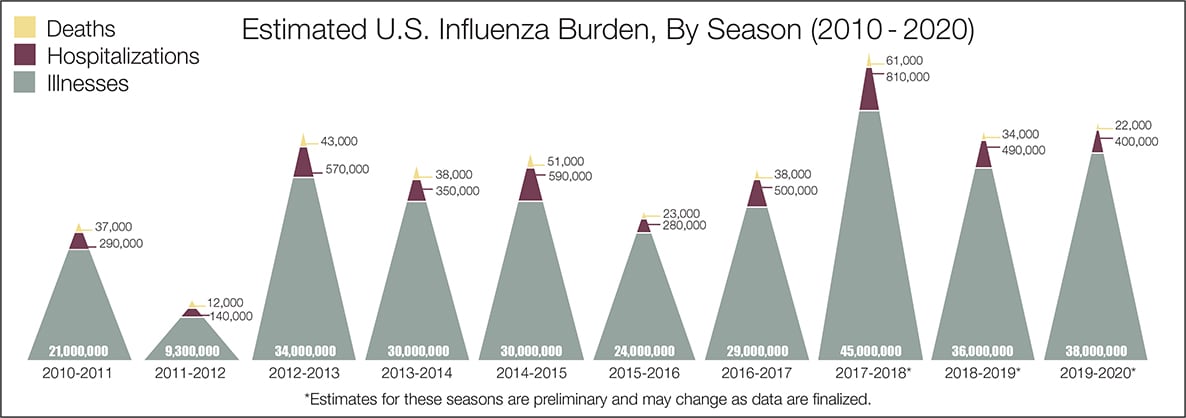
- The real question remains if the U.S. is over-reacting to this virus. The following graphic from the CDC puts the annual flu burden in perspective [click on image to enlarge]. Note that using this data is dangerous as the actual flu cases are estimated and not counted – nobody knows how accurate these guesses are.
What we do not know about the coronavirus [actually there is little scientifically proven information]. Most of our knowledge is anecdotal, from studies with limited subjects, or from studies without peer review.
- How many people have been infected as many do not show symptoms?
- Masks do work.
- Do we develop lasting immunity to the coronavirus? Another coronavirus – the simple cold – does not develop long term immunity.
- To what degree do people who never develop symptoms contribute to transmission?
- The US has scaled up coronavirus testing – and the accuracy of the tests has been improving. However, if one loses immunity – the coronavirus testing value is reduced.
- Can children widely spread coronavirus?
- Why have some places avoided big coronavirus outbreaks – and others hit hard?
- What effect will the weather have? At this point, it does not seem hot weather slows this coronavirus down – and it seems air conditioning contributes to its spread.
- Outdoor activities seem to be a lower risk than indoor activities.
- Can the world really push out an effective vaccine in 12 to 18 months?
- Will other medical treatments for Covid-19 ease symptoms and reduce deaths? So far only one drug (remdesivir) is approved for treatment.
- A current scientific understanding of the way the coronavirus works can be found [here].
Heavy breakouts of coronavirus have hit farmworkers. Farmworkers are essential to the food supply. They cannot shelter at home. Consider:
- they have high rates of the respiratory disease [occupational hazard]
- they travel on crowded buses chartered by their employers
- few have health insurance
- they cannot social distance and live two to four to a room – and they eat together
- some reports say half are undocumented
- they are low paid and cannot afford not to work – so they will go to work sick
- they do not have access to sanitation when working
- a coronavirus outbreak among farmworkers can potentially shutter entire farm
The bottom line is that COVID-19 so far has been shown to be much more deadly than the data on the flu. Using CDC data, the flu has a mortality rate between 0.06 % and 0.11 % Vs. the coronavirus which to date has a mortality rate of 4 % [the 4% is the average of overall statistics – however in the last few months it has been hovering around 1.0%] – which makes it between 10 and 80 times more deadly. The reason for ranges:
Because influenza surveillance does not capture all cases of flu that occur in the U.S., CDC provides these estimated ranges to better reflect the larger burden of influenza.
There will be a commission set up after this pandemic ends to find fault [it is easy to find fault when a once-in-a-lifetime event occurs] and to produce recommendations for the next time a pandemic happens. Those that hate President Trump will conclude the virus is his fault.
Resources:
- Get the latest public health information from CDC: https://www.coronavirus.gov .
- Get the latest research from NIH: https://www.nih.gov/coronavirus.
- Find NCBI SARS-CoV-2 literature, sequence, and clinical content: https://www.ncbi.nlm.nih.gov/sars-cov-2/.
- List of studies: https://icite.od.nih.gov/covid19/search/#search:searchId=5ee124ed70bb967c49672dad
include(“/home/aleta/public_html/files/ad_openx.htm”); ?>


