


Written by Steven Hansen
The U.S. and Global new cases 7-day rolling average continues to set new records – and this rolling average in the U.S. new cases are now 12 % higher than one week ago (yesterday it was 14 % which means the rate of acceleration is slowing). U.S. Death rates due to coronavirus have been holding relatively steady (today deaths were midrange in was seen in the last few weeks). At the end of this post is a set of interactive graphs and tables for the world and individual states – as well as today’s headlines which include;
- Vaccine Race Is On: Oxford, China Products Show Good Early Results
- 85 babies under 1 year old in Nueces County have tested positive for COVID-19
- Steroid Benefit in Severe COVID-19 Holds Up
- Protein treatment trial ‘a breakthrough’
- Oxford coronavirus vaccine data: ‘It is good news’
- Pfizer reports strong T-cell response to COVID-19 vaccine
- US Says COVID-19 Retesting Not Needed by Most

Generally, I do not believe one can compare data between countries – as there are significant differences in the way data is accumulated and the rules for counting cases.
One argument I read over the weekend was that, in the past, pandemics in the U.S., somebody had to be symptomatic to be counted. In this COVID-19 pandemic, asymptomatic people are being counted in the U.S. This skews the count in the U.S. – but the question is how much? A better comparison would be deaths (although there are issues here as there is an incentive in the U.S. to count a death as COVID-19 related and in other countries, there are incentives to undercount). The graph below counts deaths per million in various countries and shows the U.S. is not doing excellent but is far from the worst [this chart is published daily below in this post].

My continuing advice is to continue to wash your hands, wear masks, and maintain social distancing. No handwashing, mask, or social distancing will guarantee you do not get infected – but it sure as hell lowers the risk in all situations. In addition, certain activities are believed to carry higher risk – like being inside in air conditioning and removing your mask (such as restaurants, around your grandchildren, bars and gyms). It is all about viral load.
The daily number of new cases in the U.S. is remaining stubbornly high, increasing, and the 7-day rolling average continues in record territory.
The following graph showing the 7-day rolling average for new coronavirus cases has been updated through 20 July 2020:

z coronavirus.png
Coronavirus Statistics For 19 July 2020 |
| U.S. Only | Global | U.S Percentage of Total | ||||
| Today*** | Cumulative | Today*** | Cumulative | Today | Cumulative | |
| New Cases | 61,796 | 3,770,000 | 207,701 | 14,480,000 | 29.8% | 26.0% |
| Deaths** | 415 | 140,534 | 3,942 | 605,979 | 10.5% | 23.2% |
| Mortality Rate | 0.7% | 3.7% | 1.9% | 4.2% | ||
total COVID-19 Tests per 1,000 people | 2.57* | 133.54* | ||||
* as of 17 July 2020
** evidently several states included “probable” deaths today in the number
*** red color indicates record number

Coronavirus News You May Have Missed
Vaccine Race Is On: Oxford, China Products Show Good Early Results – MedPage
The chimpanzee adenovirus viral vector vaccine (ChAdOx1) against the COVID-19 coronavirus, developed at Oxford University in England, was safe and produced an immune response in healthy adult volunteers, interim data from a phase I/II trial showed.
Phase II data on a competing vaccine from China, also using an adenovirus vector to deliver a gene encoding SARS-CoV-2 antigen, also indicated the product could be effective.
These data, published simultaneously in The Lancet on Monday, along with phase I results on Moderna’s mRNA vaccine published last week, all suggest that a vaccine — and perhaps more than one — to ameliorate the COVID-19 pandemic may soon be in reach.
Are Anti-Mask Masks Legal? – ZeroHedge
There is a new form of protests sweeping across the country as individuals put on anti-Mask masks to defy mandatory mask rules. The anti-masks are made of thin material, mesh or even crochet and are advertised as having no protective qualities for Covid-19. The question is whether they are legal. They appear to be so.
A popular video shows a man wearing a mesh mask to a Tampa Walmart and saying “It was almost like not wearing a mask at all. Nobody cared. That’s because it’s not about safety. It’s all about compliance.”
Most laws like Alabama‘s only refer to a “covering” not a mask with protective qualities:
85 babies under 1 year old in Nueces County have tested positive for COVID-19 since mid-March – Texas Tribune
Eighty-five infants who are under the age of 1 have tested positive for the coronavirus in Nueces County since testing began there in March, county officials confirmed this weekend.
The county, which includes Corpus Christi, has become emblematic of the recent surge of coronavirus cases in the state. When the pandemic first started ravaging the state, Nueces County stayed relatively healthy while the Amarillo region suffered.
Now, however, the beachfront location has one of the fastest-growing outbreaks in the state, adding well over 2,000 new cases for each of the past two weeks.
In all, 8,407 people have tested positive for the coronavirus since mid-March. Children under the age of 1 represent about 1% of those positive cases. But the Nueces County number underscores that young people can be affected by the disease, though the Centers for Disease Control and Prevention and other health experts report that the risk of severe illness increases with age.
Symptom tracker app reveals six distinct types of COVID-19 infection – Reuters
The study, released online on June 16 but not peer-reviewed by independent scientists, described the six COVID-19 types as:
1 ‘Flu-like’ with no fever: Headache, loss of smell, muscle pains, cough, sore throat, chest pain, no fever.
2 ‘Flu-like’ with fever: Headache, loss of smell, cough, sore throat, hoarseness, fever, loss of appetite.
3 Gastrointestinal: Headache, loss of smell, loss of appetite, diarrhoea, sore throat, chest pain, no cough.
4 Severe level one, fatigue: Headache, loss of smell, cough, fever, hoarseness, chest pain, fatigue.
5 Severe level two, confusion: Headache, loss of smell, loss of appetite, cough, fever, hoarseness, sore throat, chest pain, fatigue, confusion, muscle pain.
6 Severe level three, abdominal and respiratory: Headache, loss of smell, loss of appetite, cough, fever, hoarseness, sore throat, chest pain, fatigue, confusion, muscle pain, shortness of breath, diarrhoea, abdominal pain.
Patients with level 4, 5 and 6 types were more likely to be admitted to hospital and more likely to need respiratory support, the researchers said.
Steroid Benefit in Severe COVID-19 Holds Up – MedPage
The sickest patients hospitalized with COVID-19 who received dexamethasone, the low-cost steroid, had a significantly lower incidence of death versus patients receiving usual care, preliminary results from the U.K.-based RECOVERY trial found.
Incidence of death was significantly lower for patients in the dexamethasone group who received mechanical ventilation versus those receiving usual care (29.3% vs 41.4%, RR 0.64, 95% CI 0.51-0.81) and those receiving supplemental oxygen without mechanical ventilation (23.3% vs 26.2%, RR 0.82, 95% CI 0.72-0.94), reported Martin Landray, PhD, of the University of Oxford, on behalf of the RECOVERY Collaborative Group, and colleagues.
However, there was no significant difference in the incidence of death between groups among those patients who did not receive respiratory support (17.8% vs 14.4%, RR 1.19, 95% CI 0.91-1.55), Landray’s group wrote in the New England Journal of Medicine.
Overall mortality at 28 days was significantly lower in the dexamethasone group versus usual care (22.9% vs 25.7%, RR 0.83, 95% CI 0.75-0.93, P<0.001), the researchers noted.
These are not new results, with the U.K.-based Randomised Evaluation of COVID-19 Therapy (RECOVERY) investigators releasing topline interim results via press release on June 16. Back in June, the investigators said they would be submitting their data for peer review.
Protein treatment trial ‘a breakthrough’ – BBC
British pharmaceutical company Synairgen claimed its new respiratory coronavirus treatment has reduced the number of hospitalized Covid-19 patients needing to be placed on ventilators.
The drug, SNG001, is a formulation of a naturally occurring antiviral protein called interferon beta, inhaled directly into the lungs via a nebulizer. In a double-blind, placebo-controlled trial of 101 patients between March 30 and May 27, the treatment produced a 79% lower risk of patients developing severe disease than those given a placebo. Synairgen also claimed that patients treated with SNG001 “were more than twice as likely to recover (defined as ‘no limitation of activities’ or ‘no clinical or virological evidence of infection’) over the course of the treatment period.”
The study has not yet been published in a peer-reviewed journal, and the full data has not been made publicly available, but Synairgen CEO Richard Marsden said the trial could “signal a major breakthrough” in the treatment of hospitalized Covid-19 patients.
Asian Americans Facing High COVID-19 Case Fatality – Health Affairs
In San Francisco, a steady trend in coronavirus (COVID-19) deaths has gone largely unnoticed until recently: Asian Americans consistently account for nearly half of COVID-19 deaths. For a city that is one-third Asian American, the disproportionate number of deaths appears striking, yet this highlights an even more worrisome statistic—Asian Americans experience a four times higher case fatality rate (CFR) than that of the overall population (5.2 percent versus 1.3 percent).
Further investigation revealed that the relatively high CFR in San Francisco reflects a pattern found across many states and counties with at least 5 percent of the population Asian American (exhibit 1). The Asian American CFR is three times that of the overall population in California (8.4 percent versus 2.6 percent) and exceeds 10 percent in Los Angeles, Chicago, New York City, and New Jersey. In Clark County, Nevada, the 2.5 times higher CFR results in a proportion of deaths (16.8 percent) that far exceeds Asian American and Pacific Islanders’ (AAPI) share of the population (10.4 percent).
Across the country, a high Asian American case fatality has emerged as another health disparity from COVID-19 impacting a minority population. Policy makers can help ameliorate these disparities by mandating standardized case and fatality reporting requirements and directing public health agencies to investigate why particular populations, including Asian Americans, face a seemingly heightened risk of death from COVID-19.
WHO applauds Oxford coronavirus vaccine data: ‘It is good news’ – CNBC
The World Health Organization on Monday applauded newly published data by researchers at Oxford University and AstraZeneca on a potential coronavirus vaccine but cautioned that it’s still early and further evidence of its effectiveness is needed.
…The phase one trial had more than 1,000 participants in people ages 18 to 55. The Oxford researchers said the vaccine produced antibodies and killer T-cells to combat the infection that lasted at least two months.
The vaccine was also found to be well-tolerated and there were no serious adverse event. Fatigue and headache were the most commonly reported side effects, the researchers said. Other common side effects included pain at the injection site, muscle ache, chills and a fever.
“The immune system has two ways of finding and attacking pathogens — antibody and T cell responses,” Oxford professor Andrew Pollard said in a release earlier in the day. “This vaccine is intended to induce both, so it can attack the virus when it’s circulating in the body, as well as attacking infected cells. We hope this means the immune system will remember the virus, so that our vaccine will protect people for an extended period.”
Pfizer reports strong T-cell response to COVID-19 vaccine – Fierce Biotech
Pfizer and BioNTech have shared (PDF) phase 1/2 data suggesting their COVID-19 vaccine triggers stronger CD8 T-cell responses than Moderna’s rival candidate. Four-fifths of subjects who received BNT162b1 had vaccine-induced CD8 T-cell responses and researchers classed most of the responses as strong.
Mounting evidence suggests T-cell responses play a role in long-term immunity against the pandemic coronavirus. That evidence has helped expand the focus of evaluations of the promise shown by the frontrunning COVID-19 vaccines beyond antibody responses to include a broader assessment of the ways the prophylactics may induce immunity.
… The results suggest Pfizer and BioNTech may have an edge over Moderna, which saw “low levels” of CD8 T-cell responses to the S-2P antigen in patients who received two 100-μg doses of mRNA-1273. Pfizer and BioNTech saw stronger CD8 responses in patients who received BNT162b1.
In the view of the researchers, the effect on CD8 cells is part of a “coordinated immune response to counter a viral intrusion” seen in patients who received BNT162b1. Other aspects of the coordinated response include increases in neutralizing antibodies, CD4 T cells and immune-modulatory cytokines. Almost 95% of patients had CD4 T-cell responses.
Masks are not a substitute for other public health measures – CNN
The World Health Organization supports the use of masks as part of a comprehensive strategy for COVID-19, but they cannot be used as a substitute for other public health measures, said Maria Van Kerkhove, WHO’s technical lead for COVID-19.
Van Kerkhove said WHO is hearing about changes in policies from many governments, who are applying mask use as part of their COVID-19 strategy, particularly in areas with active transmission or where physical distancing is not possible.
“We support the use of masks as one of the tools that can be put in place. However, it is not a substitute for other public health measure that also must be in place,” Van Kerkhove said at a WHO briefing in Geneva on Monday. “You cannot substitute the use of a mask for hand hygiene – for cleaning your hands. You cannot substitute the use of a mask for physical distancing. You cannot substitute the use of the mask for testing, finding cases, for contact tracing, for quarantining cases.”
US Says COVID-19 Retesting Not Needed by Most – U.S. News
The U.S. government’s top official in charge of coronavirus testing is urging Americans not to get retested for COVID-19 to confirm they’ve recovered.
Assistant Secretary for Health Admiral Brett Giroir said Thursday that repeat testing is not necessary for most people who are infected but remain at home. He said such testing is “clogging up the system.”
U.S. health officials will soon issue guidelines explicitly recommending against the practice, except for patients in the most severe cases.
Americans in many states continue to face long lines at testing sites and lag times obtaining their results. The problems are due to a combination of pressures, including increased testing demand, supply shortages and bottlenecks at laboratories processing the tests.
U.S. officials are aiming to increase the use of rapid tests to shorten turnaround times. Those tests can usually be developed in 15 minutes or less and can be performed at testing sites, doctor’s offices and clinics. They tend to be less accurate than the tests that need to be developed at clinical laboratories.
The following are foreign headlines with hyperlinks to the posts
U.S. travelers are now banned from Bermuda
Iraq nears 100,000 Covid-19 cases
India sees largest daily coronavirus increase with more than 40,000 new cases
UK secures early access to 90 million COVID-19 vaccine doses
Mexico reports almost 300 dead from coronavirus in a single day
Victoria records 275 new coronavirus cases, as Premier Daniel Andrews hits out at partygoers
Japan Records Highest Increase In Coronavirus Cases Since April With 510 New Infections
The following are additional national and state headlines with hyperlinks to the posts
Your ‘Doomscrolling’ Breeds Anxiety. Here’s How To Stop The Cycle
As Talks Open On New Coronavirus Aid Bill, Trump To Return To Daily Briefings
NFL Players Blitz Social Media To Voice Virus Concerns Before Training Camps Start
The End Of $600 Unemployment Benefits Will Hit Millions Of Households And The Economy
Kentucky couple under house arrest after one tests positive for coronavirus
Smithsonian announces reopening for National Zoo, Udvar-Hazy Center
N.Y.C. Enters Phase 4, but Restaurants and Bars Are Left Behind
Delta asking passengers unable to wear masks to consider staying home
Seven West Virginia counties have churches with COVID-19 outbreaks
Today’s Posts On Econintersect Showing Impact Of The Pandemic With Hyperlinks
Delaying College During The Pandemic Can Be Costly
Fiscal Policies For A Transformed World
Two-Thirds Of PPP Loans Were For $50,000 Or Less
Protracted G7 Contraction – Or Multiyear Global Depression
Coronavirus INTERACTIVE Charts
include($_SERVER[‘DOCUMENT_ROOT’].’/pages/coronavirus.htm’); ?>
Analyst Opinion of Coronavirus Data
There are several takeaways that need to be understood when viewing coronavirus statistical data:
- The global counts are suspect for a variety of reasons including political. Even the U.S. count has issues as it is possible that as much as half the population has had coronavirus and was asymptomatic. It would be a far better metric using a random sampling of the population weekly. In short, we do not understand the size of the error in the tracking numbers.
- Just because some of the methodology used in aggregating the data in the U.S. is flawed – as long as the flaw is uniformly applied – you establish a baseline. This is why it is dangerous to compare two countries as they likely use different methodologies to determine who has (and who died) from coronavirus.
- COVID-19 and the flu are different but can have similar symptoms. For sure, COVID-19 so far is much more deadly than the flu. [click here to compare symptoms]
- From an industrial engineering point of view, one can argue that it is best to flatten the curve only to the point that the health care system is barely able to cope. This solution only works if-and-only-if one can catch this coronavirus once and develops immunity. In the case of COVID-19, herd immunity may need to be in the 80% to 85% range. WHO warns that few have developed antibodies to COVID-19. At this point, herd immunity does not look like an option.
- Older population countries will have a higher death rate.
- There are at least 8 strains of the coronavirus. New York may have a deadlier strain imported from Europe, compared to less deadly viruses elsewhere in the United States.
- Each publication uses different cutoff times for its coronavirus statistics. Our data uses 11:00 am London time. Also, there is an unexplained variation in the total numbers both globally and in the U.S.
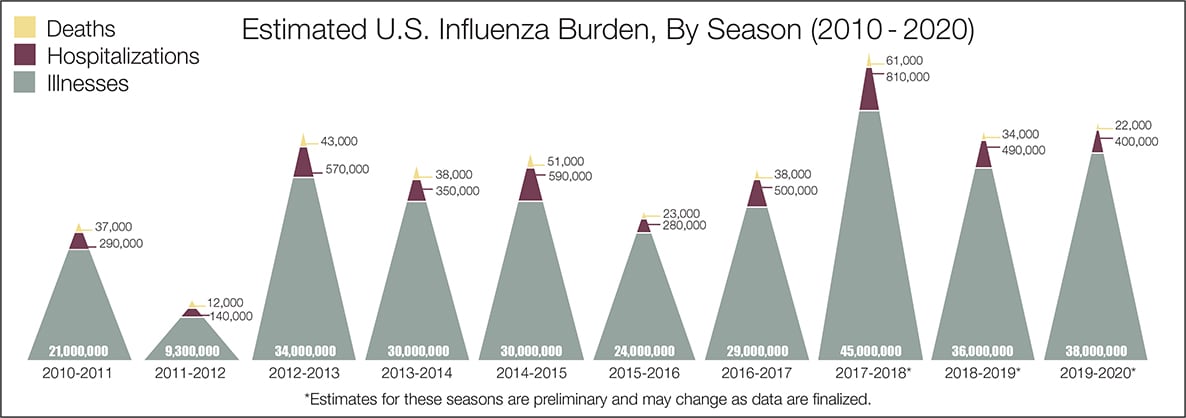
- The real question remains if the U.S. is over-reacting to this virus. The following graphic from the CDC puts the annual flu burden in perspective [click on image to enlarge]. Note that using this data is dangerous as the actual flu cases are estimated and not counted – nobody knows how accurate these guesses are.
What we do not know about the coronavirus [actually there is little scientifically proven information]. Most of our knowledge is anecdotal, from studies with limited subjects, or from studies without peer review.
- How many people have been infected as many do not show symptoms?
- Masks do work.
- Do we develop lasting immunity to the coronavirus? Another coronavirus – the simple cold – does not develop long term immunity.
- To what degree do people who never develop symptoms contribute to transmission?
- The US has scaled up coronavirus testing – and the accuracy of the tests has been improving. However, if one loses immunity – the coronavirus testing value is reduced.
- Can children widely spread coronavirus?
- Why have some places avoided big coronavirus outbreaks – and others hit hard?
- What effect will the weather have? At this point, it does not seem hot weather slows this coronavirus down – and it seems air conditioning contributes to its spread.
- Outdoor activities seem to be a lower risk than indoor activities.
- Can the world really push out an effective vaccine in 12 to 18 months?
- Will other medical treatments for Covid-19 ease symptoms and reduce deaths? So far only one drug (remdesivir) is approved for treatment.
- A current scientific understanding of the way the coronavirus works can be found [here].
Heavy breakouts of coronavirus have hit farmworkers. Farmworkers are essential to the food supply. They cannot shelter at home. Consider:
- they have high rates of the respiratory disease [occupational hazard]
- they travel on crowded buses chartered by their employers
- few have health insurance
- they cannot social distance and live two to four to a room – and they eat together
- some reports say half are undocumented
- they are low paid and cannot afford not to work – so they will go to work sick
- they do not have access to sanitation when working
- a coronavirus outbreak among farmworkers can potentially shutter entire farm
The bottom line is that COVID-19 so far has been shown to be much more deadly than the data on the flu. Using CDC data, the flu has a mortality rate between 0.06 % and 0.11 % Vs. the coronavirus which to date has a mortality rate of 4 % [the 4% is the average of overall statistics – however in the last few months it has been hovering around 1.0%] – which makes it between 10 and 80 times more deadly. The reason for ranges:
Because influenza surveillance does not capture all cases of flu that occur in the U.S., CDC provides these estimated ranges to better reflect the larger burden of influenza.
There will be a commission set up after this pandemic ends to find fault [it is easy to find fault when a once-in-a-lifetime event occurs] and to produce recommendations for the next time a pandemic happens. Those that hate President Trump will conclude the virus is his fault.
Resources:
- Get the latest public health information from CDC: https://www.coronavirus.gov .
- Get the latest research from NIH: https://www.nih.gov/coronavirus.
- Find NCBI SARS-CoV-2 literature, sequence, and clinical content: https://www.ncbi.nlm.nih.gov/sars-cov-2/.
- List of studies: https://icite.od.nih.gov/covid19/search/#search:searchId=5ee124ed70bb967c49672dad
include(“/home/aleta/public_html/files/ad_openx.htm”); ?>


