


Written by Steven Hansen
For the third consecutive day, the U.S. and Global new cases 7-day rolling average set a new record – and this rolling average in the U.S. new cases are now 20 % higher than one week ago (yesterday it was 19 %). Death rates due to coronavirus have been holding relatively steady but some are saying we will see a spike in deaths soon (today deaths continue near the upper end of the range seen in the last few weeks). At the end of this post is a set of interactive graphs and tables for the world and individual states – as well as today’s headlines which include;
- Los Angeles Apparel factory ordered closed after over 300 coronavirus cases and 4 deaths
- Researchers Create Air Filter that Can Kill the Coronavirus
- Chinese Virologist Flees Hong Kong, Accuses Beijing Of COVID-19 Cover-Up
- DNA Inherited From Neanderthals May Increase Risk of Covid-19
- Tokyo hits record daily number of infections as cases mount in Japan

Repeating from past posts, deaths resulting from the coronavirus are relatively low even whilst we hit record highs in new cases. There are two possibilities put forth by the experts:
- Deaths lag new cases by 3 to 5 weeks, This would mean we should begin to see a spike in deaths beginning 11 July 2020. [note: US Surgeon General Dr. Jerome Adams said on 04 July 2020 “We know deaths lag at least two weeks and can lag even more.” If this is true – deaths should have begun spiking beginning on 03 July]
- The current form of the coronavirus may be easier to transmit but not as deadly. This combined with better procedures in dealing with the more severe cases could result in little noticeable spike in deaths. It also should be realized that the U.S. now has one of the highest testing rates in the world which means a higher rate of identification of those who contracted COVID-19 but are not showing symptoms. Also, their is reason to believe that duplicate positive tests on a person will result in multiple new cases.
My continuing advice is to continue to wash your hands, wear masks, and maintain social distancing. No handwashing, mask, or social distancing will guarantee you do not get infected – but it sure as hell lowers the risk in all situations. In addition, certain activities are believed to carry higher risk – like being inside in air conditioning and removing your mask (such as restaurants, bars and gyms).
The daily number of new cases in the U.S. is remaining stubbornly high, increasing, and the 7-day rolling average continues in record territory.
The following graph showing the 7-day rolling average for new coronavirus cases has been updated through 11 July 2020:

z coronavirus.png​
Coronavirus Statistics For 11 July 2020 |
| U.S. Only | Global | U.S Percentage of Total | ||||
| Today*** | Cumulative | Today*** | Cumulative | Today | Cumulative | |
| New Cases | 66,625 | 3,180,000 | 229,759 | 12,480,000 | 29.0% | 25.5% |
| Deaths** | 806 | 134,097 | 5,276 | 559,998 | 15.3% | 23.9% |
| Mortality Rate | 1.2% | 4.2% | 2.3% | 4.5% | ||
total COVID-19 Tests per 1,000 people | 2.00* | 113.09* | ||||
* as of 08 July 2020
** evidently several states included “probable” deaths today in the number
*** red color indicates record number

Coronavirus News You May Have Missed
Los Angeles Apparel factory ordered closed after over 300 coronavirus cases and 4 deaths – CNN
A garment manufacturer in downtown Los Angeles with over 300 confirmed coronavirus cases among employees has been ordered closed after an investigation into the deaths of four workers, county health officials said Friday.
The Los Angeles Apparel had three deaths in June and one in July, prompting an investigation, the Los Angeles County Department of Public Health announced in a statement.
“The death of four dedicated garment workers is heartbreaking and tragic,” said Dr. Barbara Ferrer of the Los Angeles County Department of Public Health. “Business owners and operators have a corporate, moral and social responsibility to their employees and their families to provide a safe work environment.”
Los Angeles Apparel was founded in 2016 by Dov Charney, who previously founded American Apparel. It was first shut down on June 27 after violating the county’s mandatory health orders. The company failed to cooperate with the health department’s investigation of a reported coronavirus outbreak, health officials said.
Researchers Create Air Filter that Can Kill the Coronavirus – University of Houston
Researchers from the University of Houston, in collaboration with others, have designed a “catch and kill” air filter that can trap the virus responsible for COVID-19, killing it instantly.
Zhifeng Ren, director of the Texas Center for Superconductivity at UH, collaborated with Monzer Hourani, CEO of Medistar, a Houston-based medical real estate development firm, and other researchers to design the filter, which is described in a paper published in Materials Today Physics.
The researchers reported that virus tests at the Galveston National Laboratory found 99.8% of the novel SARS-CoV-2, the virus that causes COVID-19, was killed in a single pass through a filter made from commercially available nickel foam heated to 200 degrees Centigrade, or about 392 degrees Fahrenheit. It also killed 99.9% of the anthrax spores in testing at the national lab, which is run by the University of Texas Medical Branch.
“This filter could be useful in airports and in airplanes, in office buildings, schools and cruise ships to stop the spread of COVID-19,” said Ren, MD Anderson Chair Professor of Physics at UH and co-corresponding author for the paper. “Its ability to help control the spread of the virus could be very useful for society.” Medistar executives are is also proposing a desk-top model, capable of purifying the air in an office worker’s immediate surroundings, he said.
Chinese Virologist Flees Hong Kong, Accuses Beijing Of COVID-19 Cover-Up – ZeroHedge
A highly respected Chinese virologist has fled Hong Kong and says that the Chinese government knew about COVID-19 long before they claim they did, and that her supervisors – some of the top experts in the field – ignored research she was conducting at the onset of the pandemic which she says could have saved lives, according to an exclusive interview with Fox News.
Dr. Li-Meng Yan, who specialized in virology and immunology at the Hong Kong School of Public Health, fled Hong Kong on April 28 on a Cathay Pacific flight to the United States, knowing that if she were caught she could be jailed or “disappeared.”
She adds that they likely had an obligation to tell the world, given their status as a World Health Organization reference laboratory specializing in influenza viruses and pandemics, especially as the virus began spreading in the early days of 2020.
Yan, now in hiding, claims the government in the country where she was born is trying to shred her reputation and accuses government goons of choreographing a cyber-attack against her in hopes of keeping her quiet.
Yan believes her life is in danger. She fears she can never go back to her home and lives with the hard truth that she’ll likely never see her friends or family there again.
Still, she says, the risk is worth it. –Fox News
Covid-19 antibody therapy could be available this year, biotech CEO says – CNN
An antibody therapy from Eli Lilly could be on the market by the end of the year, according to the CEO of a biotech firm working with the pharmaceutical giant.
The company is two weeks into Phase 2 trials, which will involve hundreds of Covid-19 patients. Some of them will get the antibody drug at varying doses and others will receive a placebo – a pill that does nothing – and then doctors will compare how each group fares.
Hansen said the Phase 1 trial of a few dozen patients showed the drug was safe.
… That drug was tested in Phase 1 with hospitalized patients and is being tested in Phase 2 in patients who are at home.
Hansen said the drug could help another two groups – those who have been exposed to Covid-19 but have not developed symptoms, and those at high risk of being exposed, such as health care workers.
DNA Inherited From Neanderthals May Increase Risk of Covid-19 – New York Times
A stretch of DNA linked to Covid-19 was passed down from Neanderthals 60,000 years ago, according to a new study.
Scientists don’t yet know why this particular segment increases the risk of severe illness from the coronavirus. But the new findings, which were posted online on Friday and have not yet been published in a scientific journal, show how some clues to modern health stem from ancient history.
“This interbreeding effect that happened 60,000 years ago is still having an impact today,” said Joshua Akey, a geneticist at Princeton University who was not involved in the new study.
This piece of the genome, which spans six genes on Chromosome 3, has had a puzzling journey through human history, the study found. The variant is now common in Bangladesh, where 63 percent of people carry at least one copy. Across all of South Asia, almost one-third of people have inherited the segment.
Dozens of Florida hospitals max out of ICU capacity amid surge in COVID-19 cases – The Hill
Dozens of hospitals in Florida are at their ICU capacity as the state struggles to contain its massive spike of COVID-19 cases.
According to new data released by the state’s Agency for Health Care Administration, almost 85 percent of the state’s ICU beds are occupied, with just 933 ICU available beds remaining across the state.
WFLA reported that 435 were hospitalized overnight Friday, a new record. At least 52 hospitals in the state have no ICU capacity left at all.
During a Friday press conference, Gov. Ron DeSantis (R) tried to assuage fears over the mounting hospitalizations.
“We’ve got the census today. I think between 10 and 12 or 13 thousand – somewhere like that – beds are available,” DeSantis said. “There’ll be articles saying, ‘Oh, my gosh. They’re at 90 percent.’ Well, that’s how hospitals normally run.”
The governor noted that he was sending 100 contract nurses to Tampa Bay to assist area hospitals.
After peaking at an average of more than 2,000 deaths per day just three months ago, primarily driven by New York and New Jersey, fatalities in the U.S. have been slowly declining – falling to an average of less than 600 fatalities a day from June 23 through July 8. Covid-19 deaths in the U.S. have declined or remained relatively stable for weeks, even though cases have more than doubled since mid-May. But the daily death toll appears to be on the rise again in the U.S., epidemiologists say.
Covid-19 fatalities have steadily ticked up across the nation with the average number of fatalities a day rising over the last three straight days to over 600 on July 9, based on a seven-day average of daily reported deaths, driven by surges in several hot spots. Epidemiologists say it is cause for concern that deaths are beginning to accelerate again, even if it’s just a few days of data.
U.S. officials and the general public should have seen the rise in deaths coming, Larry Levitt, executive vice president for health policy at the Kaiser Family Foundation, told CNBC. Deaths tend to lag new cases because it can take weeks for a patient to get sick enough to be hospitalized and eventually die.
“This was predictable. We seem to have had difficulty in this country looking a few weeks in advance,” Levitt said. “But we know the pattern that as more people get infected, more people get hospitalized and ultimately more people die.”
India reimposes restrictions as infections spread. – New York Times
India, which four months ago brought in the world’s largest coronavirus lockdown, is reimposing restrictions in many parts of the country as medical facilities are being pushed to the brink amid a surge of new infections since the initial measures were lifted.
In Pune, officials plan to shut the city down next week after a string of days with record high new infections. In Aurangabad, an industrial town, an extended curfew has cleared streets and shut factories. In the state of Uttar Pradesh, India’s most populous, almost all businesses were ordered closed this weekend.
When Prime Minister Narendra Modi announced a nationwide lockdown in March, halting industry and ordering all 1.3 billion Indians to stay home, the hope was that the country might escape the worst. But in recent weeks, as officials began lifting restrictions to save a badly wounded economy, infections spread quickly.
Now, hospitals are reporting shortages of ventilators and other medical supplies. Doctors in New Delhi are making life-or-death choices as empty beds dwindle and patients are turned away, sometimes to their deaths. Recently, India’s caseload rose to the world’s third highest, with about 800,000 confirmed infections and more than 22,000 deaths.
How coronavirus affects the entire body – CNN
Coronavirus damages not only the lungs, but the kidneys, liver, heart, brain and nervous system, skin and gastrointestinal tract, doctors said Friday in a review of reports about Covid-19 patients.
The team at the Columbia University Irving Medical Center in New York City – one of the hospitals flooded with patients in the spring – went through their own experiences and collected reports from other medical teams around the world.
Their comprehensive picture shows the coronavirus attacks virtually every major system in the human body, directly damaging organs and causing the blood to clot, the heart to lose its healthy rhythm, the kidneys to shed blood and protein and the skin to erupt in rashes. It causes headaches, dizziness, muscle aches, stomach pain and other symptoms along with classic respiratory symptoms like coughing and fever.
“Physicians need to think of COVID-19 as a multisystem disease,” said Dr. Aakriti Gupta, a cardiology fellow at Columbia who worked on the review, in a statement. “There’s a lot of news about clotting but it’s also important to understand that a substantial proportion of these patients suffer kidney, heart, and brain damage, and physicians need to treat those conditions along with the respiratory disease.”
Tokyo hits record daily number of infections as cases mount in Japan – COVID-19 Data
Japan recorded 430 new coronavirus cases Friday, its health ministry said – the first time the country has registered more than 400 daily new infections since April 24, when it was still under a state of emergency over the pandemic.
The nationwide total includes Tokyo’s 243 new Covid-19 cases on Friday, the highest daily jump in new cases in the capital since the outbreak began.
The total number of people infected by the virus in the country so far stands at 21,841 with 995 deaths.
The following are foreign headlines with hyperlinks to the posts
German soccer club offers free coronavirus tests for 20,000 fans
Coronavirus Australia: Victoria reports 216 new Covid-19 cases and death of man in his 90s
Brazil surpasses 70,000 coronavirus deaths
The following are additional national and state headlines with hyperlinks to the posts
Disney World and other amusement parks open their doors despite surging cases.
68% Have Antibodies in This Clinic. Can a Neighborhood Beat a Next Wave?
Strict Rules Apply, But Visitors Will Be Allowed Back In New York Nursing Homes
Georgia Governor And The Mayor Of Atlanta In Turf War Over COVID-19 Restrictions
‘In A Fight For Our Lives’: Mississippi Issues New Mask Order Amid COVID-19 Spike
California Will Release Up To 8,000 Prisoners Due To Coronavirus
Nation’s Pediatricians Walk Back Support For In-Person School
S.C. Governor Imposes 11 P.M. Alcohol Curfew For Bars And Restaurants
Nearly Every Major League Baseball Team Has Had A Coronavirus Test Come Back Positive
Allies bite their tongues after Trump withdraws from WHO
Bill Gates: Coronavirus treatments should go to those who need them, not ‘highest bidder’
The states have widely varying levels of transparency when it comes to Covid. Then there is Kansas.
Wisconsin reports highest single-day COVID-19 case increase
Today’s Posts On Econintersect Showing Impact Of The Pandemic With Hyperlinks
Reopening Asia: How The Right Policies Can Help Economic Recovery
Helping Homeowners During The Covid-19 Pandemic: Lessons From The Great Recession
Restrictions Are Back: Consumer Loses Steam
The Great Depression Has Arrived, It’s Just Not Evenly Distributed
When States Pass Social Liberalization Laws, They Create Regional Advantages For Innovation
Coronavirus INTERACTIVE Charts
include($_SERVER[‘DOCUMENT_ROOT’].’/pages/coronavirus.htm’); ?>
Analyst Opinion of Coronavirus Data
There are several takeaways that need to be understood when viewing coronavirus statistical data:
- The global counts are suspect for a variety of reasons including political. Even the U.S. count has issues as it is possible that as much as half the population has had coronavirus and was asymptomatic. It would be a far better metric using a random sampling of the population weekly. In short, we do not understand the size of the error in the tracking numbers.
- Just because some of the methodology used in aggregating the data in the U.S. is flawed – as long as the flaw is uniformly applied – you establish a baseline. This is why it is dangerous to compare two countries as they likely use different methodologies to determine who has (and who died) from coronavirus.
- COVID-19 and the flu are different but can have similar symptoms. For sure, COVID-19 so far is much more deadly than the flu. [click here to compare symptoms]
- From an industrial engineering point of view, one can argue that it is best to flatten the curve only to the point that the health care system is barely able to cope. This solution only works if-and-only-if one can catch this coronavirus once and develops immunity. In the case of COVID-19, herd immunity may need to be in the 80% to 85% range. WHO warns that few have developed antibodies to COVID-19. At this point, herd immunity does not look like an option.
- Older population countries will have a higher death rate.
- There are at least 8 strains of the coronavirus. New York may have a deadlier strain imported from Europe, compared to less deadly viruses elsewhere in the United States.
- Each publication uses different cutoff times for its coronavirus statistics. Our data uses 11:00 am London time. Also, there is an unexplained variation in the total numbers both globally and in the U.S.
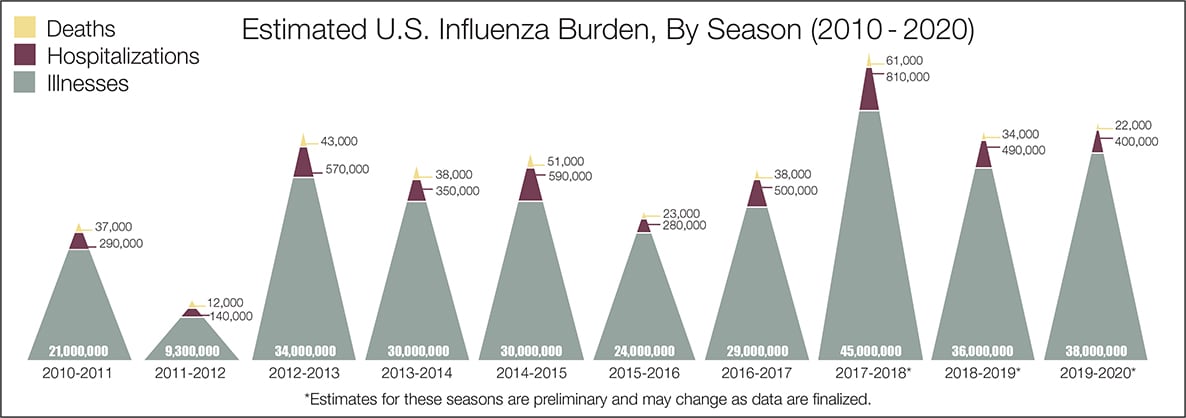
- The real question remains if the U.S. is over-reacting to this virus. The following graphic from the CDC puts the annual flu burden in perspective [click on image to enlarge]. Note that using this data is dangerous as the actual flu cases are estimated and not counted – nobody knows how accurate these guesses are.
What we do not know about the coronavirus [actually there is little scientifically proven information]. Most of our knowledge is anecdotal, from studies with limited subjects, or from studies without peer review.
- How many people have been infected as many do not show symptoms?
- To what degree do people who never develop symptoms contribute to transmission?
- The US has scaled up coronavirus testing – but the accuracy of the tests is in question.
- Can children widely spread coronavirus?
- Why have some places avoided big coronavirus outbreaks – and others hit hard?
- What effect will the weather have? At this point, it does not seem hot weather slows this coronavirus down.
- Outdoor activities seem to be a lower risk than indoor activities.
- Do we develop lasting immunity to the coronavirus? Another coronavirus – the simple cold – does not develop long term immunity.
- Can the world really push out an effective vaccine in 12 to 18 months?
- Will other medical treatments for Covid-19 ease symptoms and reduce deaths?
- A current scientific understanding of the way the coronavirus works can be found [here].
Heavy breakouts of coronavirus have hit farmworkers. Farmworkers are essential to the food supply. They cannot shelter at home. Consider:
- they have high rates of the respiratory disease [occupational hazard]
- they travel on crowded buses chartered by their employers
- few have health insurance
- they cannot social distance and live two to four to a room – and they eat together
- some reports say half are undocumented
- they are low paid and cannot afford not to work – so they will go to work sick
- they do not have access to sanitation when working
- a coronavirus outbreak among farmworkers can potentially shutter entire farm
The bottom line is that COVID-19 so far has been shown to be much more deadly than the data on the flu. Using CDC data, the flu has a mortality rate between 0.06 % and 0.11 % Vs. the coronavirus which to date has a mortality rate of over 5 % – which makes it between 45 and 80 times more deadly. The reason for ranges:
Because influenza surveillance does not capture all cases of flu that occur in the U.S., CDC provides these estimated ranges to better reflect the larger burden of influenza.
There will be a commission set up after this pandemic ends to find fault [it is easy to find fault when a once-in-a-lifetime event occurs] and to produce recommendations for the next time a pandemic happens. Those that hate President Trump will conclude the virus is his fault.
Resources:
- Get the latest public health information from CDC: https://www.coronavirus.gov .
- Get the latest research from NIH: https://www.nih.gov/coronavirus.
- Find NCBI SARS-CoV-2 literature, sequence, and clinical content: https://www.ncbi.nlm.nih.gov/sars-cov-2/.
- List of studies: https://icite.od.nih.gov/covid19/search/#search:searchId=5ee124ed70bb967c49672dad
include(“/home/aleta/public_html/files/ad_openx.htm”); ?>


