


Written by Steven Hansen
The U.S. and Global new cases 7-day rolling average today again set a new record – but this rolling average of new cases is now 29 % higher than one week ago (yesterday it was 32 % so the rate of acceleration is slowing). Death rates due to coronavirus have been holding relatively steady (today’s number was the lowest since the end of March) but some are saying we will see a spike in deaths soon. At the end of this post is a set of interactive graphs and tables for the world and individual states – as well as today’s headlines which include;
- ‘The total number of deaths is going to start going up again’
- ‘Crystal clear’ drunk people can’t socially distance
- Why tick season could be worse in the summer of Covid-19

Have a safe 4th of July weekend.
For a good review of the coronavirus news this week, we have published two posts today which reviews the news this week:
Repeating from past posts, deaths resulting from the coronavirus are relatively low even whilst we hit record highs in new cases. There are two possibilities put forth by the experts:
- Deaths lag new cases by 3 to 5 weeks, This would mean we should begin to see a spike in deaths beginning 11 July 2020. [note: US Surgeon General Dr. Jerome Adams said today “We know deaths lag at least two weeks and can lag even more.” If this is true – deaths should start spiking next week.]
- The current form of the coronavirus may be easier to transmit but not as deadly. This combined with better procedures in dealing with the more severe cases could result in little noticeable spike in deaths. It also should be realized that the U.S. now has one of the highest testing rates in the world which means a higher rate of identification of those who contracted COVID-19 but are not showing symptoms.
My continuing warning is to continue to wash your hands, wear masks, and maintain social distancing. No handwashing, mask, or social distancing will guarantee you do not get infected – but it sure as hell lowers the risk.
The daily number of new cases in the U.S. is remaining stubbornly high, increasing, and the 7-day rolling average continues in record territory.
The following graph showing the 7-day rolling average for new coronavirus cases has been updated through 05 July 2020:

z coronavirus.png
Coronavirus Statistics For 05 July 2020 |
| U.S. Only | Global | U.S Percentage of Total | ||||
| Today*** | Cumulative | Today*** | Cumulative | Today | Cumulative | |
| New Cases | 45,221 | 2,840,000 | 189,605 | 11,240,000 | 23.9% | 25.3% |
| Deaths** | 242 | 129,676 | 4,429 | 530,668 | 5.5% | 24.4% |
| Mortality Rate | 0.5% | 4.6% | 2.3% | 4.7% | ||
total COVID-19 Tests per 1,000 people | 2.18* | 103.36* | ||||
* as of 03 July 2020
** evidently several states included “probable” deaths today in the number
*** red color indicates record number
For the week ending 05 July 2020, both the U.S. and world new cases of coronavirus continue to grow.

For the week ending 05 July 2020, both the U.S. and world deaths due to coronavirus declined – does this mean the world is learning how to successfully treat COVID-19?.

Coronavirus News You May Have Missed
Can face masks lower oxygen levels or weaken the immune system? Here’s what health experts say – CNBC
Research has found that wearing a mask is one of the most effective methods Americans can take to slow the spread of the coronavirus.
Yet health myths about masks flood social media — people worry that wearing masks will lower oxygen levels or cause carbon dioxide poisoning. Others fear they’ll develop bacterial infections from moist, sweaty masks or weaken their immune system’s ability to fight off colds.
Health care professionals have attempted to clarify these misconceptions on social media. A doctor in South Carolina challenged the idea that “oxygen levels drop dramatically while wearing a mask.” Dr. Megan Hall tested her oxygen saturation and heart rate using a pulse oximeter in four situations for five minutes at a time: One without a mask, one with a surgical mask, one with a N95 mask and one with a N95 and surgical mask.
“There is no significant change in my oxygen saturation (or HR) in any scenario. Though it maybe inconvenient for some, you can still breath,” she shared on Facebook.

‘The total number of deaths is going to start going up again’ – The Hill
Former Food and Drug Administration Commissioner Scott Gottlieb warned on Sunday that mortality from coronavirus cases will rise in the near future.
Gottlieb noted that improved understanding of the coronavirus and an increased share of infections in younger people is currently leading to fewer deaths from it, but said on CBS’s “Face the Nation” that “the total number of deaths is going to start going up again as the number of hospitalizations starts to spike again.”
“We’re going to see deaths creep up,” he added. “You’re going to have more deaths, tragically.”
How deadly is the coronavirus? Scientists are searching for a definitive answer. – New York Times
At present, countries have very different case fatality rates, which measure deaths among patients known to have had Covid-19. In most cases, that number is highest in countries that have had the virus the longest.
According to data gathered by The New York Times, China had reported 90,294 cases as of Friday and 4,634 deaths, a case fatality rate of 5 percent. The United States, which has had a record number of new daily cases six times in the past two weeks, was very close to that mark. It has had 2,811,447 cases and 129,403 deaths, about 4.6 percent.
Ten sizable countries, most of them in Western Europe, have tested bigger percentages of their populations than the United States has. Their case fatality rates vary wildly: Iceland’s is less than 1 percent, New Zealand’s and Israel’s are below 2 percent. Belgium, by comparison, is at 16 percent, and Italy and Britain are at 14 percent.
Before last week, the World Health Organization had no official estimate for the infection fatality rate. Instead, it had relied on a mix of data sent in by member countries and academic groups, and on a meta-analysis done in May by scientists at the University of Wollongong and James Cook University in Australia.
Those researchers looked at 267 studies in more than a dozen countries and then chose the 25 they considered the most accurate, weighting them for accuracy, and averaged the data. They concluded that the global infection fatality rate was 0.64 percent.
That percentage of the world’s population equals 47 million people, including two million Americans.
‘Crystal clear’ drunk people can’t socially distance, say police in England – The Guardian
Drunk people are unable to properly socially distance, the chairman of the Police Federation has said as pubs reopened in England for the first time since lockdown.
John Apter said it was “crystal clear” revellers would not adhere to the one metre plus rule as restrictions were eased on Saturday.
Prof Chris Whitty said the pandemic “is a long way from gone” and urged the public to follow social-distancing rules as pubs and restaurants reopened.
But images from London’s Soho showed packed streets into the early hours of Sunday.
Apter, who was on shift in Southampton where he dealt with “naked men, happy drunks, angry drunks, fights and more angry drunks”, said: “What was crystal clear is that drunk people can’t/won’t socially distance.
Why tick season could be worse in the summer of Covid-19 – CNN
After more than three months of shutdowns, mandatory quarantines, self-imposed exile from society and working from home, nature-lovers looking for a well-earned breath of fresh air could face a possible collision course between coronavirus and tick-borne illnesses this summer.
A “perfect storm,” warns Eva Sapi, a University of New Haven biology professor and group director for the Lyme Disease Research Group.
Noting the mild winter on the East Coast, Sapi says, “We do have a bad year for the ticks.”
… Warning signs for tick-borne illnesses are “very similar to the severity that we’ve seen with Covid-19, which is that fever, the muscle aches, the headaches, the severe fatigue,” says Dr. Segal-Maurer.
She believes a unique difference is that breathing problems are common in coronavirus patients, but not with those infected by tick diseases. Yet even that distinction is up for debate.
The following are foreign headlines with hyperlinks to the posts
In Australia, thousands are told they can’t leave their homes, effective immediately.
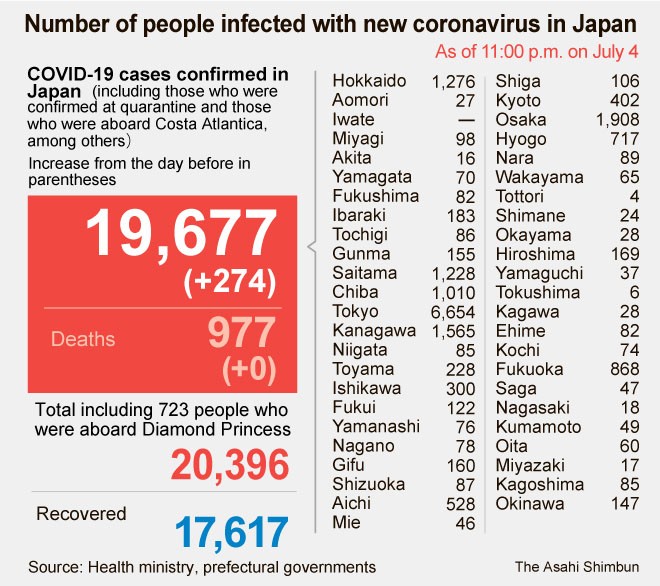
Voters endorse Toyko governor’s handling of the pandemic by re-electing her.
Iran Records Highest Daily Death Toll From COVID-19
City on US-Mexico border too overcrowded to take more Covid-19 patients, governor says
India once again records its highest daily rise in cases, as pandemic grows
Australian Medical Association calls for halt to easing coronavirus restrictions
The following are additional national and state headlines with hyperlinks to the posts
Phoenix mayor: ‘We opened way too early in Arizona’
Miami mayor says city ‘breaking record after record after record’ of coronavirus cases
Top Houston-area official: ‘We’ve got to fundamentally rethink strategy’ in dealing with coronavirus
Houston mayor: Hospitals will be overwhelmed ‘if we don’t get our hands around this virus quickly’
Voters endorse Toyko governor’s handling of the pandemic by re-electing her.
COVID-19: Florida Logs 9,999 New Cases, Percent Positive Increases

Today’s Posts On Econintersect Showing Impact Of The Pandemic With Hyperlinks
Small Business Hardships Highlight Relationship With Lenders In COVID-19 Era
You’ve Got Money: Mobile Payments Help People During The Pandemic
Coronavirus Disease Weekly News 04July 2020
Coronavirus Economic Weekly News 04July 2020
Is Swine Flu Going To Be The Next Pandemic?
Supply Versus Demand: Unemployment And Inflation In The Covid-19 Recession
Florida Sets New Single-Day Record Of Over 11,400 Coronavirus Cases
Coronavirus INTERACTIVE Charts
include($_SERVER[‘DOCUMENT_ROOT’].’/pages/coronavirus.htm’); ?>
Analyst Opinion of Coronavirus Data
There are several takeaways that need to be understood when viewing coronavirus statistical data:
- The global counts are suspect for a variety of reasons including political. Even the U.S. count has issues as it is possible that as much as half the population has had coronavirus and was asymptomatic. It would be a far better metric using a random sampling of the population weekly. In short, we do not understand the size of the error in the tracking numbers.
- Just because some of the methodology used in aggregating the data in the U.S. is flawed – as long as the flaw is uniformly applied – you establish a baseline. This is why it is dangerous to compare two countries as they likely use different methodologies to determine who has (and who died) from coronavirus.
- COVID-19 and the flu are different but can have similar symptoms. For sure, COVID-19 so far is much more deadly than the flu. [click here to compare symptoms]
- From an industrial engineering point of view, one can argue that it is best to flatten the curve only to the point that the health care system is barely able to cope. This solution only works if-and-only-if one can catch this coronavirus once and develops immunity. In the case of COVID-19, herd immunity may need to be in the 80% to 85% range. WHO warns that few have developed antibodies to COVID-19. At this point, herd immunity does not look like an option.
- Older population countries will have a higher death rate.
- There are at least 8 strains of the coronavirus. New York may have a deadlier strain imported from Europe, compared to less deadly viruses elsewhere in the United States.
- Each publication uses different cutoff times for its coronavirus statistics. Our data uses 11:00 am London time. Also, there is an unexplained variation in the total numbers both globally and in the U.S.
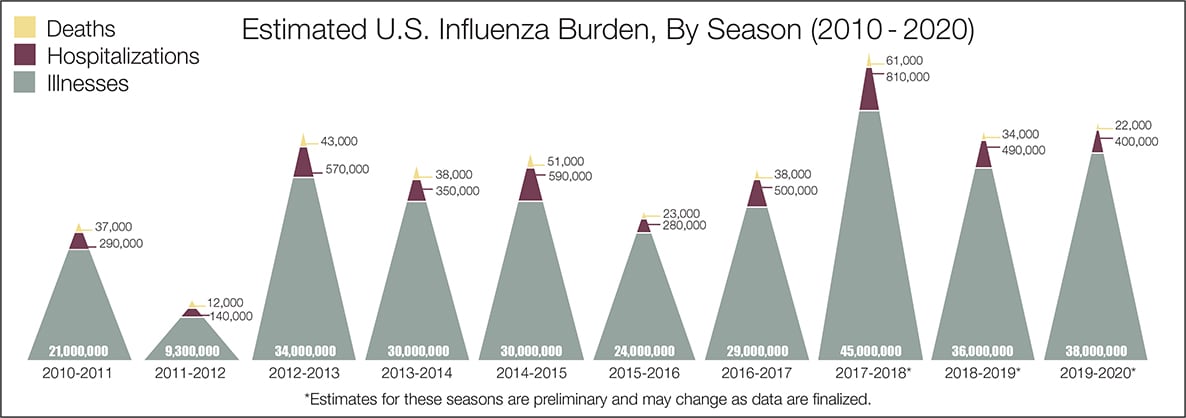
- The real question remains if the U.S. is over-reacting to this virus. The following graphic from the CDC puts the annual flu burden in perspective [click on image to enlarge]. Note that using this data is dangerous as the actual flu cases are estimated and not counted – nobody knows how accurate these guesses are.
What we do not know about the coronavirus [actually there is little scientifically proven information]. Most of our knowledge is anecdotal, from studies with limited subjects, or from studies without peer review.
- How many people have been infected as many do not show symptoms?
- To what degree do people who never develop symptoms contribute to transmission?
- The US has scaled up coronavirus testing – but the accuracy of the tests is in question.
- Can children widely spread coronavirus?
- Why have some places avoided big coronavirus outbreaks – and others hit hard?
- What effect will the weather have? At this point, it does not seem hot weather slows this coronavirus down.
- Outdoor activities seem to be a lower risk than indoor activities.
- Do we develop lasting immunity to the coronavirus? Another coronavirus – the simple cold – does not develop long term immunity.
- Can the world really push out an effective vaccine in 12 to 18 months?
- Will other medical treatments for Covid-19 ease symptoms and reduce deaths?
- A current scientific understanding of the way the coronavirus works can be found [here].
Heavy breakouts of coronavirus have hit farmworkers. Farmworkers are essential to the food supply. They cannot shelter at home. Consider:
- they have high rates of the respiratory disease [occupational hazard]
- they travel on crowded buses chartered by their employers
- few have health insurance
- they cannot social distance and live two to four to a room – and they eat together
- some reports say half are undocumented
- they are low paid and cannot afford not to work – so they will go to work sick
- they do not have access to sanitation when working
- a coronavirus outbreak among farmworkers can potentially shutter entire farm
The bottom line is that COVID-19 so far has been shown to be much more deadly than the data on the flu. Using CDC data, the flu has a mortality rate between 0.06 % and 0.11 % Vs. the coronavirus which to date has a mortality rate of over 5 % – which makes it between 45 and 80 times more deadly. The reason for ranges:
Because influenza surveillance does not capture all cases of flu that occur in the U.S., CDC provides these estimated ranges to better reflect the larger burden of influenza.
There will be a commission set up after this pandemic ends to find fault [it is easy to find fault when a once-in-a-lifetime event occurs] and to produce recommendations for the next time a pandemic happens. Those that hate President Trump will conclude the virus is his fault.
Resources:
- Get the latest public health information from CDC: https://www.coronavirus.gov .
- Get the latest research from NIH: https://www.nih.gov/coronavirus.
- Find NCBI SARS-CoV-2 literature, sequence, and clinical content: https://www.ncbi.nlm.nih.gov/sars-cov-2/.
- List of studies: https://icite.od.nih.gov/covid19/search/#search:searchId=5ee124ed70bb967c49672dad
include(“/home/aleta/public_html/files/ad_openx.htm”); ?>


