


Written by Steven Hansen
The U.S. new cases again set a new record – and today’s U.S. 7 day rolling average of new cases is now 37 % higher than one week ago (yesterday it was 40 %). Death rates due to coronavirus have been holding relatively steady but some are saying we will see a spike in deaths soon. At the end of this post is a set of interactive graphs and tables for the world and individual states – as well as today’s headlines which include;
- New Version Of Coronavirus Spreads Faster But Doesn’t Make People Sicker: Study
- CDC forecast projects nearly 148,000 US coronavirus deaths by July 25
- Fitch has downgraded a record number of sovereign ratings due to the coronavirus. It’s not done yet
- Singapore faces its worst-ever dengue outbreak just as it begins to control coronavirus second wave
- U.S. Surpasses Global Record For New COVID-19 Cases Recorded In A Day

Have a safe 4th of July weekend.
Deaths resulting from the coronavirus are relatively low even whilst we hit record highs in new cases. There are two possibilities put forth by the experts:
- Deaths lag new cases by 3 to 5 weeks, This would mean we should begin to see a spike in deaths beginning 11 July 2020. [note: US Surgeon General Dr. Jerome Adams said today “We know deaths lag at least two weeks and can lag even more.” If this is true – deaths should start spiking next week.]
- The current form of the coronavirus may be easier to transmit but not as deadly. This combined with better procedures in dealing with the more severe cases could result in little noticeable spike in deaths. It also should be realized that the U.S. now has one of the highest testing rates in the world which means a higher rate of identification of those who contracted COVID-19 but are not showing symptoms.
My continuing warning is to continue to wash your hands, wear masks, and maintain social distancing. No handwashing, mask, or social distancing will guarantee you do not get infected – but it sure as hell lowers the risk.
The number of new cases in the U.S. is remaining stubbornly high, increasing, and the 7-day rolling average continues in record territory.
The following graph showing the 7-day rolling average for new coronavirus cases has been updated through 03 July 2020:

z coronavirus.png
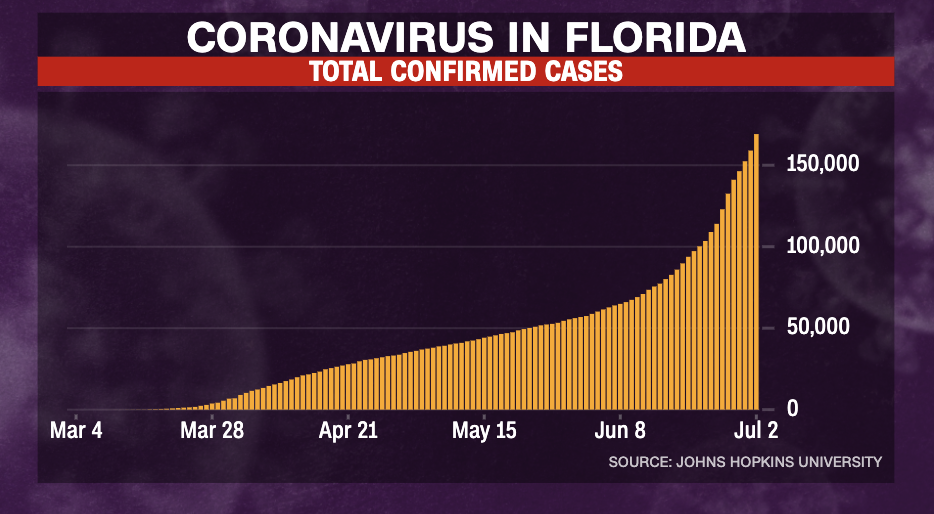
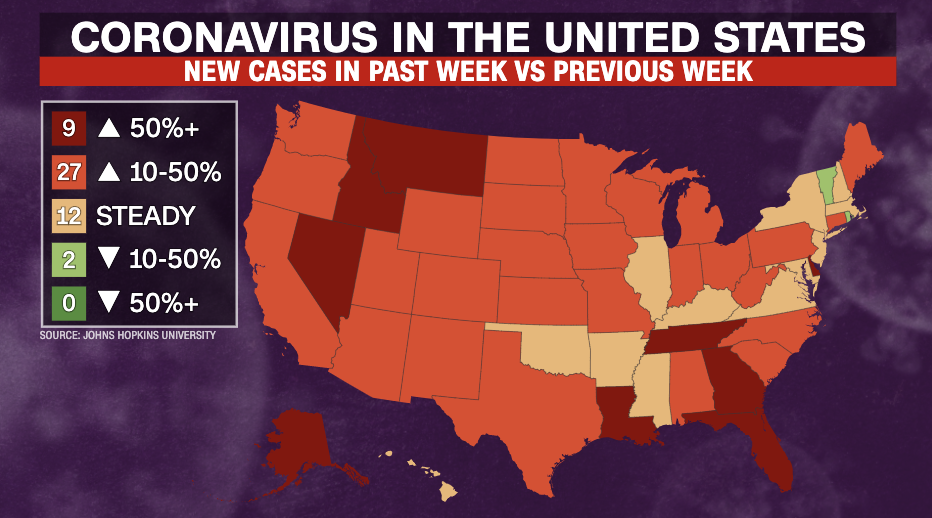
Coronavirus Statistics For 03 July 2020 |
| U.S. Only | Global | U.S Percentage of Total | ||||
| Today*** | Cumulative | Today*** | Cumulative | Today | Cumulative | |
| New Cases | 53,399 | 2,740,000 | 179,073 | 10,850,000 | 29.8% | 25.3% |
| Deaths** | 678 | 128,740 | 5,141 | 521,113 | 13.2% | 24.7% |
| Mortality Rate | 1.3% | 4.7% | 2.9% | 4.8% | ||
total COVID-19 Tests per 1,000 people | 1.92* | 101.9* | ||||
* as of 02 July 2020
** evidently several states included “probable” deaths today in the number
*** red color indicates record number
Coronavirus News You May Have Missed
New Version Of Coronavirus Spreads Faster But Doesn’t Make People Sicker: Study – Republic World
A study has confirmed that a new mutated version of coronavirus has spread from Europe to the United States. The study found that the new virus spreads much faster than earlier variations of the disease, but doesn’t seem to make people any sicker. The study said that even though COVID-19 sequence diversity is very low, natural selection can sometimes act upon rare favorable mutations. The mutated version of the virus named G614 first emerged in Europe in February and completely replaced the earlier one called D614 from the region and also from the United States.
G614 is associated with potentially higher viral loads in COVID-19 patients but not with disease severity,” the study stated. “Our global tracking data show that the G614 variant in Spike has spread faster than D614. We interpret this to mean that the virus is likely to be more infectious. Interestingly, we did not find evidence of G614 impact on disease severity; i.e., it was not significantly associated with hospitalization status,” the study added further.

CDC forecast projects nearly 148,000 US coronavirus deaths by July 25 – COVID-19 News
An ensemble forecast published by the US Centers for Disease Control and Prevention now projects nearly 148,000 coronavirus deaths in the United States by July 25.
This week’s national forecast relies on 24 individual forecasts from outside institutions and researchers. The new projections, published Thursday, forecast 147,865 deaths by July 25, with a possible range of about 139,000 to 161,000 deaths.
“THE STATE-LEVEL ENSEMBLE FORECASTS SUGGEST THAT THE NUMBER OF NEW DEATHS OVER THE NEXT FOUR WEEKS IN ARIZONA, ARKANSAS, FLORIDA, IDAHO, NEVADA, OKLAHOMA, OREGON, SOUTH CAROLINA, TEXAS, UTAH, AND WYOMING WILL LIKELY EXCEED THE NUMBER REPORTED OVER THE LAST FOUR WEEKS,” THE CDC SAYS ON ITS FORECASTING WEBSITE.
“For other states, the number of new deaths is expected to be similar to the number seen in the previous four weeks or to decrease slightly,” the forecast adds.
The US approves a new test that detects both flu and coronavirus – CDC
Earlier today, the US Food and Drug Administration authorized a new test that diagnoses both influenza and the novel coronavirus.
The test, designed by the US Centers for Disease Control and Prevention (CDC), is the first dual test to get emergency use authorization from the FDA.
“With the authorization of these tests, the FDA is helping address concerns in anticipation of this upcoming flu season during the Covid-19 pandemic, which might be especially worrying for some Americans,” FDA Commissioner Stephen Hahn said in a statement.
Gilead’s COVID-19 antiviral remdesivir gets conditional EU clearance – Reuters
The European Commission said on Friday it had given conditional approval for the use of antiviral remdesivir in severe COVID-19 patients following an accelerated review process, making it the region’s first authorised therapy to treat the virus.
The move comes just a week after the European Medicines Agency (EMA) gave its go-ahead for the drug, produced by Gilead Sciences (GILD.O), to be used in adults and adolescents from 12 years of age who are also suffering from pneumonia and require oxygen support.
It also comes just days after the company allocated nearly all of its supply of remdesivir to the United States over the next three months, stirring concerns about availability elsewhere.
“We will leave no stone unturned in our efforts to secure efficient treatments or vaccine against the coronavirus,” said Stella Kyriakides, EU Commissioner for Health and Food Safety, in a statement.
The Commission said on Wednesday it was in negotiations with Gilead to obtain doses of remdesivir for the 27 European Union countries.
U.S. Surpasses Global Record For New COVID-19 Cases Recorded In A Day – NPR
[editor’s note: we use the EU’s CDC as our reporting source which because of different cutoffs has a slightly different daily numbers due to cutoff times – however the grand totals are dead on.]
The United States has reached a daily global record for the coronavirus pandemic — reporting more than 55,000 new COVID-19 cases. The daily U.S. tally stood at 55,274 late Thursday, which exceeds the previous single-day record of 54,771 set by Brazil on June 19.
Johns Hopkins University & Medicine’s Coronavirus Resource Center, which tracks the virus worldwide, says the total number of cases reported in the U.S. stands at 2,739,879, an increase of 53,399 over Wednesday’s figure.
Brazil has the next highest number of cases with 1,496,858. Russia rounds out the top three with 660,231 cases. U.S. deaths attributed to the coronavirus stands at 128,740. Brazil ranks second with 61,884 deaths and the United Kingdom third with 44,080 deaths.
As infections spike in the U.S., a number of states are taking action to try to slow the spread of cases.
Why Fireworks Are Popping Up in States Where They’re Illegal – YouTube
[editor’s note: as many fireworks displays for the Fourth of July were canceled due to the pandemic, many are resorting to creating their own fireworks displays]
There has been a mysterious surge in fireworks across the country, from densely populated cities to suburbs where fireworks are equally illegal. New Yorkers fed up with their city’s failure to curb the thousands of noisy fireworks being set off each night surrounded the mayor’s mansion last night. Protesters honked their car horns to awaken the mayor to show him what they’ve been living through. Some suspect fireworks are being brought across state lines from places with more relaxed laws.
Secret Service members who helped organize Pence Arizona trip test positive for COVID-19: report – The Hill
Multiple Secret Service agents tasked with planning Vice President Pence’s trip to Arizona this week were reportedly removed from the trip after showing signs of coronavirus infection, sources with knowledge of the situation told The Washington Post.
As many as 10 Secret Service and other law enforcement agents working on the trip were replaced after showing symptoms of the virus and at least one tested positive for the disease, two senior administration officials, speaking on terms of anonymity, told the newspaper.
A USSS spokesperson declined to confirm that any agents were removed from the trip over COVID-19 concerns, and told The Hill in an email that the agency “continues to operate in compliance with the Centers for Disease Control and Prevention recommendations through the U.S. Secret Service Office of Safety, Health and Environmental Programs (SAF).”
Fitch has downgraded a record number of sovereign ratings due to the coronavirus. It’s not done yet – GETAKA
Fitch Ratings has downgraded a record 33 sovereign ratings in the first half of this year — and the agency is not done yet as the coronavirus pandemic pummels government finances.
James McCormack, Fitch’s global head of sovereign ratings, said the agency has placed the credit ratings of 40 countries or sovereign entities on a “negative” outlook. That means those ratings have the potential to be downgraded.
“We’ve never in the history of Fitch Ratings had 40 countries on negative outlook at the same time,” he told CNBC’s “Capital Connection” on Friday.
“That comes after we’ve already downgraded in the first half of the year 33 sovereigns. We’ve never downgraded 33 in any given year, so we’ve already done it in half a year,” he added.
Sovereign credit ratings that Fitch has downgraded include the U.K., Australia and Hong Kong.
Administration issues coronavirus guidelines for air travel – News Break
The Trump administration on Thursday released guidelines that strongly recommend that airplane passengers wear masks when they fly amid the coronavirus pandemic. The guidelines were issued jointly by the Department of Transportation (DOT), Department of Homeland Security (DHS) and the Department of Health and Human Services (HHS).
“Airlines and airports are strongly encouraged to require that everyone correctly wear a mask or cloth face covering in shared spaces,” officials said in the guidelines. “Wearing a mask or cloth face covering is particularly necessary any time social distancing cannot be maintained.”
Most of the country’s large airline companies now require passengers to wear masks while flying and won’t let them board without a mask.
The guidelines noted exceptions to the recommendation such as “children under age 2, or anyone who has a medical condition that causes trouble breathing.”
Chief Medical Officer warns coronavirus is ‘a long way from gone’ as pub set to reopen – Mirror
England’s Chief Medical Officer has warned we are walking a “narrow path” between economic catastrophe and a spike in the coronavirus as lockdown is eased.
Professor Chris Whitty warned that “this virus is a long way from gone” as he appeared with the Prime Minister on the eve of pubs reopening across England.
He added: “It is not going to be gone for a long time
“Nobody watching this believes this is a risk-free next step.
“We have to be absolutely serious about it.”
He urged people to keep following social distancing rules as lockdown restrictions are eased, adding: “If individuals, families and firms do not take them seriously the possibility of a second wave goes up sharply.”
Singapore faces its worst-ever dengue outbreak just as it begins to control coronavirus second wave – Daily Mail
- Singapore was one of the first countries outside China to be hit by coronavirus
- City-state was initially praised for suppressing the disease, before second wave
- Lockdown and contact tracing has helped get latest outbreak under control
- It is now facing its worst-ever outbreak of dengue fever, with 14,000 cases so far
The following are foreign headlines with hyperlinks to the posts
England To Lift Quarantine Rule For More Than 50 Nations — But Not For The U.S.
Pubs are reopening in Britain, and Boris Johnson urges people not to ‘overdo it.’
Alarm grows over Americans stranded in Yemen amid pandemic
UK says Americans must still quarantine despite loosened restrictions
Air France planning to cut 7,500 jobs by 2022 amid industry slump
Pakistani Foreign Minister Tests Positive for COVID-19
The pandemic could leave 41 million people unemployed in Latin American and the Caribbean
The following are additional national and state headlines with hyperlinks to the posts
LA Sheriff To Fine $300 For Not Wearing A Mask In Public
In Arizona, Nearly 1 In 4 Coronavirus Tests Now Comes Back Positive
Face Masks Mandatory In Most Of Texas, Starting Friday
More than 100 Seattle students living in frat houses test positive for coronavirus
Governor puts two week pause on further reopening in Washington state, strengthens mask order
Members of Red Sox test positive for COVID-19, team confirms
More than 20 percent of coronavirus tests were positive in South Carolina Thursday
About 43% of California’s total Covid-19 cases are located in Los Angeles County
North Carolina reports highest one-day increase of new coronavirus cases
158 Covid-19 cases linked to one bar in Michigan, health official says
Puerto Rico will require Covid-19 test results from visitors
Today’s Posts On Econintersect Showing Impact Of The Pandemic With Hyperlinks
Rail Week Ending 27 June 2020 – June Down 14.3% Year-over-Year
Annual Real GDP Will Be 3.4% Lower Than Projected In January Due To Coronavirus
Seven In 10 Firms Sought Financial Help During The COVID-19 Crisis
Infographic Of The Day: How Technology Can Help The Economy Recover From The Coronavirus
Infographic Of The Day: How Technology Can Help The Economy Recover From The Coronavirus
Coronavirus INTERACTIVE Charts
include($_SERVER[‘DOCUMENT_ROOT’].’/pages/coronavirus.htm’); ?>
Analyst Opinion of Coronavirus Data
There are several takeaways that need to be understood when viewing coronavirus statistical data:
- The global counts are suspect for a variety of reasons including political. Even the U.S. count has issues as it is possible that as much as half the population has had coronavirus and was asymptomatic. It would be a far better metric using a random sampling of the population weekly. In short, we do not understand the size of the error in the tracking numbers.
- Just because some of the methodology used in aggregating the data in the U.S. is flawed – as long as the flaw is uniformly applied – you establish a baseline. This is why it is dangerous to compare two countries as they likely use different methodologies to determine who has (and who died) from coronavirus.
- COVID-19 and the flu are different but can have similar symptoms. For sure, COVID-19 so far is much more deadly than the flu. [click here to compare symptoms]
- From an industrial engineering point of view, one can argue that it is best to flatten the curve only to the point that the health care system is barely able to cope. This solution only works if-and-only-if one can catch this coronavirus once and develops immunity. In the case of COVID-19, herd immunity may need to be in the 80% to 85% range. WHO warns that few have developed antibodies to COVID-19. At this point, herd immunity does not look like an option.
- Older population countries will have a higher death rate.
- There are at least 8 strains of the coronavirus. New York may have a deadlier strain imported from Europe, compared to less deadly viruses elsewhere in the United States.
- Each publication uses different cutoff times for its coronavirus statistics. Our data uses 11:00 am London time. Also, there is an unexplained variation in the total numbers both globally and in the U.S.
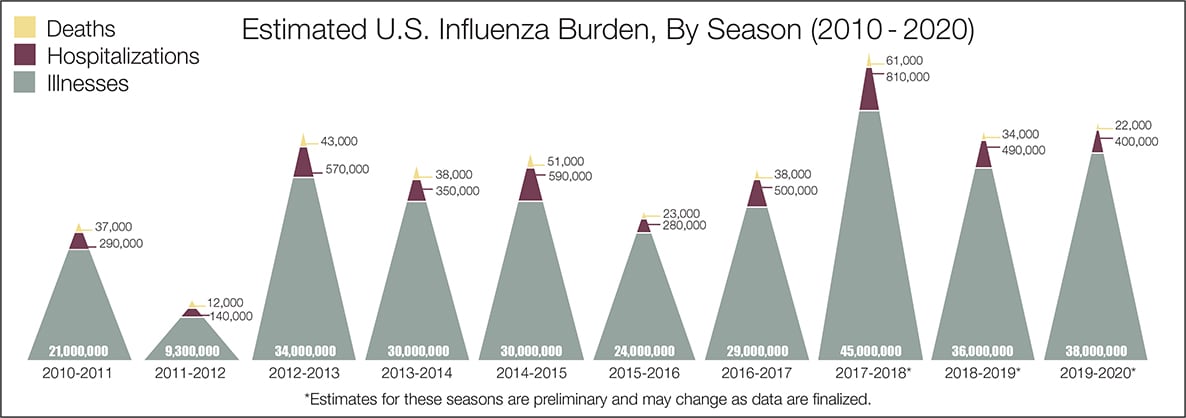
- The real question remains if the U.S. is over-reacting to this virus. The following graphic from the CDC puts the annual flu burden in perspective [click on image to enlarge]. Note that using this data is dangerous as the actual flu cases are estimated and not counted – nobody knows how accurate these guesses are.
What we do not know about the coronavirus [actually there is little scientifically proven information]. Most of our knowledge is anecdotal, from studies with limited subjects, or from studies without peer review.
- How many people have been infected as many do not show symptoms?
- To what degree do people who never develop symptoms contribute to transmission?
- The US has scaled up coronavirus testing – but the accuracy of the tests is in question.
- Can children widely spread coronavirus?
- Why have some places avoided big coronavirus outbreaks – and others hit hard?
- What effect will the weather have? At this point, it does not seem hot weather slows this coronavirus down.
- Outdoor activities seem to be a lower risk than indoor activities.
- Do we develop lasting immunity to the coronavirus? Another coronavirus – the simple cold – does not develop long term immunity.
- Can the world really push out an effective vaccine in 12 to 18 months?
- Will other medical treatments for Covid-19 ease symptoms and reduce deaths?
- A current scientific understanding of the way the coronavirus works can be found [here].
Heavy breakouts of coronavirus have hit farmworkers. Farmworkers are essential to the food supply. They cannot shelter at home. Consider:
- they have high rates of the respiratory disease [occupational hazard]
- they travel on crowded buses chartered by their employers
- few have health insurance
- they cannot social distance and live two to four to a room – and they eat together
- some reports say half are undocumented
- they are low paid and cannot afford not to work – so they will go to work sick
- they do not have access to sanitation when working
- a coronavirus outbreak among farmworkers can potentially shutter entire farm
The bottom line is that COVID-19 so far has been shown to be much more deadly than the data on the flu. Using CDC data, the flu has a mortality rate between 0.06 % and 0.11 % Vs. the coronavirus which to date has a mortality rate of over 5 % – which makes it between 45 and 80 times more deadly. The reason for ranges:
Because influenza surveillance does not capture all cases of flu that occur in the U.S., CDC provides these estimated ranges to better reflect the larger burden of influenza.
There will be a commission set up after this pandemic ends to find fault [it is easy to find fault when a once-in-a-lifetime event occurs] and to produce recommendations for the next time a pandemic happens. Those that hate President Trump will conclude the virus is his fault.
Resources:
- Get the latest public health information from CDC: https://www.coronavirus.gov .
- Get the latest research from NIH: https://www.nih.gov/coronavirus.
- Find NCBI SARS-CoV-2 literature, sequence, and clinical content: https://www.ncbi.nlm.nih.gov/sars-cov-2/.
- List of studies: https://icite.od.nih.gov/covid19/search/#search:searchId=5ee124ed70bb967c49672dad
include(“/home/aleta/public_html/files/ad_openx.htm”); ?>


