


Written by Steven Hansen
The non-seasonally adjusted S and P CoreLogic Case-Shiller home price index (20 cities – although only 19 cities this month) year-over-year rate of home price growth improved from 3.9 % to 4.0 %. The index authors stated, “… April’s housing price data continue to be remarkably stable”.

Analyst Opinion of Case-Shiller HPI
All home price indices are continuing to show home price growth is accelerating year-over-year. It is interesting that the coronavirus had little effect on home prices. However, the impact has varied significantly at the local level.
- 20 city unadjusted home price rate of growth accelerated by 0.1 % month-over-month. [Econintersect uses the change in year-over-year growth from month-to-month to calculate the change in the rate of growth]
- Note that the Case-Shiller index is an average of the last three months of data.
- The market expected from Econoday:
| Consensus Range | Consensus | Actual | |
| 20-city, SA – M/M | 0.4 % to 0.6 % | +0.5 % | +0.3 % |
| 20-city, NSA – M/M | -0.6 % to 1.0 % | +1.0 % | +0.9% |
| 20-city, NSA – Yr/Yr | 2.5 % to 4.1 % | +3.6 % | +4.0 % |
S&P/Case-Shiller Home Price Indices Year-over-Year Change
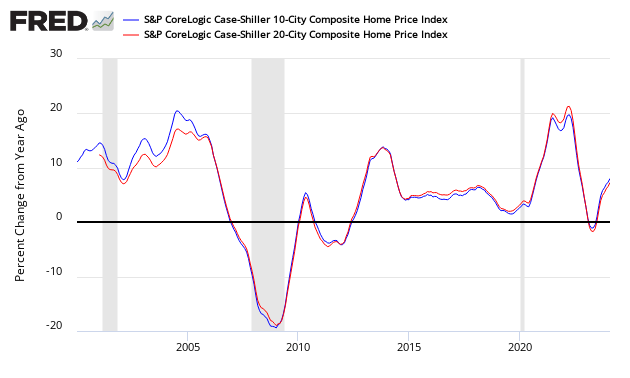
Comparing the NAR and Case-Shiller home price indices, it needs to be understood each of the indices uses a unique methodology in compiling their index – and no index is perfect.

The way to understand the dynamics of home prices is to watch the direction of the rate of change. Here home price growth generally appears to stabilize (rate of growth not rising or falling).

There are some differences between the indices on the rate of “recovery” of home prices.
When asked what today’s release means for the housing market, Selma Hepp, deputy chief economist for CoreLogic said,
While actions to mitigate the pandemic have varied, everyone has been affected by COVID-19 – and the impact has not been even across local economies or housing markets. Nevertheless, some of the tailwinds that supported the demand coming into 2020, such as demographics and low mortgage rates, remain intact and may even accelerate demand. Still, supply headwinds, such as declining for-sale inventories, will continue to keep a lid on the number of transactions but also push up home price growth.
A synopsis of Authors of the Leading Indices:
Case Shiller’s Craig J. Lazzara, Managing Director and Global Head of Index Investment Strategy at S&P Dow Jones Indices stated:
April’s housing price data continue to be remarkably stable. The National Composite Index rose by 4.7% in April 2020, with comparable growth in the 10- and 20-City Composites (up 3.4% and 4.0%, respectively). In all three cases, April’s year-over-year gains were ahead of March’s, continuing a trend of gently accelerating home prices that began last fall. Results in April continued to be broad-based. Prices rose in each of the 19 cities for which we have reported data, and price increases accelerated in 12 cities.
As was the case in March, we have data from only 19 cities this month, since transactions records for Wayne County, Michigan (in the Detroit metropolitan area) continue to be unavailable. This is, so far, the only directly visible impact of COVID-19 on the S&P CoreLogic Case-Shiller Indices. The price trend that was in place pre-pandemic seems so far to be undisturbed, at least at the national level. Indeed, prices in 12 of the 20 cities in our survey were at an all-time high in April.
Among the cities, Phoenix retains the top spot for the 11th consecutive month, with a gain of 8.8% for April. Home prices in Seattle rose by 7.3%, followed by increases in Minneapolis (6.4%) and Cleveland (6.0%). Prices were particularly strong in the West and Southeast, and comparatively weak in the Northeast.
CoreLogic believes home prices will remain firm moving forward (April 2020 Data). Per Dr. Frank Nothaft, chief economist at CoreLogic and Frank Martell, president and CEO of CoreLogic stated:
The very low inventory of homes for sale, coupled with homebuyers’ spur of record-low mortgage rates, will likely continue to support home price growth during the spring. If unemployment remains elevated in early 2021, then we can expect home prices to soften. Our forecast has home prices down in 12 months across 41 states.
Tight supply and pent-up demand, particularly among millennials, provides optimism for a bounce-back in the housing market purchase activity and home prices over the medium term. The next 12 to 18 months are going to be very tough times for the broader economy. As employment and economic activity begin to pick up, as it will surely do, we expect housing to be a driver in a national recovery.y remain in place. Once the shelter-in-place policies are lifted, we expect millennials, who submitted home-purchase applications well into the crisis, to lead the way back to a positive, purchase-driven housing cycle
The National Association of Realtors says (May 2020 data):
Sales completed in May reflect contract signings in March and April – during the strictest times of the pandemic lockdown and hence the cyclical low point. Home sales will surely rise in the upcoming months with the economy reopening, and could even surpass one-year-ago figures in the second half of the year.
New home construction needs to robustly ramp up in order to meet rising housing demand. Otherwise, home prices will rise too fast and hinder first-time buyers, even at a time of record-low mortgage rates.
The U.S. Federal Housing Finance Agency produces an All-Transactions House Price Index for the United States:

Econintersect publishes knowledgeable views of the housing market.
Caveats on the Use of Home Price Indices
The housing price decline seen since 2005 varies by zip code – and seems to have ended somewhere around the beginning of the 2Q2012. Every area of the country has differing characteristics. Since January 2006, the housing declines in Charlotte and Denver are well less than 10%, while Las Vegas home prices had declined by almost 60%.
Each home price index uses a different methodology – and this creates slightly different answers.
The most broadly based index is the US Federal Housing Finance Agency’s House Price Index (HPI) – a quarterly broad measure of the movement of single-family house prices. This index is a weighted, repeat-sales index on the same properties in 363 metro centers, compared to the 20 cities Case-Shiller.
The US Federal Housing Finance Agency also has an index (HPIPONM226S) based on 6,000,000 same home sales – a much broader index than Case-Shiller. Also, there is a big difference between home prices and owner’s equity (OEHRENWBSHNO) which has been included in the graph below.
Comparing Various Home Price Indices to Owner’s Equity (blue line)


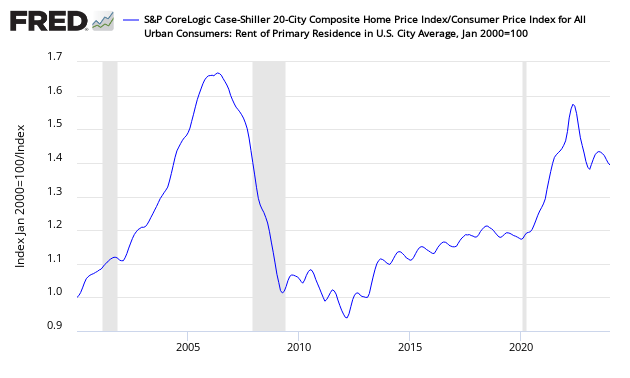
The affordability factor favors rental vs owning.
Price to Rent Ratio – Indexed on January 2000 – Based on Case-Shiller 20 cities index ratio to CPI Rent Index
include(“/home/aleta/public_html/files/ad_openx.htm”); ?>


