


Written by Steven Hansen
The U.S. new cases are still seeing accelerated growth – and today’s 7 day rolling average of new cases is now 34 % higher than one week ago (yesterday it was 32 %). At the end of this post is a set of interactive graphs and tables for the world and individual states – as well as today’s headlines which include;
- The coronavirus pandemic has moved into younger populations in US
- Coronavirus antibody tests work best 2 to 5 weeks after symptoms
- GAO report finds widespread delays in US government response to Coronavirus
- CDC says no clear evidence coronavirus quarantines for travelers, like in New York, work
- Virus pummels commercial real estate, could end long boom

My continuing warning is to continue to wear masks and maintain social distancing. No mask or social distancing will guarantee you do not get infected – but it sure as hell lowers the risk.
The number of new cases in the U.S. is remaining stubbornly high and increasing. Some sources are saying that today was a record day at 38,672 (this is from the COVID Tracking Project). We use a different tracking source but the overall numbers pretty much line up. But in any event, the outbreak new cases are accelerating – and is in the territory where there is a chance the economy will be locked down again.
The following graph showing the 7-day rolling average for new coronavirus cases has been updated through 25 June 2020:

z coronavirus.png
Coronavirus Statistics For 25 June 2020 |
| U.S. Only | Global | U.S Percentage of Total | ||||
| Today | Cumulative | Today | Cumulative | Today | Cumulative | |
| New Cases | 34,339 | 2,380,000 | 170,912 | 9,400,000 | 20.1% | 25.3% |
| Deaths | 751 | 121,979 | 5,197 | 482,468 | 14.5% | 25.3% |
| Mortality Rate | 2.2% | 5.1% | 3.0% | 5.1% | ||
total COVID-19 Tests per 1,000 people | 1.40* | 83.24* | ||||
* as of 22 June 2020
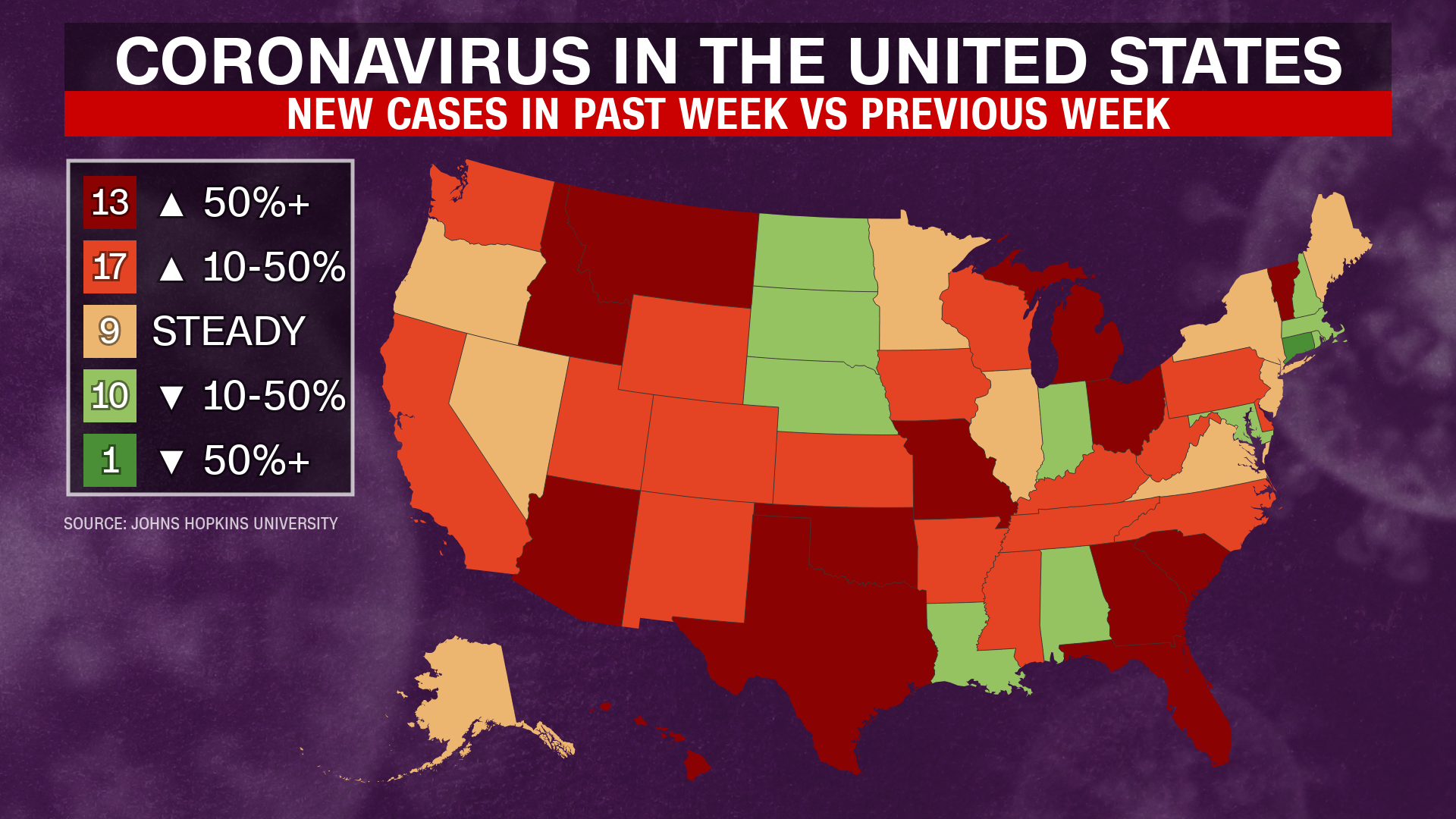
60% of US states are reporting increases in new cases – CNN
Coronavirus News You May Have Missed
CDC chief: Covid-19 infections could be 10 times higher than confirmed cases – Politico
CDC Director Robert Redfield on Thursday said the number of coronavirus infections in the U.S. could be 10 times higher than the confirmed case count — meaning a total of more than 20 million.
“Our best estimate right now is for every case reported there were actually 10 other infections,” Redfield said during a call with reporters, referencing data from antibody tests that show who has been exposed to the virus.
He added that with cases spiking across the country, Americans should continue social distancing and wearing face coverings. He particularly singled out younger people, under the age of 50, who have accounted for an uptick in cases as states began to reopen.
“I’m asking people to recognize we’re in a different situation today than we were in March and April where the virus was disproportionately being recognized in older adults,” he said.
The coronavirus pandemic has moved into younger populations in US, CDC says – CNN
The coronavirus pandemic has moved into younger populations across much of the US, a change that could mean less serious illness and lower rates of death, the US Centers for Disease Control and Prevention said Thursday.
“It is obvious that we are seeing right now infections that are targeting younger individuals,” CDC Director Dr. Robert Redfield said during a media telebriefing.
Younger people may not be taking the risk of pandemic spread as seriously as they should, CDC’s Dr. Jay Butler added. “We may need to get out the message that young people are not somehow naturally immune to this virus, although they may be at lower risk of severe infection,” he said.
The risk of serious complications and death rises with age, the CDC says, although there’s no clear age cutoff for higher or lower risk. People with diabetes, kidney disease, moderate to severe asthma, and obesity are also at higher risk.
Coronavirus antibody tests work best 2 to 5 weeks after symptoms – Cochrane Library
The review shows that antibody tests could have a useful role in detecting if someone has had COVID‐19, but the timing of when the tests are used is important. Antibody tests may help to confirm COVID‐19 infection in people who have had symptoms for more than two weeks and do not have a RT‐PCR test, or have negative RT‐PCR test results. The tests are better at detecting COVID‐19 in people two or more weeks after their symptoms started, but we do not know how well they work more than five weeks after symptoms started. We do not know how well the tests work for people who have milder disease or no symptoms, because the studies in the review were mainly done in people who were in hospital. In time, we will learn whether having previously had COVID‐19 provides individuals with immunity to future infection.
Further research is needed into the use of antibody tests in people recovering from COVID‐19 infection, and in people who have experienced mild symptoms or who never experienced symptoms.
GAO report finds widespread delays in US government response to Coronavirus – CNN
A new Government Accountability Office report out Thursday highlights how unprepared the US government was to tackle coronavirus and deal with the corresponding economic crisis that required Congress to get trillions in federal stimulus dollars out the door.
The report — which is just the latest look at the US government’s response to the coronavirus — lays out how the US fell short on everything from testing to ensuring hospitals and states had adequate supplies. It also looks closely at how agencies struggled to ensure billions in stimulus dollars got to American struggling with an economic crisis.
“Both the Congress and the administration have acted to mobilize resources quickly to help the nation respond to and recover from the pandemic. However, the negative effects of the pandemic on families, communities, and health care systems and on the long-term economic condition of millions of Americans and U.S. businesses are likely to persist into the future,” the report states.
$1.4 Billion in Coronavirus Stimulus Checks Went to Dead People, Government Watchdog Finds – Newsweek
The federal government mistakenly sent more than $1.4 billion in coronavirus stimulus checks to dead people earlier this year in the flurry to get money to people hurting as businesses across the country shut down to slow the virus’ spread, according to a government watchdog’s new report.
The Government Accountability Office’s first review of the federal government’s response to the coronavirus describes a series of confusions and contradictory rules that left gaps that created the potential for fraud in the massive direct payment program for individuals.
CDC says no clear evidence coronavirus quarantines for travelers, like in New York, work – CNBC
There’s no clear evidence out-of-state quarantines like those imposed by New York, New Jersey and Connecticut are effective in containing the coronavirus, the Centers for Disease Control and Prevention said Thursday.
On Wednesday, New York Gov. Andrew Cuomo announced that travelers arriving in New York, New Jersey and Connecticut from Florida, Texas and other states with spiking Covid-19 infection rates will be subject to a 14-day quarantine and fines if they don’t self-isolate. The idea is that the states can keep their transmission rates down by deterring non-residents from traveling to the tri-state region.
“We worked very hard to get the viral transmission rate down,” Cuomo said at a news conference with New Jersey Gov. Phil Murphy and Connecticut Gov. Ned Lamont. “We don’t want to see it go up because a lot of people come into this region and they can literally bring the infection with them.”
But Robert Redfield, the director of the CDC, said Thursday that the agency does not have any data to support that those measures work.
How likely are kids to get Covid-19? Scientists see a ‘huge puzzle’ without easy answers – STAT
There is some evidence that kids are less likely to catch the virus and less likely to spread it, but it’s not clear exactly how strong that evidence is. Much of it was generated at a time when children were caught up in the topsy-turvy world of Covid-19 transmission suppression, with schools closed and families cocooned, limiting their chances of catching or spreading the SARS-CoV-2 virus. In reality, it may take reopening schools and returning children to a closer-to-normal life for the picture to come into clearer focus.
If we’re lucky, and the hints in the data hold true, a normalizing of children’s lives — and the lives of their parents — could be safely achieved. If we’re not lucky, and the hints were false harbingers, more disruption likely lies ahead.
“We are going to find out,” said Sean O’Leary, a pediatric infectious diseases specialist at Children’s Hospital of Colorado and vice chair of the infectious diseases committee of the American Academy of Pediatrics.
Europe sees a ‘significant resurgence’ of cases, a W.H.O. official warns – New York Times
The number of new cases in Europe increased last week for the first time in months, the World Health Organization said on Thursday.
In 11 countries in particular, “accelerated transmission has led to very significant resurgence,” said Dr. Hans Kluge, the W.H.O.’s regional director for Europe, warning that if left unchecked, the resurgence could “push health systems to the brink once again.”
Dr. Kluge did not name the countries, but he added that a total of 30 European countries had reported increases in the number of new cases over the previous two weeks.
Virus pummels commercial real estate, could end long boom – AP
Americans are likely to see more “for rent” signs in the coming months as many businesses devastated by the coronavirus pandemic abandon offices and storefronts and potentially end a long boom in the nation’s commercial real estate market.
Hotels, restaurants and stores that closed in March have seen only a partial return of customers, and many may fail. Commercial landlords have already reported an increase in missed rent payments. They expect vacancies to rise through the end of the year.
Two trends compound the problem: Office tenants are considering renting less space as more employees work from home, and the trend toward online shopping is accelerating, which could cut already weak demand for retail space in downtown areas and malls.
COVID-19 Infection Rate In Rio’s Favelas Far Exceeds Official Count, A New Study Says – NPR
In a new study, researchers carried out 3,210 rapid tests on residents of six of the city’s most densely populated areas. They found the highest rate of positive tests — 28% — in Cidade de Deus, a favela made famous by the 2002 movie City of God.
The survey was carried out by Rio’s mayor’s department in collaboration with the Brazilian Institute of Public Opinion and Statistics, a leading research and polling organization.
In Rio de Janeiro’s largest favela, Rocinha, home to at least 100,000 people, the sample showed almost 1 in 4 of those tested was infected. (By comparison, studies project that 9.5% of people in São Paulo, Brazil’s most populous state, are infected).
The survey’s findings indicate the infection rate is much higher than the official count — more than 3,600 confirmed cases and at least 707 deaths — in the neighborhoods covered by the survey.
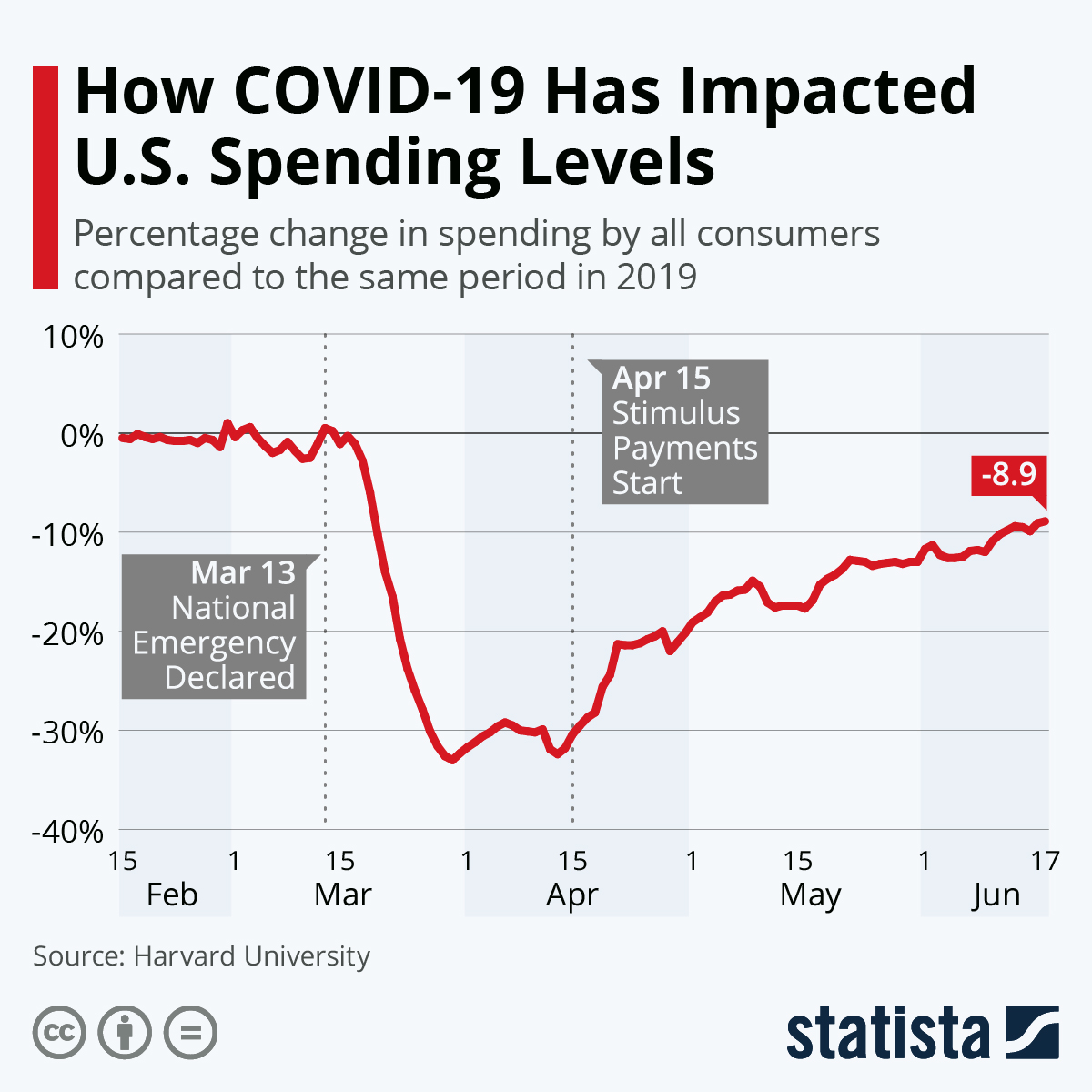
How COVID-19 Has Impacted U.S. Spending Levels – Statista
Opportunity Insights researchers at Harvard University have been using credit card data to track U.S. spending levels throughout the pandemic. As this infographic shows, consumer spending plummeted between the middle and end of March. While it was 0.5 percent higher on March 13 than the same day in 2019, it plunged 33 percent by March 30. As states reopen, the trend has started to gradually improve but spending levels remained 10 percent lower than last year on June 15. The situation remains delicate with Dr. Anthony Fauci recently warning of a “disturbing surge in U.S. coronavirus cases”. Seven states have now reported a record increase in infections as well as a record number of patients admitted to hospital.
You will find more infographics at Statista
An Oregon county drops its mask exemption for people of color after racist response – CNN
A mask mandate exemption for people of color meant to address racial profiling concerns has been removed after racist backlash, Oregon county officials said in a statement.
“The expressions of racism regarding the exception has created a ripple of fear throughout our communities of color. The very policy meant to protect them, is now making them a target for further discrimination and harassment,” Lincoln County leaders said Wednesday.
The county requires most residents to wear face coverings in public settings, indoors or outdoors. The locale, which is overwhelmingly White, had been one of the first places in the United States to exempt non-White residents if they fear harassment.
Also exempt are people with disabilities or medical conditions whose breathing would be obstructed by a mask and children under 12, though children ages 2 through 12 are still encouraged to cover their faces.
Texas’ Largest Hospital Reaches 100 Percent ICU Capacity – Newsweek
Houston’s Texas Medical Center, considered the largest medical complex in the world, reached 100 percent ICU occupancy Thursday, as Texas continues to cope with a surge in coronavirus cases.
The news comes as cases of the novel coronavirus continue to rise throughout Texas. In Harris County, where Houston is located, there are currently over 25,000 confirmed cases and at least 346 deaths. According to the Texas Department of Health and Human Services, there are currently over 125,000 confirmed cases in Texas and at least 2,249 fatalities.
While early studies of who was dying of Covid-19 identified risks such as obesity and having diabetes, there is a growing realization that those initial conclusions might have been misleading, obscuring a more significant explanation.
As researchers pull back their lens from individuals to population-level risk factors, they’re finding that, in the U.S., race may be as important as age in gauging a person’s likelihood of dying from the disease.
The higher the percentage of Black residents in a county, the higher its death rate from Covid-19 — even after accounting for income, health insurance coverage, rates of diabetes and obesity, and public transit use, finds a new study by researchers at the MIT Sloan School of Management. With those plausible explanations ruled out, “the causal mechanism has to be something else,” said applied economist Chris Knittel, the study’s senior author. “If I were a public official, I’d be looking at differences in the quality of insurance, conditions such as chronic stress, and systemic discrimination.”
Just a day prior to reaching the 100 percent occupancy rate for ICU beds, Texas Medical Center issued a statement suggesting that it could handle the surge in cases but the ICU capacity was being stretched.
The following are foreign headlines with hyperlinks to the posts
After three-month virus delay, Japan opens its shortened baseball season
Berlin’s Club Scene May Not Survive the Pandemic
PORTUGAL TO BRING BACK CORONAVIRUS LOCKDOWN TO SEVERAL AREAS OF LISBON, PRIME MINISTER SAYS
Coronavirus: 165 cases at Kober meat factory
The following are additional national and state headlines with hyperlinks to the posts
Disney delays reopening Disneyland and other California theme parks
The federal government is ending funding for coronavirus test sites in 5 states
Caesars mandates guests wear masks
Trump administration ending support for 7 Texas testing sites as coronavirus cases spike
Alabama Records Highest Daily Increase in COVID-19 Cases Since Pandemic
Dallas May Open Pop-Up Hospital as Coronavirus Surge Sparks Capacity Fears
4,000 People Allowed to Attend Concert at Old Prison Amid COVID-19 Spread
Florida Breaks Daily Coronavirus Case Record For Second Time In a Week
Texas Governor Hits ‘Pause’ On Further Reopening Amid COVID-19 Surge
Cowboys-Steelers Hall of Fame game canceled, HOF ceremony postponed to 2021 due to pandemic
Kentucky Derby Rescheduled To September, Will Take Place With Fans
With COVID-19 Cases Rising, Some States Slow Their Reopening Plans
Survey: Women Are Rethinking Having Kids As They Face Pandemic Challenges
Massachusetts rolls out plan for schools to reopen this fall amid coronavirus
Mississippi reports 1,092 new COVID-19 cases, largest single-day increase
Several Trump campaign staffers are quarantining after Tulsa rally
Today’s Posts On Econintersect Showing Impact Of The Pandemic With Hyperlinks
June 2019 Kansas City Fed Manufacturing Squeaks Into Expansion
Third Estimate 1Q2020 GDP Unchanged at 5.0%. Corporate Profits Declined.
Headline Durable Goods New Orders Improved In May 2020
20 June 2020 Initial Unemployment Claims 1,480,000 This Week
Infographic Of The Day: An 18-Month View Of A Post-COVID World
States With Enough Contact Tracers
Is It 1999 Or 2007? Retail Investors Flood The Market
COVID-19 Is Laying Waste To Many US Recycling Programs
Coronavirus INTERACTIVE Charts
include($_SERVER[‘DOCUMENT_ROOT’].’/pages/coronavirus.htm’); ?>
Analyst Opinion of Coronavirus Data
There are several takeaways that need to be understood when viewing coronavirus statistical data:
- The global counts are suspect for a variety of reasons including political. Even the U.S. count has issues as it is possible that as much as half the population has had coronavirus and was asymptomatic. It would be a far better metric using a random sampling of the population weekly. In short, we do not understand the size of the error in the tracking numbers.
- Just because some of the methodology used in aggregating the data in the U.S. is flawed – as long as the flaw is uniformly applied – you establish a baseline. This is why it is dangerous to compare two countries as they likely use different methodologies to determine who has (and who died) from coronavirus.
- COVID-19 and the flu are different but can have similar symptoms. For sure, COVID-19 so far is much more deadly than the flu. [click here to compare symptoms]
- From an industrial engineering point of view, one can argue that it is best to flatten the curve only to the point that the health care system is barely able to cope. This solution only works if-and-only-if one can catch this coronavirus once and develops immunity. In the case of COVID-19, herd immunity may need to be in the 80% to 85% range. WHO warns that few have developed antibodies to COVID-19. At this point, herd immunity does not look like an option.
- Older population countries will have a higher death rate.
- There are at least 8 strains of the coronavirus. New York may have a deadlier strain imported from Europe, compared to less deadly viruses elsewhere in the United States.
- Each publication uses different cutoff times for its coronavirus statistics. Our data uses 11:00 am London time. Also, there is an unexplained variation in the total numbers both globally and in the U.S.
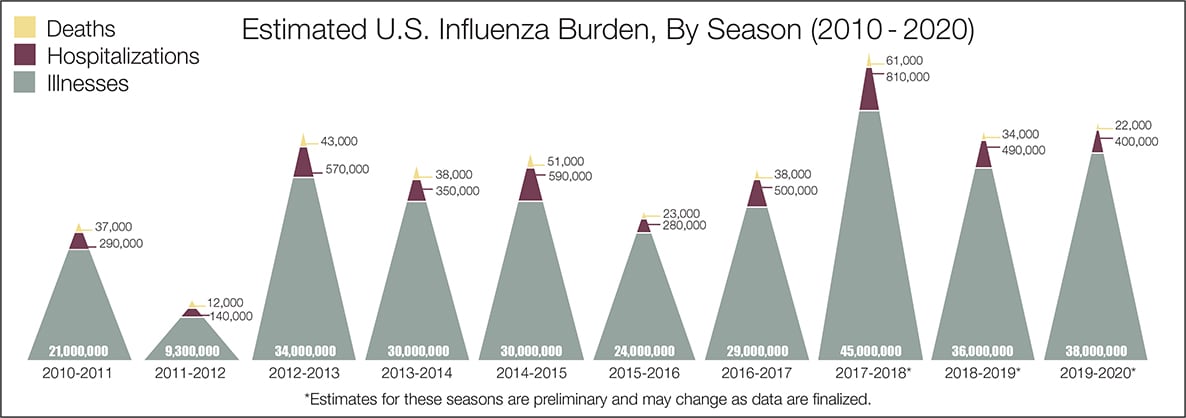
- The real question remains if the U.S. is over-reacting to this virus. The following graphic from the CDC puts the annual flu burden in perspective [click on image to enlarge]. Note that using this data is dangerous as the actual flu cases are estimated and not counted – nobody knows how accurate these guesses are.
What we do not know about the coronavirus [actually there is little scientifically proven information]. Most of our knowledge is anecdotal, from studies with limited subjects, or from studies without peer review.
- How many people have been infected as many do not show symptoms?
- To what degree do people who never develop symptoms contribute to transmission?
- The US has scaled up coronavirus testing – but the accuracy of the tests is in question.
- Can children widely spread coronavirus?
- Why have some places avoided big coronavirus outbreaks – and others hit hard?
- What effect will the weather have? At this point, it does not seem hot weather slows this coronavirus down.
- Outdoor activities seem to be a lower risk than indoor activities.
- Do we develop lasting immunity to the coronavirus? Another coronavirus – the simple cold – does not develop long term immunity.
- Can the world really push out an effective vaccine in 12 to 18 months?
- Will other medical treatments for Covid-19 ease symptoms and reduce deaths?
- A current scientific understanding of the way the coronavirus works can be found [here].
Heavy breakouts of coronavirus have hit farmworkers. Farmworkers are essential to the food supply. They cannot shelter at home. Consider:
- they have high rates of the respiratory disease [occupational hazard]
- they travel on crowded buses chartered by their employers
- few have health insurance
- they cannot social distance and live two to four to a room – and they eat together
- some reports say half are undocumented
- they are low paid and cannot afford not to work – so they will go to work sick
- they do not have access to sanitation when working
- a coronavirus outbreak among farmworkers can potentially shutter entire farm
The bottom line is that COVID-19 so far has been shown to be much more deadly than the data on the flu. Using CDC data, the flu has a mortality rate between 0.06 % and 0.11 % Vs. the coronavirus which to date has a mortality rate of over 5 % – which makes it between 45 and 80 times more deadly. The reason for ranges:
Because influenza surveillance does not capture all cases of flu that occur in the U.S., CDC provides these estimated ranges to better reflect the larger burden of influenza.
There will be a commission set up after this pandemic ends to find fault [it is easy to find fault when a once-in-a-lifetime event occurs] and to produce recommendations for the next time a pandemic happens. Those that hate President Trump will conclude the virus is his fault.
Resources:
- Get the latest public health information from CDC: https://www.coronavirus.gov .
- Get the latest research from NIH: https://www.nih.gov/coronavirus.
- Find NCBI SARS-CoV-2 literature, sequence, and clinical content: https://www.ncbi.nlm.nih.gov/sars-cov-2/.
- List of studies: https://icite.od.nih.gov/covid19/search/#search:searchId=5ee124ed70bb967c49672dad
include(“/home/aleta/public_html/files/ad_openx.htm”); ?>


