


Written by Steven Hansen
The U.S. new cases are still seeing accelerated growth – and today’s 7 day rolling average of new cases is 30 % higher than one week ago. At the end of this post is a set of interactive graphs and tables for the world and individual states – as well as today’s headlines which include;
- How Widespread Coronavirus Testing Helped Meatpacking Plants Slow Outbreaks
- Beijing outbreak shows COVID-19’s insidious ability to hide
- Some S.C. Protests Postponed After Attendees Test Positive for Coronavirus
- As Problems Grow With Abbott’s Fast COVID Test, FDA Standards Are Under Fire

My continuing warning is to continue to wear masks and maintain social distancing.
Even though the number of new cases in the U.S. is remaining stubbornly high and increasing, deaths are the lowest since 27 March 2020 and still trending down.
The following graph showing the 7-day rolling average for new coronavirus cases has been updated through 22 June 2020:

z coronavirus.png
Coronavirus Statistics For 23 June 2020 |
| U.S. Only | Global | U.S Percentage of Total | ||||
| Today | Cumulative | Today | Cumulative | Today | Cumulative | |
| New Cases | 31,390 | 2,310,000 | 136,633 | 9,060,000 | 23.0% | 25.5% |
| Deaths | 427 | 129,402 | 3,432 | 471,681 | 12.4% | 25.5% |
| Mortality Rate | 1.4% | 5.2% | 2.5% | 5.2% | ||
| total COVID-19 Tests per 1,000 people | 1.40* | 83.24* | ||||
* as of 22 June 2020
Coronavirus News You May Have Missed
Study suggests 80% of Covid-19 cases in the US went undetected in March – CNN
A new study suggests that as many as 8.7 million Americans came down with coronavirus in March, but more than 80% of them were never diagnosed.
A team of researchers looked at the number of people who went to doctors or clinics with influenza-like illnesses that were never diagnosed as coronavirus, influenza or any of the other viruses that usually circulate in winter.
There was a giant spike in these cases in March, the researchers reported in the journal Science Translational Medicine.
“The findings support a scenario where more than 8.7 million new SARS-CoV-2 infections appeared in the U.S. during March and estimate that more than 80% of these cases remained unidentified as the outbreak rapidly spread,” Justin Silverman of Penn State University, Alex Washburne of Montana State University and colleagues at Cornell University and elsewhere, wrote.
How Widespread Coronavirus Testing Helped Meatpacking Plants Slow Outbreaks – NPR
… When it was all finished, about a thousand workers at the [Tyson Foods pork processing plant in Waterloo, Iowa] plant had tested positive for the virus. Hundreds of them had no COVID-19 symptoms. Without testing, they would have continued going to work together in close quarters, potentially spreading the virus.
Since then, Tyson has carried out one-time tests of every worker at almost 20 of its facilities, from Maine to Virginia and Texas. “We’re somewhere around 30,000 people, team members, that have been tested,” says Brooks. “That’s about a quarter of our workforce.”
Meatpacking plants have been among the country’s worst coronavirus hot spots, with thousands of workers infected. Dozens have died. But the rapid roll out of testing among workers in those plants could offer lessons that other businesses may need to emulate as they try to re-open.
Tyson is not alone among meat companies in its program to test workers, but it has released the most information from those tests. It also has brought in an outside company, Matrix Medical, to run the program. It appears to be one of the largest privately run coronavirus testing programs in the country.
Fauci warns of ‘more and more’ coronavirus complications in young people – CNBC
Dr. Anthony Fauci, the nation’s leading infectious disease expert, said Tuesday that doctors and infectious disease specialists are seeing “more and more” complications with Covid-19 in young people.
Early in the outbreak in the U.S., researchers said the virus appeared to be sparing young people while being particularly severe for the elderly and those with underlying health conditions.
That’s not the case, Fauci, director of the National Institute of Allergy and Infectious Diseases, said during a House Energy and Commerce Committee hearing. “To think young people have no deleterious consequences is not true. We’re seeing more and more complications in young people.”
Fauci said he’s never seen a single virus have such a wide range of symptoms.
Right Now There Is A “Mad Rush” To Get Out Of The Cities – TMIN
So many wealthy people are rushing to move away from the big cities that it is creating a bit of a “real estate boom” in many suburban areas, small towns and rural communities. Fear of COVID-19, a collapsing economy and the tremendous urban violence that we have witnessed in recent weeks have combined to create a frenzy of activity. Last week, my wife and I heard from a friend in New York City that is all of a sudden desperate to move to another state, and I certainly can’t blame him for wanting to relocate. If I was in his shoes, I would be wanting to move too. But at this point so many people are all thinking the same thing that the demand for housing in certain areas threatens to greatly exceed the supply. In fact, one real estate agent in the San Francisco area is describing it as “a mad rush to get out of the city”
Beijing outbreak shows COVID-19’s insidious ability to hide – the Japan Times
Just as Beijing looked poised to claim victory over the coronavirus, a 52-year-old man with fever and chills showed how the pandemic can come roaring back from apparent obscurity.
The patient had shopped for meat and fish at a wholesale market in southern Beijing eight days before testing positive on June 11. His infection marked the Chinese capital’s first reported COVID-19 case in 55 days and scuppered hopes that months of physical distancing, meticulous testing and quarantining had driven the pathogen to extinction in the city of over 20 million.
Now, more than 200 people have tested positive across Beijing, schools are shut and thousands of domestic flights canceled. The resurgence offers a stark warning to countries that appear to have cut chains of transmission: The coronavirus’s ability to cause little or no symptoms in a large proportion of people enables it to spread silently for weeks — even months — creating viral reservoirs that can remain hidden until someone becomes sick enough to warrant testing.
“Transmission could have started a month earlier, with already so many asymptomatic or mildly symptomatic patients shedding lots of the virus into the environment,” George Gao, head of the Chinese Center for Disease Control and Prevention, told government advisers at a meeting in Shanghai last week. It’s possible the virus lurked in dark, humid conditions before it was amplified in infected people, he said.
The flareup in China’s political center also reveals the difficulty of ridding the insidious contagion without an effective vaccine.
Sanofi eyes approval of COVID-19 vaccine by first half of 2021 – Reuters
French drugmaker Sanofi SA said on Tuesday it expects to get approval for the potential COVID-19 vaccine it is developing with Britain’s GlaxoSmithKline Plc by the first half of next year, faster than previously anticipated.
Sanofi, which is hosting a virtual research and development event, and GSK had said in April the vaccine, if successful, would be available in the second half of 2021.
“We are being guided by our dialogue with regulatory authorities,” Sanofi research chief John Reed told reporters, when asked about the accelerated time frame.
There are currently no vaccines to prevent the coronavirus that has infected more than 9 million people and killed over 469,000 globally, and only a couple of medicines that have demonstrated benefit in hospitalized COVID-19 patients in clinical trials.
As the coronavirus infects younger people and doctors learn to provide better care to patients, the death rate from Covid-19 could drop in coming weeks, former Food and Drug Administration Commissioner Dr. Scott Gottlieb told CNBC on Tuesday.
A number of governors, including Florida Gov. Ron DeSantis and Texas Gov. Greg Abbott, have said young people account for many new infections in their states. Young and otherwise healthy people are less likely to die of Covid-19, according to data compiled by the Centers for Disease Control and Prevention, though they can develop severe disease and scientists are still researching the long-term health effects of an infection.
“As the hospitals fill up with Covid patients, we’re going to see how much the mortality rate declines as a function of it’s a younger cohort, younger age cohort, but also we have better treatment,” Gottlieb said on “Squawk Box.” “There’s no question that we’re going to preserve more life now that we have these therapeutic opportunities available to us.”
In Florida, DeSantis noted last week that the average age of those who test positive has fallen from 65.5 years old in March to 37 in June, citing that as evidence that the state is effectively protecting the most vulnerable. Some health officials, however, have warned that even if mostly younger people are getting infected right now, they are likely to go on and spread the disease to older people and those with underlying conditions who are more vulnerable.
India Has Bungled Its Coronavirus Crisis – FP
India has crossed two bleak landmarks in its battle against the coronavirus.
The country has now reached over 400,000 infections, making it the fourth-worst-hit country in the world, overtaking Britain, Spain, and Italy. But it’s also lifted its 76-day lockdown and allowed workplaces, places of worship, hotels, and restaurants to reopen.
The grim dichotomy indicates India’s bungling response to the coronavirus, one that is sending the country hurtling toward a catastrophic health crisis.
New cases are rising unabated, growing at a faster rate than ever before; hospitals are running out of beds and ventilators, testing remains low; and the geographical spread of the virus is increasing, reaching new areas in rural India. And yet, with its economy reeling under losses caused by the lockdown—its central bank, the Reserve Bank of India, has already estimated that this year will see negative growth—the country is opening up in order to try to stave off economic disaster. In the process, it is walking head-on into a pandemic at its peak.
The crisis is already in full display in its top two cities, New Delhi and Mumbai, which combined account for around a third of India’s total cases.
Hospitals are already full, and critical patients with a range of conditions being turned away. Earlier this month, in Delhi’s suburb of Noida, an eight-month-pregnant woman died in an ambulance after six hospitals refused to admit her despite a 13-hour-long hunt. In Mumbai, a 68-year-old COVID-19 patient died because health authorities could not arrange a ventilator for her, despite repeated pleas by her relatives for two days.
The stories are grim, yet it is only likely to get worse.
[editor’s note: you need to read the article to find out what India did wrong]
Today, under the leadership of President Trump, the Centers for Medicare & Medicaid Services (CMS) is calling for a renewed national commitment to value-based care based on Medicare claims data that provides an early snapshot of the impact of the coronavirus disease 2019 (COVID-19) pandemic on the Medicare population. The data shows that older Americans and those with chronic health conditions are at the highest risk for COVID-19 and confirms long-understood disparities in health outcomes for racial and ethnic minority groups and among low-income populations.
“The disparities in the data reflect longstanding challenges facing minority communities and low income older adults, many of whom face structural challenges to their health that go far beyond what is traditionally considered ‘medical’,” said CMS Administrator Seema Verma. “Now more than ever, it is clear that our fee-for-service system is insufficient for the most vulnerable Americans because it limits payment to what goes on inside a doctor’s office. The transition to a value-based system has never been so urgent. When implemented effectively, it encourages clinicians to care for the whole person and address the social risk factors that are so critical for our beneficiaries’ quality of life.”
The data released today includes the total number of reported COVID-19 cases and hospitalizations among Medicare beneficiaries between January 1 and May 16, 2020. The snapshot breaks down COVID-19 cases and hospitalizations for Medicare beneficiaries by state, race/ethnicity, age, gender, dual eligibility for Medicare and Medicaid, and urban/rural locations. The new data show that more than 325,000 Medicare beneficiaries had a diagnosis of COVID-19 between January 1 and May 16, 2020. This translates to 518 COVID-19 cases per 100,000 Medicare beneficiaries. The data also indicate that nearly 110,000 Medicare beneficiaries were hospitalized for COVID-19-releated treatment, which equals 175 COVID-19 hospitalizations per 100,000 Medicare beneficiaries.
Blacks were hospitalized with COVID-19 at a rate nearly four times higher than whites. The disparities presented in the snapshot go beyond race/ethnicity and suggest the impact of social determinants of health, particularly socio-economic status.
Other key data points:
- End-stage renal disease (ESRD) patients (individuals with chronic kidney disease undergoing dialysis) had the highest rate of hospitalization among all Medicare beneficiaries, with 1,341 hospitalizations per 100,000 beneficiaries. Patients with ESRD are also more likely to have chronic comorbidities associated with increased COVID-19 complications and hospitalization, such as diabetes and heart failure.
- The second highest rate was among beneficiaries enrolled in both Medicare and Medicaid (also known as “dual eligible”), with 473 hospitalizations per 100,000 beneficiaries.
- Among racial/ethnic groups, Blacks had the highest hospitalization rate, with 465 per 100,000. Hispanics had 258 hospitalizations per 100,000. Asians had 187 per 100,000 and whites had 123 per 100,000.
- Beneficiaries living in rural areas have fewer cases and were hospitalized at a lower rate than those living in urban/suburban areas (57 versus 205 hospitalizations per 100,000).
New U.S. COVID-19 cases surge 25% last week; Arizona, Florida and Texas set records – Reuters
The United States saw a 25% increase in new cases of COVID-19 in the week ended June 21 compared to the previous seven days, with Arizona, Florida and Texas experiencing record surges in new infections, a Reuters analysis found.
Twenty-five U.S. states reported more new cases last week than the previous week, including 10 states that saw weekly new infections rise more than 50%, and 12 states that posted new records, according to the analysis of data from The COVID Tracking Project, a volunteer-run effort to track the outbreak.
Texas reported one of the largest rises in new cases at 24,000 for the week ended June 21, an increase of 84% from the previous week. The number of COVID-19 tests that came back positive in the state rose to 10%, from 7%.
New cases in Florida rose 87% last week to almost 22,000, with the state’s positive test rate nearly doubling to 11%.
Arizona reported 17,000 new cases, a 90% increase, with 20% of tests coming back positive, according to the analysis.
Some S.C. Protests Postponed After Attendees Test Positive for Coronavirus – Newsweek
A protest organizer in South Carolina said future demonstrations coordinated by his advocacy group will canceled until further notice, after about a dozen people who participated in recent rallies tested positive for the novel coronavirus.
“Some of our leaders, photographers and protestors have tested positive for COVID-19,” said Lawrence Dishawn Nathaniel in a video announcement shared to Facebook on Sunday. Nathaniel, who founded nonprofit community organization People Demand Action, has helped lead protest efforts across South Carolina over the past month with an initiative called I Can’t Breathe SC.
Nathaniel went on to explain the new diagnosis numbers in greater detail in the video. He said four organizers, three photographers, six protestors and several artists confirmed they had contracted the respiratory illness after attending demonstrations between May 30 and June 17 in Columbia, Charleston and Greenville.
As Problems Grow With Abbott’s Fast COVID Test, FDA Standards Are Under Fire – Kaiser Health News
In mid-May, the Food and Drug Administration issued a rare public warning about an Abbott Laboratories COVID-19 test that for weeks had received high praise from the White House because of its speed: Test results could be wrong.
The agency at that point had received 15 “adverse event reports” about Abbott’s ID NOW rapid COVID test suggesting that infected patients were wrongly told they did not have the coronavirus, which had led to the deaths of tens of thousands of Americans. The warning followed multiple academic studies showing higher “false negative” rates from the Abbott device, including one from New York University researchers who found it missed close to half of the positive samples detected by a rival company’s test.
But then, in a move that confounded lab officials and other public health experts, a senior FDA official later that month said coronavirus tests provided outside lab settings would be considered useful in fighting the pandemic even if they miss 1 in 5 positive cases — a worrisome failure rate.
The FDA has now received a total of 106 reports of adverse events for the Abbott test, a staggering increase. The agency has not received a single adverse event report for any other point-of-care tests meant to diagnose COVID-19, an agency spokesperson said.
‘They Just Dumped Him Like Trash’: Nursing Homes Evict Vulnerable Residents – New York Times
More than any other institution in America, nursing homes have come to symbolize the deadly destruction of the coronavirus crisis. More than 51,000 residents and employees of nursing homes and long-term care facilities have died, representing more than 40 percent of the total death toll in the United States.
But even as they have been ravaged, nursing homes have also been enlisted in the response to the outbreak. They are taking on coronavirus-stricken patients to ease the burden on overwhelmed hospitals — and, at times, to bolster their bottom lines.
A Lakeview official said the company’s evictions were appropriate and weren’t an attempt to free space for Covid-19 patients. But similar scenes are playing out at nursing homes nationwide. They are kicking out old and disabled residents — among the people most susceptible to the coronavirus — and shunting them into homeless shelters, rundown motels and other unsafe facilities, according to 22 watchdogs in 16 states, as well as dozens of elder-care lawyers, social workers and former nursing home executives.
Many of the evictions, known as involuntary discharges, appear to violate federal rules that require nursing homes to place residents in safe locations and to provide them with at least 30 days’ notice before forcing them to leave.
Could Extended Anticoagulation Help After COVID-19? – MedPage
After hospitalization for medical illness, an extended course of low-dose anticoagulation reduced arterial and venous thromboembolic events combined, secondary analysis of a randomized trial suggested — a finding with implications for post-COVID care.
Taking 10-mg rivaroxaban (Xarelto) for 45 days post-discharge reduced fatal and major events by a relative 28% in patients with additional risk factors for venous thromboembolism (VTE) in a prespecified secondary analysis of the MARINER trial.
… While these findings have to be considered exploratory due to MARINER having failed in its primary endpoint of lowering risk of symptomatic VTE and death due to VTE compared with placebo, the researchers noted that the carefully selected patient population appeared to gain net clinical benefit when considering bleeding risk.
The following are foreign headlines with hyperlinks to the posts
Brazil – Pandemic meets political crisis as investigations hit Bolsonaro allies
What can England now do? UK PM Johnson unveils easing of COVID lockdown
Barcelona Opera Reopens With An Audience Of Plants
Saudi Arabia Announces This Year’s Hajj Will Be ‘Very Limited’
Delta To Resume Flights Between The U.S. And China
Coronavirus latest: Germany lockdown widened after meat-packing outbreak
The following are additional national and state headlines with hyperlinks to the posts
More young people across the South are testing positive for coronavirus, officials warn
States with the Fewest and Most Coronavirus Restrictions
Majority of COVID-19 Contact Tracing Apps Lack Adequate Security
We Can Protect the Economy From Pandemics. Why Didn’t We?
‘Government itself can’t solve this problem’: Florida officials alarmed as virus rages
Coronavirus Concerns Shift Presidential Debate From Michigan To Florida
Former California Governors Unite To Promote Mask Wearing
Texas Children’s Hospital now admitting adult patients due to COVID-19 spike in Houston
Coronavirus pandemic could lead to up to 500,000 fewer US births, study suggests
Brazil Judge Orders President Bolsonaro to Wear a Mask or Pay a Fine
US CDC has developed a single test that will check for coronavirus and both strains of the flu
Today’s Posts On Econintersect Showing Impact Of The Pandemic With Hyperlinks
June 2020 Richmond Fed Manufacturing Survey Improves
May 2020 Headline New Home Sales Remain Strong
What’s The Real Reason Deposits Have Risen?
Retail Sales Bounce, But Consumers Are Tapped Out
Coronavirus INTERACTIVE Charts
include($_SERVER[‘DOCUMENT_ROOT’].’/pages/coronavirus.htm’); ?>
Analyst Opinion of Coronavirus Data
There are several takeaways that need to be understood when viewing coronavirus statistical data:
- The global counts are suspect for a variety of reasons including political. Even the U.S. count has issues as it is possible that as much as half the population has had coronavirus and was asymptomatic. It would be a far better metric using a random sampling of the population weekly. In short, we do not understand the size of the error in the tracking numbers.
- Just because some of the methodology used in aggregating the data in the U.S. is flawed – as long as the flaw is uniformly applied – you establish a baseline. This is why it is dangerous to compare two countries as they likely use different methodologies to determine who has (and who died) from coronavirus.
- COVID-19 and the flu are different but can have similar symptoms. For sure, COVID-19 so far is much more deadly than the flu. [click here to compare symptoms]
- From an industrial engineering point of view, one can argue that it is best to flatten the curve only to the point that the health care system is barely able to cope. This solution only works if-and-only-if one can catch this coronavirus once and develops immunity. In the case of COVID-19, herd immunity may need to be in the 80% to 85% range. WHO warns that few have developed antibodies to COVID-19. At this point, herd immunity does not look like an option.
- Older population countries will have a higher death rate.
- There are at least 8 strains of the coronavirus. New York may have a deadlier strain imported from Europe, compared to less deadly viruses elsewhere in the United States.
- Each publication uses different cutoff times for its coronavirus statistics. Our data uses 11:00 am London time. Also, there is an unexplained variation in the total numbers both globally and in the U.S.
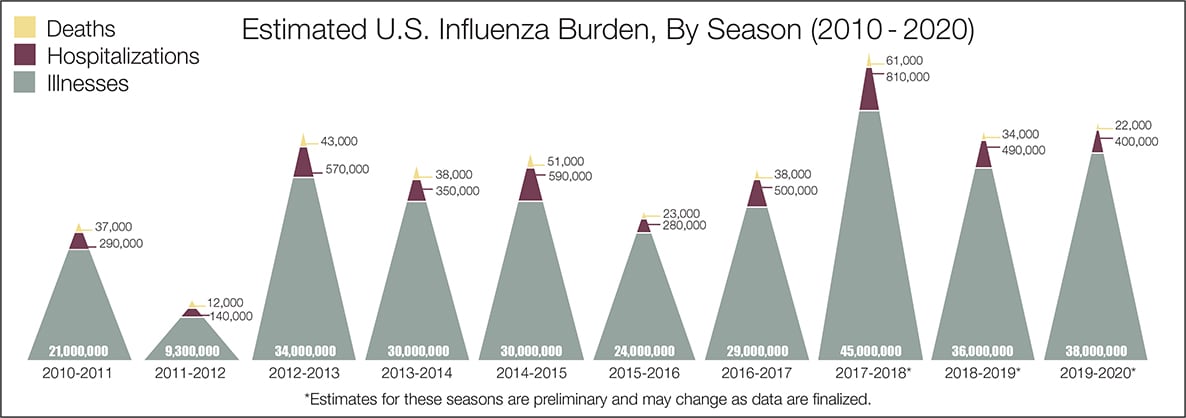
- The real question remains if the U.S. is over-reacting to this virus. The following graphic from the CDC puts the annual flu burden in perspective [click on image to enlarge].
What we do not know about the coronavirus [actually there is little scientifically proven information]. Most of our knowledge is anecdotal, from studies with limited subjects, or from studies without peer review.
- How many people have been infected as many do not show symptoms?
- To what degree do people who never develop symptoms contribute to transmission?
- The US has scaled up coronavirus testing – but the accuracy of the tests is in question.
- What forms of social distancing work best?
- Can children widely spread coronavirus?
- Why have some places avoided big coronavirus outbreaks – and others hit hard?
- What effect will the weather have?
- Can we reopen parks and beaches safely – but outdoor activities seem to be a lower risk than indoor activities.
- Do we develop lasting immunity to the coronavirus? Another coronavirus – the simple cold – does not develop long term immunity.
- Can the world really push out a vaccine in 12 to 18 months?
- Will we get other medical treatments for Covid-19?
Heavy breakouts of coronavirus have hit farmworkers. Farmworkers are essential to the food supply. They cannot shelter at home. Consider:
- they have high rates of the respiratory disease [occupational hazard]
- they travel on crowded buses chartered by their employers
- few have health insurance
- they cannot social distance and live two to four to a room – and they eat together
- some reports say half are undocumented
- they are low paid and cannot afford not to work – so they will go to work sick
- they do not have access to sanitation when working
- a coronavirus outbreak among farmworkers can potentially shutter entire farm
The bottom line is that COVID-19 so far has been shown to be much more deadly than the data on the flu. Using CDC data, the flu has a mortality rate between 0.06 % and 0.11 % Vs. the coronavirus which to date has a mortality rate of over 5 % – which makes it between 45 and 80 times more deadly. The reason for ranges:
Because influenza surveillance does not capture all cases of flu that occur in the U.S., CDC provides these estimated ranges to better reflect the larger burden of influenza.
There will be a commission set up after this pandemic ends to find fault [it is easy to find fault when a once-in-a-lifetime event occurs] and to produce recommendations for the next time a pandemic happens. Those that hate President Trump will conclude the virus is his fault. The most important issue will be an analysis of whether the federal government took a strong enough lead in dealing with the pandemic – and that includes every single politician!
Resources:
- Get the latest public health information from CDC: https://www.coronavirus.gov .
- Get the latest research from NIH: https://www.nih.gov/coronavirus.
- Find NCBI SARS-CoV-2 literature, sequence, and clinical content: https://www.ncbi.nlm.nih.gov/sars-cov-2/.
- List of studies: https://icite.od.nih.gov/covid19/search/#search:searchId=5ee124ed70bb967c49672dad
include(“/home/aleta/public_html/files/ad_openx.htm”); ?>


