


Written by Steven Hansen
Retail sales SIGNIFICANTLY improved according to US Census headline data – but still remains in contraction year-over-year. The three-month rolling average again declined.
.
Analyst Opinion of Retail Sales
This report was significantly affected by the coronavirus shutdown. A note from U/S. Census:
Due to recent events surrounding COVID-19, many businesses are operating on a limited capacity or have ceased operations completely. The Census Bureau has monitored response and data quality and determined estimates in this release meet publication standards.
There was an upward adjustment to last month’s data. The real test of strength is the rolling averages which declined. Overall, this report is considered much better than last month.
Please consider that this data is not adjusted for inflation.

Econintersect Analysis:
- the unadjusted sales rate of growth accelerated 11.9 % month-over-month, and down 7.7 % year-over-year.
- unadjusted sales 3-month rolling year-over-year average growth decelerated 5.2 % month-over-month, down 11.5 % year-over-year.

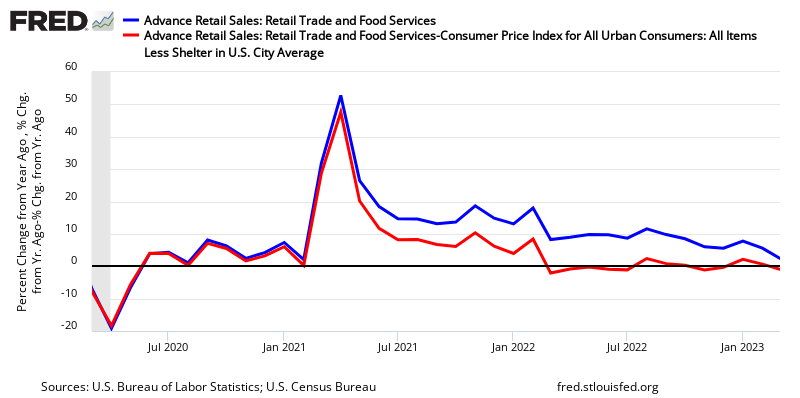
- unadjusted sales (but inflation-adjusted) down 6.6 % year-over-year
- this is an advance report. Please see the caveats section below which shows variations between the advance report and the “final”.
- in the seasonally adjusted data – the improvement was widespread
U.S. Census Headline Analysis:
- seasonally adjusted sales up 17.7 % month-over-month, down 6.1 % year-over-year (published down 8.6 % YoY last month).
- the market was expecting (from Econoday):
| seasonally adjusted | Consensus Range | Consensus | Actual |
| Retail Sales – M/M change | 2.3 % to 12.2 % | 7.5 % | +17.7 % |
| Retail Sales less autos – M/M change | 0.4 % to 8.6 % | 5.2 % | +12.4 % |
| Less Autos & Gas – M/M Change | 0.3 % to 5.0 % | 4.0 % | +12.4 % |
| Control Group – M/M change | 0.5 % to 8.9 % | 4.3 % | +10.6 % |
Year-over-Year Change – Unadjusted Retail Sales (blue line) and Inflation-Adjusted Retail Sales (red line)
Retail sales per capita are now trending down – see graph below.
Year-over-Year Percent Change – Per Capita Seasonally Adjusted Retail Sales

From the U.S. Census Bureau press release:
Advance estimates of U.S. retail and food services sales for May 2020, adjusted for seasonal variation and holiday and trading-day differences, but not for price changes, were $485.5 billion, an increase of 17.7 percent (± 0.5 percent) from the previous month, but 6.1 percent (± 0.7 percent) below May 2019. Total sales for the March 2020 through May 2020 period were down 10.5 percent (± 0.5 percent) from the same period a year ago. The March 2020 to April 2020 percent change was revised from down 16.4 percent (± 0.5 percent) to down 14.7 percent (± 0.2 percent). Retail trade sales were up 16.8 percent (± 0.5 percent) from April 2020, but 1.4 percent (± 0.7 percent) below last year. Nonstore retailers were up 30.8 percent (± 1.4 percent) from May 2019, while building material and garden equipment and supplies dealers were up 16.4 percent (± 1.9 percent) from last year.
Seasonally Adjusted Retail Sales – All (red line), All except food services (blue line), and All except motor vehicles (green line)

The differences between the headlines and Econintersect are due to different approaches to seasonal adjustment (see caveats at the end of this post).
Comparison of the Year-over-Year Census Seasonally Adjusted Retail Sales (blue line) and Econintersect’s Unadjusted Retail Sales (red line)
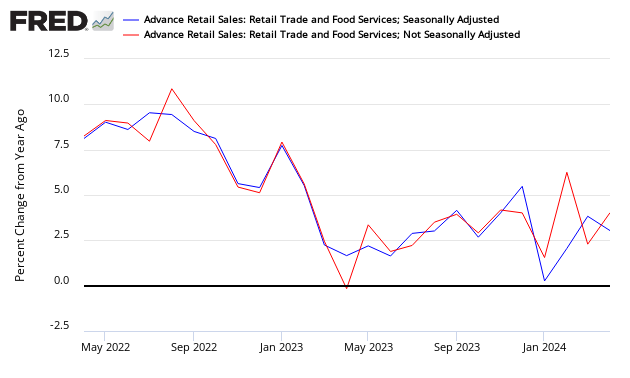
Declines of short duration often occur in the seasonally adjusted series without a recession resulting.
Retail and Food Services Sales – Seasonally Adjusted

And finally, as retail sales can be a component of determining a recession start date, the zero-line of the graph below could be an indicator a recession was underway (or about to begin).
Retail Sales – Recession Watch Graph

Caveats On Advance Retail Sales
This data release is based on estimates. However, the estimates have proven to be fairly accurate although tend to miss at economic turning points. Therefore up to three months are subject to backward revisions, although normally slight, can sometimes be modest.
The data in this series is not inflation-adjusted – and Econintersect adjusts using CPI less shelter CUSR0000SA0L2. The St. Louis Fed also inflation adjusts the Census seasonally adjusted data. The last two recessions began as the inflation-adjusted retail sales crossed the zero growth line.
Comparison of Real Year-over-Year Growth between FRED’s Real Retail Sales (green line) and Econintersect’s Inflation Adjusted Retail Sales

As in most US Census reports, Econintersect does not agree with the seasonal adjustment methodology used and provides an alternate analysis. The issue is that the exceptionally large recession and the subsequent economic roller coaster has caused data distortions that become exaggerated when the seasonal adjustment methodology uses more than one year’s worth of data. Further, Econintersect believes there is a New Normal seasonality. Using data prior to the end of the recession for seasonal analysis could provide the wrong conclusion.
The impact of the monthly retail sales data on GDP is not straight forward. Real GDP (of which the consumer is over 60%) is adjusted for inflation. Further, GDP is an analysis of quarter-over-quarter or year-over-year growth, while retail sales is a monthly data series.
Econintersect determines the month-over-month change by subtracting the current month’s year-over-year change from the previous month’s year-over-year change.
include(“/home/aleta/public_html/files/ad_openx.htm”); ?>


