


Written by Steven Hansen
New Coronavirus cases in the U.S. remain elevated but have eased somewhat over the last 2 days. Global new cases still continue to grow. At the end of this post is a set of interactive graphs and tables for the world and individual states – as well as today’s headlines which include;
- WHO Creates ‘Confusion’ About Asymptomatic Spread. Here’s What We Know
- The US will run key studies on 3 coronavirus vaccines starting this summer
- Coronavirus hospitalizations rise sharply in several states following Memorial Day
- Many registered clinical trials of potential COVID-19 treatments have design flaws
- The global economic outlook is highly uncertain

The U.S. continues to be a smaller and smaller portion of the new global coronavirus cases. It is interesting that although American’s believe they have the best health care system in the world, the mortality rate is little different than the world average.
It would seem that four forces are driving the increase in new coronavirus cases since 01 June 2020 [although there was a modest improvement in the last 2 days]:
- the Memorial Day weekend brought people together
- the easing of the lockdown across the U.S.
- the protests bringing people in closer proximity
- as farmworkers work and live in close proximity, coronavirus cases have been raging

z coronavirus.png
The following graph from the New York Times shows the current hotspots for new coronavirus outbreaks.

Coronavirus News You May Have Missed
WHO Creates ‘Confusion’ About Asymptomatic Spread. Here’s What We Know – NPR
This week, the matter of asymptomatic transmission of the novel coronavirus has caused much confusion — and sparked a lively debate on Twitter.
It started Monday when the World Health Organization discussed the current understanding of asymptomatic transmission at a press conference.
(“Asymptomatic” refers to people who are infected by the virus but never develop any symptoms.)
“From the data we have it still seems to be rare that an asymptomatic actually transmits onward to a secondary individual,” said Maria Van Kerkhove, technical lead for WHO’s health emergencies program. In other words, it seems unlikely that people who are infected by the virus but don’t develop symptoms are spreading the virus to others.
… “To make a statement, to say that [asymptomatic transmission is] a rare event was not correct,” said Dr. Anthony Fauci, a key member of the White House’s coronavirus task force, said in an interview with Good Morning America, “And that’s the reason why the WHO walked that back.”
On Tuesday, WHO held a social media Q+A to clarify the comments. “I was responding to a question at the press conference. I wasn’t stating a policy of WHO or anything like that,” Van Kerkhove said. “I think that’s a misunderstanding to state that asymptomatic transmission globally is very rare.”
According to Van Kerkhove, what she meant to convey is that she has not seen evidence indicating that transmission from asymptomatic individuals is widespread. “What we need to better understand is, how many of the people in the population don’t have symptoms? And separately, how many of those individuals go on to transmit to others?”
Johnson & Johnson to begin human trials for coronavirus vaccine in late July, earlier than expected – CNBC
- Johnson & Johnson announced Wednesday its early-stage human trial for a potential coronavirus vaccine will begin in the second half of July, earlier than its initial forecast of September.
- The company began developing a Covid-19 vaccine in January.
- It is using the same technologies it used to make its experimental Ebola vaccine, which was provided to people in the Democratic Republic of Congo in late 2019.
US will run key studies on 3 coronavirus vaccines starting this summer – COVID19 data
The US government will fund and conduct key studies on three experimental coronavirus vaccines – those developed by Moderna, Oxford University/AstraZeneca, and Johnson & Johnson, Dr. Anthony Fauci confirmed to CNN.
Phase three trials, which typically involve tens of thousands of people and measure whether a vaccine is safe and effective, will begin with Moderna in July, then Oxford/AstraZeneca in August and Johnson & Johnson in September.
An architect of Japan’s virus strategy sees flaws in West’s approach at fighting the pandemic – Japan Times
[editor’s note: not only is this opinion, but there are many factors involved here which caused the difference in infection rates. And this post ignores that Korea had a lower infection rate yet tracking down each individual coronavirus case]
One of the key architects of Japan’s coronavirus strategy has hailed the country’s response to the pandemic, saying its approach was more effective than those implemented by Western nations.
“Data clearly indicates that the measures taken by Japan have been more effective than those taken in Western countries,” Hitoshi Oshitani, a professor of virology at Tohoku University and a member of the expert panel advising the government, said in an interview with Diplomacy, a journal published by the country’s Foreign Ministry.
Western countries became involved in a “war of attrition” of tracking down each individual case of the virus to thoroughly eliminate them, Oshitani said. Japan, on the other hand, allowed some degree of transmission of the virus and focused instead on identifying clusters of infection. This avoided exhausting the testing and medical system but was effective in eliminating large-scale transmission, he said in the interview, which was released in Japanese earlier this month.
Coronavirus hospitalizations rise sharply in several states following Memorial Day – Washington Post
As the number of new coronavirus cases continues to increase worldwide, and more than a dozen states and Puerto Rico are recording their highest averages of new cases since the pandemic began, hospitalizations in at least nine states have been on the rise since Memorial Day.
In Texas, North and South Carolina, California, Oregon, Arkansas, Mississippi, Utah and Arizona, there are an increasing number of patients under supervised care since the holiday weekend because of coronavirus infections. The spikes generally began in the past couple weeks and in most states are trending higher.
Data from states that are reporting some of their highest seven-day averages of new cases is disproving the notion that the country is seeing such a spike in cases solely because of the continued increase in testing, according to data tracked by The Washington Post.
Service members who reported taking preventive measures had a lower infection rate than did those who did not report taking these measures (e.g., wearing a face covering, 55.8% versus 80.8%; avoiding common areas, 53.8% versus 67.5%; and observing social distancing, 54.7% versus 70.0%, respectively.
[editor’s note: face masks and social distancing lowers your risk of coronavirus infection]
Emergency Room visits down 49% since January, analysis reveals – Becker Hospital Review
Emergency department volume fell 49 percent between January and April, with facilities in urban areas seeing the largest drop, according to an analysis from the Emergency Department Benchmarking Alliance.
The analysis includes self-reported comparative ED volume data for the first four months of 2019 and 2020 from EDBA members representing 2,240 EDs nationwide. EDBA examined trends in overall ED volume, along with volume differences based on facility type and location.
ED volume rose 7 percent year over year in January and 4 percent in February, likely due to flu season.
“We started off the year with a positive increase in volume from the previous year across the board,” Mike Gibbons, RN, executive director of EDBA, told Becker’s. “That’s been kind of consistent in what’s going on in emergency medicine. Year-over-year, there is about a 2.5 percent annual increase in volume.”
However, ED volume fell 19 percent year over year in March, when COVID-19 spurred nationwide lockdowns. By April, ED volume was down 48 percent. This figure depicts a larger hit to EDs compared to a recent CDC analysis, which found that average weekly ED visits fell 42 percent year over year in April.
Lilly Announces Start of a Phase 1 Study for its Second Potential COVID-19 Antibody Treatment – Lilly
Eli Lilly and Company (NYSE: LLY) announced today its partner Junshi Biosciences (HKEX: 1877) has dosed the first healthy volunteer in a study of a potential neutralizing antibody treatment designed to fight COVID-19.
The investigational medicine, referred to as JS016, is being co-developed by Junshi Biosciences and Lilly, with Junshi Biosciences leading development in Greater China. Lilly has exclusive rights in the rest of the world and will begin dosing patients in a complementary Phase 1 study in the United States in the coming days. Both Phase 1 studies aim to evaluate the safety, tolerability, pharmacokinetics and immunogenicity of JS016 in healthy participants who have not been diagnosed with COVID-19. This is Lilly’s second neutralizing antibody to start clinical trials, following LY-CoV555 that recently entered Phase 1 and is currently being tested in hospitalized COVID-19 patients.
Lilly is planning a clinical development program which includes a portfolio of monotherapy and combination antibody regimens (the latter often referred to as antibody “cocktails”) in order to understand which provide the best efficacy and tolerability in patients. These cocktails will include JS016, LY-CoV555, as well as additional antibodies currently in preclinical development. JS016 and LY-CoV555 bind different epitopes on the spike protein and thus expand the diversity of options for achieving efficacy and avoiding resistance.
Many registered clinical trials of potential COVID-19 treatments have design flaws — no clinical endpoints, small samples, no control groups, or no blinding – BMJ Open
Overall, 201 clinical trials were registered for testing the therapeutic benefits of 92 drugs or plasma, including 64 in monotherapy and 28 different combinations. Only eight (8.7%) products or combinations involved new molecular entities. The other test therapies had a wide range of prior medical uses, including as antivirals, antimalarials, immunosuppressants and oncology treatments. In 152 trials (75.7%), patients were randomised to treatment or comparator, including 55 trials with some form of blinding and 97 open-label studies. The 49 (24.4%) of trials without a randomised design included 29 single armed studies and 20 trials with some comparison group. Most trial designs featured multiple endpoints. Clinical endpoints were identified in 134 (66.7%) of trials and included COVID-19 symptoms, death, recovery, required intensive care and hospital discharge. Clinical scales were being used in 33 (16.4%) trials, most often measures of oxygenation and critical illness. Surrogate endpoints or biomarkers were studied in 88 (42.3%) of trials, primarily assays of viral load. Although the trials were initiated in more than 17 countries or regions, 100 (49.8%) were registered in China and 78 (37.8%) in the USA. Registered trials increased rapidly, with the number of registered trials doubling from 1 March to 26 March 2020.
Conclusions While accelerating morbidity and mortality from the COVID-19 pandemic has been paralleled by early and rapid clinical investigation, many trials lack features to optimise their scientific value. Global coordination and increased funding of high-quality research may help to maximise scientific progress in rapidly discovering safe and effective treatments.
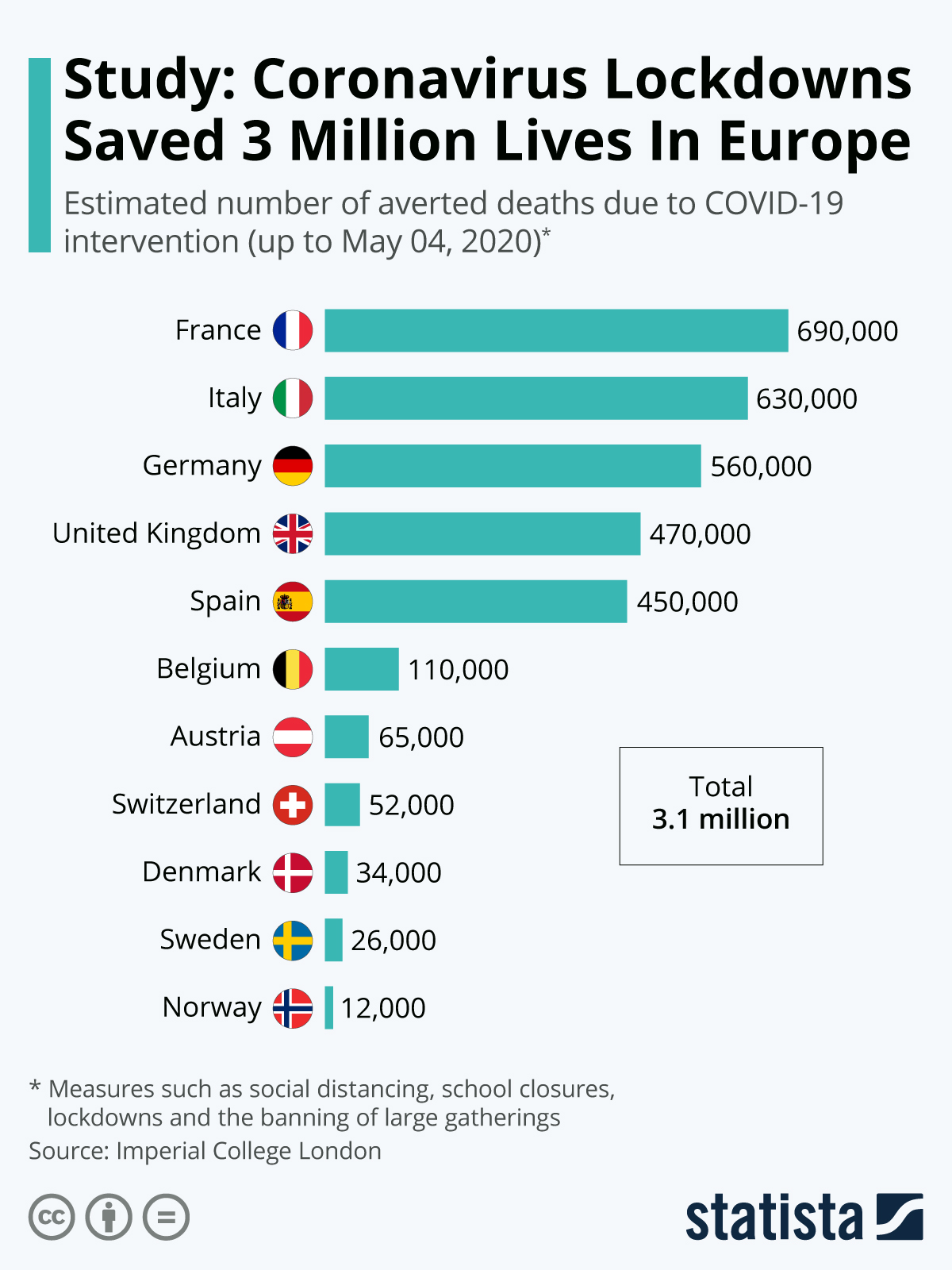
Study: Coronavirus Lockdowns Saved 3 Million Lives In Europe – Statista
At the end of March, scientists at London’s Imperial College published a report showing that lockdowns across Europe had averted 59,000 deaths. That was still a desperate time for many countries across the continent with Italy’s Civil Protection Agency reporting 837 fatalities on March 31 alone. Things have now improved drastically in Italy where the curve has been flattened and there were 53 deaths on June 07. The Imperial College has now published fresh data up to May 04 which shows that government intervention saved an estimated 3.1 million people in 11 different European countries.
They are Austria, Belgium, Denmark, France, Germany, Italy, Norway, Spain, Sweden, Switzerland and the United Kingdom who had a collective total of 128,928 deaths as of May 04. The study used a novel Bayesian mechanistic model of the infection cycle to observed deaths in order to estimate the number of deaths that would have occurred if no action was taken. It found that an estimated 690,000 lives have been saved in France, along with 630,000 in Italy and 560,000 in Germany. Despite the positive findings, the study cautioned that only 3-4 percent of Europe’s population have contracted COVID-19, meaning herd immunity is still a distant prospect while the emergence of a second wave is a distinct possibility.
You will find more infographics at Statista
The global outlook is highly uncertain – OCED
The COVID-19 pandemic is a global health crisis without precedent in living memory. It has triggered the most severe economic recession in nearly a century and is causing enormous damage to people’s health, jobs and well-being.
The Outlook focuses on two equally probable scenarios – one in which a second wave of infections, with renewed lock-downs, hits before the end of 2020, and one in which another major outbreak is avoided.

The following are foreign headlines with hyperlinks to the posts
Poland temporarily shuts 12 coal mines after surge of cases spread underground
Saudi Arabia records highest daily coronavirus case count
Mumbai’s positive Covid-19 cases surpass original epicenter Wuhan
Germany will lift border controls with France, Austria, Denmark and Sweden next week
The following are additional national and state headlines with hyperlinks to the posts
Sunnyvale medical technology executive charged with coronavirus-related fraud
The PGA Tour returns to action Thursday, but what can we expect in the coronavirus world?
Texas reports a third straight day of record coronavirus hospitalizations
Major League Soccer will restart on July 8 at Disney World
American Airlines to Put 141 Planes Back in Service to Boost Flights
12 states see rising Covid-19 hospitalizations as Arizona asks hospitals to activate emergency plans
Coronavirus Statistics For 10 June 2020 |
| U.S. Only | Global | U.S Percentage of Total | ||||
| Today | Cumulative | Today | Cumulative | Today | Cumulative | |
| New Cases | 18,655 | 1,980,000 | 125,281 | 7,210,000 | 14.9% | 27.5% |
| Deaths | 999 | 112,006 | 4,929 | 411,195 | 20.3% | 27.2% |
| Mortality Rate | 5.4% | 5.7% | 3.3% | 5.7% | ||
| total COVID-19 Tests per 1,000 people | 1.73* | 61.59* | ||||
* as of 06 June 2020
Today’s Posts On Econintersect Showing Impact Of The Pandemic With Hyperlinks
10 June 2020 FOMC Meeting Statement: Participants See Economy Contracting 6.5% in 2020
May 2020 CPI: Year-over-Year Inflation Rate Slows to 0.1%
COVID-19 And Women’s UnEmployment
Best Labor Report In History: What Does It Mean?
Coronavirus Wreaks Havoc On Economic Growth Prospects
What Goes Into The Toilet Doesn’t Always Stay There, And Other Coronavirus Risks In Public Bathrooms
Coronavirus INTERACTIVE Charts
include($_SERVER[‘DOCUMENT_ROOT’].’/pages/coronavirus.htm’); ?>
Analyst Opinion of Coronavirus Data
There are several takeaways that need to be understood when viewing coronavirus statistical data:
- The global counts are suspect for a variety of reasons including political. Even the U.S. count has issues as it is possible that as much as half the population has had coronavirus and was asymptomatic. It would be a far better metric using a random sampling of the population weekly. In short, we do not understand the size of the error in the tracking numbers.
- Just because some of the methodology used in aggregating the data in the U.S. is flawed – as long as the flaw is uniformly applied – you establish a baseline. This is why it is dangerous to compare two countries as they likely use different methodologies to determine who has (and who died) from coronavirus.
- COVID-19 and the flu are different but can have similar symptoms. For sure, COVID-19 so far is much more deadly than the flu. [click here to compare symptoms]
- From an industrial engineering point of view, one can argue that it is best to flatten the curve only to the point that the health care system is barely able to cope. This solution only works if-and-only-if one can catch this coronavirus once and develops immunity. In the case of COVID-19, herd immunity may need to be in the 80% to 85% range. WHO warns that few have developed antibodies to COVID-19. At this point, herd immunity does not look like an option.
- Older population countries will have a higher death rate.
- There are at least 8 strains of the coronavirus. New York may have a deadlier strain imported from Europe, compared to less deadly viruses elsewhere in the United States.
- Each publication uses different cutoff times for its coronavirus statistics. Our data uses 11:00 am London time. Also, there is an unexplained variation in the total numbers both globally and in the U.S.
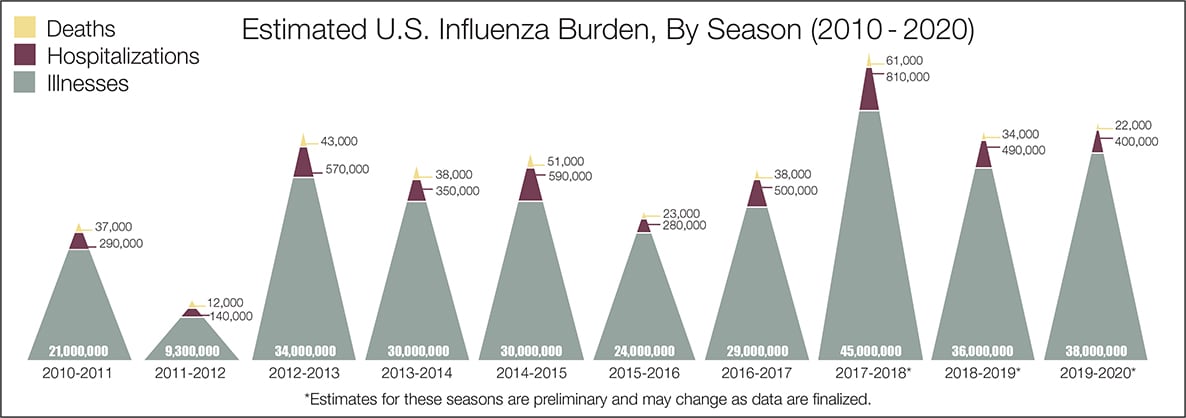
- The real question remains if the U.S. is over-reacting to this virus. The following graphic from the CDC puts the annual flu burden in perspective [click on image to enlarge].
What we do not know about the coronavirus [actually there is little scientifically proven information]. Most of our knowledge is anecdotal, from studies with limited subjects, or from studies without peer review.
- How many people have been infected as many do not show symptoms?
- To what degree do people who never develop symptoms contribute to transmission?
- The US has scaled up coronavirus testing – but the accuracy of the tests is in question.
- What forms of social distancing work best?
- Can children widely spread coronavirus?
- Why have some places avoided big coronavirus outbreaks – and others hit hard?
- What effect will the weather have?
- Can we reopen parks and beaches safely – but outdoor activities seem to be a lower risk than indoor activities.
- Do we develop lasting immunity to the coronavirus? Another coronavirus – the simple cold – does not develop long term immunity.
- Can the world really push out a vaccine in 12 to 18 months?
- Will we get other medical treatments for Covid-19?
Heavy breakouts of coronavirus have hit farmworkers. Farmworkers are essential to the food supply. They cannot shelter at home. Consider:
- they have high rates of the respiratory disease [occupational hazard]
- they travel on crowded buses chartered by their employers
- few have health insurance
- they cannot social distance and live two to four to a room – and they eat together
- some reports say half are undocumented
- they are low paid and cannot afford not to work – so they will go to work sick
- they do not have access to sanitation when working
- a coronavirus outbreak among farmworkers can potentially shutter entire farm
The bottom line is that COVID-19 so far has been shown to be much more deadly than the data on the flu. Using CDC data, the flu has a mortality rate between 0.06 % and 0.11 % Vs. the coronavirus which to date has a mortality rate of over 5 % – which makes it between 45 and 80 times more deadly. The reason for ranges:
Because influenza surveillance does not capture all cases of flu that occur in the U.S., CDC provides these estimated ranges to better reflect the larger burden of influenza.
There will be a commission set up after this pandemic ends to find fault [it is easy to find fault when a once-in-a-lifetime event occurs] and to produce recommendations for the next time a pandemic happens. Those that hate President Trump will conclude the virus is his fault. The most important issue will be an analysis of whether the federal government took a strong enough lead in dealing with the pandemic – and that includes every single politician!
Resources:
- Get the latest public health information from CDC: https://www.coronavirus.gov .
- Get the latest research from NIH: https://www.nih.gov/coronavirus.
- Find NCBI SARS-CoV-2 literature, sequence, and clinical content: https://www.ncbi.nlm.nih.gov/sars-cov-2/.
- List of studies: https://icite.od.nih.gov/covid19/search/#search:searchId=5ee124ed70bb967c49672dad
include(“/home/aleta/public_html/files/ad_openx.htm”); ?>


