


Written by Steven Hansen
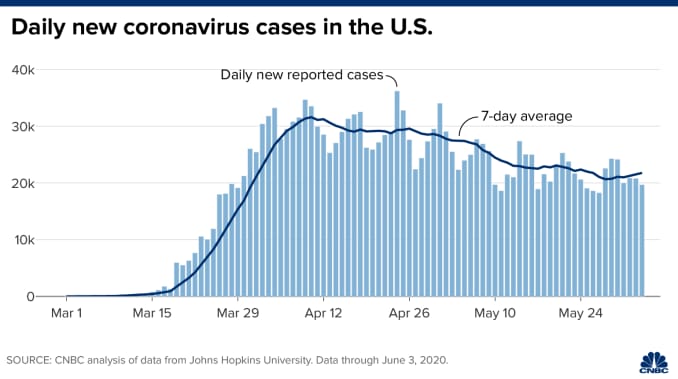
The 7 day rolling average of new coronavirus cases in the U.S. has changed very little over the last 5 days. At the end of this post is a set of interactive graphs and tables for the world and individual states – as well as today’s headlines which include;
- Nursing homes which had confirmed cases of COVID-19
- How long does the coronavirus last inside the body?
- Most Hospitalized COVID Patients Have Neurologic Symptoms
- Will Warm Weather Slow Spread of Novel Coronavirus?


Coronavirus News You May Have Missed
COVID-19 in Nursing Homes: CMS Names Names – MedPage Today
The public can now see — for each of 13,600 nursing homes in the country by name — which ones had suspected versus confirmed cases of COVID-19, which had COVID-19 deaths, and whether they were residents or staff.
With 88% of 15,400 Medicare and Medicaid-eligible nursing homes reporting as of May 31, Medicare officials yesterday rolled out a federal database showing how the nation’s 95,515 confirmed COVID-19 cases, 58,288 suspected cases, and 31,782 deaths among nursing home residents were distributed.
Of the facilities that reported, 25% reported cases or deaths.
The link to the data, which will be updated weekly, can be accessed on the CMS’s Nursing Home Compare website or downloaded as a spreadsheet and filtered or sorted.
How long does the coronavirus last inside the body? – National Geographic
… Scientists are still trying to understand why some COVID-19 patients like Lowenstein are having these kinds of relapses—sometimes weeks or months after they first got sick.
It’s possible that long-term patients are struggling because some of the coronavirus sticks around in their tissues. Researchers are now figuring out how long the germ stays alive inside the body, a situation known as viral persistence. That may be different from the length of time that someone who had COVID-19 can shed viral fragments, which can sometimes cause false positives on diagnostic tests.
… One complicating factor for COVID-19 is that many of the tests used by doctors tracking patients—or by researchers swabbing hospital light switches—use the polymerase chain reaction (PCR) method. This test searches for genetic fragments of the virus that are expelled by a person’s breath or sampled in their stool, urine, or other secretions. A PCR test can tell you whether someone has recently caught the disease, but it can’t distinguish between the live replicating virus and non-infectious viral debris.
… Working out the true windows of viral persistence will help resolve whether people are being re-infected with COVID-19, whether they develop lasting immunity—and, ultimately, how long sick people need to stay isolated.
… knowledge gaps in the safe use of cleaners and disinfectants among U.S. adults; the largest gaps were found in knowledge about safe preparation of cleaning and disinfectant solutions and about storage of hand sanitizers out of the reach of children. Mixing of bleach solutions with vinegar or ammonia, as well as application of heat, can generate chlorine and chloramine gases that might result in severe lung tissue damage when inhaled (4,5). Furthermore, exposures of children to hand sanitizers, particularly via ingestion, can be associated with irritation of mucous membranes, gastrointestinal effects, and in severe cases, alcohol toxicity (6). The risk of ingestion and consequent toxicity from improperly stored hand sanitizers, cleaners, and disinfectants can also extend to pets (7).
Consistent with current guidance for daily cleaning and disinfection of frequently touched surfaces (2), a majority of respondents reported increased frequency of cleaning in the home. However, approximately one third reported engaging in high-risk practices such as washing food products with bleach, applying household cleaning and disinfectant products to bare skin, and intentionally inhaling or ingesting cleaners or disinfectants. These practices pose a risk of severe tissue damage and corrosive injury (8,9) and should be strictly avoided. Although adverse health effects reported by respondents could not be attributed to their engaging in high-risk practices, the association between these high-risk practices and reported adverse health effects indicates a need for public messaging regarding safe and effective cleaning and disinfection practices aimed at preventing SARS-CoV-2 transmission in households.
COVID-19 prevention messages should continue to emphasize evidence-based, safe practices such as frequent hand hygiene and frequent cleaning and disinfection of high-touch surfaces (2). These messages should include specific recommendations for the safe use of cleaners and disinfectants, including the importance of reading and following label instructions, using water at room temperature for dilution (unless otherwise stated on the label), avoiding mixing of chemical products, wearing skin protection and considering eye protection for potential splash hazards, ensuring adequate ventilation, and storing and using chemicals and hand sanitizers out of the reach of children and pets (10). Despite the knowledge gaps and high-risk practices identified in this survey, most respondents believed that they knew how to clean and disinfect their homes safely; thus, prevention messages should highlight identified gaps in knowledge about safe and effective practices and provide targeted information using innovative communication strategies (e.g., digital, social media) regarding safe cleaning and disinfection. These messages about cleaning and disinfection practices for COVID-19 prevention can be coordinated and disseminated through trusted sources of information such as national, state, and local public health agencies and medical providers.
The findings in this report are subject to at least four limitations. First, although survey responses were weighted to be nationally representative of U.S. demographics, whether responses among this opt-in panel sample are truly representative of knowledge, attitudes, and practices shared by the broader U.S. population is difficult to determine. Second, social desirability bias might have affected responses, with some respondents potentially overstating their perceived knowledge or underreporting engagement in high-risk practices; thus, these findings might underestimate the risk for exposures. Third, cross-sectional data captured in survey responses do not allow for direct attribution of specific outcomes, such as adverse health effects, to specific knowledge gaps or practices. Finally, responses were recorded at a single point in time and might not reflect ongoing shifts in public opinion or cleaning and disinfection practices by the public throughout the national COVID-19 response.
Efforts are ongoing to collect these data over time and to characterize knowledge gaps and practices among specific demographic and geographic groups. These data will allow for development and evaluation of further targeted messaging to ensure safe cleaning and disinfection practices in U.S. households during and after the COVID-19 pandemic.
Most Hospitalized COVID Patients Have Neurologic Symptoms – MedPage Today
More than half of COVID-19 patients admitted to two hospitals in Spain developed some form of neurologic symptoms, a retrospective, observational study showed.
Neurologic manifestations were seen in 57.4% of 841 patients hospitalized with COVID-19 in March, reported Carlos Manuel Romero-Sanchez, MD, of Complejo Hospitalario Universitario de Albacete in Spain, and co-authors in Neurology.
In 4.1% of COVID-19 deaths in the study, neurologic complications were considered the fundamental cause.
…Disorders of consciousness were nearly twice as high (38.9%) among patients with severe COVID-19 (with severity defined by 2007 Infectious Diseases Society of America/American Thoracic Society criteria). Most cases of altered consciousness were secondary to severe hypoxemia, the researchers noted. Of patients with severe COVID-19, 14.9% had delirium and 9.4% had coma.
Will Warm Weather Slow Spread of Novel Coronavirus? – NIH.gov
With the start of summer coming soon, many are hopeful that the warmer weather will slow the spread of SARS-CoV-2, the novel coronavirus that causes COVID-19. There have been hints from lab experiments that increased temperature and humidity may reduce the viability of SARS-CoV-2. Meanwhile, other coronaviruses that cause less severe diseases, such as the common cold, do spread more slowly among people during the summer.
We’ll obviously have to wait a few months to get the data. But for now, many researchers have their doubts that the COVID-19 pandemic will enter a needed summertime lull. Among them are some experts on infectious disease transmission and climate modeling, who ran a series of sophisticated computer simulations of how the virus will likely spread over the coming months [1]. This research team found that humans’ current lack of immunity to SARS-CoV-2—not the weather—will likely be a primary factor driving the continued, rapid spread of the novel coronavirus this summer and into the fall.
These sobering predictions, published recently in the journal Science, come from studies led by Rachel Baker and Bryan Grenfell at Princeton Environmental Institute, Princeton, NJ. The Grenfell lab has long studied the dynamics of infectious illnesses, including seasonal influenza and respiratory syncytial virus (RSV). Last year, they published one of the first studies to look at how our warming climate might influence those dynamics in the coming years [2].
U.S. coronavirus cases have been slowly ticking up since Memorial Day – CNBC
Coronavirus cases in the United States have been slowly ticking up since the Memorial Day holiday, according to a CNBC analysis of data compiled by Johns Hopkins University.
New cases hit a peak of 31,578, based on a seven-day average, on April 10 before steadily falling to an eight-week low of just over 20,600 a day on May 28 — and have been rising ever since. New cases in the U.S. have risen over the last three days in a row with a seven-day average of 21,763 new cases reported Wednesday, the data shows.
Research shows that it can take anywhere from five to 12 days for people to show symptoms from the coronavirus, which may explain why U.S. cases are only just now starting to rise after several states reopened beaches and relaxed social distancing rules over Memorial Day, which fell on May 25. The virus, however, can spread a lot earlier than that and can even be passed along by people who don’t have any symptoms, according to the World Health Organization. Covid-19 patients who develop symptoms are contagious for one to three days before showing any signs of sickness, the WHO said.
U.S. doctors group sues FDA for limiting access to drug touted by Trump for COVID-19 – Reuters
A group of conservative U.S. doctors has sued the Food and Drug Administration for limiting use of the malaria drug hydroxychloroquine for COVID-19, arguing that the therapy should be made widely available to fight the pandemic.
The lawsuit represents the latest front in a highly politicized U.S. debate over access to hydroxychloroquine. The drug has been championed by President Donald Trump as a potential “game-changer” against the coronavirus, but its value has yet to be established. A clinical trial released on Wednesday found it to be ineffective in preventing infection.
The FDA, which regulates medicines in the United States, has restricted use of the drug from the national stockpile to COVID-19 patients who are hospitalized and cannot enroll in a clinical trial. States can set their own rules for prescription, with many influenced by the FDA’s warning that the drug has a risk of a side-effect of dangerous heart arrhythmias.
That harms the rights of its member doctors to prescribe as they see fit, causing “economic injury,” the Association of American Physicians and Surgeons (AAPS) argues in its suit, filed in a Michigan federal district court on Tuesday.
One generous proposal on Capitol Hill could put as much as $10,000 per month into American families’ hands to help them weather the coronavirus pandemic.
In some ways, it’s a nod to universal basic income, the concept of indefinitely providing people with a guaranteed amount of money per month. But the plan calls for providing the financial relief for only as long as the pandemic lasts.
The bill, named the Monthly Economic Crisis Support Act, was introduced in May by Sens. Kamala Harris, D-Calif.; Bernie Sanders, I-Vt.; and Ed Markey, D-Mass.
It calls for sending $2,000 per month to individuals and $4,000 to couples, as well as $2,000 per child for up to three children. Those earning under $120,000 would be eligible for support, though the payments would be reduced for income over $100,000.
California Says Film, TV Production can Resume June 12 – VOA
California will allow film, television and music production to resume June 12 if conditions permit after months of lockdown due to the coronavirus pandemic, the governor’s office said Friday.
Film and television productions in the Golden State have been shuttered since mid-March.
The reopening will be subject to approval by local health officers, the California Public Health Office said.
“To reduce the risk of COVID-19 transmission, productions, cast, crew and other industry workers should abide by safety protocols agreed by labor and management, which may be further enhanced by county public health officers,” it said.
G20 pledges more than $21 billion for coronavirus fight – France 24
The Group of 20 rich and emerging economies has pledged more than $21 billion to fight the coronavirus, the group said early on Saturday.
“The G20, with invited countries, has coordinated the global efforts to support the fight against the COVID-19 pandemic. To date, G20 members and invited countries have pledged over US$21 billion to support funding in global health,” the group said in a statement.
The pledges will be directed towards diagnostics, vaccines, therapeutics, and research and development, the statement added.
In April the group called on all countries, non-governmental organizations, philanthropies and the private sector to help close a financing gap estimated at over $8 billion to combat the COVID-19 pandemic.
Coronavirus Rips Into Regions Previously Spared – New York Times
Globally, known cases of the virus are growing faster than ever with more than 100,000 new ones a day. The surge is concentrated in densely populated, low- and middle-income countries across the Middle East, Latin America, Africa and South Asia.
Not only has it filled hospitals and cemeteries there, it has frustrated the hopes of leaders who thought they were doing everything right, or who believed they might somehow escape the pandemic’s worst ravages.

The following are foreign headlines with hyperlinks to the posts
China warns citizens not to travel to Australia due to ‘significant increase’ in racial violence
The following are additional national and state headlines with hyperlinks to the posts
‘Operation Warp Speed’ is fueling vaccine fears, two top experts worry
Coronavirus Statistics For 06 June 2020 |
| U.S. Only | Global | U.S Percentage of Total | ||||
| Today | Cumulative | Today | Cumulative | Today | Cumulative | |
| New Cases | 25,178 | 1,900,000 | 102,355 | 6,710,000 | 24.6% | 28.3% |
| Deaths | 932 | 109,143 | 3,787 | 394,713 | 24.6% | 27.7% |
| Mortality Rate | 3.7% | 5.7% | 3.7% | 5.9% | ||
| total COVID-19 Tests per 1,000 people | 1.3* | 59.85* | ||||
* as of 04 June 2020
Today’s Posts On Econintersect Showing Impact Of The Pandemic With Hyperlinks
How The Great Lockdown Saved Lives
New Zealand Hits A 95% Chance Of Eliminating Coronavirus But We Predict New Cases Will Emerge
COVID-19 Cases Per Million Inhabitants: A Comparison
Lockdown: We Need To Experiment With Reopenings Now To Prevent A Second Wave
Coronavirus INTERACTIVE Charts
include($_SERVER[‘DOCUMENT_ROOT’].’/pages/coronavirus.htm’); ?>
Analyst Opinion of Coronavirus Data
There are several takeaways that need to be understood when viewing coronavirus statistical data:
- The global counts are suspect for a variety of reasons including political. Even the U.S. count has issues as it is possible that as much as half the population has had coronavirus and was asymptomatic. It would be a far better metric using a random sampling of the population weekly. In short, we do not understand the size of the error in the tracking numbers.
- Just because some of the methodology used in aggregating the data in the U.S. is flawed – as long as the flaw is uniformly applied – you establish a baseline. This is why it is dangerous to compare two countries as they likely use different methodologies to determine who has (and who died) from coronavirus.
- COVID-19 and the flu are different but can have similar symptoms. For sure, COVID-19 so far is much more deadly than the flu. [click here to compare symptoms]
- From an industrial engineering point of view, one can argue that it is best to flatten the curve only to the point that the health care system is barely able to cope. This solution only works if-and-only-if one can catch this coronavirus once and develops immunity. In the case of COVID-19, herd immunity may need to be in the 80% to 85% range. WHO warns that few have developed antibodies to COVID-19. At this point, herd immunity does not look like an option.
- Older population countries will have a higher death rate.
- There are at least 8 strains of the coronavirus. New York may have a deadlier strain imported from Europe, compared to less deadly viruses elsewhere in the United States.
- Each publication uses different cutoff times for its coronavirus statistics. Our data uses 11:00 am London time. Also, there is an unexplained variation in the total numbers both globally and in the U.S.
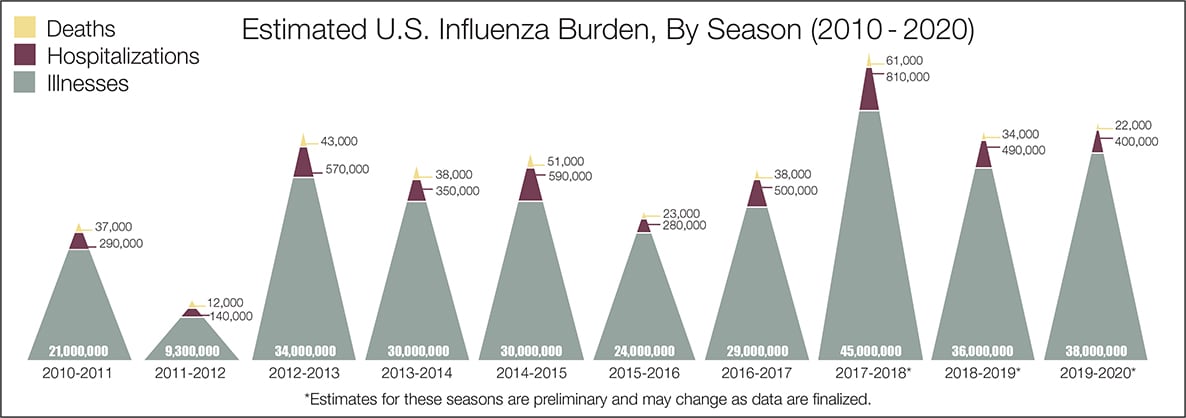
- The real question remains if the U.S. is over-reacting to this virus. The following graphic from the CDC puts the annual flu burden in perspective [click on image to enlarge].
What we do not know about the coronavirus [actually there is little scientifically proven information]. Most of our knowledge is anecdotal, from studies with limited subjects, or from studies without peer review.
- How many people have been infected?
- Can the US really scale up coronavirus testing and tracing?
- What forms of social distancing work best?
- Can children widely spread coronavirus?
- Why have some places avoided big coronavirus outbreaks?
- What effect will the weather have?
- Can we reopen parks and beaches? [we will find out soon as many beaches and parks have reopened]
- Do we develop lasting immunity to the coronavirus?
- Can the world really push out a vaccine in 12 to 18 months?
- Will we get other medical treatments for Covid-19?
- Do we need all these ventilators?
The bottom line is that COVID-19 so far has been shown to be much more deadly than the data on the flu. Using CDC data, the flu has a mortality rate between 0.06 % and 0.11 % Vs. the coronavirus which to date has a mortality rate of over 5 % – which makes it between 45 and 80 times more deadly. The reason for ranges:
Because influenza surveillance does not capture all cases of flu that occur in the U.S., CDC provides these estimated ranges to better reflect the larger burden of influenza.
There will be a commission set up after this pandemic ends to find fault [it is easy to find fault when a once-in-a-lifetime event occurs] and to produce recommendations for the next time a pandemic happens. Those that hate President Trump will conclude the virus is his fault. The most important issue will be an analysis of whether the federal government took a strong enough lead in dealing with the pandemic – and that includes every single politician!
include(“/home/aleta/public_html/files/ad_openx.htm”); ?>


