


Written by Steven Hansen
Every day recently, the global new coronavirus cases hit a new high – all while cases continue to decline in the U.S. At the end of this post is a set of interactive graphs and tables for the world and individual states – as well as today’s headlines which include;
- The Mysterious Missing Link – Anti-Malaria Drug & Zinc
- How we make decisions during a pandemic
- Covid-19 Brings a Reckoning of Layoffs to Silicon Valley

This week’s charts show new coronavirus cases per week and coronavirus deaths declined relative to the previous week.


Stay safe and enjoy your weekend.
Coronavirus News You May Have Missed
Here’s how retirement communities are adapting to a post-Covid 19 world – CNBC
- Operators of age-restricted retirement communities that market to older people are making changes in an effort to keep their residents safe amid a pandemic.
- While the amenities offered by these communities and the social opportunities they provide often are what draws individuals to them, safety is going to rank as equally important, experts say.
- Such communities may face a dip in occupancy rates, as would-be residents delay their decision to move or decide to age in place, in the safety of their own home, experts say.
WHO Releases New Guidance For Outdoor Events And Mass Gatherings Amid Pandemic – RepublicWorld
As leading countries move towards establishing normalcy, World Health Organization (WHO) issued guidelines on mass gathering amid the pandemic. The new guidelines, which include suggestions such as holding gathering outside, inviting only healthy people etc, recommend changes to large events and encourage people to do a ‘risk assessment’ before organizing events. This comes as the coronavirus pandemic has infected a total of 6,063,588 and killed 369244 people across the world, as per latest data by John Hopkins University.
“Since mass gatherings have substantial political, cultural, social, and economic implications, authorities should assess the importance and necessity of an event and consider the option that it may take place, provided all associated public health risks are adequately addressed and mitigated,” the new guidance said.
‘Risk assessment’
The Geneva-based organisation also called on public health organisations and event organizers to perform a risk assessment before holding a mass gathering. According to WHO, people should identify the risk that “enhance, prevent, degrade or delay” mass gatherings. In addition, the WHO also listed steps, the organizers could take if large events took place. The steps included staggering arrivals, increasing the frequency of transport and designating seatings. In addition to that, WHO advised event organisers to adjust the capacity of the venue and to hold events virtually or outdoors.
[editor’s note: the complete guidance from the WHO can be found here]
The Mysterious Missing Link – Anti-Malaria Drug & Zinc – ZeroHedge
[editor’s note: the use of zinc with Hydroxychloroquine has been a staple in many countries]
Mystery surrounds why an anti-malaria drug is not being tested as a Covid-19 treatment in combination with zinc, which doctors say is crucial for efficacy.
What the mainstream media did not point out is that the Lancet study failed to test HCQ with zinc. Other experts have found zinc to be vital for efficacy in this context.
Zinc, available as an over-the-counter supplement, has long been seen as an immune-system booster that helps develop immune cells, or antibodies, and can strengthen the body’s response to a virus.
American infectious disease specialist Joseph Rahimian explained that, in relation to Covid-19, zinc ‘does the heavy lifting and is the primary substance attacking the pathogen‘. HCQ is said to work as a delivery systemfor zinc in fighting coronavirus.
Ironically, the Lancet study came out at the same time as it was reported that India’s premier health body had expanded use of HCQ as a preventive for key workers following three studies showing positive results.
California emergency physician Dr Anthony Cardillo said during a local television interview:
‘[HCQ] really only works in conjunction with zinc. Every patient I have prescribed it to has been very, very ill and within eight to twelve hours they were basically symptom-free and so clinically I am seeing a resolution.’
European Union Leaders Urge U.S. To Remain In WHO – NPR
Officials with the European Union are urging President Trump to rethink his recently announced plans to pull the United States from the World Health Organization.
The president told reporters on Friday of his intentions to immediately cut ties with the international health agency. On Saturday, European Commission President Ursula von der Leyen and Josep Borrell, the EU’s top diplomat, called on Trump to reconsider his plans, saying “actions that weaken international results” during the coronavirus pandemic “must be avoided.”
“The WHO needs to continue being able to lead the international response to pandemics, current and future,” said von der Leyen and Borrell in a joint statement. “For this, the participation and support of all is required and very much needed.”
The officials also note that the members of the WHO had agreed earlier this month to review lessons learned from the pandemic response.
Younger generations already hit by COVID-19 Recession – PBS
But the cohort most affected by the pandemic-fueled economic crisis may be those who haven’t yet joined the labor market, said John Friedman, an economist and professor at Brown University.
“If you graduate into a bad economy, there’s a permanent impact” on earning potential and lost wages, Friedman said.
Chart by Megan McGrew/PBS NewsHour

How we make decisions during a pandemic – Knowable Magazine
“The idea is if people just have information, then they will make the rational choice. And that’s just wrong.” – ​DAMON CENTOLA
We might like to think that our behavioral choices, especially around something so important as a global pandemic, are based purely on the best information we have.
But that isn’t the case, say experts in behavioral science and social psychology. In fact, we are all susceptible to biases that push and pull our brains in invisible ways.
This happens in part because of overconfidence in our ability to know why we make the choices we do. “There’s a powerful belief in the value of introspection, which much of social psychology and psychological science has shown is a mistake,” says Jennifer Lerner, a psychologist at the Harvard Kennedy School. “We are not good at understanding what our brains are doing … . Even things that are conscious are affected by nonconscious factors in ways we don’t know.”
Covid-19 Brings a Reckoning of Layoffs to Silicon Valley – Bloomberg
Layoffs have slammed tech companies both large and small since the start of the coronavirus pandemic in mid-March. The industry has cut more than 40,000 jobs so far, but this month was the cruelest yet. In a single week in early May, Uber Technologies Inc. announced it would slash 3,700 positions, Airbnb Inc. said it would cut 1,900 and Lyft Inc. fired or furloughed more than 1,000.

The following are foreign headlines with hyperlinks to the posts
Australian Health Authorities Urge Caution as Lockdowns Ease
How China Tested 11 Million People for Virus in Just Two Weeks
Spanish government will seek a further extension of the state of emergency
Jerusalem’s holiest site reopens as coronavirus restrictions ease
South Korean clubs will use QR codes to log visitors amid coronavirus
Russia ‘grateful’ To India For Supply Of HCQ Medicines Amid COVID-19 Crisis
Venezuela To Partially Reopen The Country From June 1 With On-off Policy
Peru Reports 7,386 New Coronavirus Cases, Nationwide Toll Soars To 155,671
The following are state headlines with hyperlinks to the posts
In Boom-and-Bust San Francisco, Pandemic Brings Grim New Reality
| Here Are All The NYC Restaurants That Have Permanently Closed During The Coronavirus Crisis |
Coronavirus Statistics For 30 May 2020 |
| U.S. Only | Global | U.S Percentage of Total | ||||
| Today | Cumulative | Today | Cumulative | Today | Cumulative | |
| New Cases | 23,297 | 1,770,000 | 127,605 | 6,030,000 | 18.3% | 29.4% |
| Deaths | 945 | 103,781 | 4,049 | 368,944 | 23.3% | 28.1% |
| Mortality Rate | 4.1% | 5.9% | 3.2% | 6.1% | ||
| total COVID-19 Tests per 1,000 people | 1.49* | 48.64* | ||||
* as of 29 May 2020
Today’s Posts On Econintersect Showing Impact Of The Pandemic With Hyperlinks
Think Coronavirus Caused The Crash? These Two Charts Beg To Differ
Social Distancing, But Mostly During The Workweek?
The COVID-19 Fiscal Multiplier: Lessons From The Great Recession
Job Training Mismatch And The COVID-19 Recovery: A Cautionary Note From The Great Recession
COVID-19 Mortgage Relief – The Role Of Income Support
COVID-19 Worsens Pre-existing Financial Vulnerabilities
Infographic Of The Day: How To Find Work In The Remote Economy
Why Leaders Breaking Rules Is A Far More Serious Attack On Our Liberty Than Lockdown Itself
Coronavirus Disease News 31May 2020
Coronavirus Economic News 31May 2020
U.S. Economy Sees Sharp Downturn Amid COVID-19 Crisis
Coronavirus: Why We’re Using Llamas To Help Fight The Pandemic
Coronavirus INTERACTIVE Charts
include($_SERVER[‘DOCUMENT_ROOT’].’/pages/coronavirus.htm’); ?>
Analyst Opinion of Coronavirus Data
There are several takeaways that need to be understood when viewing coronavirus statistical data:
- The global counts are suspect for a variety of reasons including political. Even the U.S. count has issues as it is possible that as much as half the population has had coronavirus and was asymptomatic. It would be a far better metric using a random sampling of the population weekly. In short, we do not understand the size of the error in the tracking numbers.
- Just because some of the methodology used in aggregating the data in the U.S. is flawed – as long as the flaw is uniformly applied – you establish a baseline. This is why it is dangerous to compare two countries as they likely use different methodologies to determine who has (and who died) from coronavirus.
- COVID-19 and the flu are different but can have similar symptoms. For sure, COVID-19 so far is much more deadly than the flu. [click here to compare symptoms]
- From an industrial engineering point of view, one can argue that it is best to flatten the curve only to the point that the health care system is barely able to cope. This solution only works if-and-only-if one can catch this coronavirus once and develops immunity. In the case of COVID-19, herd immunity may need to be in the 80% to 85% range. WHO warns that few have developed antibodies to COVID-19. At this point, herd immunity does not look like an option.
- Older population countries will have a higher death rate.
- There are at least 8 strains of the coronavirus. New York may have a deadlier strain imported from Europe, compared to less deadly viruses elsewhere in the United States.
- Each publication uses different cutoff times for its coronavirus statistics. Our data uses 11:00 am London time. Also, there is an unexplained variation in the total numbers both globally and in the U.S.
- The real question remains if the U.S. is over-reacting to this virus. The following graphic from the CDC puts the annual flu burden in perspective [click on image to enlarge].
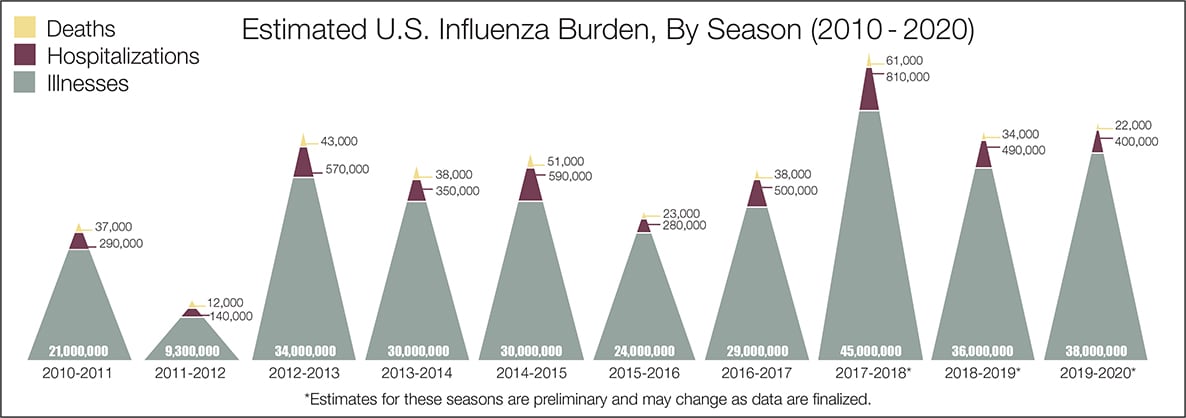
What we do not know about the coronavirus [actually there is little scientifically proven information]. Most of our knowledge is anecdotal, from studies with limited subjects, or from studies without peer review.
- How many people have been infected?
- Can the US really scale up coronavirus testing and tracing?
- What forms of social distancing work best?
- Can children widely spread coronavirus?
- Why have some places avoided big coronavirus outbreaks?
- What effect will the weather have?
- Can we reopen parks and beaches? [we will find out soon as many beaches and parks have reopened]
- Do we develop lasting immunity to the coronavirus?
- Can the world really push out a vaccine in 12 to 18 months?
- Will we get other medical treatments for Covid-19?
- Do we need all these ventilators?
The bottom line is that COVID-19 so far has been shown to be much more deadly than the data on the flu. Using CDC data, the flu has a mortality rate between 0.06 % and 0.11 % Vs. the coronavirus which to date has a mortality rate of over 5 % – which makes it between 45 and 80 times more deadly. The reason for ranges:
Because influenza surveillance does not capture all cases of flu that occur in the U.S., CDC provides these estimated ranges to better reflect the larger burden of influenza.
There will be a commission set up after this pandemic ends to find fault [it is easy to find fault when a once-in-a-lifetime event occurs] and to produce recommendations for the next time a pandemic happens. Those that hate President Trump will conclude the virus is his fault. The most important issue will be an analysis of whether the federal government took a strong enough lead in dealing with the pandemic – and that includes every single politician!
include(“/home/aleta/public_html/files/ad_openx.htm”); ?>


