



Of the four regional Federal Reserve manufacturing surveys released to date, all are in contraction.
Analyst Opinion of Richmond Manufacturing
The important Richmond Fed subcategories (new orders and unfilled orders) improved but remain deep in contraction. This survey was somewhat better than last month.
Market expectations from Econoday were -40 to -38 (consensus -39). The actual survey value was -27 [note that values above zero represent expansion].
Fifth District manufacturing remained soft in May, according to the most recent survey from the Richmond Fed. The composite index rose from a record low of −53 in April to −27 in May, remaining at its lowest level since 2009. All three components — shipments, new orders and employment — were above their April readings but still in contractionary territory. The index for local business conditions was also negative, but contacts expected conditions to improve in the next six months.
Many survey participants reported decreases in employment and the average workweek in May. However, the indexes for wages and the availability of workers with the necessary skills were both close to 0. Respondents expected to see increases in both wages and available skills in the coming months.
On average, growth of prices paid by manufacturing firms slowed in May, while that of prices received accelerated. The average growth rate of prices received surpassed that of prices paid. Contacts expected the growth rates of both prices paid and prices received to increase in the near future
z richmond_man1.PNG
Richmond Fed (hyperlink to reports):
z richmond_man.PNG


Summary of all Federal Reserve Districts Manufacturing:
Kansas Fed (hyperlink to reports):

z kansas_man.PNG
Dallas Fed (hyperlink to reports):

z dallas_man.PNG
Philly Fed (hyperlink to reports):

z philly fed1.PNG
New York Fed (hyperlink to reports):

z empire1.PNG
Federal Reserve Industrial Production – Actual Data (hyperlink to report):
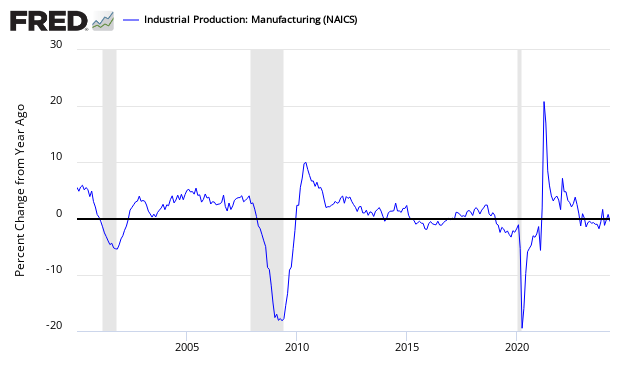
Holding this and other survey’s Econintersect follows accountable for their predictions, the following graph compares the hard data from Industrial Products manufacturing subindex (dark blue bar) and US Census manufacturing shipments (red bar) to the Richmond Fed survey (darkest bar).

In the above graphic, hard data is the long bars, and surveys are the short bars. The arrows on the left side are the key to growth or contraction.
include(“/home/aleta/public_html/files/ad_openx.htm”); ?>


