


Written by Steven Hansen
The daily death count due to coronavirus increased today – but it is still the best three day period since 04 April. New coronavirus cases three day rolling average is the second-lowest day since 01 April. At the end of this post is a set of interactive graphs and tables for the world and individual states – as well as today’s headlines which include studies where monkeys develop immunity from coronavirus reinfection; California huge budgetary shortfall; and fears that 60 million people will be added to those in extreme poverty due to the coronavirus.

Today, all 50 states have reopened – but the rules vary widely as the following YouTube video shows:
Coronavirus News You May Have Missed
China’s New Outbreak Shows Signs the Virus Could Be Changing – NDTV
Chinese doctors are seeing the coronavirus manifest differently among patients in its new cluster of cases in the northeast region compared to the original outbreak in Wuhan, suggesting that the pathogen may be changing in unknown ways and complicating efforts to stamp it out.
Patients found in the northern provinces of Jilin and Heilongjiang appear to carry the virus for a longer period of time and take longer to test negative, Qiu Haibo, one of China’s top critical care doctors, told state television on Tuesday.
Patients in the northeast also appear to be taking longer than the one to two weeks observed in Wuhan to develop symptoms after infection, and this delayed onset is making it harder for authorities to catch cases before they spread, said Qiu, who is now in the northern region treating patients.
… Scientists still do not fully understand if the virus is changing in significant ways and the differences Chinese doctors are seeing could be due to the fact that they’re able to observe patients more thoroughly and from an earlier stage than in Wuhan. When the outbreak first exploded in the central Chinese city, the local health-care system was so overwhelmed that only the most serious cases were being treated. The northeast cluster is also far smaller than Hubei’s outbreak, which ultimately sickened over 68,000 people.
… Researchers worldwide are trying to ascertain if the virus is mutating in a significant way to become more contagious as it races through the human population, but early research suggesting this possibility has been criticized for being overblown.
Monkeys infected with COVID-19 develop immunity in studies, a positive sign for vaccines – Reuters
Two studies in monkeys published on Wednesday offer some of the first scientific evidence that surviving COVID-19 may result in immunity from reinfection, a positive sign that vaccines under development may succeed, U.S. researchers said on Wednesday.
… In one of the new studies, researchers infected nine monkeys with COVID-19, the illness caused by the novel coronavirus. After they recovered, the team exposed them to the virus again and the animals did not get sick.
… In the second study, Barouch and colleagues tested 25 monkeys with six prototype vaccines to see if antibodies produced in response were protective. … All of the control animals showed high degrees of virus in their noses and lungs, but in the vaccinated animals, “we saw a substantial degree of protection,”
[editor’s note: these studies have been peer reviewed but monkey’s are not humans]
Coronavirus: A mink may have transmitted COVID-19 to a human, says Dutch government – Euronews
The Dutch government says it has evidence to suggest a human has contracted coronavirus from a mink.
In a letter sent on Wednesday, the Dutch agriculture minister Carola Schouten said a worker on a mink farm had contracted a strain of COVID-19 that was similar to that found in an animal on the premises.
She said this meant it was “likely” that mink-to-human transmission had occurred.
“These new research results have a major impact on the owners, families and employees of mink companies as well as on the local communities,” she said in the letter.
Coronavirus: World Bank warns 60m at risk of ‘extreme poverty’ – BBC
Up to 60m people will be pushed into “extreme poverty” by the coronavirus warns the president of the World Bank.
David Malpass said the bank expects global economic growth to shrink by 5% this year as nations deal with the pandemic.
This has already led to millions losing their jobs and businesses failing, with poorer countries feeling the brunt.
“Millions of livelihoods have been destroyed and healthcare systems are under strain worldwide,” he said.
“Our estimate is that up to 60 million people will be pushed into extreme poverty – that erases all the progress made in poverty alleviation in the past three years,” Mr Malpass warned on Tuesday.
The World Bank defines “extreme poverty” as living on less than $1.90 (Pound Sterling1.55) per person per day.
Chinese advisers hit back at allegations the country is using coronavirus aid for political leverage – CNN
Accusations that China is using coronavirus aid to boost its geopolitical influence and vie for global leadership are “narrow-minded,” Chinese People’s Political Consultative Conference (CPPCC)’s spokesman Guo Weimin has said.
“The accusations that China is aggressively publicizing its foreign assistance or even vying for global leadership through providing assistance are narrow minded and simply make no sense at all,” Guo said at a news conference on Wednesday days before the CPPCC national committee’s annual conference.
He added that China is distributing aid for “the purpose of controlling the epidemic as soon as possible, and saving as many lives as possible.”
The CPPCC is China’s leading political advisory body.
Guo accused “certain politicians from the US and other countries” of politicizing the coronavirus pandemic and “stigmatizing China” adding that “these politicians are either trying to distract public attention and shift responsibilities to serve the needs of domestic politics or are spreading false information and blaming China out of ideological bias.”
Trump threatens to withhold Michigan, Nevada funding over mail-in voting – The Hill
President Trump on Wednesday threatened to withhold federal funding to Michigan after its secretary of state, Jocelyn Benson (D), announced all of the state’s registered voters would receive applications for absentee ballots in the mail this year.
Trump falsely claimed that Benson sent ballots, and not ballot applications, to the state’s registered voters and that the step was done “illegally.” The president threatened to withhold funding if the state did not reverse course, suggesting its move would encourage voter fraud. Trump later threatened to suspend federal funding to Nevada, which is holding a mail-in primary election, claiming the state was creating a “great Voter Fraud scenario” and allow people to “cheat in elections.”
“Breaking: Michigan sends absentee ballots to 7.7 million people ahead of Primaries and the General Election,” Trump tweeted. “This was done illegally and without authorization by a rogue Secretary of State. I will ask to hold up funding to Michigan if they want to go down this Voter Fraud path!”
Canada’s top doctor says she’ll wear a mask when physical distancing isn’t possible – CBC
After downplaying the effectiveness of non-medical face masks, both the chief public health officer and federal health minister now say they would wear them in cases where physical distancing isn’t possible in public.
Theresa Tam, the country’s top doctor, said Tuesday that while the scientific research “is not quite there” yet on the effectiveness of non-medical masks in stopping the spread of COVID-19, she wouldn’t hesitate to use a mask when grocery shopping or riding transit.
“That’s one option,” she said of wearing a mask. “It is an added layer of prevention and protecting the spreading to others.”
Global daily cases increased by most ever, WHO says – CNBC
Countries around the world collectively reported more new cases to the WHO in the past 24 hours than ever before, WHO Director-General Tedros Adhanom Ghebreyesus said. Most new infections are coming from the Americas, followed by Europe and the Middle East, according to data compiled by the WHO. However, the virus could be spreading unknown in parts of the world with limited testing capacity and health care infrastructure.
Cuba goes a week without a single coronavirus death – TBS News
Cuba has gone a week without any coronavirus-related deaths, health officials said Wednesday, as the numbers of cases in the country continue to drop.
According to a John Hopkins University tally, the country has so far recorded nearly 1,900 coronavirus cases with 79 deaths, reports the CNN.
Cuban health officials announced 13 additional Covid-19 cases Wednesday without any new fatalities.
People diagnosed with the coronavirus in Cuba are required to receive treatment at hospitals, and wearing masks in public is mandatory.
C.D.C. releases guidance that the White House had shelved. – New York Times
The Centers for Disease Control and Prevention quietly released more detailed guidance for schools, businesses, transit systems and other industries hoping to reopen safely amid the coronavirus pandemic after fear that the White House had shelved the guidelines.
The 60-page document, which a C.D.C. spokesman said was uploaded over the weekend, but which received little notice, adds great detail to six charts that the C.D.C. had released last week. The guidance provides specific instructions for different sectors to detect and trace the virus based on exposure and risk after the pandemic. Here are some key elements.
The Nightmare That Colleges Face This Fall – The Atlantic
University presidents are scrambling for answers on everything from on-campus housing to revenue-generating sports.
Classes will take place in the fall-but how? There’s still no consensus on what next semester will be like. Not even close.
This spring’s university closures have bought school leaders time to figure out how to introduce social distance into spaces designed to bring people together-classrooms, dining facilities, study lounges, and campus housing, to name a few. And although pivoting to online learning has likely helped slow the spread of the coronavirus in college towns, a meaningful solution to the crisis appears far off. Colleges cannot keep students away forever; their bottom lines can’t handle that financial pressure. Residence halls are scheduled to reopen for the fall semester three months from now. Nearly everyone with an eye on higher education is asking one question: How can schools pull this off?
No cash, please, we’re skittish: How coronavirus has spawned fear of paper money – Los Angeles Times
In troubled times, people have been known to hoard currency at home – a financial security blanket against deep uncertainty.
But in the coronavirus crisis, things are different. This time cash, passed from person to person like the virus itself, is a source of suspicion rather than reassurance.
No longer a thing to be shoved mindlessly into a pocket, tucked into a worn wallet or thrown casually on a kitchen counter, paper money has seen its status change during the virus era – perhaps irrevocably. The pandemic has also reawakened the debate about the continued viability of what has been the lifeblood of global economies: physical bank notes and coins.
Plastic bags were finally being banned. Then came the pandemic. – VOX
Since the Covid-19 pandemic upended life across the globe, ravaging economies and bringing entire health care systems to their knees, everyone is being forced to compromise. Retailers are banning consumers from bringing in their own reusable bags, cities and states are rolling back or delaying single-use plastic bans, and municipalities are scaling back recycling operations, with hygiene fears underlying it all.
With plastic production already projected to increase by 40 percent over the next decade, campaigners like Leonard fear the pandemic could unravel hard-fought measures to pare back the 8 million metric tons of plastic that enters our oceans every year.
The signs so far haven’t been reassuring: Customers at Target, for instance, are no longer able to bring in their own bags “out of an abundance of caution, and until further notice,” a spokesperson told The Goods, using an oft-repeated phrase. The retailer’s in-store recycling kiosks are similarly on hiatus. In early March, the coffee juggernaut Starbucks announced that its baristas would no longer accept customer-proffered mugs. Dunkin’ (nee Donuts) quickly followed suit.
Gov Newsom Calls For $1 Trillion In Federal Aid For California As LA Drags Feet On Reopening – Zero Hedge
During the interview, the Cali governor reiterated his demand for $1 trillion in federal aid for California, despite emerging evidence that economic reopenings haven’t produced the feared spike in cases – in fact, many states that have dragged their feet on reopening have seen higher rates of infection.
Fox Business’s Charlie Gasparino reported that there is a “growing consensus” between both parties for another $1 trillion round of stimulus spending after Memorial Day. But with every governor walking to the White House with their hand out, the battle over the next aid bill should be especially fierce, forcing Dems to reckon with the reality that they really don’t need all that money.
[editor’s note: see next post]
California’s Budget Bust-Up – city journal.org
Every state and municipal budget in America will take a big hit because of the coronavirus lockdowns, but no public purse is in as much trouble as California’s. Its Department of Finance recently estimated that the Golden State could face a $54 billion shortfall in the fiscal year beginning July 1, which surely must be the largest deficit any state has ever accumulated, surpassing the $40 billion hole that nearly swallowed Sacramento in 2008. Still, though Governor Gavin Newsom said last weekend that the staggering deficit was “a direct result of Covid-19,” that’s clearly not true. Critics have long warned that the state’s tax base is volatile, being increasingly reliant on wealthy residents and vulnerable to sharp contraction in the next recession. Combine that with California’s spending spree-including expenditures to fix problems that the state’s own bad policies have worsened-and the swing from prosperity to penury isn’t hard to understand.
… California officials blame the projected $54 billion shortfall on the coronavirus shutdown, but steep deficits always loomed in the next recession. Last year, the Public Policy Institute of California estimated that, even in a moderate downturn, the state would face revenue shortfalls averaging more than $22 billion a year for the next four years-totaling more than $90 billion. For a severe recession-as we may now be facing-the study projected revenue losses of $170 billion stretching over five years.
Retailers Get Pummeled In Wake of COVID After Rough 3 Years – Challenger, Gray & Christmas
Retailer Pier 1 Imports announced it would close all remaining 540 stores and try to find a buyer for its online business. It follows bankruptcy announcements from JC Penney, J. Crew, and Neiman Marcus.
“Retail has been undergoing technological updates, shifting consumer behavior and low foot traffic over the last three years that has led to mass closures of brick-and-mortar establishments and job cuts,” said Andrew Challenger, SVP of global outplacement and executive coaching firm Challenger, Gray & Christmas, Inc.
“The current COVID crisis is exacerbating Retail woes. Companies that did not have a robust online offering are being hit particularly hard,” he added.
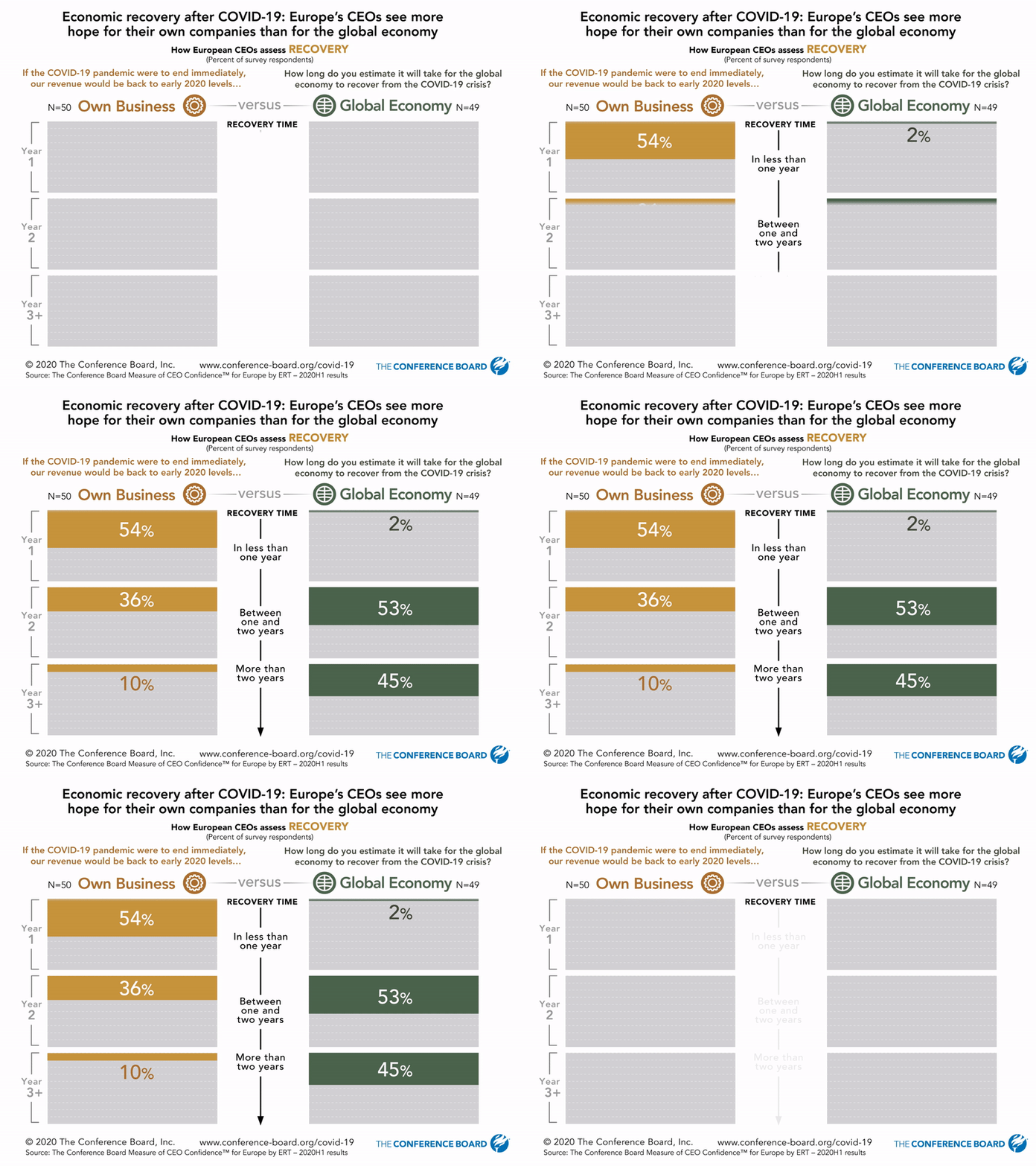
Economic recovery after COVID-19: Will large companies in Europe fare better than the global economy? – The Conference Board
As countries in Europe begin a gradual reboot of their economies, CEOs and Chairs of major industrial companies in Europe expect the global economy to recover slowly. A majority of respondents (53 percent) say it will take between one and two years for the global economy to recover from the COVID-19 crisis, and 45 percent expect it will take more than two years.
However, 54 percent of CEOs said that if the COVID-19 pandemic were to end now, their revenue would return to early 2020 levels in less than one year, and 14 percent expected it to recover within three months. Could the recovery be less difficult for large industrial companies than for other parts of the economy?
Perhaps the larger businesses in the survey have more resilience and liquidity to weather the storm than small and medium-sized enterprises, which make up more than half the global economy. Another possible explanation is that industrial firms are more likely to benefit from pent-up demand than service companies once the economy starts to recover.
The need to go is a big barrier to going out. Why public bathrooms are a stumbling block for reopening. – The Washington Post
The idea of a return to life in public is unnerving enough for many people. But it turns out that one of the biggest obstacles to dining in a restaurant, renewing a doctor’s appointment or going back to the office is the prospect of having to use a public restroom – a tight, intimate and potentially germ-infested space.
It’s a hurdle vexing many business owners as they prepare to reopen in a time of social distancing, reduced capacity and heightened anxiety about the very air we breathe.
Why meatpacking plants have become coronavirus hot spots – VOX
The working conditions in meatpacking plants create a perfect storm for coronavirus transmission. Workers are unable to maintain the recommended 6 feet of distance on the processing floor, and they breathe heavily while hauling cuts of meat, possibly spreading virus particles in the cold air.
Companies that own these plants have sought to implement temperature checks and social distancing measures in common spaces outside the processing floor, as well as administer additional protective equipment. But it’s also possible that the virus is spreading outside the plants themselves, as low-wage, mostly immigrant workers live in crowded conditions and commute via public transit.
Consumers are seeing the effects at the grocery store and fast food restaurants. Meat and pork prices have jumped at least 3 percent. And while America isn’t at risk of running out of food generally, there have been spot shortages of meat such that some retailers, including Costco and Kroger, have started limiting the number of meat items that customers can purchase.
Federal agencies share principles for offering responsible small-dollar loans – Federal Reserve
The federal financial institution regulatory agencies today issued principles for offering small-dollar loans in a responsible manner to meet financial institutions customers’ short-term credit needs.
The Federal Reserve Board, the Federal Deposit Insurance Corporation, the National Credit Union Administration, and the Office of the Comptroller of the Currency recognize the important role that responsibly offered small-dollar loans can play in helping customers meet their ongoing needs for credit from temporary cash-flow imbalances, unexpected expenses, or income shortfalls, including during periods of economic stress, natural disasters, or other extraordinary circumstances such as the public health emergency created by COVID-19.
The agencies are issuing the “Interagency Lending Principles for Offering Responsible Small-Dollar Loans” to encourage supervised banks, savings associations, and credit unions to offer responsible small-dollar loans to customers for consumer and small business purposes.
A March 26 joint agency statement encouraged banks, savings associations, and credit unions to offer responsible small-dollar loans to consumers and small businesses in response to COVID-19.
Coronavirus Statistics For 20 May 2020 |
| U.S. Only | Global | U.S Percentage of Total | ||||
| Today | Cumulative | Today | Cumulative | Today | Cumulative | |
| New Cases | 19,970 | 1,530,000 | 94,557 | 4,860,000 | 21.1% | 31.5% |
| Deaths | 1,568 | 91,921 | 4,776 | 323,046 | 32.8 % | 28.5% |
| Mortality Rate | 7.9% | 6.0% | 5.1% | 6.6% | ||
| total COVID-19 Tests per 1,000 people | 1.02 | 35.75 | ||||
Today’s Posts On Econintersect Showing Impact Of The Pandemic With Hyperlinks
29 April 2020 FOMC Meeting Minutes: Economic Outlook Dependent On the Course Of the Pandemic
An Eye-Opening Perspective: Emerging Markets And Epidemics
How Pandemics Leave The Poor Even Farther Behind
An Eye-Opening Perspective: Emerging Markets And Epidemics
What Will The World Look Like After COVID-19?
Coronavirus School Closures Impact 1.3 Billion Children And Remote Learning Is Increasing Inequality
“Negative” Interest Rates And The War On Cash
Vaccine At ‘Warp Speed’? Let’s Think About It
Sudden Loss Of Smell – Why It Is A Reason To Self-isolate
Coronavirus INTERACTIVE Charts
include($_SERVER[‘DOCUMENT_ROOT’].’/pages/coronavirus.htm’); ?>
Analyst Opinion of Coronavirus Data
There are several takeaways that need to be understood when viewing coronavirus statistical data:
- The global counts are suspect for a variety of reasons including political. Even the U.S. count has issues as it is possible that as much as half the population has had coronavirus and was asymptomatic. It would be a far better metric using a random sampling of the population weekly. In short, we do not understand the size of the error in the tracking numbers.
- Just because some of the methodology used in aggregating the data in the U.S. is flawed – as long as the flaw is uniformly applied – you establish a baseline. This is why it is dangerous to compare two countries as they likely use different methodologies to determine who has (and who died) from coronavirus.
- COVID-19 and the flu are different but can have similar symptoms. For sure, COVID-19 so far is much more deadly than the flu. [click here to compare symptoms]
- From an industrial engineering point of view, one can argue that it is best to flatten the curve only to the point that the health care system is barely able to cope. This solution only works if-and-only-if one can catch this coronavirus once and develops immunity. In the case of COVID-19, herd immunity may need to be in the 80% to 85% range. WHO warns that few have developed antibodies to COVID-19. At this point, herd immunity does not look like an option.
- Older population countries will have a higher death rate.
- There are at least 8 strains of the coronavirus. New York may have a deadlier strain imported from Europe, compared to less deadly viruses elsewhere in the United States.
- Each publication uses different cutoff times for its coronavirus statistics. Our data uses 11:00 am London time. Also, there is an unexplained variation in the total numbers both globally and in the U.S.
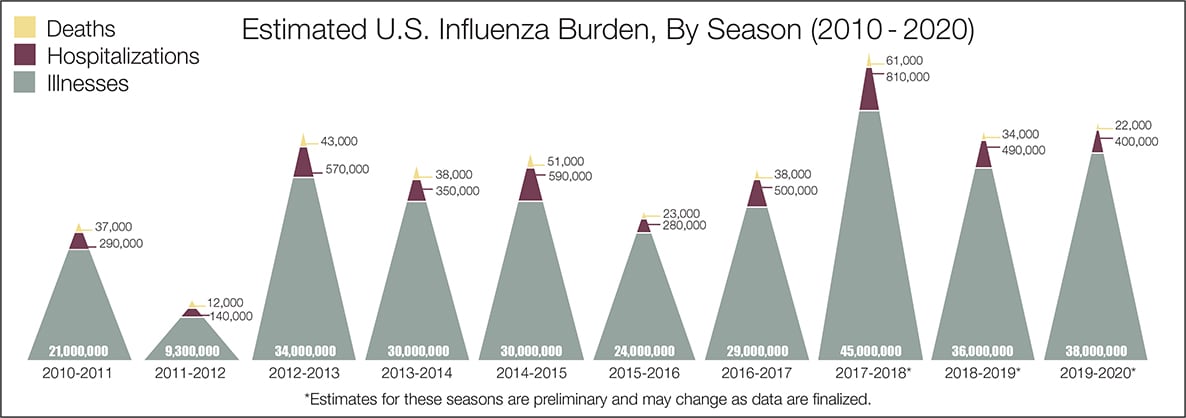
- The real question remains if the U.S. is over-reacting to this virus. The following graphic from the CDC puts the annual flu burden in perspective [click on image to enlarge].
What we do not know about the coronavirus [actually there is little scientifically proven information]. Most of our knowledge is anecdotal, from studies with limited subjects, or from studies without peer review.
- How many people have been infected?
- Can the US really scale up coronavirus testing and tracing?
- What forms of social distancing work best?
- Can children widely spread coronavirus?
- Why have some places avoided big coronavirus outbreaks?
- What effect will the weather have?
- Can we reopen parks and beaches? [we will find out soon as many beaches and parks have reopened]
- Do we develop lasting immunity to the coronavirus?
- Can the world really push out a vaccine in 12 to 18 months?
- Will we get other medical treatments for Covid-19?
- Do we need all these ventilators?
The bottom line is that COVID-19 so far has been shown to be much more deadly than the data on the flu. Using CDC data, the flu has a mortality rate between 0.06 % and 0.11 % Vs. the coronavirus which to date has a mortality rate of over 5 % – which makes it between 45 and 80 times more deadly. The reason for ranges:
Because influenza surveillance does not capture all cases of flu that occur in the U.S., CDC provides these estimated ranges to better reflect the larger burden of influenza.
There will be a commission set up after this pandemic ends to find fault [it is easy to find fault when a once-in-a-lifetime event occurs] and to produce recommendations for the next time a pandemic happens. Those that hate President Trump will conclude the virus is his fault. The most important issue will be an analysis of whether the federal government took a strong enough lead in dealing with the pandemic – and that includes every single politician!
include(“/home/aleta/public_html/files/ad_openx.htm”); ?>


