


Written by Steven Hansen
This week, while the world count of new coronavirus cases increased, the U.S. had the lowest weekly count since 29 March 2020. At the end of this post is a set of interactive graphs and tables for the world and individual states – as well as today’s headlines which predict an increase in coronavirus cases as more-and-more states lift restrictions; and there is a surge in cases in countries that have relaxed their lockdowns.


This week, deaths due to coronavirus declined (lower than any week since 12 April 2020 – but the global deaths declined faster.

A light moment for these hard coronavirus times – some entertaining videos.
I Can’t Go To Work – Coronavirus Parody
Fixin To Die For No Reason Rag (Country Joe McDonald CoronaVirus Parody)
You Gotta Wash Your Hands (Coronavirus Covid 19 Beatles Parody)
Coronavirus News You May Have Missed
Key virus modeler says rise in mobility is driving up death projection – Axios
Christopher Murray, director of University of Washington’s Institute for Health Metrics and Evaluation, said on CBS News’ “Face the Nation” Sunday that his coronavirus model projects that more than 137,000 people in the United States may die from the virus by August.
Why it matters: Murray’s influential IHME model, which is one of the forecasts used by the White House, has been criticized for frequently revising its projections. Murray said his team is tracking cellphone data and has seen “explosive increases in mobility in a number of states” that will likely translate into more cases and deaths in 10 days.
What he’s saying: “We’re seeing, in some states, a 20 percentage point increase in just 1o days in mobility, and that will translate into more human contact, more transmission,” Murray said.
- Murray explained that the rise in mobility is likely a result of states relaxing lockdown measures and of people simply growing tired of staying indoors.
- “The places that are taking off the social distancing mandates, the bump in mobility appears to be larger,” he said. “So somewhere like Georgia, which was one of the first, we’re seeing is in that category of a pretty big increase.”
Reopenings bring new coronavirus cases in South Korea as nations fear second wave – the japan times
South Korea’s capital closed down more than 2,100 bars and other nightspots Saturday because of a new cluster of coronavirus infections, Germany scrambled to contain fresh outbreaks at slaughterhouses and Italian authorities worried that people were getting too friendly at cocktail hour during the country’s first weekend of eased restrictions.
The new flareups — and fears of a second wave of contagion — underscored the dilemma authorities face as they try to reopen their economies.
Around the world, the U.S. and other hard-hit countries are wrestling with how to ease curbs on business and public activity without causing the virus to come surging back.
Three members of the White House coronavirus task force quarantine – Associated Press
Three members of the White House coronavirus task force, including Dr. Anthony Fauci, placed themselves in quarantine after contact with someone who tested positive for COVID-19, another stark reminder that not even one of the nation’s most secure buildings is immune from the virus.
Fauci, the director of the National Institute of Allergy and Infectious Diseases and a leading member of the task force, has become nationally known for his simple and direct explanations to the public about the coronavirus and COVID-19, the disease it causes. Also quarantining are Dr. Robert Redfield, director of the Centers for Disease Control and Prevention, and the commissioner of the Food and Drug Administration, Stephen Hahn.
Fauci’s institute said that he has tested negative for COVID-19 and will continue to be tested regularly. It added that he is considered at “relatively low risk” based on the degree of his exposure, and that he would be “taking appropriate precautions” to mitigate the risk to personal contacts while still carrying out his duties. While he will stay at home and telework, Fauci will go to the White House if called and take every precaution, the institute said.
Travel changed after 9/11; Here’s how it will look after the Covid-19 pandemic finally recedes – CNBC
- The Covid-19 pandemic has brought travel and tourism to a near-standstill, and no one is sure when it will restart.
- When travel does begin again, look for it to start with road trips not too far from home, say experts.
- The new travel normal may mean a shift to vacation rentals over hotels, driving rather than flying, and an increase in the use of travel insurance and personal travel advisors.
New cluster in China highlights the challenge of controlling infections as countries open up. – New York Times
The health authorities in northeastern China have reported a new cluster of cases in a town near the Russian border, a flare-up that shows the continuing difficulties in stopping the coronavirus even for countries that have been largely successful in curbing infections.
Eleven new cases were recorded on Saturday in the town of Shulan in Jilin Province. They were traced to a 45-year-old woman who was confirmed to be infected on Thursday, but health officials were still trying to determine how she had contracted the virus.
China has begun to reopen after a widespread lockdown put in place to control the coronavirus, which first emerged in the city of Wuhan late last year. But small outbreaks have persisted. Parts of northeastern China increased controls last month after a spate of new cases traced to people returning from Russia.
New data shows why Spain’s 2 largest cities are not relaxing restrictions yet – CNN
As just over half of Spain’s population prepares to move ahead with the next step in de-escalation on Monday, the latest figures on coronavirus cases indicate why the two largest cities, Madrid and Barcelona, will continue to enforce stricter movement and mobility measures for now, a top health official said Sunday.
The Health Ministry reported at least 621 new Covid-19 cases across Spain since Saturday, and 64% of them are in the Madrid region, in Catalonia – where Barcelona is located, and in two other regions adjacent to Madrid.
“The regions with the greatest population, where the epidemic has occurred, have had a little different diffusion” from the rest of Spain, said Dr. Fernando Simón, Spain’s director of Health Emergencies. “They are Madrid, Catalonia and we also have some more cases in Castilla La Mancha and Castilla Leon.”
Why some nurses have quit during the coronavirus pandemic – NBC News
As COVID-19 has infected more than one million Americans, nurses working on the front lines of the pandemic with little protective support have made the gut-wrenching decision to step away from their jobs, saying they were ill-equipped and unable to fight the disease and feared not only for their own safety but also for that of their families.
Many of these nurses, who have faced backlash for quitting, say new CDC protocols have made them feel expendable and have not kept their safety in mind, leaving them no choice but to walk away from a job they loved.
‘We’re not cannon fodder, we’re human beings’
Coronavirus: The tide is coming for medicinal cannabis – DW
Cannabis researchers in Canada say the plant-based drug may provide resistance to SARS-CoV-2. Their preliminary findings are part of broader research into the use of medicinal cannabis in treating cancer.
The search for a vaccine for the new coronavirus, SARS-CoV-2, or indeed a medicinal drug to cure it, has taken researchers down both traditional and less traditional avenues.
They have looked at existing drug candidates, such as remdesivir, which was original developed to treat Ebola. In Germany, the first clinical trials for a coronavirus vaccine are based on a candidate developed for cancer immunology.
There’s a study out of France that suggests nicotine — typically ingested via the often-lethal pastime of smoking — may protect people against the novel coronavirus, itself a potentially fatal lung infection.
And, now, preliminary research is emerging out of Canada that certain strains of the psychoactive drug cannabis may also increase resistance to the coronavirus. If the study, which is not yet peer reviewed, can be verified, it would appear that cannabis works in a similar way to nicotine.
“The results on COVID-19 came from our studies on arthritis, Crohn’s disease, cancer and others,” says Dr. Igor Kovalchuck, a professor of Biological Sciences at the University of Lethbridge, in an email to DW.
Keys to coping with lockdown – Knowable Magazine
The sense of isolation that these people felt when doing their jobs — the first two are astronauts who served on the International Space Station and the third is a former US Navy submariner — was extreme. But millions of people around the world, cut off from friends and family and cooped up 24-7 alone or with a small core group, have been experiencing many of the same emotions and frustrations.
For policymakers, scientists and the public, the Covid-19 lockdowns are a journey into the unknown, with big questions about how they will play out. What are the likely impacts on people of social distancing? What could the long-term effects be on our collective mental health?
… So while most of us might think of elderly people living alone as particularly lonely, the data don’t agree. A recent analysis of a huge 2018 survey, carried out by UK psychologists and the BBC, looked at 46,054 people aged 16 to 99 years, living across 237 countries, islands and territories. It found loneliness across the board, but more severe the younger someone was.
Coronavirus Statistics For 10 May 2020
| U.S. Only | Global | U.S Percentage of Total | ||||
| Today | Cumulative | Today | Cumulative | Today | Cumulative | |
| New Cases | 25,612 | 1,310,000 | 86,740 | 3,990,000 | 29.5% | 32.8% |
| Deaths | 1,614 | 78,764 | 4,297 | 278,814 | 37.6% | 28.3% |
| Mortality Rate | 6.3% | 6.0% | 5.0% | 7.0% | ||
| total COVID-19 Tests per 1,000 people | 0.91 | 26.31 | ||||
Today’s Posts On Econintersect Showing Impact Of The Pandemic With Hyperlinks
How Will COVID-19 Affect Financial Assets, Delinquency And Bankruptcy?
U.S. Firms Foresee Intensifying Coronavirus Impact
Fiscal Policies For The Recovery From COVID-19
Where Have The Paycheck Protection Loans Gone So Far?
The Week Ahead: Roadblocks To Recovery
The American Virus Over the Past 102 Years
Coronavirus Economic News 10May 2020
Coronavirus Disease News 10May 2020
“Wear The Mask And Do The Task”
Europe Faces Historic Recession Due To COVID-19 Pandemic
Is It Safe To Visit Your Mother On Mother’s Day? A Doctor Offers A Decision Checklist
When Lockdown Ends: The Brave New Economy
What Needs To Go Right To Get A Coronavirus Vaccine In 12-18 Months
Coronavirus INTERACTIVE Charts
include($_SERVER[‘DOCUMENT_ROOT’].’/pages/coronavirus.htm’); ?>
Analyst Opinion of Coronavirus Data
There are several takeaways that need to be understood when viewing coronavirus statistical data:
- The global counts are suspect for a variety of reasons including political. Even the U.S. count has issues as it is possible that as much as half the population has had coronavirus and was asymptomatic. It would be a far better metric using a random sampling of the population weekly. In short, we do not understand the size of the error in the tracking numbers.
- Just because some of the methodology used in aggregating the data in the U.S. is flawed – as long as the flaw is uniformly applied – you establish a baseline. This is why it is dangerous to compare two countries as they likely use different methodologies to determine who has (and who died) from coronavirus.
- COVID-19 and the flu are different but can have similar symptoms. For sure, COVID-19 so far is much more deadly than the flu. [click here to compare symptoms]
- From an industrial engineering point of view, one can argue that it is best to flatten the curve only to the point that the health care system is barely able to cope. This solution only works if-and-only-if one can catch this coronavirus once and develops immunity. In the case of COVID-19, herd immunity may need to be in the 80% to 85% range. WHO warns that few have developed antibodies to COVID-19. At this point, herd immunity does not look like an option.
- Older population countries will have a higher death rate.
- There are at least 8 strains of the coronavirus. New York may have a deadlier strain imported from Europe, compared to less deadly viruses elsewhere in the United States.
- Each publication uses different cutoff times for its coronavirus statistics. Our data uses 11:00 am London time. Also, there is an unexplained variation in the total numbers both globally and in the U.S.
- The real question remains if the U.S. is over-reacting to this virus. The following graphic from the CDC puts the annual flu burden in perspective [click on image to enlarge].
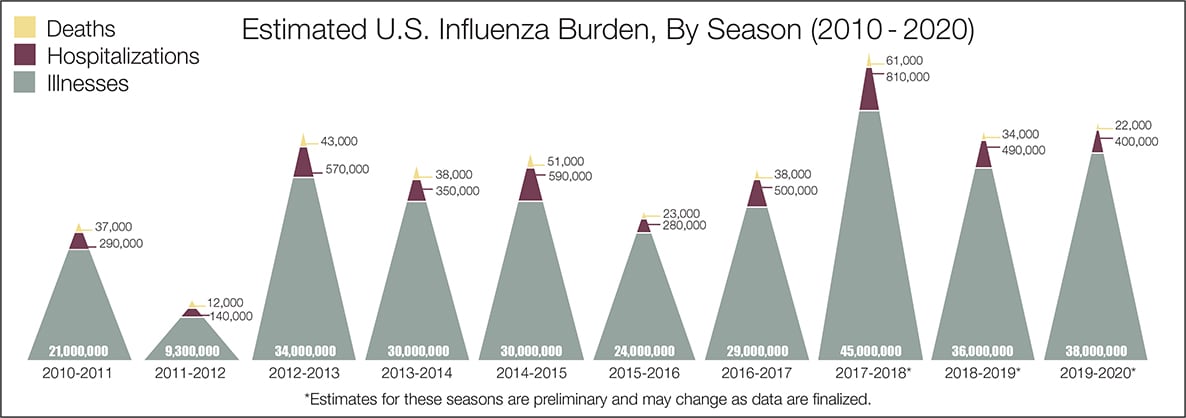
What we do not know about the coronavirus [actually there is little scientifically proven information]. Most of our knowledge is anecdotal, from studies with limited subjects, or from studies without peer review.
- Is social distancing at 6 feet correct? Some are saying 4 meters (13 feet). And what is the correct social distance if one rides a bike?
- Will warm weather and higher humidity slow the coronavirus spread? Will September see another spike in cases? Next Winter may see more cases than seen previously.
- Should we decontaminate products (such as food) that are brought into the house?
- Does one develop immunity after recovering from coronavirus?
- Is COVID-19 mutating? How will this impact the ability to create immunization or even immunity?
- Are ventilators damaging patients – should oxygen be used instead?
- The U.S. outsourced bat virus research to Wuhan after the U.S. shut down its testing due to containment issues.
The bottom line is that COVID-19 so far has been shown to be much more deadly than the data on the flu. Using CDC data, the flu has a mortality rate between 0.06 % and 0.11 % Vs. the coronavirus which to date has a mortality rate of over 5 % – which makes it between 45 and 80 times more deadly. The reason for ranges:
Because influenza surveillance does not capture all cases of flu that occur in the U.S., CDC provides these estimated ranges to better reflect the larger burden of influenza.
There will be a commission set up after this pandemic ends to find fault [it is easy to find fault when a once-in-a-lifetime event occurs] and to produce recommendations for the next time a pandemic happens. Those that hate President Trump will conclude the virus is his fault. The most important issue will be an analysis of whether the federal government took a strong enough lead in dealing with the pandemic.
include(“/home/aleta/public_html/files/ad_openx.htm”); ?>


