


Written by Steven Hansen
The U.S. pandemic new cases and deaths increased for the third day in a row. Following is a set of interactive graphs and tables for the world and individual states – as well as today’s headlines which include discussion of how fast the economy can recover.

The biggest news today was the jobs report – which came in as bad as expected. The real situation – the household survey removed 6,432,000 people from the labor force which explains why the unemployment rate was not worse.
Coronavirus News You May Have Missed
Second-Quarter GDP Growth Estimate Decreases – Atlanta Federal Reserve
The GDPNow model estimate for real GDP growth (seasonally adjusted annual rate) in the second quarter of 2020 is -34.9 percent on May 8, down from -17.6 percent on May 5. After this morning’s releases of the employment report by the U.S. Bureau of Labor Statistics and the wholesale trade report from the U.S. Census Bureau, the nowcasts of second-quarter real personal consumption expenditures growth and second-quarter real gross private domestic investment growth decreased from -21.7 percent and -22.1 percent, respectively, to -33.9 percent and -62.8 percent, respectively. Also, the nowcast of second-quarter real government spending growth decreased from 1.9 percent to -6.7 percent, while the nowcast of the contribution of the change in real net exports to second-quarter real GDP growth increased from 0.82 percentage points to 1.62 percentage points.

Recovery could be slow, uneven and dependent on whether companies still need as many workers – CNBC
Economists say how those workers will return to their jobs is difficult to forecast, and that makes the recovery from the abrupt shutdown of the economy in late March likely to be slow and bumpy instead of the V-shaped bounce some had once expected.
States are reopening in an uneven fashion, and the course of the virus remains uncertain, with no medical way to prevent it so far. The hardest-hit sectors are those that are most impacted by social distancing and the virus, and it may be more difficult for those businesses to return to normal any time soon.
Michelle Meyer, head of U.S. economics at Bank of America, said the fact that 18 million people interviewed by the government described their layoffs as “temporary” was a “silver lining.” The 18 million were part of more than 23 million unemployed people in the government’s household survey.
“With 78% classified as temporarily unemployed, workers should be able to be more seamlessly rehired upon reopening. But time is of the essence,” she said.
Labor Report First Look Updated – Atlanta Fed
[editor’s note: we analyzed the worst ever BLS Jobs report – click here to view]

The nation’s largest cities emerge as focal points for the virus. – New York Times
The three largest cities in the United States – New York City, Los Angeles and Chicago – are also the primary generators of new cases each day, data shows.
Cook County, Ill., which includes Chicago, and New York City are now reporting roughly the same case numbers each day; Los Angeles County, Calif., consistently has the third-most cases.
Mayor Lori Lightfoot of Chicago is soon expected to unveil a plan to gradually reopen the city, but cautioned that Chicago is not yet ready to return to normal. “We can’t send people back to work, we can’t open up our city yet when we don’t see a decrease in the cases, which we have not seen yet at all,” Ms. Lightfoot said on Thursday, adding: “When we don’t see a sustained decline in hospitalizations, I.C.U. beds, all of those things are really important and the data has to drive what we do from a public policy standpoint.”
The NYPD issued hundreds of summonses related to the virus. Most went to black and Hispanic people. – The Washington Post
Police in New York City have issued hundreds of summonses related to the coronavirus since the outbreak was deemed an emergency there in mid-March – most of them to black and Hispanic men and women in the city, the department’s data show.
Over several weeks, New York police visited bars, parks, restaurants, supermarkets and other locations across the city, ultimately issuing 374 summonses “for acts likely to spread disease and to violate emergency measures,” the department said in a news release Friday. Social gatherings accounted for a significant portion of the summonses, the NYPD said.
Four in five summonses were issued to black and Hispanic people, the data show. Out of the 374 summonses issued regarding social distancing, the NYPD said, 193 went to black people and 111 went to Hispanic people.
The figures also show that people given summonses tended to be male (88 percent of all summonses) and relatively young. Two out of three summonses in the data released Friday were given to people in their 20s and 30s.
Mexico Ignores Wave of Coronavirus Deaths in Capital – New York Times
The Mexican government is not reporting hundreds, possibly thousands, of deaths from the coronavirus in Mexico City, dismissing anxious officials who have tallied more than three times as many fatalities in the capital than the government publicly acknowledges, according to officials and confidential data reviewed by The New York Times.
The tensions have come to a head in recent weeks, with Mexico City alerting the government to the deaths repeatedly, hoping it will come clean to the public about the true toll of the virus on the nation’s biggest city and, by extension, the country at large.
But that has not happened. Doctors in overwhelmed hospitals in Mexico City say the reality of the epidemic is being hidden from the country. In some hospitals, patients lie on the floor, splayed on mattresses. Elderly people are propped up on metal chairs because there are not enough beds, while patients are turned away to search for space in less-prepared hospitals. Many die while searching, several doctors said.
First at-home saliva test for COVID-19 earns FDA approval – Live Science
The U.S. Food and Drug Administration (FDA) has approved the first at-home saliva collection test for COVID-19, which people could use to sample their own saliva and send it into a lab for results.
Developed by RUCDR Infinite Biologics, a biorepository based at Rutgers University in New Jersey, the test received “amended emergency use authorization” from the FDA late on May 7, according to a statement from the university. In April, the lab received emergency use authorization for their saliva collection method, which allowed health care workers to begin testing New Jersey residents at select sites throughout the state, The New York Times reported April 29.
Panama Canal preps for reduced container growth scenario – JOC
Panama Canal administrator Ricaurte Vasquez said the number of container ship transits in May will reveal the extent of the COVID-19 impact on containerized trade as the waterway prepares for a long-term future marked more by regional trade than global trade.
The disruption caused by the coronavirus disease 2019 (COVID-19) will accelerate some cargo owners’ effort to reduce risk by shortening their supply chains feeding the United States, whether that’s shifting production from Asia to Mexico or even to the United States, Vasquez said in a media conference call Thursday. While the extent of the regionalization of containerized trade won’t spur a complete shift in manufacturing and the changes will be marginal, he said the canal was speeding up plans to understand and address them.
“If manufacturing becomes more robotic, then places with cheap energy will replace places with low-cost labor,” said Vasquez, adding that tariffs and overall rising labor costs in Asian countries are spurring shippers to look elsewhere to expand. Given the pandemic originated from China, he said companies will try to “disperse risk from single-sourcing into multiple-sourcing.”
100 Days Into COVID-19, Where Do We Stand? – WebMD
The United States saw its first confirmed case of COVID-19 on Jan. 20. By the end of February, we had our first American death. We’ve now passed the 100-day mark, and the numbers are alarming, with 1.2 million confirmed cases here. More than 70,000 people have died here. And because testing has been limited, experts say those numbers are really much larger. So obviously, it’s bad. But is it getting better?
“We’re not doing well at all,” says Jeffrey Shaman, PhD, a professor of environmental health sciences at Columbia University Mailman School of Public Health, who has led work to model national projections. “We had our first confirmed case the same day as South Korea. We have six times as many people, but 100 times as many cases.”
Even though some states have been relaxing social distancing restrictions, not one has met federal guidelines for being able to do say, says Caitlin Rivers, PhD, a researcher from the Johns Hopkins Center for Health Security who testified before the House Appropriations Subcommittee on Wednesday.
Coronavirus: Russian hospital staff ‘working without masks’ – BBC
As coronavirus spreads more widely in Russia’s provinces, hospitals – often old and ill-equipped – have become infection “hot spots”. The number of medical workers getting sick, and dying, is growing.
President Putin admitted that there was a shortage of PPE and ordered an increase in production. But even now, many Russian healthcare staff are scared to complain publicly about having to work without proper protection.
Pence Spokeswoman Katie Miller Tests Positive For Coronavirus – NPR
The White House on Friday confirmed a second case of coronavirus this week, now in Vice President Pence’s office, as both the president and his No. 2 have recently begun traveling again.
Pence spokeswoman Katie Miller tested positive for the virus on Friday, after having tested negative Thursday.
President Trump told reporters Friday that Miller hasn’t come into contact with him but has “spent some time” with the vice president.
8 Ways COVID-19 Will Change Architecture – Architizer
Looking to respond constructively to the COVID-19 pandemic, many architects have turned to what they know best: design and innovation. The new restrictions placed on society have been a catalyst to rethink much of what we take for granted in the built environment. The way the world has adapted to this new lifestyle may forecast new normals following the COVID-19 outbreak.
Though we can’t say exactly what the future will look like, we can examine current trends, tactics and concepts that have played huge roles during the pandemic. The following trends may have long lasting impacts on the way cities are designed.
- A shift away from large city offices
- Decrease in car reliance
- New forms of public space
- New restaurant layouts
- An increase in modular construction
- An increasing reliance on adaptive reuse
- New innovations in lightweight architecture
- Flexible building design
Weekly Business Outlook Survey on the COVID-19 Outbreak – Philadelphia Federal Reserve

Coronavirus Statistics For 08 May 2020
| U.S. Only | Global | U.S Percentage of Total | ||||
| Today | Cumulative | Today | Cumulative | Today | Cumulative | |
| New Cases | 28,369 | 1,260,000 | 94,158 | 3,810,000 | 30.1% | 33.1% |
| Deaths | 2,239 | 75,670 | 5,780 | 269,068 | 38.7% | 28.1% |
| Mortality Rate | 7.9% | 6.0% | 6.1% | 7.1% | ||
| total COVID-19 Tests per 1,000 people | 0.96 | 24.49 | ||||
Today’s Posts On Econintersect Showing Impact Of The Pandemic With Hyperlinks
April 2020 Monthly Budget Review: Coronavirus Upset The Budget
01 May 2020 ECRI’s WLI Improves Again But Remains Deep In Contraction
March 2020 Headline Wholesale Sales and Inventories Decline
April 2020 BLS Jobs Situation – Worst Report Ever
Rail Week Ending 02 May 2020 – Rail Contracted 21.2% In April
Coronavirus Is A Failure Of Global Governance
The Surprisingly Simple Way To Open America In 14 Days And Avoid A Depression
COVID-19 Detected At Meat Plants In 19 U.S. States
Responding To Collapse, Part 16: Shortages Of Money, Part 1
To Understand The Danger Of COVID-19 Outbreaks In Meatpacking Plants, Look At The Industry’s History
Coronavirus INTERACTIVE Charts
include($_SERVER[‘DOCUMENT_ROOT’].’/pages/coronavirus.htm’); ?>
Analyst Opinion of Coronavirus Data
There are several takeaways that need to be understood when viewing coronavirus statistical data:
- The global counts are suspect for a variety of reasons including political. Even the U.S. count has issues as it is possible that as much as half the population has had coronavirus and was asymptomatic. It would be a far better metric using a random sampling of the population weekly. In short, we do not understand the size of the error in the tracking numbers.
- Just because some of the methodology used in aggregating the data in the U.S. is flawed – as long as the flaw is uniformly applied – you establish a baseline. This is why it is dangerous to compare two countries as they likely use different methodologies to determine who has (and who died) from coronavirus.
- COVID-19 and the flu are different but can have similar symptoms. For sure, COVID-19 so far is much more deadly than the flu. [click here to compare symptoms]
- From an industrial engineering point of view, one can argue that it is best to flatten the curve only to the point that the health care system is barely able to cope. This solution only works if-and-only-if one can catch this coronavirus once and develops immunity. In the case of COVID-19, herd immunity may need to be in the 80% to 85% range. WHO warns that few have developed antibodies to COVID-19. At this point, herd immunity does not look like an option.
- Older population countries will have a higher death rate.
- There are at least 8 strains of the coronavirus. New York may have a deadlier strain imported from Europe, compared to less deadly viruses elsewhere in the United States.
- Each publication uses different cutoff times for its coronavirus statistics. Our data uses 11:00 am London time. Also, there is an unexplained variation in the total numbers both globally and in the U.S.
- The real question remains if the U.S. is over-reacting to this virus. The following graphic from the CDC puts the annual flu burden in perspective [click on image to enlarge].
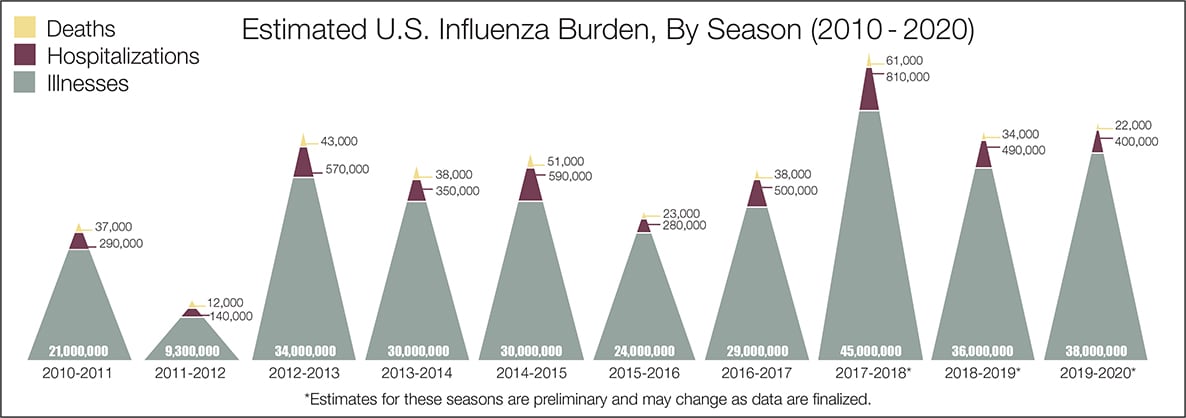
What we do not know about the coronavirus [actually there is little scientifically proven information]. Most of our knowledge is anecdotal, from studies with limited subjects, or from studies without peer review.
- Is social distancing at 6 feet correct? Some are saying 4 meters (13 feet). And what is the correct social distance if one rides a bike?
- Will warm weather and higher humidity slow the coronavirus spread? Will September see another spike in cases? Next Winter may see more cases than seen previously.
- Should we decontaminate products (such as food) that are brought into the house?
- Does one develop immunity after recovering from coronavirus?
- Is COVID-19 mutating? How will this impact the ability to create immunization or even immunity?
- Are ventilators damaging patients – should oxygen be used instead?
- The U.S. outsourced bat virus research to Wuhan after the U.S. shut down its testing due to containment issues.
The bottom line is that COVID-19 so far has been shown to be much more deadly than the data on the flu. Using CDC data, the flu has a mortality rate between 0.06 % and 0.11 % Vs. the coronavirus which to date has a mortality rate of over 5 % – which makes it between 45 and 80 times more deadly. The reason for ranges:
Because influenza surveillance does not capture all cases of flu that occur in the U.S., CDC provides these estimated ranges to better reflect the larger burden of influenza.
There will be a commission set up after this pandemic ends to find fault [it is easy to find fault when a once-in-a-lifetime event occurs] and to produce recommendations for the next time a pandemic happens. Those that hate President Trump will conclude the virus is his fault. The most important issue will be an analysis of whether the federal government took a strong enough lead in dealing with the pandemic.
include(“/home/aleta/public_html/files/ad_openx.htm”); ?>


