


Written by Steven Hansen
Today new coronavirus cases declined but deaths remain high – accounting for over 40% of global deaths. Following is a set of interactive graphs and tables for the world and individual states – as well as today’s headlines on coronavirus which include topics on U.S. involvement in the Wuhan lab and that New York may have been hit by a deadlier strain imported from Europe.

Several selections today in the coronavirus news have been contributed by Roger Erickson, GEI author and Biology Entrepreneur
Coronavirus News You May Have Missed
Public-private cooperation for pandemic preparedness and response – centerforhealthsecurity.org – note: this event occurred 6 months ago. [similar post from John Hopkins here]
The next severe pandemic will not only cause great illness and loss of life but could also trigger major cascading economic and societal consequences that could contribute greatly to global impact and suffering. Efforts to prevent such consequences or respond to them as they unfold will require unprecedented levels of collaboration between governments, international organizations, and the private sector. There have been important efforts to engage the private sector in epidemic and outbreak preparedness at the national or regional level.1,2 However, there are major unmet global vulnerabilities and international system challenges posed by pandemics that will require new robust forms of public-private cooperation to address.
The Event 201 pandemic exercise, conducted on October 18, 2019, vividly demonstrated a number of these important gaps in pandemic preparedness as well as some of the elements of the solutions between the public and private sectors that will be needed to fill them. The Johns Hopkins Center for Health Security, World Economic Forum, and Bill & Melinda Gates Foundation jointly propose the following:
- Governments, international organizations, and businesses should plan now for how essential corporate capabilities will be utilized during a large-scale pandemic.
- Industry, national governments, and international organizations should work together to enhance internationally held stockpiles of medical countermeasures (MCMs) to enable rapid and equitable distribution during a severe pandemic.
- Countries, international organizations, and global transportation companies should work together to maintain travel and trade during severe pandemics. Travel and trade are essential to the global economy as well as to national and even local economies, and they should be maintained even in the face of a pandemic.
- Governments should provide more resources and support for the development and surge manufacturing of vaccines, therapeutics, and diagnostics that will be needed during a severe pandemic.
- Global business should recognize the economic burden of pandemics and fight for stronger preparedness.
- International organizations should prioritize reducing economic impacts of epidemics and pandemics.
- Governments and the private sector should assign a greater priority to developing methods to combat mis- and disinformation prior to the next pandemic response.
Ministers were warned last year of the grave consequences a future pandemic would unleash on the UK, a leaked Cabinet Office briefing has revealed.
Tens of thousands of deaths, crippling economic costs and creaking public services were predicted in the 2019 National Security Risk Assessment (NSRA) which mapped out how an outbreak would likely unfold.
Ahead of the current coronavirus crisis, it recommended stockpiling personal protective equipment and drawing up plans to repatriate stranded Britons abroad.
The government was also told to shore up the infrastructure needed to conduct mass contact tracing, in a revelation that will pour petrol on the simmering row over the lack of testing.
Why US outsourced bat virus research to Wuhan – Asia Times
… because of public health concerns, the US government banned all federal funding on efforts to weaponize three viruses – influenza, Middle East respiratory syndrome (MERS) and severe acute respiratory syndrome (SARS).
In the face of a moratorium in the US, Dr Anthony Fauci – the director of the National Institute of Allergy and Infectious Diseases (NIAID) and currently the leading doctor in the US Coronavirus Task Force – outsourced in 2015 the GOF research to China’s Wuhan lab and licensed the lab to continue receiving US government funding.
The Wuhan lab is now at the center of scrutiny for possibly releasing the SARS-CoV-2 coronavirus and causing the global Covid-19 pandemic.
It is understandable that the Chinese lab likely struggled with safety issues given the fact US labs share similar problems, and indeed in January 2018 the US Embassy in Beijing sent cables warning about the safety of the Wuhan lab and asked for help.
Covid-19 Has A Grandma, Grandpa And Great Grandpa. Where Are They? – orientalreview.org
- Five top Chinese scientific organisations have collected the data 93 genome specimens of COVID-19 that have been published in a global database based on inputs from 12 countries on four different continents.
- The research has shown that the Covid-19’s earliest “ancestor” is a virus known as mv1, which subsequently evolved into haplotypes H13 and H38. (A haplotype is a group of genes within an organism that was inherited together from a single parent.)
- In turn, H13 and H38 evolved into a second-generation haplotype – H3 – which subsequently involved into H1 (Covid-19).
- That is to say, in plain terms, Covid-19’s “father” is H3; its “grandparents” are H13 and H38; and, its “great grandfather” is mv1.
- Now, although the virus that was discovered in the Wuhan seafood market (Covid-19) was of the H1 variety alright, only its “father” H3 has been spotted in Wuhan – and that too, NOT in the seafood market.
- Importantly, the Covid-19’s “grandparents” – H13 and H38 – have never been spotted in Wuhan.
“This suggests that the H1 specimen was brought to the seafood market by some infected person, which sparked the epidemic. The gene sequence cannot lie.” (Ambassador Zhang)
Coronavirus’s ability to mutate has been vastly underestimated, and mutations affect deadliness of strains, Chinese study finds – South China Morning Post [similar post here]
- The most aggressive strains of Sars-CoV-2 could generate 270 times as much viral load as the least potent type
- New York may have a deadlier strain imported from Europe, compared to less deadly viruses elsewhere in the United States
The Pandemic Will Change American Retail Forever – The Atlantic
We are entering a new evolutionary stage of retail, in which big companies will get bigger, many mom-and-pop dreams will burst, chains will proliferate and flatten the idiosyncrasies of many neighborhoods, more economic activity will flow into e-commerce, and restaurants will undergo a transformation unlike anything the industry has experienced since Prohibition.
This is a dire forecast, but there is a glimmer of hope. If cities become less desirable in the next few years, they will also become cheaper to live in. In time, more affordable rents could attract more interesting people, ideas, and companies. This may be the cyclical legacy of the coronavirus: suffering, tragedy, and then rebirth. The pandemic will reset our urban equilibrium and, just maybe, create a more robust and resilient American city for the 21st century.
At least 8 strains of the coronavirus have been identified – The Hill
Researchers say the small mutations are useful in showing how the virus is spreading around the world, and aren’t cause for concern.
- Thousands of genetic sequences of the virus have been uploaded to the open database NextStrain.
- The database shows how the virus is spreading and splitting into new but similar subtypes.
- Researchers say the mutations are slight and it does not appear the strains will grow more lethal as they evolve.
Tyson Foods chairman warns ‘the food supply chain is breaking’ – NBC News
The board chairman of Tyson Foods is warning that “millions of pounds of meat will disappear” from the national food supply chain as the coronavirus outbreak forces food processing plants to shutter.
“The food supply chain is breaking,” John Tyson wrote in a full-page advertisement published Sunday in The New York Times, The Washington Post and The Arkansas Democrat-Gazette.
“There will be limited supply of our products available in grocery stores until we are able to reopen our facilities that are currently closed,” he wrote in the advertisement, which was also published as a blog post on the company’s website.
In recent weeks, the major poultry producer has temporarily suspended operations at plants across the country. The company halted operations Wednesday at an Iowa plant that is crucial to the nation’s pork supply.
Federal Reserve Board announces an expansion of the scope and duration of the Municipal Liquidity Facility – Federal Reserve
The Federal Reserve Board on Monday announced an expansion of the scope and duration of the Municipal Liquidity Facility (MLF). The facility, which was announced on April 9 as part of an initiative to provide up to $2.3 trillion in loans to support U.S. households, businesses, and communities, will offer up to $500 billion in lending to states and municipalities to help manage cash flow stresses caused by the coronavirus pandemic.
| U.S. Only | Global | U.S Percentage of Total | ||||
| Today | Cumulative | Today | Cumulative | Today | Cumulative | |
| New Cases | 26,857 | 965,910 | 83,758 | 2,920,000 | 32.1% | 33.1% |
| Deaths | 2,172 | 53,189 | 5,929 | 201,315 | 42.8% | 26.6% |
| Mortality Rate | 6.3% | 5.7% | 4.7% | 7.1% | ||
| total COVID-19 Tests per 1,000 people | 0.77 | 16.42 | ||||
Today’s Posts On Econintersect Showing Impact Of The Pandemic With Hyperlinks
The Future Of Work After COVID: How Will Work Look After The Pandemic Ends?
April 2020 Texas Manufacturing Dives Deeper Into Contraction
Passenger Car Sales Plummet In COVID-19 Crisis
The Coronavirus Pandemic Might Make Buildings Sick, Too
The Week In Doom: Don’t Drink The Bleach
Coronavirus INTERACTIVE Charts
include($_SERVER[‘DOCUMENT_ROOT’].’/pages/coronavirus.htm’); ?>
Analyst Opinion of Coronavirus Data
There are several takeaways that need to be understood when viewing coronavirus statistical data:
- The global counts are suspect for a variety of reasons including political. Even the U.S. count has issues as it is possible that as much as half the population has had coronavirus and was asymptomatic. It would be a far better metric using a random sampling of the population weekly. In short, we do not understand the size of the error in the tracking numbers.
- Just because some of the methodology used in aggregating the data in the U.S. is flawed – as long as the flaw is uniformly applied – you establish a baseline. This is why it is dangerous to compare two countries as they likely use different methodologies to determine who has (and who died) from coronavirus.
- COVID-19 and the flu are different but can have similar symptoms. For sure, COVID-19 so far is much more deadly than the flu. [click here to compare symptoms]
- From an industrial engineering point of view, one can argue that it is best to flatten the curve only to the point that the health care system is barely able to cope. This solution only works if-and-only-if one can catch this coronavirus once and develops immunity. In the case of COVID-19, herd immunity may need to be in the 80% to 85% range. WHO warns that few have developed antibodies to COVID-19. At this point, herd immunity does not look like an option.
- Older population countries will have a higher death rate.
- Each publication uses different cutoff times for its coronavirus statistics. Our data uses 11:00 am London time. Also, there is an unexplained variation in the total numbers both globally and in the U.S.
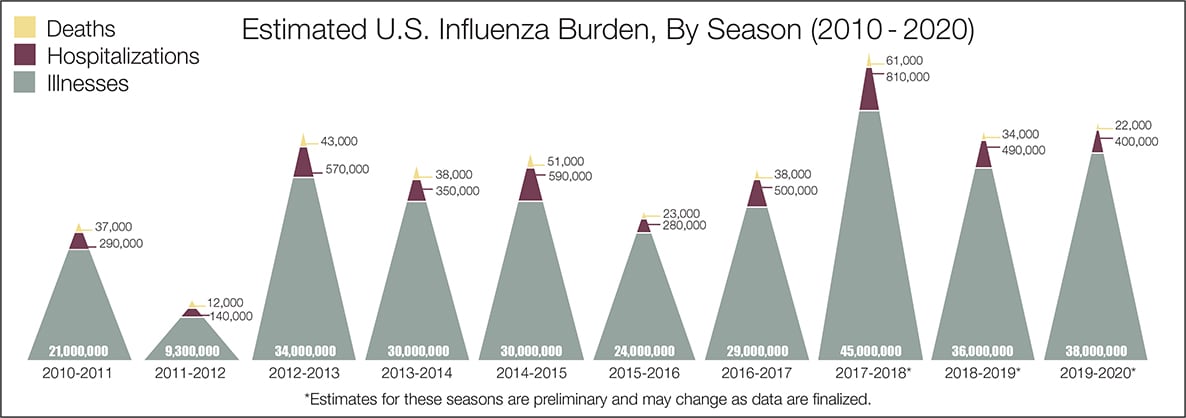
- The real question remains if the U.S. is over-reacting to this virus. The following graphic from the CDC puts the annual flu burden in perspective [click on image to enlarge].
What we do not know about the coronavirus [actually there is little scientifically proven information]. Most of our knowledge is anecdotal – not backed by scientific studies:
- Is social distancing at 6 feet correct? Some are saying 4 meters (13 feet). And what is the correct social distance if one rides a bike?
- Will warm weather and higher humidity slow the coronavirus spread? Will September see another spike in cases? Next Winter may see more cases than seen previously.
- Should we decontaminate products (such as food) that are brought into the house?
- Does one develop immunity after recovering from coronavirus?
- Is COVID-19 mutating? How will this impact the ability to create immunization or even immunity?
- Are ventilators damaging patients – should oxygen be used instead?
The bottom line is that COVID-19 so far has been shown to be much more deadly than the data on the flu. Using CDC data, the flu has a mortality rate between 0.06 % and 0.11 % Vs. the coronavirus which to date has a mortality rate of over 5 % – which makes it between 45 and 80 times more deadly. The reason for ranges:
Because influenza surveillance does not capture all cases of flu that occur in the U.S., CDC provides these estimated ranges to better reflect the larger burden of influenza.
include(“/home/aleta/public_html/files/ad_openx.htm”); ?>


