


Written by Steven Hansen
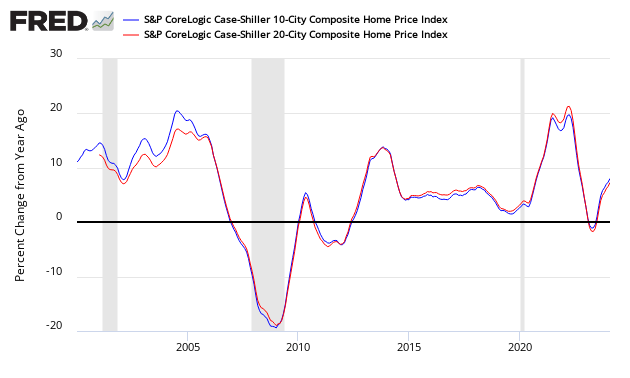
The non-seasonally adjusted S And P CoreLogic Case-Shiller home price index (20 cities) year-over-year rate of home price growth was unchanged at 2.0 %. The index authors stated, “Phoenix saw an increase in its YOY price change to 6.3% and retained its leading position.”.

Analyst Opinion of Case-Shiller HPI
The continued slowing of the year-over-year growth rate is good news for the economy. Note that the NAR’s existing home prices are trending up – the exact opposite of Case-Shiller.
- 20 city unadjusted home price rate of growth accelerated by 0.0 % month-over-month. [Econintersect uses the change in year-over-year growth from month-to-month to calculate the change in the rate of growth]
- Note that the Case-Shiller index is an average of the last three months of data.
- The market expected from Econoday: [not updated yet]
| Consensus Range | Consensus | Actual | |
| 20-city, SA – M/M | 0.0 % to 0.3 % | +0.1 % | -0.2 % |
| 20-city, NSA – M/M | 0.2 % to 0.5 % | +0.4 % | +0.0 % |
| 20-city, NSA – Yr/Yr | 2.0 % to 2.5 % | +2.1 % | +2.0 % |
S&P/Case-Shiller Home Price Indices Year-over-Year Change
When asked what today’s release means for the housing market, Dr. Ralph B. McLaughlin, deputy chief economist, and executive of research and insights for CoreLogic said:
Persistently low mortgage rates have seemingly ended what might have otherwise been a home price race-to-the-bottom this late in our economic expansion. Mortgage rates this low at the end of an economic cycle is nearly unprecedented and may be very well keeping the housing market – and U.S. economy – afloat.
Comparing the NAR and Case-Shiller home price indices, it needs to be understood each of the indices uses a unique methodology in compiling their index – and no index is perfect.

The way to understand the dynamics of home prices is to watch the direction of the rate of change. Here home price growth generally appears to stabilize (rate of growth not rising or falling).

There are some differences between the indices on the rate of “recovery” of home prices.
A synopsis of Authors of the Leading Indices:
Case Shiller’s Philip Murphy, Managing Director and Global Head of Index Governance at S&P Dow Jones Indices:
The U.S. National Home Price NSA Index trend remained intact with a year-over-year price change of 3.2%. However, a shift in regional leadership may be underway beneath the headline national index.
Phoenix saw an increase in its YOY price change to 6.3% and retained its leading position. However, Las Vegas dropped from number two to number eight among the cities of the 20-City Composite, falling from a 4.7% YOY change in July to only 3.3% in August. Meanwhile, the Southeast region included three of the top four cities. Charlotte, Tampa, and Atlanta all recorded solid YOY performance with price changes of 4.5%, 4.3%, and 4.0%, respectively. In the Northwest, Seattle’s YOY change turned positive (0.7%) after three consecutive months of negative YOY price changes. The 10-City Composite YOY price change declined slightly from July to 1.5%, while the 20-City Composite YOY price change remained steady at 2.0%. San Francisco was the only city to record a negative YOY price change (-0.1%).
CoreLogic believes affordability is now improving (August 2019 Data). Per Dr. Frank Nothaft, chief economist at CoreLogic and Frank Martell, president and CEO of CoreLogic stated:
The 3.6% increase in annual home price growth this August marked a big slowdown from a year earlier when the U.S. index was up 5.5%. While the slowdown in appreciation occurred across the country at all price points, it was most pronounced at the lower end of the market. Prices for the lowest-priced homes increased by 5.5%, compared with August 2018, when prices increased by 8.4%. This moderation in home-price growth should be welcome news to entry-level buyers.
The millennial cohort has now entered the housing market in force and is already driving major changes in buying and selling patterns. Almost half of the millennials over 30 years old have bought a house in the last three years. These folks are increasingly looking to move out of urban centers in favor of the suburbs, which offers more privacy and a greener environment,”. Perhaps most significantly, almost 80% of all millennials are confident they will become homeowners in the future.
The National Association of Realtors says (September 2019 data):
Lawrence Yun, NAR’s chief economist, said that despite historically low mortgage rates, sales have not commensurately increased, in part due to a low level of new housing options. “We must continue to beat the drum for more inventory,” said Yun, who has called for additional home construction for over a year. “Home prices are rising too rapidly because of the housing shortage, and this lack of inventory is preventing home sales growth potential.”
“For families on the sidelines thinking about buying a home, current rates are making the climate extremely favorable in markets across the country,” said NAR President John Smaby, a second-generation Realtor from Edina, Minnesota, and broker at Edina Realty. “These traditionally low rates make it that much easier to qualify for a mortgage, and they also open up various housing selections to buyers everywhere.”
“Mortgage rates under 4% are amazingly attractive for homebuyers,” said Yun. “The rise in foot traffic as evidenced by the open rates of SentriLock key boxes shows growing buyer interest.”
The U.S. Federal Housing Finance Agency produces an All-Transactions House Price Index for the United States:

Econintersect publishes knowledgeable views of the housing market.
Caveats on the Use of Home Price Indices
The housing price decline seen since 2005 varies by zip code – and seems to have ended somewhere around the beginning of the 2Q2012. Every area of the country has differing characteristics. Since January 2006, the housing declines in Charlotte and Denver are well less than 10%, while Las Vegas home prices had declined by almost 60%.
Each home price index uses a different methodology – and this creates slightly different answers.
The most broadly based index is the US Federal Housing Finance Agency’s House Price Index (HPI) – a quarterly broad measure of the movement of single-family house prices. This index is a weighted, repeat-sales index on the same properties in 363 metro centers, compared to the 20 cities Case-Shiller.
The US Federal Housing Finance Agency also has an index (HPIPONM226S) based on 6,000,000 same home sales – a much broader index than Case-Shiller. Also, there is a big difference between home prices and owner’s equity (OEHRENWBSHNO) which has been included in the graph below.
Comparing Various Home Price Indices to Owner’s Equity (blue line)


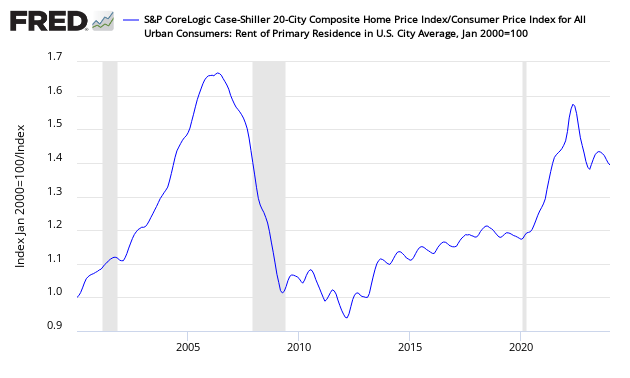
The affordability factor favors rental vs owning.
Price to Rent Ratio – Indexed on January 2000 – Based on Case-Shiller 20 cities index ratio to CPI Rent Index
include(“/home/aleta/public_html/files/ad_openx.htm”); ?>


