


Written by Steven Hansen
This post is a review of all major leading indices showing their values as of the date of this post. Generally, the indices are forecasting weak growth.
Analyst Opinion of the Leading Indicator Forecasts
Most of the leading indicators are based on factors which are known to have significant backward revisions – and one cannot take any of their trends to the bank. The only indicators with minimal backward revision are ECRI, RecessionAlert’s WLEI, and the Chemical Activity Barometer. Unfortunately, the Chemical Activity Barometer is targeted to the industrial sector of the economy – and at best seems to be a coincident indicator, not a leading indicator. Note that both ECRI and RecessionAlert have improving trend lines. RecessionAlert is projecting the strongest growth of all the indicators.
The leading indicators are to a large extent monetary based. Econintersect does not use any portion of the leading indicators in its economic index. Most leading indices in this post look ahead six months – and are all subject to backward revision.
Leading Indicators Conclusion: At this point, Econintersect continues to see NO particular dynamic at this time which will deliver noticeably better growth in the foreseeable future – and no indicator is forecasting a recession over the next six months.
- Chemical Activity Barometer (CAB) growth rate is below average for times of economic expansion and its rate of growth and its rate of growth are little changed.
- ECRI’s WLI is forecasting insignificant growth in the business cycle six months from today.
- The Conference Board (LEI) 6 month rolling average suggesting little growth over the next 6 months – and has slow growth trends.
- The Philly Fed’s Leading Index continued backward revisions make this index worthless – and it is showing relatively weak growth.
- Econintersect’s Economic Index is projecting a slow rate of growth.
Philly Fed Leading Index
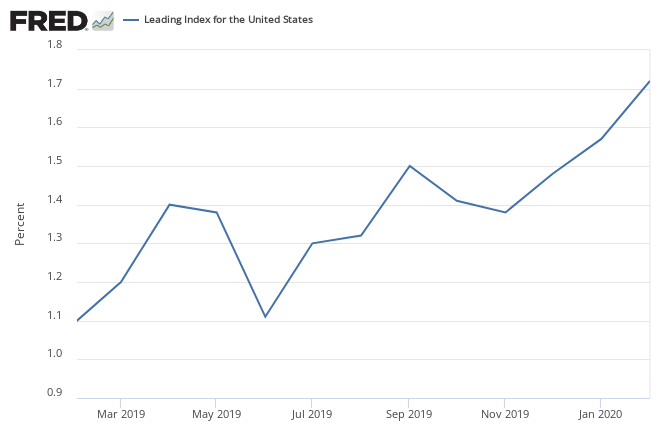
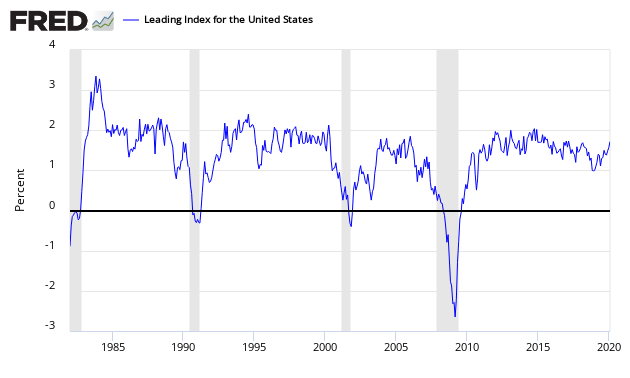
The Philly Fed Leading Index for the United States is continuously recalculated. Note that this index is not accurate in real-time as it is subject to backward revision, Per the Philly Fed:
The Federal Reserve Bank of Philadelphia has released the leading indexes for the 50 states for June 2019. The indexes are a six-month forecast of the state coincident indexes (also released by the Bank). Forty-eight state coincident indexes are projected to grow over the next six months, and two are expected to decrease. For comparison purposes, the Philadelphia Fed has also developed a similar leading index for its U.S. coincident index, which is projected to grow 1.2 percent over the next six months.
[click on the graphic to enlarge]

z philly fed leading.PNG
Index Values Over the Last 12 Months
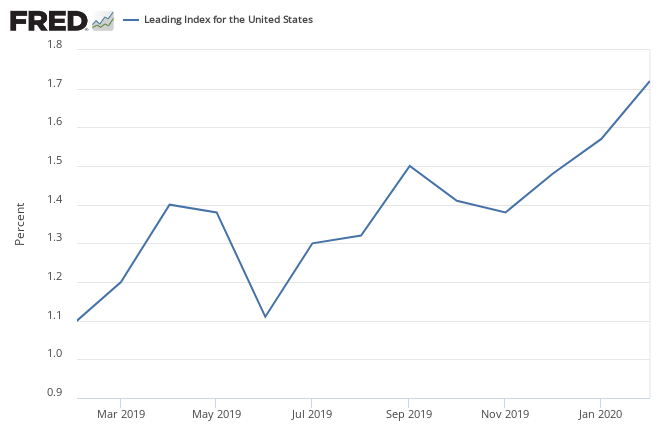
This index has been noisy and is below the mid-range of the values seen since the end of the Great Recession.
Chemical Activity Barometer (CAB)
The CAB is an exception to the other leading indices as it leads the economy by two to fourteen months, with an average lead of eight months. The CAB is a composite index which comprises indicators drawn from a range of chemicals and sectors. Its relatively new index has been remarkably accurate when the data has been back-fitted, however – its real-time performance is unknown – you can read more here. A value above zero is suggesting the economy is expanding. Note that the authors of this index want to be measured against industrial production. Econintersect‘s analysis of this index is [here].

z chemical_activity_barometer.png
ECRI WLI Index
ECRI’s Weekly Leading Index – the methodology used in created this index is not released but is widely believed to be monetary based. Econintersect‘s review of this index is [here].

The Conference Board’s Leading Economic Indicator (LEI)
The LEI has historically begun contracting well before a recession.

Econintersect Economic Index
Unlike the other leading indices, Econintersect Leading Index (LEI) only forecasts one month in advance.
The EEI is a non-monetary based economic index which counts “things” that have shown to be indicative of direction of the Main Street economy at least 30 days in the future. Note that the Econintersect Economic Index is not constructed to mimic GDP (although there are correlations, the turning points may be different), and tries to model the economic rate of change seen by business and Main Street. The vast majority of this index uses data not subject to backward revision.
Econintersect Economic Index (EEI) with a 3 Month Moving Average (red line)

include(“/home/aleta/public_html/files/ad_openx.htm”); ?>


![[click on the graphic to enlarge]](https://econintersect.com/images/z%20philly%20fed%20leading.PNG)