


Written by Steven Hansen
The non-seasonally adjusted S and P CoreLogic Case-Shiller home price index (20 cities) year-over-year rate of home price growth slowed from 2.7 % to 2.5 %. The index authors stated, “ the national supply of housing is trending upward and suggesting weaker demand”.

Analyst Opinion of Case-Shiller HPI
The continued slowing of the year-over-year growth rate is good news for the economy. Note that the NAR’s existing home prices are trending up – the exact opposite of Case-Shiller.
- 20 city unadjusted home price rate of growth decelerated 0.3 % month-over-month. [Econintersect uses the change in year-over-year growth from month-to-month to calculate the change in the rate of growth]
- Note that the Case-Shiller index is an average of the last three months of data.
- The market expected from Econoday:
| Consensus Range | Consensus | Actual | |
| 20-city, SA – M/M | 0.0 % to 0.2 % | +0.2 % | +0.0 % |
| 20-city, NSA – M/M | 0.2 % to 0.7 % | +0.5 % | +0.8 % |
| 20-city, NSA – Yr/Yr | 2.2 % to 2.6 % | 2.5 % | +2.5 % |
S&P/Case-Shiller Home Price Indices Year-over-Year Change
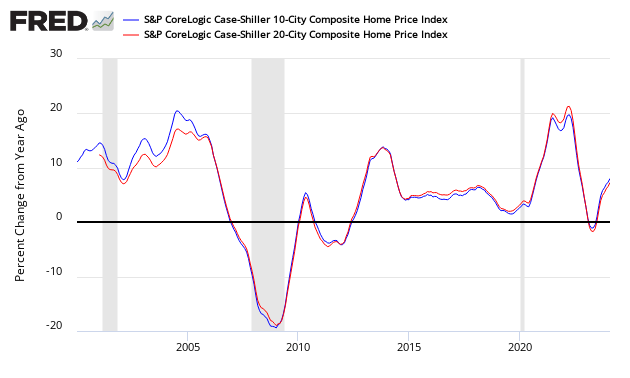
Comparing the NAR and Case-Shiller home price indices, it needs to be understood each of the indices uses a unique methodology in compiling their index – and no index is perfect.

The way to understand the dynamics of home prices is to watch the direction of the rate of change. Here home price growth generally appears to stabilize (rate of growth not rising or falling).

There are some differences between the indices on the rate of “recovery” of home prices.
A synopsis of Authors of the Leading Indices:
Case Shiller’s Philip Murphy, Managing Director and Global Head of Index Governance at S&P Dow Jones Indices:
Home price gains continued in a trend of broad-based moderation. Year-over-year price gains remain positive in most cities, though at diminishing rates of change. Seattle is a notable exception, where the YOY change has decreased from 13.1% in April 2018 to 0.0% in April 2019.
The national average 30-year fixed mortgage rate rose from below 4% in late 2017 to briefly reaching almost 5% by the latter part of 2018. Peak YOY changes in the 20-City Composite coincided with the upward turn in mortgage rates during the first quarter of 2018. In 2019, mortgage rates reversed course again and the 30-year fixed mortgage rate is again under 4%, yet the YOY house price moderation that coincided with the 2018 uptick in rates has not changed course. Other industry statistics are consistent with this observation. For example, the national supply of housing is trending upward and suggesting weaker demand. Perhaps the trend for the moment is toward normalization around the real long run average annual price increase. Comparing the YOY National Index nominal change of 3.5% to April’s inflation rate of 2.0% yields a real house price change of 1.5% – edging closer to the real long run average of 1.2% cited by David Blitzer last month.
CoreLogic believes affordability is now improving (April 2019 Data). Per Dr. Frank Nothaft, chief economist at CoreLogic and Frank Martell, president and CEO of CoreLogic stated:
The pickup in sales between March and April, has helped to counter the recent slowing in annual home-price growth. Mortgage rates are 0.6 percentage points below what they were one year ago and incomes are up, which has improved affordability for buyers. However, price growth has remained the highest for lower-priced homes, constraining housing choices for first-time buyers.
According to our consumer research, buyers feel that high prices are forcing them to spend more than they’d expect on a home. As many as one-third of buyers admit they put down a higher down payment as well.
The National Association of Realtors says (May 2019 data):
Lawrence Yun, NAR’s chief economist, said the 2.5% jump shows that consumers are eager to take advantage of the favorable conditions. “The purchasing power to buy a home has been bolstered by falling mortgage rates, and buyers are responding.”
“The month of May ushered in the home sales upswing that we had been expecting,” said NAR President John Smaby, a second-generation Realtor® from Edina, Minnesota and broker at Edina Realty. “Sales are strengthening in all regions while we see price appreciation for recent buyers.”
The U.S. Federal Housing Finance Agency produces an All-Transactions House Price Index for the United States:

Econintersect publishes knowledgeable views of the housing market.
Caveats on the Use of Home Price Indices
The housing price decline seen since 2005 varies by zip code – and seems to have ended somewhere around the beginning of the 2Q2012. Every area of the country has differing characteristics. Since January 2006, the housing declines in Charlotte and Denver are well less than 10%, while Las Vegas home prices had declined almost 60%.
Each home price index uses a different methodology – and this creates slightly different answers.
The most broadly based index is the US Federal Housing Finance Agency’s House Price Index (HPI) – a quarterly broad measure of the movement of single-family house prices. This index is a weighted, repeat-sales index on the same properties in 363 metro centers, compared to the 20 cities Case-Shiller.
The US Federal Housing Finance Agency also has an index (HPIPONM226S) based on 6,000,000 same home sales – a much broader index than Case-Shiller. Also, there is a big difference between home prices and owner’s equity (OEHRENWBSHNO) which has been included in the graph below.
Comparing Various Home Price Indices to Owner’s Equity (blue line)


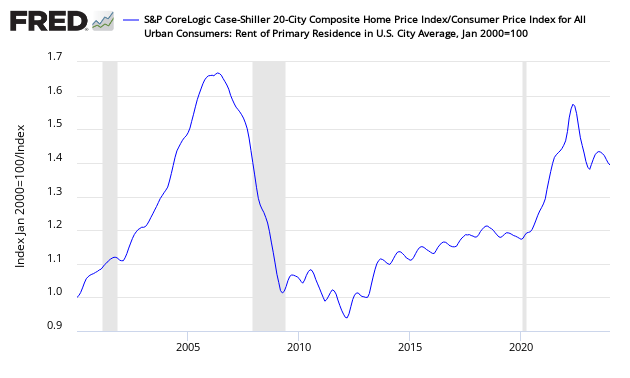
The affordability factor favors rental vs owning.
Price to Rent Ratio – Indexed on January 2000 – Based on Case-Shiller 20 cities index ratio to CPI Rent Index
include(“/home/aleta/public_html/files/ad_openx.htm”); ?>


