


Written by Steven Hansen
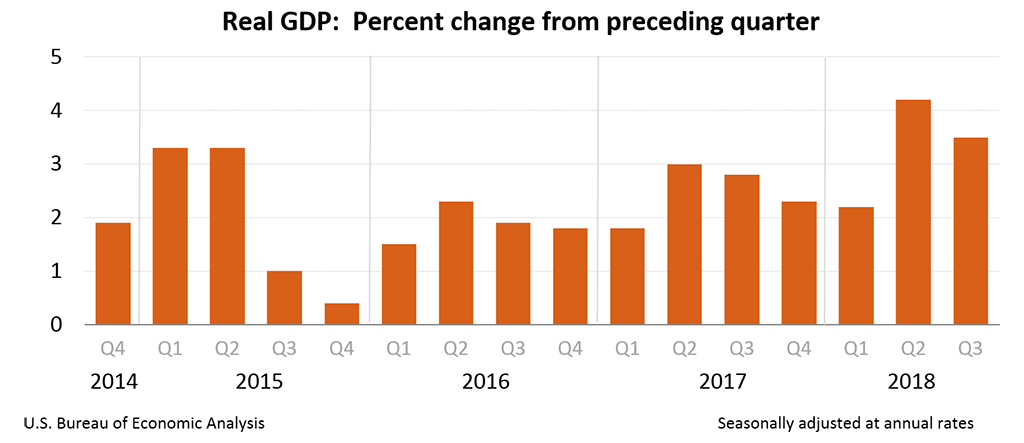
The headline second estimate of third quarter 2018 Real Gross Domestic Product (GDP) remained unchanged from the advance estimate’s +3.5 %.

Analyst Opinion of GDP
Over 2 % of this 3.5% growth number is attributable to inventory growth (materials manufactured but not yet sold). I consider this a very weak report on GDP.
I am not a fan of quarter-over-quarter exaggerated method of measuring GDP – but my year-over-year preferred method showed moderate acceleration from last quarter.
The market expected (from Econoday):
| Seasonally Adjusted Quarter-over-Quarter Change at annual rate | Consensus Range | Consensus | Advance Actual | Second Actual | Third Actual |
| Real GDP | 3.3 % to 3.7 % | 3.5 % | +3.5 % | +3.5 % | |
| GDP price index | 1.4 % to 1.7 % | 1.7 % | +1.7 % | +1.7 % | |
| Real Consumer Spending – Q/Q change | 3.5 % to 3.9 % | 3.7 % | +4.0 % | +3.6 % |
- Headline GDP is calculated by annualizing one quarter’s data against the previous quarters data. A better method would be to look at growth compared to the same quarter one year ago. For 3Q2018, the year-over-year growth is now 3.0 % – up from 2Q2018’s 2.9 % year-over-year. So one might say that the rate of GDP growth improved 0.1 % from the previous quarter.
 ​
​
Real GDP Expressed As Year-over-Year Change

The same report also provides Gross Domestic Income which in theory should equal Gross Domestic Product. Some have argued the discrepancy is due to misclassification of capital gains as ordinary income – but whatever the reason, there are differences.
Real GDP (blue line) Vs. Real GDI (red line) Expressed As Year-over-Year Change

This second estimate released today is based on more complete source data than were available for the “advance” estimate issued last month. (See caveats below.)
Real GDP per Capita

The table below compares the previous quarter estimate of GDP (Table 1.1.2) with the current estimate this quarter which shows:
- consumption for goods and services declined adding 2.5 % to GDP.
- trade balance worsened deducting 1.9 % from GDP
- inventory change added 2.3 % to GDP (inventory change is part of domestic investment)
- domestic investment had added 0.3 % to GDP
- federal spending added 0.4 % to GDP
The following is Table 1.1.2 before the annual revision: [click to enlarge]

z gdp_table.png
What the BEA says about the second estimate of GDP:
With this second estimate for the third quarter, the general picture of economic growth remains the same; upward revisions to nonresidential fixed investment and private inventory investment were offset by downward revisions to personal consumption expenditures (PCE) and state and local government spending.
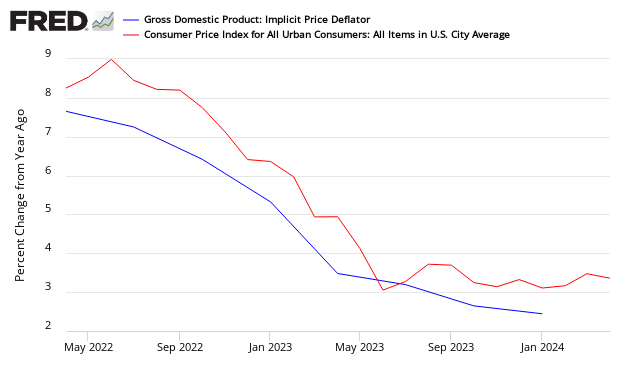
The following compares the GDP deflator to the Consumer Price Index:
BLS explaination of the changes to GDP:
The third-quarter percent change in real GDP was unrevised from the advance estimate, reflecting upward revisions to nonresidential fixed investment and private inventory investment that were offset by downward revisions to PCE and state and local government spending. For the second quarter of 2018, the percent change in real GDI was revised from 1.6 percent to 0.9 percent based on newly-available tabulations from the BLS Quarterly Census of Employment and Wages program.

Caveats on the Use of Gross Domestic Product (GDP)
GDP is market value of all final goods and services produced within the USA where money is used in the transaction – and it is expressed as an annualized number. GDP = private consumption + gross investment + government spending + (exports imports), or GDP = C + I + G + (X – M). GDP counts monetary expenditures. It is designed to count value added so that goods are not counted over and over as they move through the manufacture – wholesale – retail chain.
The vernacular relating to the different GDP releases:
“Advance” estimates, based on source data that are incomplete or subject to further revision by the source agency, are released near the end of the first month after the end of the quarter; as more detailed and more comprehensive data become available, “second” and “third” estimates are released near the end of the second and third months, respectively. The “latest” estimates reflect the results of both annual and comprehensive revisions.
Consider that GDP includes the costs of suing your neighbor or McDonald’s for hot coffee spilled in your crotch, plastic surgery or cancer treatment, buying a new aircraft carrier for the military, or even the replacement of your house if it burns down – yet little of these activities is real economic growth.
GDP does not include include home costs (other than the new home purchase price even though mortgaged up the kazoo), interest rates, bank charges, or the money spent buying anything used.
It does not measure wealth, disposable income, or employment.
In short, GDP does not measure the change of the economic environment for Joe Sixpack in 1970, and Joe Sixpack’s kid, yet pundits continuously compare GDP across time periods.
Although there always will be some correlation between all economic pulse points, GDP does not measure the economic elements that directly impact the quality of life of its citizens.
include(“/home/aleta/public_html/files/ad_openx.htm”); ?>


