


Written by Steven Hansen
The non-seasonally adjusted S and P CoreLogic Case-Shiller home price index (20 cities) year-over-year rate of home price growth decelerated from 5.5 % to 5.1 %. The index authors stated “nine cities saw prices decline in September compared to August”.

Analyst Opinion of Case-Shiller HPI
I continue to see this a situation of supply and demand. It is the affordability of the homes which is becoming an issue for the lower segments of consumers. With the rise in mortgage rates, it is pricing more and more consumers out of the market. If mortgage rates continue to rise – we likely will see some retrenchment in home prices.
- 20 city unadjusted home price rate of growth decelerated 0.4 % month-over-month. [Econintersect uses the change in year-over-year growth from month-to-month to calculate the change in rate of growth]
- Note that Case-Shiller index is an average of the last three months of data.
- The market expected from Econoday:
| Consensus Range | Consensus | Actual | |
| 20-city, SA – M/M | 0.2 % to 0.4 % | 0.3 % | +0.3 % |
| 20-city, NSA – M/M | +0.0 % | ||
| 20-city, NSA – Yr/Yr | 5.1 % to 5.6 % | 5.3 % | +5.2 % |
S&P/Case-Shiller Home Price Indices Year-over-Year Change
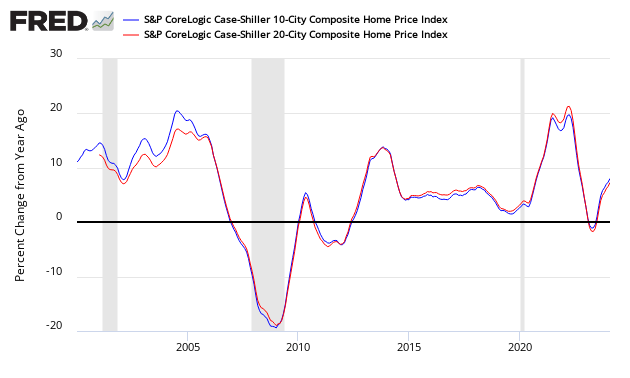
Comparing the NAR and Case-Shiller home price indices, it needs to be understood each of the indices uses a unique methodology in compiling their index – and no index is perfect.

The way to understand the dynamics of home prices is to watch the direction of the rate of change. Here home price growth generally appears to be stabilize (rate of growth not rising or falling).

There are some differences between the indices on the rate of “recovery” of home prices.
A synopsis of Authors of the Leading Indices:
Case Shiller’s David M. Blitzer, Chairman of the Index Committee at S&P Indices:
Home prices plus data on house sales and construction confirm the slowdown in housing. The S&P CoreLogic Case-Shiller National Index showed a 5.5% year-over-year gain, weaker for the second month in a row as 16 of 20 cities showed smaller annual price gains. On a monthly basis, nine cities saw prices decline in September compared to August. In Seattle, where prices were rising at doubledigit annual rates a few months ago, prices dropped last month. The few places reporting larger gains including some of the cities which had the biggest gains and largest losses 10 years ago: Las Vegas, Phoenix and Tampa.
Sales of both new and existing single family homes peaked one year ago in November 2017. Sales of existing homes are down 9.3% from that peak. Housing starts are down 8.7% from November of last year. The National Association of Home Builders sentiment index dropped seven points to 60, its lowest level in two years. One factor contributing to the weaker housing market is the recent increase in mortgage rates. Currently the national average for a 30-year fixed rate loan is 4.9%, a full percentage point higher than a year ago.
CoreLogic believes affordability is slowing home price growth (September 2018 Data). Per Dr Frank Nothaft, chief economist for CoreLogic and Frank Martell, president and CEO of CoreLogic stated:
The erosion of affordability in the highest cost markets has begun to slow home price growth. Hawaii, California and Massachusetts had median sales prices above $400,000 this summer, the highest in the nation, while annual home price growth slowed steadily between June and September in these three states. When comparing September 2018 with September 2017, annual price appreciation slowed more in these states than in the U.S overall. Nationally, annual price growth slowed 0.5 percentage points. However, in Hawaii, California and Massachusetts growth rates decreased by 1.7, 0.7 and 1 percentage points, respectively.
…. In some markets, homebuyers and sellers are remaining cautious and taking a pause as price appreciation continues to rise. By waiting to sell, homeowners believe they will get the greatest return on their investment; the more money they have for a downpayment, the easier the purchase payments will be for their next home.
The National Association of Realtors also worries about affordability (October 2018 data):
Lawrence Yun, NAR’s chief economist, says increasing housing inventory has brought more buyers to the market. “After six consecutive months of decline, buyers are finally stepping back into the housing market,” he said. “Gains in the Northeast, South and West – a reversal from last month’s steep decline or plateau in all regions – helped overall sales activity rise for the first time since March 2018.”
“As more inventory enters the market and we head into the winter season, home price growth has begun to slow more meaningfully,” said Yun. “This allows for much more manageable, less frenzied buying conditions.”
“Rising interest rates and increasing home prices continue to suppress the rate of first-time homebuyers. Home sales could further decline before stabilizing. The Federal Reserve should, therefore, re-evaluate its monetary policy of tightening credit, especially in light of softening inflationary pressures, to help ease the financial burden on potential first-time buyers and assure a slump in the market causes no lasting damage to the economy,” says Yun.
“Despite this much-welcomed month over month gain, sales are still down from a year ago, a large reason for which is affordability challenges from higher interest rates,” said NAR President John Smaby, a second-generation Realtor® from Edina, Minnesota and broker at Edina Realty. “Prospective buyers looking for their dream home in this market should contact a Realtor® as a first step in the buying process to help them navigate this more challenging environment.”
The U.S. Federal Housing Finance Agency produces an All-Transactions House Price Index for the United States:

Econintersect publishes knowledgeable views of the housing market.
Caveats on the Use of Home Price Indices
The housing price decline seen since 2005 varies by zip code – and seems to have ended somewhere around the beginning of the 2Q2012. Every area of the country has differing characteristics. Since January 2006, the housing declines in Charlotte and Denver are well less than 10%, while Las Vegas home prices had declined almost 60%.
Each home price index uses a different methodology – and this creates slightly different answers.
The most broadly based index is the US Federal Housing Finance Agency’s House Price Index (HPI) – a quarterly broad measure of the movement of single-family house prices. This index is a weighted, repeat-sales index on the same properties in 363 metro centers, compared to the 20 cities Case-Shiller.
The US Federal Housing Finance Agency also has an index (HPIPONM226S) based on 6,000,000 same home sales – a much broader index than Case-Shiller. Also, there is a big difference between home prices and owner’s equity (OEHRENWBSHNO) which has been included on the graph below.
Comparing Various Home Price Indices to Owner’s Equity (blue line)


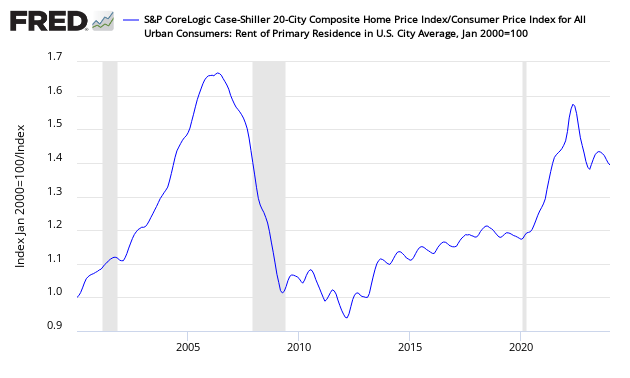
The affordability factor favors rental vs owning.
Price to Rent Ratio – Indexed on January 2000 – Based on Case-Shiller 20 cities index ratio to CPI Rent Index
include(“/home/aleta/public_html/files/ad_openx.htm”); ?>


